
The Thai Pumpkin Curry that ruined all other versions for me cost 50 baht and came in a plastic bag tied with a rubber band. Sukhumvit Soi 38, around nine at night, a cart with one wok and a chalkboard listing six things.
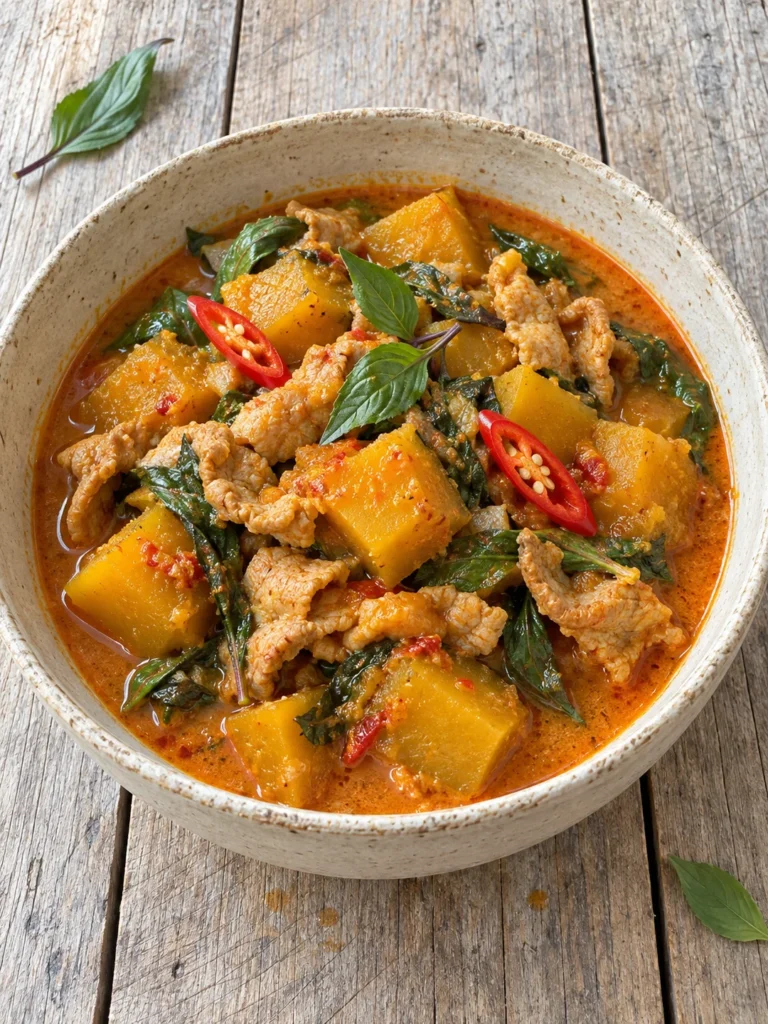
The woman running it worked with her left hand only. Her right stayed on the wok handle the entire time, tilting it, never letting go. I stood in a queue of eleven people and watched her make the same dish fourteen times without measuring anything.
I had been at a wine dinner earlier that evening. The sommelier there, a Thai guy named Pond who had trained in Adelaide, spent twenty minutes explaining why he poured an off-dry Riesling with the pumpkin curry on the tasting menu. Then he told me the stall version was better than his kitchen’s and drew me a map on the back of a coaster.
What Pond Got Right About the Stall
He was correct. The restaurant version was smoother and had a nicer plate. The stall version tasted like it had been hit harder in the pan.
What I did not understand until later was that the difference was all in the first five minutes. The stall woman cracked her coconut cream properly. The restaurant had not bothered.
The dish is gaeng phet fak thong, a central Thai curry built on prik gaeng phet, a pounded fresh red chili paste. Not curry powder. Nothing dry about it. Chilies and squash both arrived in Siam through Portuguese maritime trade starting in the sixteenth century and got folded into a paste-pounding tradition that was already there.
It is everyday food. Pumpkin is cheap and keeps forever, and a few slices of pork get stretched across a whole pot to feed a family over rice. Meat as seasoning, not centerpiece. That framing changed how I cooked it.
The Part Where Most People Go Wrong
Cracking the coconut cream. This is the step that decides everything and it is the step everyone skips.
You take the thick cream off the top of unshaken cans, about a cup, and you cook it down in a dry wok until it splits. Five to seven minutes. The surface goes grainy and clear oil starts pooling at the edges. It looks broken. It is supposed to look broken.
Then the paste goes into that hot split oil and fries for four or five minutes while you smear it against the metal. My first attempt I gave it ninety seconds because I got nervous. The result was thin and tasted like raw chili paste stirred into soup. Not good.
The second time I set a timer and walked away from it, which is a strange thing to do with a hot wok but it worked. The kitchen smelled sharply of galangal and the oil ran bright red. That is the signal.

Getting the Squash Right in an LA Kitchen
Fak thong is not sold anywhere near me, so kabocha it is. I get mine at the Thai market on Hollywood Boulevard, the one with the fish tanks in back, and the guy at the register always asks if I want it cut. I always say no, then regret it at home.
Do not use a Western carving pumpkin. It turns watery and stringy and you will end up with orange soup. Kabocha has the dense starchy flesh that holds a cube.
Breaking one down takes a heavy knife and some nerve. I use my old German chef’s knife, the one with a chip near the heel from an incident with a frozen chicken I do not want to discuss. Halve it through the stem, scoop the seeds, wedge it, pare the skin.
The other trap is timing. Five to eight minutes in the simmer, then stop. Slide a knife tip in and feel for light resistance. This pumpkin curry is not meant to collapse into purée, and the cubes falling apart is the most common failure after undercooked paste.
What I Used
- Kabocha squash, about a pound and a half, peeled and cubed
- Thai red curry paste, three tablespoons, Maesri or Mae Ploy
- Coconut cream, one cup, scooped off the top of unshaken cans
- Coconut milk, a cup and a half, the thin stuff underneath
- Water, half a cup
- Pork shoulder, ten ounces, sliced thin against the grain, optional
- Fish sauce, two and a half tablespoons
- Palm sugar, a tablespoon and a half, shaved off the disc
- Makrut lime leaves, six, center rib pulled out, torn
- Thai basil, a loose cup, stems off
- Fresh red Thai chilies, two, sliced on a long diagonal

Adjusting It and Getting It Wrong
Palm sugar comes in hard discs that resist a knife. Ten seconds in the microwave and it shaves easily. I learned this after two minutes of scraping at one with increasing irritation on a Tuesday night.
Skip the pork entirely if you want. Swap the fish sauce for light soy and a pinch of salt and it is complete without meat. Thais make it that way routinely and nobody considers it a lesser version.
Seasoning is the last puzzle. Fish sauce and palm sugar go in at the end and then you taste and adjust, chasing a balance where nothing dominates. I add fish sauce a teaspoon at a time. I always say that, then usually pour it straight from the bottle and get away with it.
Serve it with jasmine rice on the side, not poured over. The basil and chilies go in off the heat so the residual warmth just wilts them.
One Thing Worth Knowing About Thai Pumpkin Curry
There is a second Thai dish with the same squash called fakthong kaeng buat, and it is a dessert. Sweetened coconut cream, no chili, completely different intent. People confuse them constantly and then wonder why their savory curry tastes like pudding.
I made this on a Sunday in February with rain coming down on the skylight and a stack of unopened mail on the counter. Had Khruangbin on, which felt a little on the nose, and did not care.
Leftovers keep three days but the pumpkin goes softer each time you reheat it, so undercook slightly if you plan to save some. Cold, straight from the container, standing at the fridge. Honestly one of the better ways to eat it.
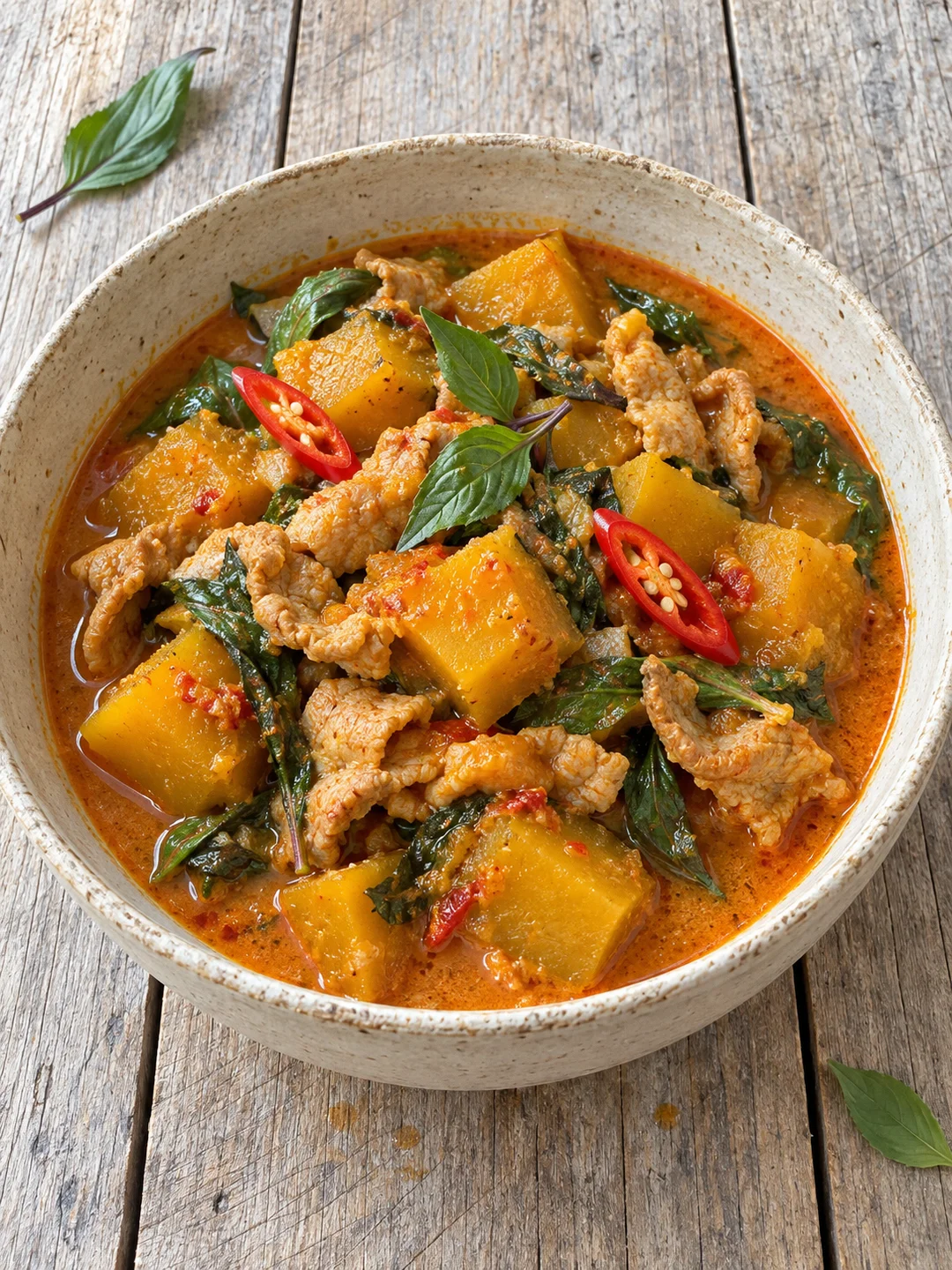
Thai Pumpkin Curry
Ingredients
Equipment
Method
- Cut the kabocha in half through the stem with a heavy knife, scoop out the seeds and stringy pulp with a spoon, then cut into wedges and pare off the skin. Chop into 1 inch cubes. You want about 4 cups. Set aside.
- Open the coconut milk cans without shaking them and spoon the thick white cream off the top until you have 1 cup. Pour the remaining thin liquid into a measuring cup and top up with more coconut milk to reach 1.5 cups.
- Heat the 1 cup coconut cream in a wok over medium-high heat. Let it bubble and reduce for 5 to 7 minutes, stirring now and then, until it thickens, the surface looks grainy, and clear coconut oil pools at the edges. This is the cream cracking and it is the foundation of the curry.
- Add the red curry paste to the split oil and fry it for 4 to 5 minutes, pressing and smearing it against the hot wok with the spatula. The paste will darken, tighten, and the oil will run bright red. Your kitchen should smell sharply of chili and galangal. Do not rush this step.
- Add the sliced pork and stir for 2 to 3 minutes until every piece is coated in paste and the outside has turned pale. Skip this step entirely if you are making it vegetarian.
- Pour in the 1.5 cups coconut milk and the water. Stir to dissolve the paste, then bring to a gentle simmer over medium heat.
- Add the pumpkin cubes and the torn makrut lime leaves. Simmer uncovered for 5 to 8 minutes, stirring gently once or twice. Test with a knife tip, it should slide in with light resistance. Stop there. The cubes must hold their shape, not collapse into purée.
- Season with the fish sauce and palm sugar. Stir and taste. You are chasing a balance of salty, sweet, and spicy where none dominates. Add fish sauce a teaspoon at a time if it tastes flat, more palm sugar if the chili heat is too forward.
- Pull the wok off the heat. Scatter in the Thai basil and sliced red chilies and fold once, letting the residual heat wilt the leaves without cooking them. Serve immediately with steamed jasmine rice on the side.