
Pumpkin Waffles were not what I expected to eat at nine in the morning in Providence, Rhode Island, in a third-floor apartment that smelled like last night’s garlic. But there they were. Nonna Rosa had already been up for two hours.

Her name is Rosa Albanese, she is seventy-nine, and she lives directly above a restaurant her grandson Marco runs on Atwells Avenue. She retired from a textile mill in Pawtucket almost thirty years ago and has not stopped moving since. I met her because I was staying two doors down and she caught me reading a map on the stoop like a tourist, which I was.
How I Ended Up in Rosa’s Kitchen
Marco does the dinner service downstairs. Heavy stuff. Braises, red sauce, the kind of menu that makes people loosen their belts.
Rosa does breakfast upstairs for whoever turns up, which in late October was me and a neighbour called Denny who fixes boat engines. She told me Marco had never once made her a waffle in his life and that this was a personal failing she reminded him about regularly. Then she handed me a whisk and told me to stop standing there.
Her waffle iron was older than me. Square, heavy, hinged like a trap, with a cloth cord that looked mildly illegal. She brushed the plates with butter using a folded paper towel because she said brushes hold too much and you end up frying.
The Part Where I Learned I Had Been Doing It Wrong
I had made waffles at home before and they came out fine. Fine is the problem. They went limp about ninety seconds after they left the iron, which I had always blamed on the iron.
Rosa’s first correction was the resting. She mixed the batter, covered the bowl with a plate, and then just stood there talking to me about her sister in Cranston for fifteen minutes. The flour hydrates in that window and the leaveners actually wake up. Skip it and you get something gummy in the middle.
Her second correction was cornstarch. A couple of spoonfuls into the dry mix, which sounds fussy and is not. It keeps the outside crisp long enough to actually get the thing to the table.
Third, and this is the one I resisted, was the wire rack. She would not let anyone stack them. Not even for a second. Steam gets trapped between two hot waffles and the crust is gone before you have found the syrup.

A Few Things Worth Knowing About Pumpkin Waffles
This is not an heirloom dish and Rosa was the first to say so. Pumpkin waffles are a modern American seasonal thing, a collision of two much older lines. Waffles come down from flat cakes cooked between hinged metal plates going back to the Greek obleios and medieval Europe, and the deep-pocketed Belgian version got its American fame at the 1964 New York World’s Fair.
Pumpkin came from the other direction entirely. It was colonial staple food, boiled into stews and porridge long before anyone thought about dessert, and early pumpkin pies were literally hollowed-out pumpkins filled with milk, honey and spices and cooked in the ashes. The custard pie we recognise got written down in 1796 in Amelia Simmons’ American Cookery, the first cookbook published in the United States.
Pre-mixed pumpkin pie spice hit shops in the early 1930s and slowly went into everything. Which is how the autumn pie flavour ended up on the breakfast table.
One thing people get wrong constantly. Pumpkin spice contains no pumpkin. It is cinnamon, nutmeg, ginger, allspice and cloves. All the actual pumpkin flavour comes from the purée, and the purée has to be the plain unsweetened kind, not pie filling. Pie filling is already sugared and spiced and it will throw the whole balance sideways.
What I Used
- 2 cups all-purpose flour, spooned and levelled
- 2 tablespoons cornstarch, the crisping trick
- 3 tablespoons packed brown sugar
- 2 teaspoons baking powder
- Half a teaspoon baking soda
- Three quarters of a teaspoon fine sea salt
- 2 teaspoons pumpkin pie spice
- 1 and three quarter cups buttermilk, room temperature
- Three quarters of a cup unsweetened pumpkin purée, room temperature
- 2 large eggs, room temperature
- 6 tablespoons melted unsalted butter, plus more for the plates
Making Them Back Home
First weekend of November, back in my own kitchen. Rain on the window, which almost never happens, so it felt appropriately seasonal.
I get the buttermilk from the little market on my walk home, the one that keeps the good stuff at the back behind the yoghurt. The purée is whatever unsweetened can I can find. I have roasted my own sugar pumpkin exactly once and it was watery and I was annoyed about it for a week.
The room-temperature thing genuinely matters. Cold buttermilk against melted butter gives you little butter pebbles suspended in the batter instead of a smooth emulsion. I learned that the hard way in my first attempt, when I pulled everything straight out of the fridge and wondered why the waffles cooked unevenly.
Waffle batter is not pancake batter, by the way. Same shopping list, different ratios. Waffles need more fat and more liquid because they sit in a hot iron far longer than a pancake sits on a griddle.
I put on the Bill Evans record Rosa had playing that morning, or near enough, and ate salted almonds standing at the counter through the fifteen-minute rest. That rest is the only annoying part of this pumpkin waffles recipe and the almonds make it disappear.
Half a cup of batter per waffle, iron on medium-high, five to six minutes. Longer than plain waffles because of the moisture in the purée. Wait until the steam slows to almost nothing and the edges look properly bronzed. My iron is a cheap one with a dented corner and it still works fine, so do not let anyone sell you a four-hundred-dollar machine.

Swaps and Small Changes
No buttermilk in the fridge, stir a tablespoon of lemon juice into one and three quarter cups of whole milk and leave it ten minutes. Works. Not identical but nobody at your table will run a lab test.
If the batter runs thin and the waffles spread out flat, whisk in two or three extra tablespoons of flour. Purée moisture varies wildly between brands.
I usually go warm maple syrup and toasted pecans. Rosa did honey butter and nothing else, and honestly hers was better. I almost wrote that I prefer the pecans. No, I do not. Hers was better.
They freeze well too. Cool them flat on a sheet pan, bag them, then straight into the toaster from frozen. Cold ones eaten standing at the fridge at midnight, also acceptable.
Still Texting Rosa
She does not text so much as dictate voice notes that run four minutes and include weather reports. I send her photos of the waffles every autumn and she tells me the edges could be darker.
Marco still has not made her one. I checked.
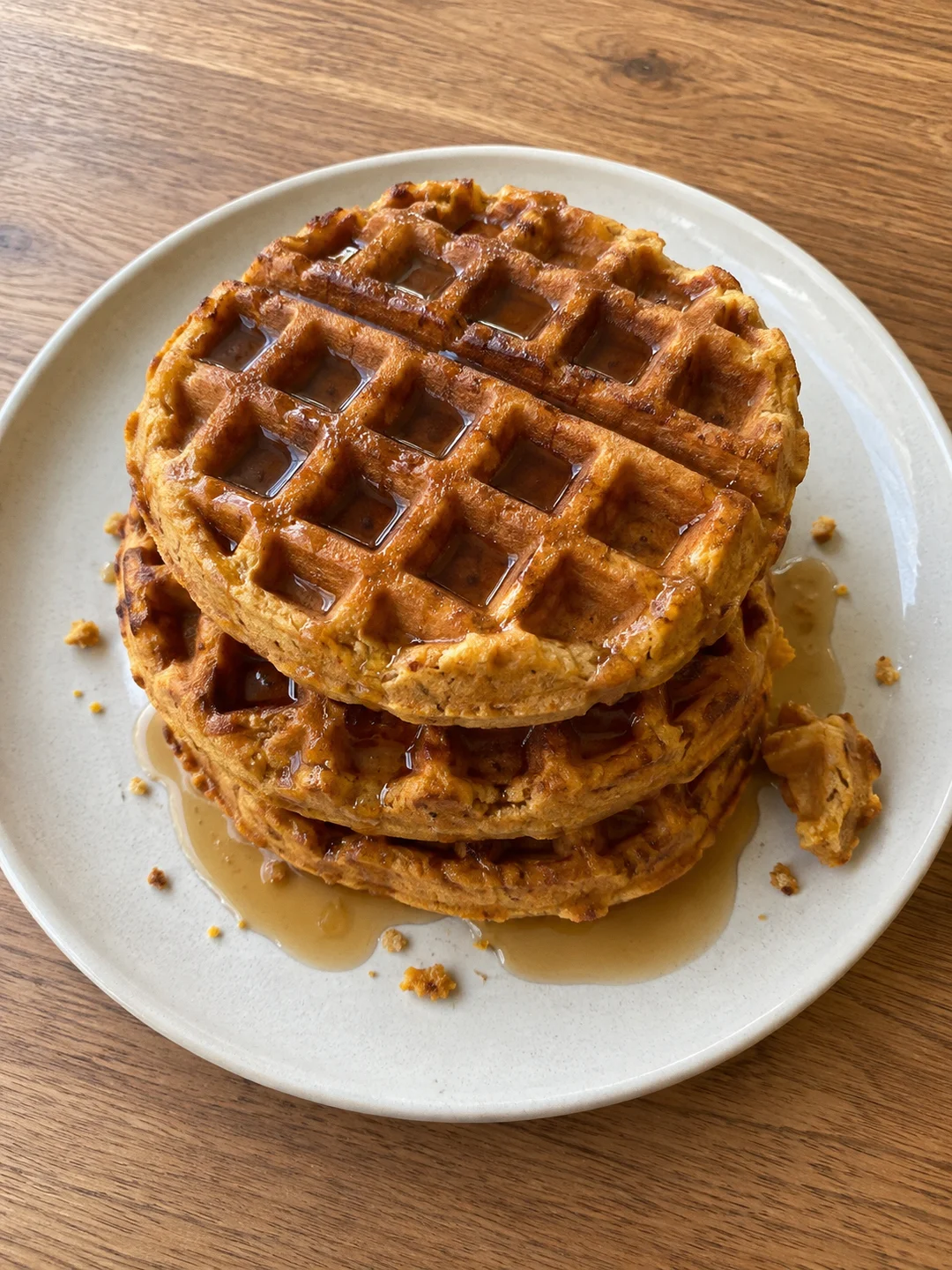
Pumpkin Waffles
Ingredients
Equipment
Method
- Whisk the flour, cornstarch, brown sugar, baking powder, baking soda, salt and pumpkin pie spice together in a large bowl until evenly combined and no lumps of brown sugar remain.
- In a second bowl, whisk the buttermilk, pumpkin purée and eggs until smooth, then whisk in the melted butter. Everything should be at room temperature so the fat emulsifies instead of seizing into specks.
- Pour the wet mixture into the dry and stir with a spatula just until no dry flour remains. A few lumps are correct. Stop mixing the moment it comes together, or the gluten overdevelops and the waffles turn tough.
- Let the batter rest on the counter for 15 minutes. The flour hydrates, the leaveners activate, and the batter thickens noticeably. Do not skip this step.
- Preheat the waffle iron on medium-high and brush both plates generously with melted butter.
- Ladle about 1/2 cup batter into the center of the iron, close the lid, and cook 5 to 6 minutes. Pumpkin waffles take longer than plain ones because of the moisture in the purée, so wait until the steam slows to a trickle and the waffle is deep golden with crisp edges.
- Transfer each waffle directly to a wire rack in a single layer. Never stack them hot, or trapped steam softens the crust.
- Grease the iron again between batches and repeat with the remaining batter. Serve immediately while the edges are still crackling.