
The Pumpkin Roll that ruined me for every other autumn dessert was sitting on a folding table in Lancaster, Pennsylvania, under a piece of plastic wrap, on a Tuesday morning in October. Central Market. The guide leading our food walk was a woman named Deb who had clearly done this walk four hundred times and still got excited at the cheese counter.

She stopped us at a Mennonite baker’s stall almost as an afterthought. Two minutes, she said, then we are going to the pretzel guy.
We did not go to the pretzel guy for twenty five minutes.
What Happened at Lancaster Central Market
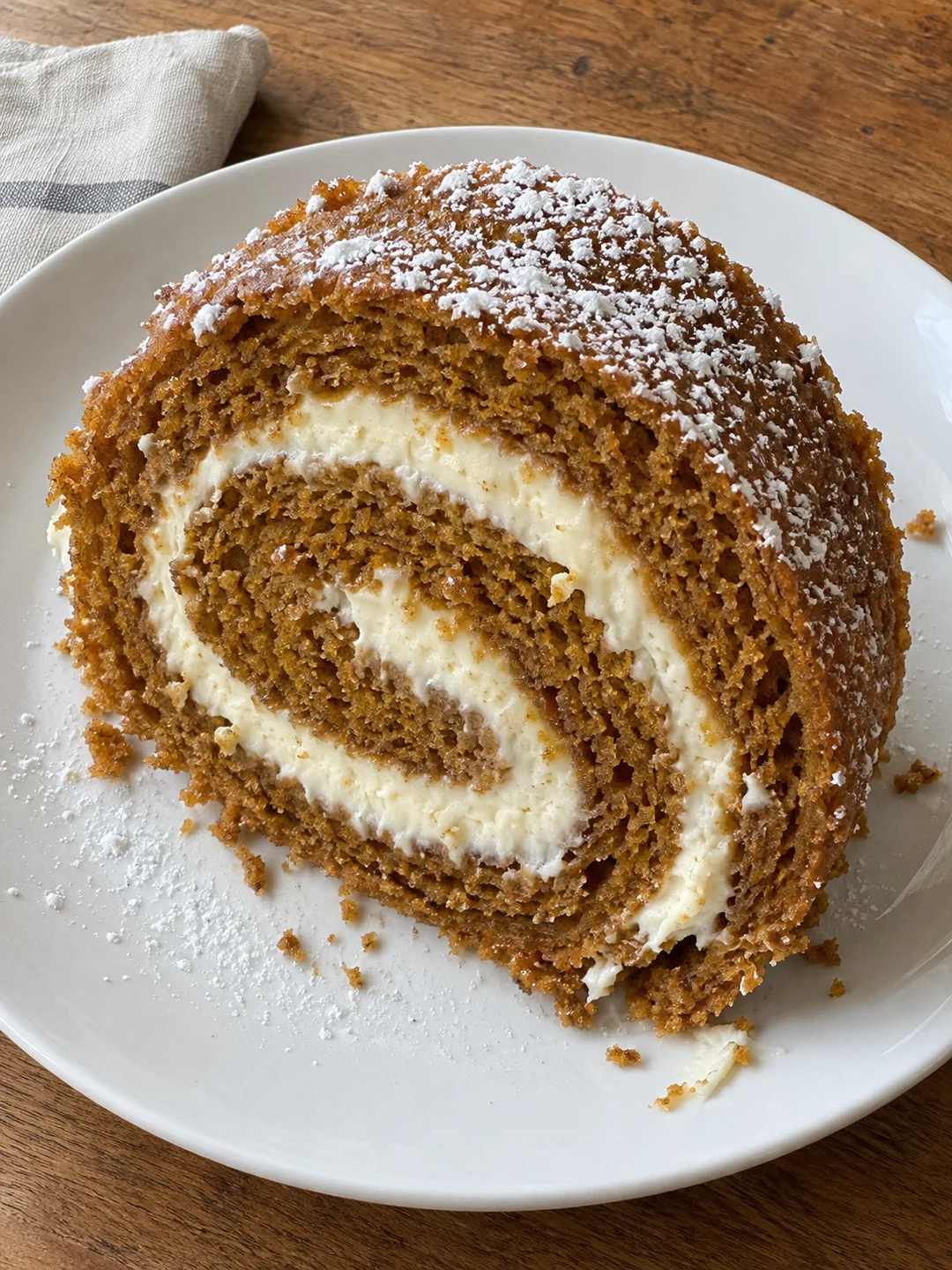
The stall holder was a man in his sixties named Amos who sliced a roll open in front of us with a knife he wiped on a cloth between every cut. Dark gold spiral, pale swirl through the middle, the cut face almost damp looking. The smell was cinnamon and ginger and something closer to bread than cake.
He told me the spiral is trained while the cake is hot, which is the entire trick and the part most people get wrong. Roll it flat-cooled and it splits down the middle every time. He said it like he was mildly tired of explaining it.
I bought a whole one. Ate three slices in the car with black coffee before I had left the parking lot, which is not something I am proud of and also not something I regret.
A Jelly Roll Wearing a Different Coat
The format is European. Rolled sponge cakes came out of 19th century Central Europe, probably Austria, and crossed to America as the jelly roll. The pumpkin version is a much more recent and very American invention, taking hold in mid-century home baking and going properly national by the 1970s.
And here is the bit that made me laugh when I looked into it. Most of that spread is credited to the recipe printed on the back of the Libby’s canned pumpkin label. Handwritten cards passed down three generations in families all across the country, traceable to a can.
In Lancaster County it is more than a printed card, though. Pumpkin is a staple autumn crop there and Amish and Mennonite bakers make these fresh through pumpkin season and sell them at market stalls exactly like the one Deb dragged us to. Church suppers. Bake sales. Thanksgiving tables. It has a place.
One thing worth saying plainly. This is not a pumpkin pie in another shape. It is a sponge cake in the jelly roll tradition with a separate cream cheese filling, and the two have almost nothing in common besides the squash.
Bringing the Pumpkin Roll Home
I made my first attempt about a week after I got back, on a Sunday morning before the street outside had woken up. It cracked. Badly. Because I had cooled the cake flat like a reasonable person and then tried to bend it, which is exactly what Amos told me not to do.
Second attempt I did it his way. Out of the oven, knife around the edges, inverted onto the sugared towel and rolled up while it was hot enough that I was doing a little dance with my fingertips. No crack. None.
Sourcing is easy here, which is part of why this travelled home so well. Canned pumpkin puree is in every supermarket. The only thing I import from that trip is the memory of how Amos held the knife.

What I Used
- 3 large eggs, room temperature, beaten with the sugar until they ribbon
- 1 cup granulated sugar
- Two thirds cup canned pumpkin puree, unsweetened, and I will come back to this
- 1 teaspoon fresh lemon juice
- Three quarters cup all-purpose flour
- 1 teaspoon baking powder
- 2 teaspoons ground cinnamon, 1 teaspoon ground ginger, half a teaspoon nutmeg grated fresh if you have the whole ones
- Half a teaspoon salt
- 8 oz full-fat block cream cheese, softened properly
- 6 tablespoons unsalted butter, softened
- 1 cup confectioners’ sugar for the filling, sifted, plus more for the towel and the top
- 1 teaspoon vanilla extract
The Two Things People Get Wrong
Canned pumpkin puree is not canned pumpkin pie filling. The mix is already sweetened and spiced and will wreck the balance completely. I know the cans look nearly identical on the shelf. Read them.
And full-fat block cream cheese, no negotiating. Light or whipped will not set firm enough and you will get a smeared spiral instead of a clean one.
People also assume fresh homemade puree is automatically better. It is not, necessarily. Moisture content in fresh pumpkin swings wildly and a watery puree thins the batter, which is one more reason for the cake to crack. I use the can. Cheerfully.
Inside the Batter, Inside the Roll
The eggs and sugar go under the beater for four or five full minutes and this is the only lift the cake gets. No butter in the sponge, no oil, nothing else holding air. You are watching for the batter to go pale and thick and fall off the beaters in a wide sheet rather than a drizzle. Stop at three minutes and you get a flat dense sheet that will tear.
Then the dry ingredients get sifted over and folded, not stirred. Every stroke you take after the streaks disappear is air leaving the bowl. I fold with my spatula cutting down the middle and lifting up the sides, and I stop the second it looks smooth.
In the pan the layer looks alarmingly thin. It is supposed to. Thirteen to fifteen minutes at 375 F and the surface springs back when you press the centre, edges just starting to pull away.
Then the fast part. Knife round the edges, flip it onto that heavily sugared towel, peel the parchment off in one steady pull, and roll from a short end while the crumb is still hot and pliable. The steam trapped inside sets the curve as it cools. An hour on a rack, seam down, and the cake has essentially forgotten it was ever flat.

Filling, Chilling, Slicing
Cream cheese, butter, sifted sugar and vanilla go together for two or three minutes until there is not a single lump left. Lumps show up as bumps in the spiral, which nobody but you will notice and which will bother only you.
Unroll gently, leave a slight curl, spread the filling and leave half an inch bare at the far end so it does not squeeze out. Re-roll from the same end, leaving the towel behind this time. Wrap tight and into the fridge for an hour at minimum and two if you can wait, which I usually cannot.
Slice with a sharp knife, wiping the blade between cuts. I trim the two end slices and eat them standing at the counter. This pumpkin roll recipe makes ten proper slices, or eight if you are being honest about how you cut cake.
One Last Thing About Lancaster
Serve it plain with strong black coffee, the way they do it there. No cream, no sauce, nothing on the plate but the slice. Amos would have had opinions about a drizzle.
I went back to Central Market the following autumn and he was still there, same cloth, same knife. He did not remember me at all, which felt exactly right.
Pumpkin Roll
Ingredients
Equipment
Method
- Preheat the oven to 375 F. Grease a 10x15 inch jelly roll pan, line the bottom with parchment paper, then grease the parchment as well.
- Lay a thin cotton kitchen towel on the counter and sift 1/4 cup confectioners' sugar generously over an area slightly larger than the pan. Cover it right to the edges. Set this aside where you can reach it fast.
- Whisk the flour, baking powder, cinnamon, ginger, nutmeg and salt together in a bowl.
- Beat the eggs and granulated sugar with an electric mixer on high for 4 to 5 minutes, until the mixture is pale, thick and falls from the beaters in a wide ribbon. This aeration is the cake's only lift, so do not cut it short.
- Beat in the pumpkin puree and lemon juice on low just until combined, about 15 seconds.
- Sift the dry ingredients over the batter and fold them in with a spatula, cutting down through the center and lifting up the sides, until no dry streaks remain. Stop as soon as it is smooth.
- Pour the batter into the prepared pan and spread it into an even layer with an offset spatula, reaching into all four corners. The layer will look thin, which is correct.
- Bake for 13 to 15 minutes, until the surface springs back when pressed lightly in the center and the edges just begin to pull from the pan.
- Immediately run a knife around the edges and invert the hot cake onto the sugared towel. Peel off the parchment in one steady pull. Work fast, the cake must stay hot.
- Starting from a short end, roll the hot cake up inside the towel into a snug log. Set it seam side down on a rack and leave it to cool completely in that rolled shape, about 1 hour. This trains the spiral and is what stops it cracking later.
- Beat the cream cheese, butter, 1 cup sifted confectioners' sugar and vanilla together on medium-high for 2 to 3 minutes, until smooth and fluffy with no lumps.
- Gently unroll the cooled cake, leaving it lying on the towel. Do not try to flatten it completely, a slight curl is fine and helps the re-roll.
- Spread the filling evenly over the cake, leaving a 1/2 inch bare border along the far short end so the filling does not squeeze out.
- Re-roll the cake from the same short end you started with, this time lifting the towel to guide it but leaving the towel behind. Finish with the seam underneath.
- Wrap the roll tightly in plastic wrap and refrigerate at least 1 hour, ideally 2, until firm enough to slice cleanly.
- Unwrap, dust with the remaining 2 tablespoons confectioners' sugar, and cut into 1 inch slices with a sharp knife, wiping the blade between cuts.