
The pumpkin lasagna that changed my mind about lasagna came out of a kitchen the size of my bathroom, in a family-run place off Piazza Erbe in Mantua. No English menu. No menu at all, actually. The owner, a woman named Grazia, just pointed at the chalkboard and then at me.

I nodded because that is what you do. Ten minutes later she set down a square of pale gold pasta with roasted squash on top and a few sage leaves gone crisp at the edges.
Not a speck of red anywhere in it.
The Conversation I Mostly Did Not Understand
Grazia’s son translated some of it, badly, and she filled the gaps by miming. She held her hands over an imaginary pan and made a slow flattening gesture, then a sharp one, like something disappearing. I understood that part perfectly. Cook the pumpkin until the water is gone.
She said the squash came from the fields outside town, the dense Mantuan kind, and she was unimpressed when I asked if tomato ever went in it. That got a flat hand wave. This is the white lasagna of Lombardy, built on besciamella, and putting ragu near it is somebody else’s dish.
She also told me, through her son, that people assume the sweet edge in Mantuan pumpkin cooking is some trendy invention. It is not. The city has been pairing squash with amaretti and mostarda in its tortelli di zucca for centuries. Same flavour language, different shape.
Getting It Back to My Own Kitchen
I flew home two days later and made a mess of it on the first try. I did not cook the squash down far enough, and when I cut into the pan there was a puddle at the bottom of every slice. That is not the pumpkin’s fault. That is mine, and yours, if it happens to you.
Second attempt I went the other way and let the pan go properly dry, almost to the point where I worried I had ruined it. That was the one. The filling turned dense and nutty and held together when I mashed it.
I buy the squash at the Wednesday farmers market, usually kabocha because the guy at the second stall keeps them and they are drier than butternut. Skip anything sold for carving. Those things are ninety percent water and a lie.
What I Used
- About three pounds of pumpkin or winter squash, kabocha or buttercup if you can get it
- Extra virgin olive oil, three good glugs
- Three garlic cloves, whole, not chopped
- A dozen sage leaves, most for the pan and a few for the top
- Unsalted butter and plain flour for the besciamella
- Whole milk, warmed, about four cups
- Fresh nutmeg, grated, and black pepper
- Fresh egg lasagne sheets, or oven-ready dried if the shop has failed you
- Mozzarella, torn and left to drain in a sieve
- Parmigiano Reggiano, finely grated, more than you think
- Salt

The Afternoon It Bakes
This is a Sunday thing for me. I start around three, when the light in my kitchen goes long and orange across the table, which feels almost too on the nose for a squash dish but there it is.
I put on a Paolo Conte record because it is the only Italian thing I own on vinyl and it suits the pace of standing over a pan for twenty minutes doing nothing but stirring. Glass of something white. A small bowl of olives I will finish before the besciamella is done.
The pumpkin goes in with the whole garlic and eight sage leaves and then it is just patience. Five minutes on medium, then low and partly covered, and you wait until the pan looks bone dry. If liquid pools, crank the heat and drive it off. Grazia’s flat hand gesture, basically.
The besciamella I make in the little saucepan my mother gave me, the one with the burn mark on the side from a caramel incident I do not want to discuss. Butter, flour, two minutes of whisking until it smells faintly of shortbread. Then warm milk a splash at a time. Rush it and you get lumps, and no amount of whisking later saves that.
Fold two thirds of the mashed pumpkin into the sauce and keep the rest in chunks for the top. The chunks are not decoration. They roast in the oven and give you something to bite against all that softness.
Why This Pumpkin Lasagna Is Worth the Fuss
Layered baked pasta has been part of Italian cooking for a very long time, with the word lasagne showing up in the Bolognese records back in 1282. The pumpkin version is a Po Valley thing, and it took hold in Mantua and Ferrara once New World squash arrived in Renaissance northern Italy and found a region that already knew exactly what to do with it.
It is still a proper autumn and winter first course up there. Sunday lunches, Christmas tables, the vegetarian option that nobody treats as a compromise.
The pumpkin lasagna recipe I settled on is close to what Grazia served me, though I use slightly more nutmeg than I suspect she would approve of. I like it aggressive. It cuts the sweetness of the squash and keeps the whole thing from going one-note.

Small Changes and Honest Warnings
Drain the mozzarella. Thirty minutes in a sieve, no exceptions. Undrained cheese and under-cooked squash are the only two reasons this dish ever fails, and both are fixable before the oven is even on.
If you want the full Mantuan version, crush four or five amaretti into the pumpkin filling with a spoonful of chopped mostarda di mele. I do this maybe half the time. Depends who is coming over, honestly, because it divides people sharply and I am not always in the mood to defend it.
You can build the whole thing the day before and keep it in the fridge. Add ten minutes to the bake. And do not skip the rest after it comes out, because a lasagna cut too early slides apart on the plate and you will be annoyed with yourself.
Leftovers keep three days. Cold, straight from the fridge, standing at the counter. I might like it better that way.
What Stayed With Me
I think about that room sometimes, the noise of it, Grazia’s son trying to explain besciamella with his hands while she shouted corrections over the pass. I did not get her recipe. I got a gesture and a strong opinion about tomato.
Turns out that was enough. Every time the pan goes dry and the kitchen smells of sage and browning butter, I am back at that table for a second.
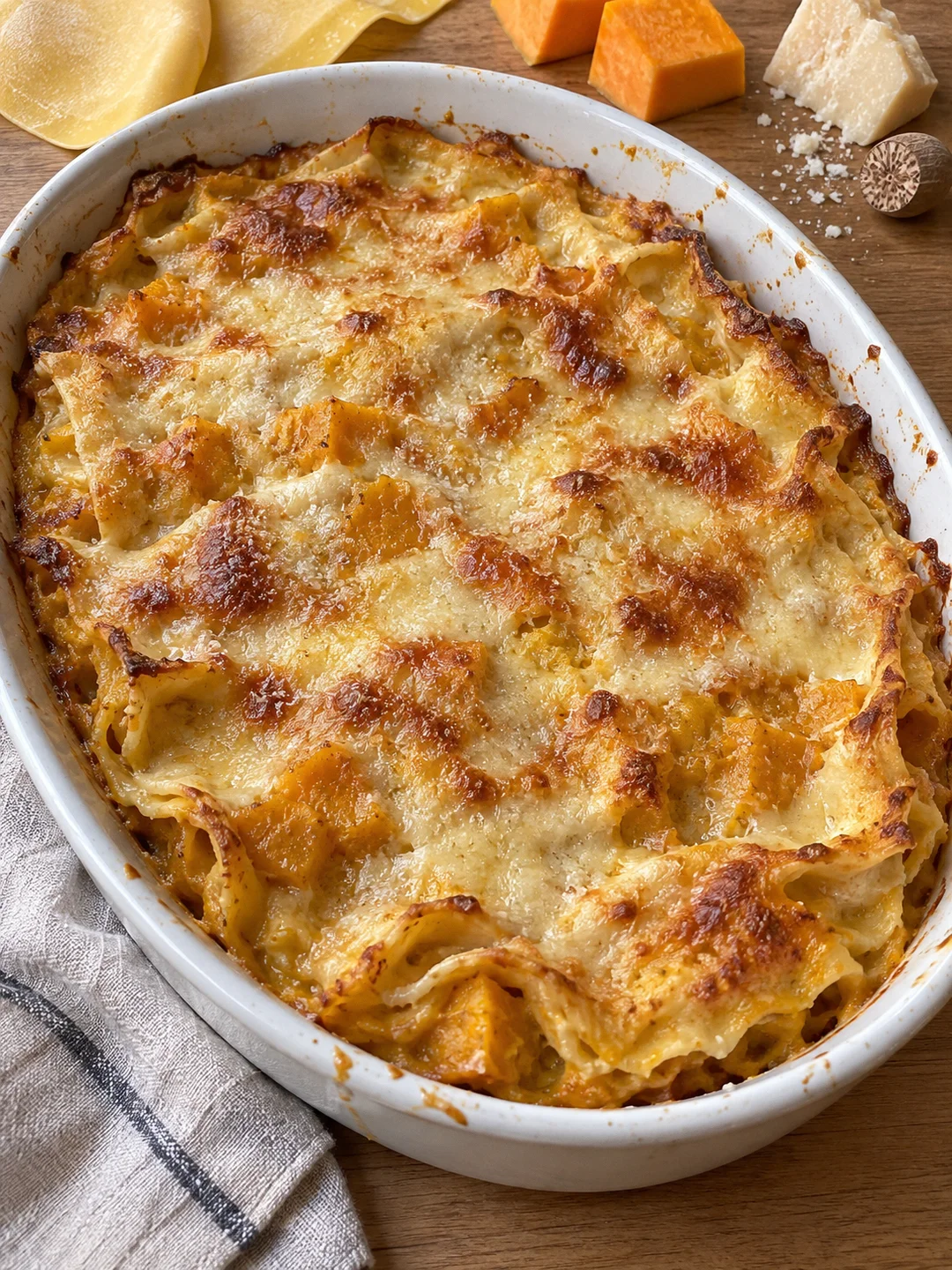
Pumpkin Lasagna
Ingredients
Equipment
Method
- Peel and seed the pumpkin and cut it into 3/4 inch cubes. You want about 2.25 lb of prepared flesh.
- Heat the olive oil in a large skillet over medium heat. Add the whole garlic cloves and 8 sage leaves and cook 1 minute until fragrant.
- Add the pumpkin cubes and 1 teaspoon salt. Cook over medium heat for 5 minutes, stirring, then lower the heat, cover partially and cook 15 to 20 minutes more until the pumpkin is completely soft and the pan looks dry. If liquid is pooling, uncover and raise the heat until it evaporates. This step decides whether the lasagna is silky or watery.
- Remove and discard the garlic and sage leaves. Scoop out about one third of the pumpkin and set it aside in chunks for the top. Mash the remaining two thirds to a smooth puree and let it cool.
- Make the besciamella. Melt the butter in a medium saucepan over low heat. Whisk in the flour and cook 2 minutes, stirring constantly, until you have a smooth pale roux that smells faintly of biscuits.
- Pour in the warm milk a little at a time, whisking after each addition so no lumps form. Cook over low heat 10 to 15 minutes, stirring continuously, until the sauce thickly coats the back of a wooden spoon. Season with the remaining 1/2 teaspoon salt, the nutmeg and the black pepper.
- Set aside 1 cup of besciamella for the top. Fold the cooled pumpkin puree into the remaining besciamella until evenly orange. Taste and adjust the salt.
- Preheat the oven to 350 F. Spread a thin film of the reserved plain besciamella over the bottom of the 9x13 inch dish.
- Lay down a layer of pasta sheets. Spread over about a quarter of the pumpkin besciamella, scatter a quarter of the drained mozzarella and a handful of Parmigiano. Repeat for four layers, finishing with pasta.
- Spoon the remaining plain besciamella over the top layer and spread it to the edges. Scatter the reserved pumpkin chunks, the last of the Parmigiano and the 4 remaining sage leaves.
- Bake 25 to 30 minutes, until the top is golden and the edges are bubbling. If it browns too fast, tent loosely with foil.
- Rest the lasagna 10 to 15 minutes before cutting. It needs that time to set, and the slices will hold their shape instead of sliding apart.