
The first Pan de Muerto I ever ate was handed to me in a paper napkin on the night of November 1, in the Jardín Centenario in Coyoacán, Mexico City. Marigolds everywhere. Somebody’s uncle playing a trumpet badly and nobody minding.

I had gone down for Día de Muertos as a solo traveler with no real plan, which is usually how the good trips start. The woman who ran the little hostel I was staying in, Rocío, walked me down to the plaza because I would otherwise have spent the evening taking photos of candles like a tourist. She pointed at a bakery stall with a line twelve deep and said we were going to wait.
The Night the Plaza Smelled Like Oranges
What I remember is the smell before the taste. Orange blossom, warm sugar, a little anise, drifting over copal smoke and wet flowers.
Rocío bought four loaves. Two went on the ofrenda back at the hostel, next to a photo of her father in a fishing hat, and two got torn up at the kitchen table with hot chocolate at eleven at night. She told me the dead take the smell and the living take the bread, and that is the whole arrangement.
After the holiday she kept baking it on Sundays for whoever was still around, which that November was me and a quiet Argentinian guy waiting on a visa. She let me stand next to her and watch for three weeks. I measured nothing. I just learned what the dough was supposed to look like when it stopped sticking to her hands.
What Pan de Muerto Actually Is
It is not an ancient Aztec bread, and I wish fewer blogs said it was. Wheat, yeast and the baking oven all arrived with the Spanish, and November 1 and 2 come off the Christian calendar.
Its direct ancestor is the Spanish pan de ánimas, soul bread, baked for All Saints’ and All Souls’ Day in Castile and Aragon and carried over to New Spain. Indigenous communities already set food out for their dead, so the imported loaf slipped into a ritual that was waiting for it. The dramatic story about friars inventing the bread to replace human sacrifice is folklore, not documented history.
There is also no single correct version. The sugared dome with bones across the top is the Mexico City one. Oaxaca bakes pan de yema with sesame, Michoacán makes figure breads, and all of them are equally traditional.
The crossed strips are read as bones, sometimes as teardrops, with the little knob in the middle standing in for the skull and the round loaf for the cycle that keeps going. And the orange-blossom water is not decoration. It is the scent that calls the dead home, and it is the thing you absolutely cannot swap for vanilla.

What I Used
- All-purpose flour, about four and a half cups, plus a dusting for the counter
- Instant yeast
- Granulated sugar, half a cup for the dough and three quarters of a cup for rolling the baked loaves
- Fine salt
- Anise seed, lightly crushed under the flat of a knife
- Four whole eggs and two extra yolks, all at room temperature
- Unsalted butter, ten tablespoons for the dough and four melted for brushing
- Whole milk, lukewarm, nothing hotter than bathwater
- Orange-blossom water, two tablespoons, the real agua de azahar
- Zest of two oranges
Bringing Pan de Muerto Back to My Kitchen
The agua de azahar was the only hard part, and only for about a day. The Mexican grocery I like did not have it the week I looked, so I bought a bottle at a Lebanese shop near the station instead, where it sits on the shelf for rosewater syrups and baklava. Same thing. Cheaper, actually.
Two tablespoons sounds like a lot. It is not. Someone asked me how to make pan de muerto with orange blossom water and not have it taste like soap, and the honest answer is that the orange zest does the balancing, so do not skip the zest to save time. Grate both oranges. All of it.
My first attempt was a brick. The dough was sticky after the butter went in and I panicked and dusted in more flour, maybe a third of a cup, and the crumb came out tight and dry instead of pulling apart in strands. Oil your hands and keep kneading instead. It does come together.
The other thing I changed is the butter temperature, which matters more here than in anything else I bake. Rocío’s kitchen was warm all day and her butter was always perfectly soft on the counter. Mine, in a cold winter kitchen with the windows shut, needs cubing an hour ahead, and I refuse to shortcut it in the microwave because melted butter makes a greasy dough that never climbs.
I knead it fifteen minutes in a stand mixer that walks slowly across the counter and has to be watched. By hand it is thirty to forty minutes of slapping and folding, which I have done once, on a Sunday morning before anyone in the building was up, with the radio on low. Worth doing once to know what the dough feels like.

Shaping the Bones
Judge the first rise by volume, not by the clock. Press a finger in and the dent should fill back slowly. In a warm kitchen that is ninety minutes. In February it has taken me three hours and I just let it.
Divide into four, pinch a quarter off each piece for decoration, and roll the big pieces into tight domes by cupping your hand and dragging them in circles until the skin goes taut. For the bones, roll a rope under three fingers, pressing and releasing, so you leave knobbly bulges along the length. They look wrong until they bake. Then they look exactly right.
Brush with melted butter while the loaves are too hot to hold and roll them in sugar straight away, pressing so it sticks in a thick coat. Do it late and the sugar slides off in sheets.
What Does Not Travel Home
What I cannot recreate is the plaza. The trumpet, the candle smoke, the crowd pressing toward the stall, the fact that the bread meant something specific to the woman standing next to me.
So I bake four loaves and give three away, usually to neighbors who did not ask for bread. That is as close as I can get to the original arrangement, and it turns out to be close enough.
The sugar gets on everything. Shirt, counter, floor.
I pull one apart while it is still warm enough to steam, with coffee, standing up. Rocío would say that is the point and that I should stop photographing it. She is right, and I still photograph it.
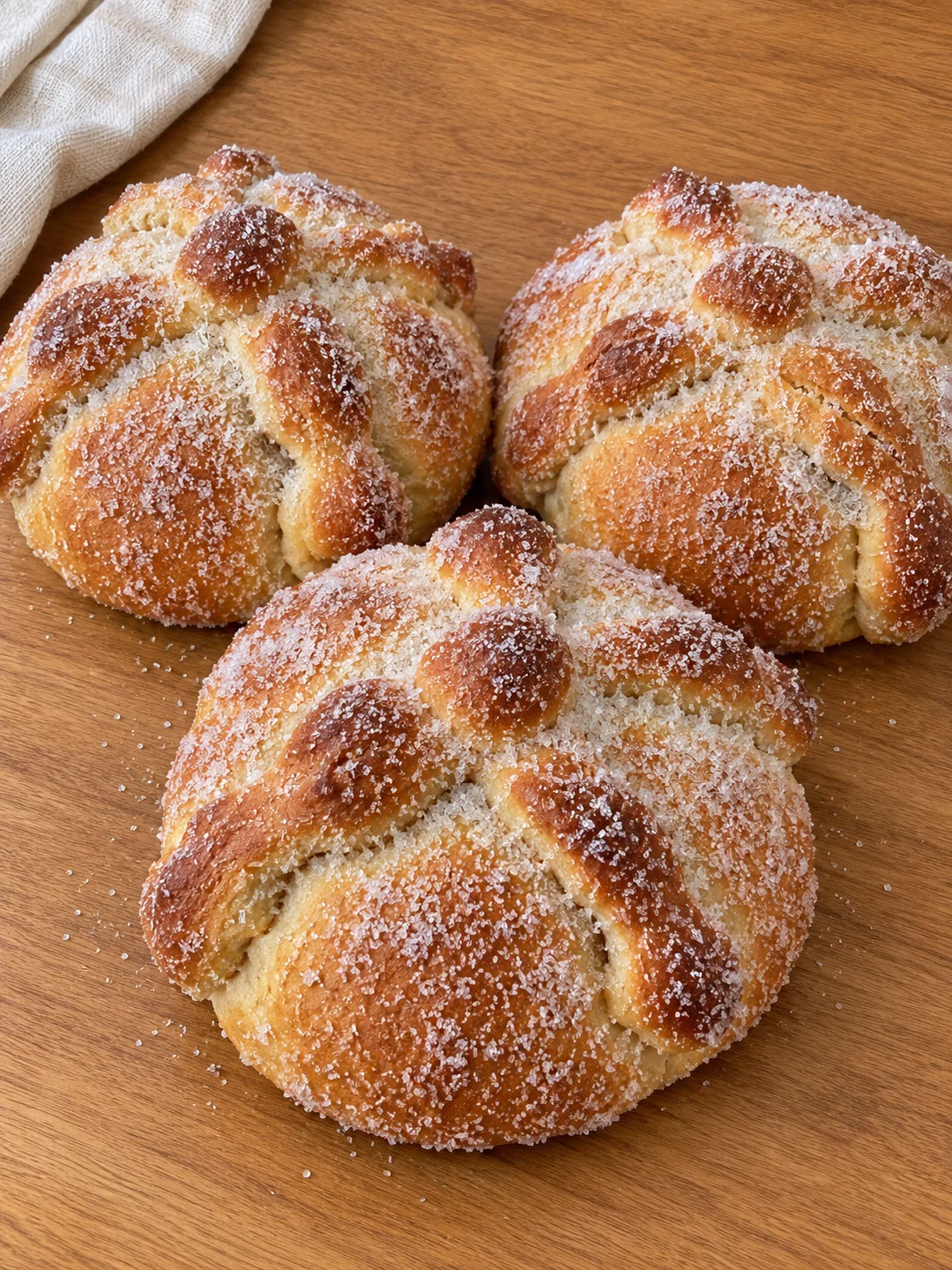
Pan De Muerto
Ingredients
Equipment
Method
- Mound the flour in the bowl of a stand mixer and stir the instant yeast through it. Add the 0.5 cup sugar, salt and crushed anise seed and mix on low for 20 seconds to distribute everything evenly.
- Make a well in the center. Add the 4 whole eggs, 2 egg yolks, orange-blossom water and orange zest. Mix on low with the dough hook until a rough, shaggy dough forms, about 2 minutes.
- With the mixer running on low, pour in the lukewarm milk in a slow stream, a little at a time. Stop as soon as the dough comes together into one mass. It should be soft and tacky.
- Add the soft butter a few cubes at a time, waiting until each addition disappears into the dough before adding more. This takes about 5 minutes. The dough will look slack and greasy at first, then pull back together.
- Knead on medium-low for 15 minutes, until the dough is smooth, elastic and pulls cleanly away from the sides of the bowl. By hand on a lightly floured surface this takes 30 to 40 minutes of slapping and folding. Do not add extra flour to fix stickiness.
- Shape the dough into a ball, place it in a large bowl, cover with a damp towel and leave in a warm spot until fully doubled in volume, 1.5 to 3 hours depending on your kitchen. Press a finger into it: the dent should fill back slowly, not spring straight back.
- Turn the dough onto a lightly floured surface and press out the gas. Divide it into 4 equal pieces. Pinch off about one quarter of each piece and set those smaller pieces aside for the decoration.
- Round each of the 4 large pieces into a tight dome by cupping your hand over it and dragging it in circles against the surface until the skin is taut. Place two domes on each parchment-lined baking sheet, well apart.
- From each reserved piece, pull off a small marble of dough and set aside for the crown. Roll the rest into two ropes about 6 inches long. Make the bones by rolling each rope under three fingers, pressing down and releasing, so you leave knobbly bulges along the length.
- Lay two bones over each loaf in a cross, running down the sides and tucking the ends under the base. Press the small marble of dough into the center where the bones meet, dabbing with water to help it stick.
- Cover the loaves loosely with a towel and leave to rise again until puffy and nearly doubled, 45 to 75 minutes. Meanwhile, heat the oven to 350 F and let it come fully up to temperature.
- Bake for 20 to 25 minutes, until the loaves are deeply golden and sound hollow when tapped on the base. Keep the oven door shut for the first 15 minutes so the color sets. If they brown too fast, tent loosely with foil.
- Working while the loaves are still hot, brush them all over with melted butter, including the bones. Pour the 0.75 cup sugar into a shallow bowl and roll each loaf in it, pressing gently so the sugar sticks in a thick coat.
- Cool on a rack for at least 30 minutes before tearing into them. The crumb needs that time to set.