
Smash Burgers with Special Sauce are what I make when the apartment is too quiet and I’m too lazy to be sad about it. The cast iron is already on the stove from earlier, the fridge has cold chuck, and that’s enough infrastructure for a good night.

I don’t think a single one of these has ever made it to a real plate. They get eaten standing up, over a paper towel, while leaning on the counter, ideally with the lights low and the kitchen still smelling like beef and butter. That, to me, is a feature.
The whole thing, start to finish, takes about fifteen minutes if I’m moving with intent. Most of that is waiting on the pan. The actual cooking is over in two.
The Napkin That Lives by My Stove
The recipe came to me on a grease-stained napkin. A homestay host I’d been staying with for a couple of weeks wrote it down one night while we were eating burgers at her kitchen table, ballpoint pen against thin paper, the words bleeding wherever her thumb had pressed too hard.
She told me to smash hard, only once. To never be precious about the sauce. To use the cheapest American cheese I could find, because the expensive stuff doesn’t melt the same.
I taped the napkin to the inside of my spice cabinet and it has lived there for years. It’s faded at the corners now, and half the cayenne measurement is illegible.
I don’t need to read it anymore. Some recipes you read once and then they live in your hands.
The smash burger itself is older than her napkin by about a century. The Oklahoma fried onion burger was born in El Reno in 1926, when a cook at the Hamburger Inn smashed cheap onion slices into beef on a hot griddle to stretch the meat through the Depression.
The technique drifted into Kentucky and Midwestern diners, lived in lunch counters for decades, and came back as a cultural moment in the 2010s. None of which she explained at the table. She just said smash hard.
What Goes Into Smash Burgers with Special Sauce
- One pound of fresh ground chuck, 80/20, very cold, torn into four ragged loose balls
- Four slices of deli-style American cheese, individually wrapped, no apologies
- Four potato buns, ideally Martin’s
- One small yellow onion, shaved as thin as paper
- Sixteen dill pickle chips, plus a tablespoon of brine for the sauce
- A tablespoon of neutral high-smoke-point oil or beef tallow
- Two tablespoons of softened butter for the buns
- Kosher salt and black pepper, applied only after smashing
- Half a cup of full-fat mayonnaise
- Two tablespoons of ketchup and one of yellow mustard
- A tablespoon of finely minced dill pickles
- Smoked paprika, garlic powder, and a whisper of cayenne

Inside the Pan
The skillet has been on high heat for five minutes and is now smoking in that quiet, serious way. The oil goes in and breaks into shimmering rivulets across the iron. The beef ball lands and there’s a half second of suspense before everything starts moving.
Then the spatula comes down through the parchment, hard, and the ball flattens out wide and thin. Muscle fibers at the edges tear apart into frilly, ragged tendrils, swimming in their own rendered fat. Those tendrils are doing the most important work in the room.
This is where lacy crust comes from. Not from a thicker patty, not from a longer cook. From the chaos of those torn edges.
The Maillard reaction starts almost immediately. Amino acids meet sugars at around three hundred degrees and begin building new flavor compounds at a speed that cannot be replicated by a thicker puck on a medium grill.
The crust deepens from pink to mahogany to almost black at the edges. Juice beads up on the raw top side and starts to bubble. Salt lands on the wet surface and dissolves, seasoning all the way through.
People will tell you smashing squeezes the juices out. They are wrong. The patty is raw when it’s smashed, and the surface is so hot that the side touching the iron seizes into a crust within seconds, sealing in everything that matters.
A bench scraper goes in flat and firm. The crust releases in one piece, intact, lacy edges still attached.
The patty flips and the cheese lands. Proteins denature on contact, the fat phase weeps out into a glossy bead, and the slice slumps over the beef in a slow, willing collapse.

Building the Smash Burgers with Special Sauce
While the patties cook, the buns get buttered and toasted in a second pan until they go deep gold and a little crisp at the edges. This is non-negotiable. A soft untoasted bun under a juicy patty becomes wet bread in about ninety seconds, and wet bread is a hate crime against burgers.
The sauce is already in the fridge, getting better by the minute. Cold mayonnaise and pickle brine and mustard become more themselves after twenty minutes of sitting together.
The first time I made the sauce I ate it straight off a spoon, which was embarrassing and which I will do again.
I always sauce both halves of the bun. Sauce on only one half is a small sad lie you tell yourself to feel virtuous, and it never works.
Pickles go on the bottom, four chips, overlapping. The cheese-draped patty lands next, then a small mound of raw shaved onion, then the lid. Press gently.
If I’m being honest, I usually eat the first burger before the second one is even built. That’s also a feature.
Twists for Other Late Nights
Some nights I go double, two two-ounce patties stacked with cheese between each one, which is structurally unwise and emotionally correct. Some nights I shave the onion thin and press it directly into the beef before smashing, the way it’s done in El Reno. The onion fries into the crust and the whole thing tastes like 1926.
Other nights I swap the American for sharp cheddar, or add pickled jalapeños under the patty, or skip the ketchup in the sauce entirely and go full pickle and mustard for something sharper. None of it is wrong. The napkin doesn’t care.
This is the meal that turns a tired night into a small, complete event. Two minutes at the stove, three minutes assembling, twelve minutes of standing in a quiet kitchen feeling unexpectedly okay. That’s the whole pitch, and most nights, that’s enough.
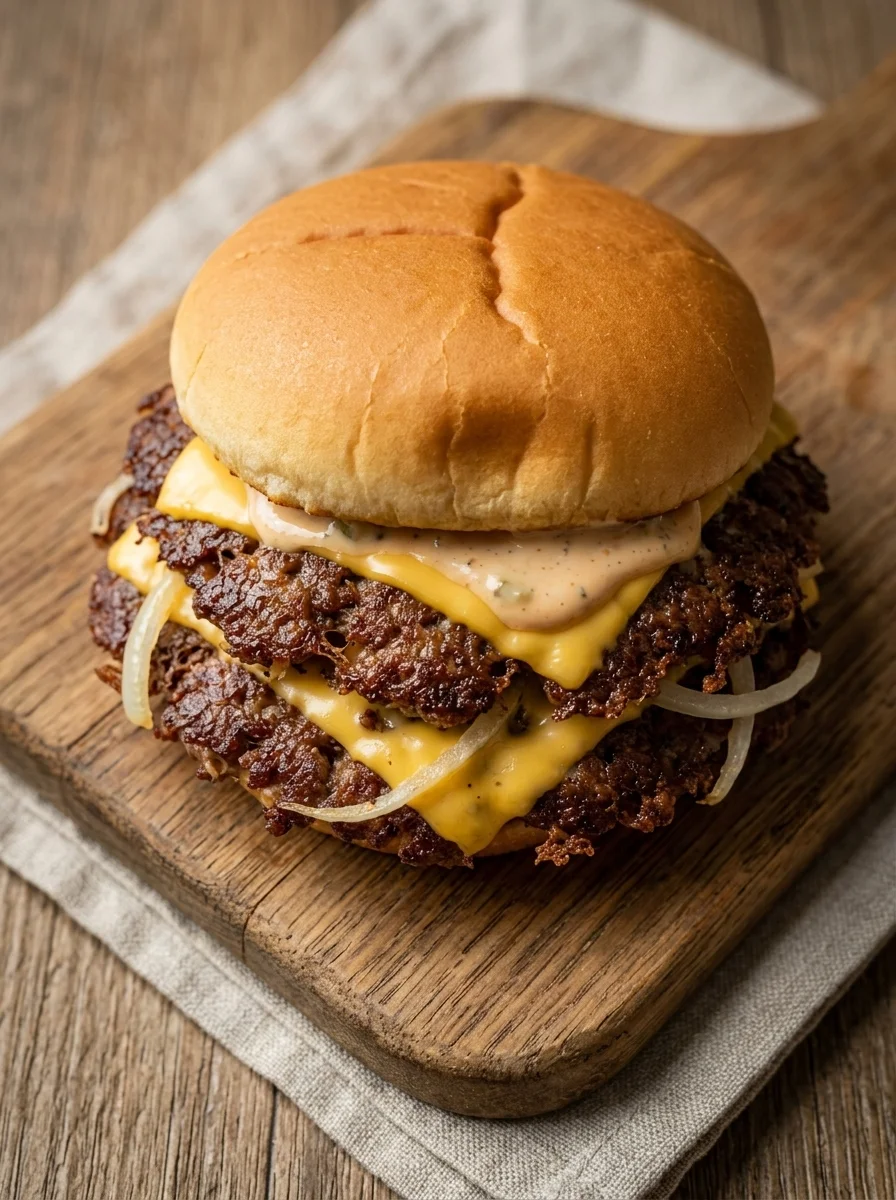
Classic Smash Burgers with Special Sauce
Ingredients
Equipment
Method
- Make the special sauce. In a small bowl, whisk together the mayonnaise, ketchup, mustard, pickle brine, minced pickles, smoked paprika, garlic powder, and cayenne. Cover and refrigerate while you cook.
- Divide the cold ground beef into 4 loose, ragged 4-ounce balls (or 8 balls of 2 ounces for doubles). Do not pack or season them. Keep them in the fridge until the pan is ready.
- Set a cast-iron skillet or flat-top griddle over high heat for at least 5 minutes, until it is smoking hot. Add the oil or beef tallow and swirl to coat.
- Butter the cut sides of the potato buns and toast them in a separate skillet over medium heat until deep golden, about 1 minute. Set aside cut-side up.
- Place a beef ball on the hot surface. Lay a small square of parchment over it and immediately press down hard with a stiff metal spatula or burger press, flattening the patty to about 1/4 inch thick and 4 to 5 inches wide. Peel off the parchment.
- Working quickly, repeat with as many balls as your pan will fit without crowding. Season each smashed patty generously with kosher salt and black pepper.
- Cook undisturbed for 60 to 90 seconds, until the edges are dark, lacy, and crisp and the surface bleeds juice.
- Slide a bench scraper firmly under each patty to release the entire browned crust, then flip. Immediately top each patty with a slice of American cheese.
- Cook for another 30 to 45 seconds, until the cheese melts and the second side is just cooked through. Remove from the heat.
- Build each burger: spread special sauce on both halves of a toasted bun, lay 4 pickle chips on the bottom, add the cheese-topped patty, scatter a small mound of shaved onion on top, and close with the bun lid.
- Serve immediately while the crust is still crisp and the cheese is molten.