
The best stuffed bell peppers I have ever eaten came out of a steam tray at a roadside kafana on the highway between Banja Luka and Belgrade, around four in the afternoon, after eight hours on a bus with a broken air conditioner. I was not looking for lunch. I was looking for a bathroom and a cold drink.
The place had three tables, a glass case of pastries nobody had touched, and a pot behind the counter that the woman kept nudging with a wooden spoon. She did not ask what I wanted. She pointed at the pot and then at me.
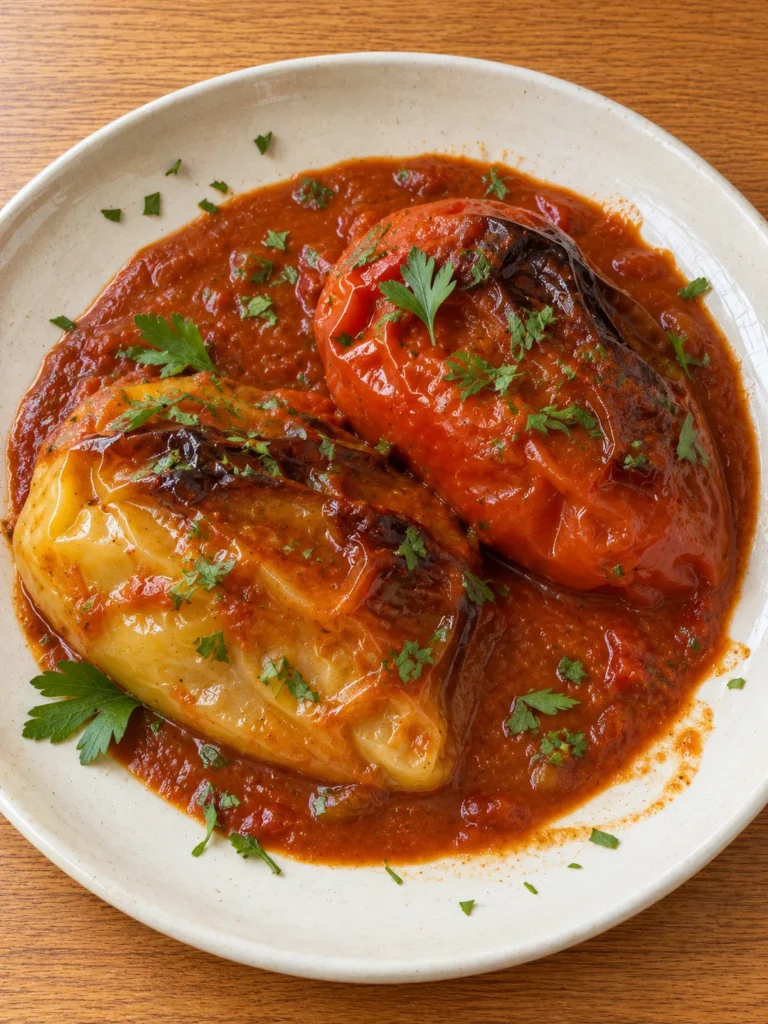
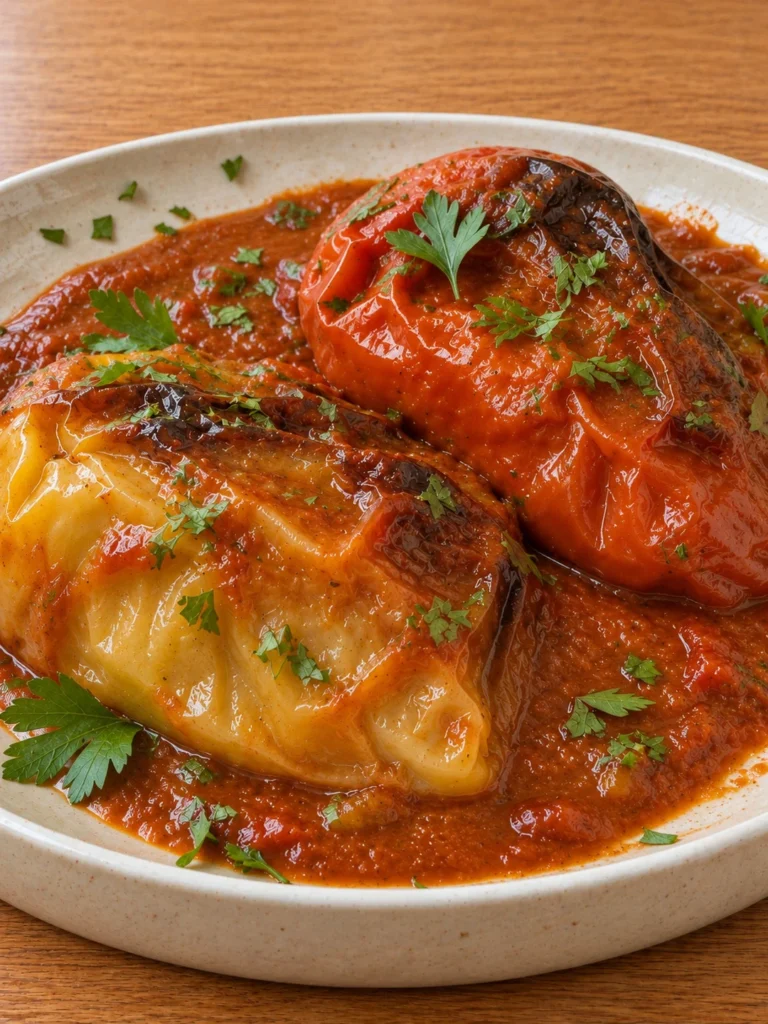
Two peppers came out in a shallow bowl, swimming in rust-red sauce, sagging sideways like they had given up. A slice of white bread on the rim. A spoonful of something sour and white on top. I ate both and then sat there for twenty minutes doing nothing.
The Napkin That Came Home With Me
Two nights later I was in a homestay in Banja Luka, one of those apartments with a balcony full of drying paprika and a landlady who treats guests as a staffing problem she has solved. Her name was Dragica. When I described the roadside bowl she made a face that I understood perfectly, the face of a woman who thinks highway food is an insult to a good dish.
She made them the next evening. Then she wrote the recipe on a paper napkin from the kitchen drawer, in pen, while oil from the pan was still on her fingers. I still have the napkin. The grease spot has gone translucent over the part where she wrote the amount of rice, which is annoying because the amount of rice turns out to matter more than anything else.
Her instruction, repeated three times, was that the peppers are not supposed to stand up at the end. If they stand up, you did not cook them long enough.
What Dragica Would Not Let Me Get Wrong
Peppers are a New World crop. They did not reach Europe until the 16th century, arriving via Spain and moving east through Ottoman trade routes, which means the dish in its current form is nowhere near as ancient as it feels. The technique is the old part. The Ottomans had been stuffing vegetables, leaves and fruit for centuries under the name dolma, which just means stuffed, and the sweet pepper slid straight into that repertoire as biber dolması.
Four hundred years of Ottoman rule carried it across the Balkans, where it picked up local names. Punjene paprike in Serbia, Bosnia and Croatia. Töltött paprika in Hungary, made with the pale wax pepper instead. Ardei umpluți in Romania, gemista in Greece, piperki polneti in Macedonia.
It is harvest food, not party food. Late summer and early autumn, when peppers flood the markets and cost almost nothing, made in one enormous pot that a household eats off for three days. The same frugal instinct as ajvar and pickling, stretching half a pound of mince across a full table with rice and a grated carrot.
Two things it is not. It is not baked dry in the oven, and it is not capped with melted cheese. The cheese lid is an American addition. In Bosnia the finish is sauce and a spoon of kiselo mlijeko.
What I Used
- Eight medium thin-walled sweet peppers, red and yellow, about four inches long
- A pound of ground pork and half a pound of ground beef, not the lean stuff
- Short-grain rice, rinsed and raw, half a cup and no more
- One big yellow onion, finely diced, plus three cloves of garlic
- A grated carrot, which is the frugal trick that makes it taste like more meat than it is
- Sunflower oil or lard
- Good sweet paprika, Balkan or Hungarian, split between the filling and the roux
- Flat-leaf parsley, salt, a lot of black pepper
- One russet potato cut into thick rounds, to cork the peppers shut
- Three cups of tomato passata and two cups of water or light stock
- A bay leaf, two tablespoons of flour, a pinch of sugar only if your tomato is sharp
Making Stuffed Bell Peppers in a Kitchen That Is Not Bosnia
The pepper problem is real. Dragica used pale wax peppers that she bought in a crate for less than the cost of a coffee. Thick green bells are the wrong vessel, they stay firm and taste grassy, so I buy whatever thin-walled red and yellow ones the Armenian grocer on the corner has, and in September the Hollywood farmers’ market has gypsy peppers that are almost exactly right.
I core them whole. Stem end cut off in a neat circle, half an inch down, seeds pulled out with my fingers, and I trim the ribs that block the opening. No slicing in half lengthwise. The whole pepper is a sealed jar that steams the filling from the inside, and that is the entire mechanism of the dish.
The onions go low and slow for twelve minutes in my cast iron, until they are sweet and barely coloured. Then off the heat before the paprika goes in, because paprika scorches in about four seconds and turns bitter in a way you cannot fix. I learned that the first time. The whole pot tasted like a struck match.
Fill three-quarters full. Not to the brim. Raw rice swells violently inside a sealed pepper and will split the walls open, which is exactly what happened to two of mine the first attempt because I did not trust that much empty space.
Eighty Minutes of Doing Nothing
Sunday afternoons are when I make these, usually because I have come back from somewhere on a red-eye and cannot face anything that needs attention. The peppers stand close-packed in my Dutch oven, lid slightly chipped on one side, potato caps up, holding each other upright. Passata and water poured around until they sit two-thirds under. Bay leaf tucked in.
Then low heat, lid on, and seventy to eighty minutes of not stirring. Light moves across the kitchen table in that time. Usually I have something on quietly, Vashti Bunyan or whatever was already playing, and the whole apartment goes to tomato and paprika.
The zaprška comes at the end. Oil and flour whisked in a small saucepan for two minutes until it smells nutty, paprika off the heat, then a ladle of hot tomato liquid from the pot beaten in until smooth. That goes back around the peppers with a tilt of the pot rather than a stir, and ten uncovered minutes thickens the sauce to something that coats a spoon.
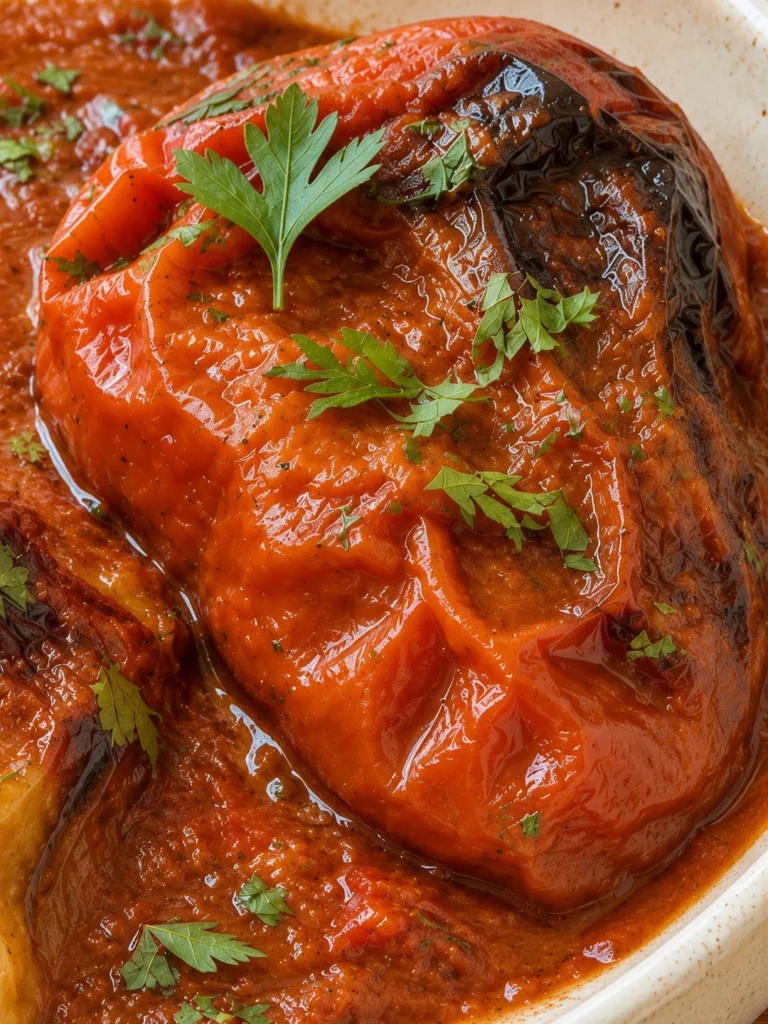
Lift them out with a spoon underneath and a spatula, carefully, because by now they are barely holding together.
What Changed Once I Got Home
I cannot recreate bus-hunger, so I do not try. What I have instead is day two. Cool them completely, refrigerate, reheat gently in the sauce, and they are better. Firmer in the filling, deeper in the tomato.
I eat them cold sometimes. Straight from the container, standing at the counter, which Dragica would almost certainly disapprove of. Sour cream on top is non-negotiable for me, and bread to drag through the sauce, although mashed potato is the move if you have twenty extra minutes.
The napkin lives in my recipe drawer, grease spot and all. I have the amounts memorised now but I would not throw it out.
Stuffed Bell Peppers
Ingredients
Equipment
Method
- Cut the stem end off each pepper in a neat circle, about 1/2 inch down, and pull out the core and seeds with your fingers or a paring knife. Keep each pepper whole and intact. Rinse the insides and shake dry. Trim any ribs that block the opening.
- Heat 2 tablespoons of the oil in a large skillet over medium-low heat. Add the onion and a pinch of salt and sweat it slowly for 10 to 12 minutes, stirring often, until completely soft, sweet and barely colored. Add the garlic and grated carrot and cook 2 minutes more. Slide the pan off the heat and stir in 1 tablespoon of the sweet paprika so it blooms in the residual heat without scorching. Let it cool to lukewarm.
- In a large bowl, combine the ground pork, ground beef, rinsed rice, the cooled onion mixture, parsley, 2 teaspoons salt and the black pepper. Mix with your hand for about a minute until it holds together but is still loose and moist. Do not compact it.
- Fill each pepper with the meat mixture using a spoon, pushing it down gently. Stop about three-quarters of the way up. The rice needs that empty space to swell. Cap each opening with a round of potato, pressing it in like a cork.
- Stand the peppers upright and close-packed in a deep heavy pot, potato caps up. They should support each other so nothing tips over. Tuck any leftover filling between them as small meatballs.
- Whisk the passata with the water and pour it around the peppers until they sit about two-thirds submerged. Tuck in the bay leaf. Taste the liquid, season with salt, and add the sugar only if the tomato is sharp.
- Bring to a bare simmer over medium heat, then cover, reduce the heat to low and cook for 70 to 80 minutes. Do not stir. Shake the pot gently once or twice. The peppers are done when the walls have collapsed and a knife slides through with no resistance, and the rice inside is fully swollen and tender.
- Make the zaprška about 10 minutes before the end. Heat the remaining 1 tablespoon oil in a small saucepan over medium-low heat, whisk in the flour and cook 2 minutes until it smells nutty and turns pale gold. Pull it off the heat, whisk in the remaining 1 tablespoon paprika, then whisk in a ladleful of hot tomato liquid from the pot until smooth.
- Pour the roux back around the peppers, tilting the pot gently to distribute it rather than stirring. Simmer uncovered for the last 10 minutes so the sauce thickens, glosses over and the pepper tops blister slightly.
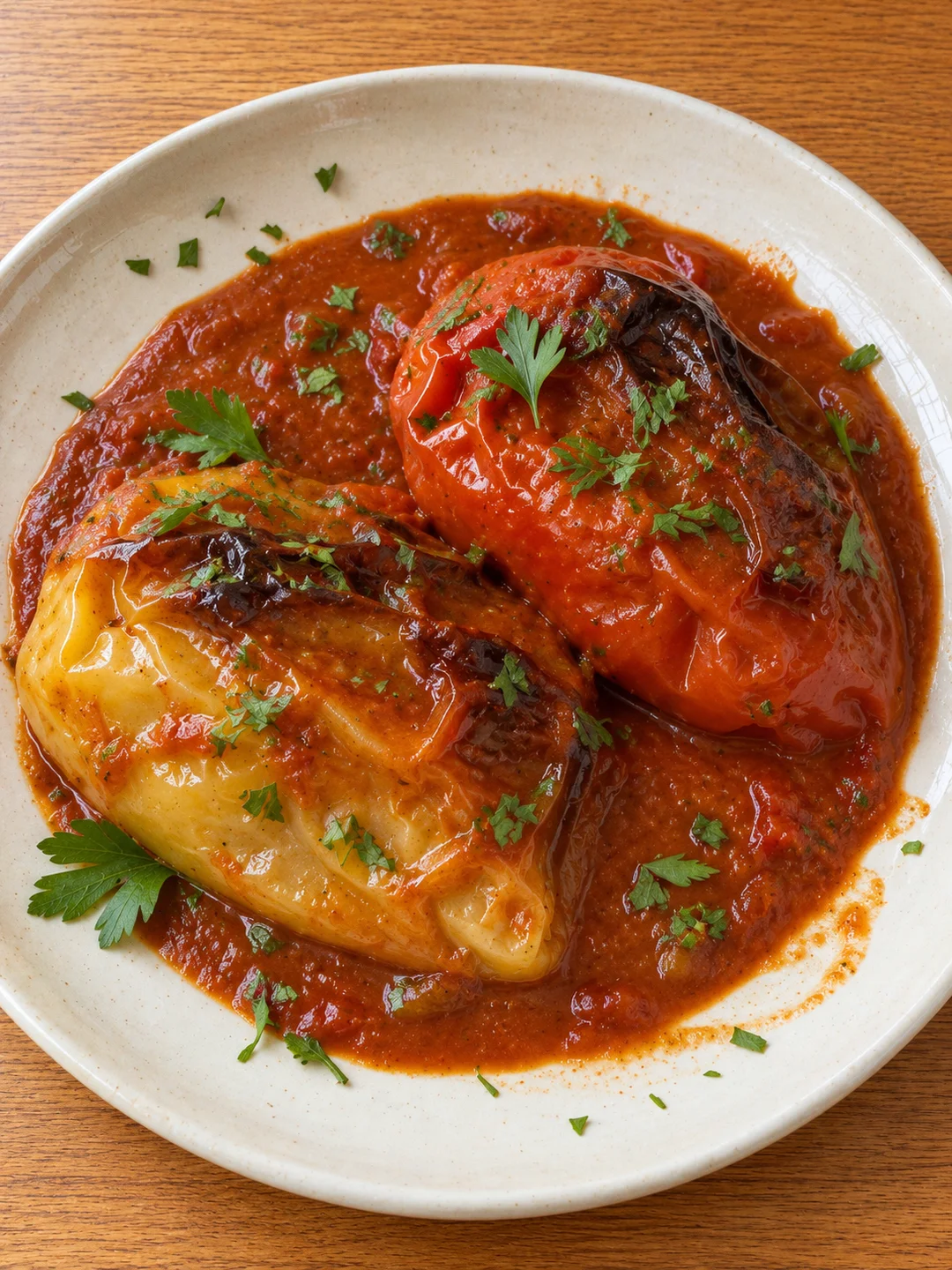
- Rest off the heat for 10 minutes. Lift the peppers out with a large spoon and a spatula underneath so they do not break, spoon the thick sauce over them, and scatter with chopped parsley.