
Swedish Cardamom Buns first landed on my plate at a roadside place called Skogsbacken, forty minutes outside Malmö, on the kind of grey Tuesday afternoon where the light never really commits. The kitchen had officially closed. The owner, a woman named Linnea Ohlsson, sat down at my table with two buns and a pot of black coffee and told me to eat before we talked.
Linnea runs the place with her brother. She used to be a physiotherapist in Copenhagen. She quit, moved back over the bridge to her mother’s old village, and opened a lunch spot that only serves until two. After two, she bakes. That is the whole business plan.
I had stopped in for soup. I stayed for three hours.
How A Roadside Lunch Turned Into A Baking Lesson
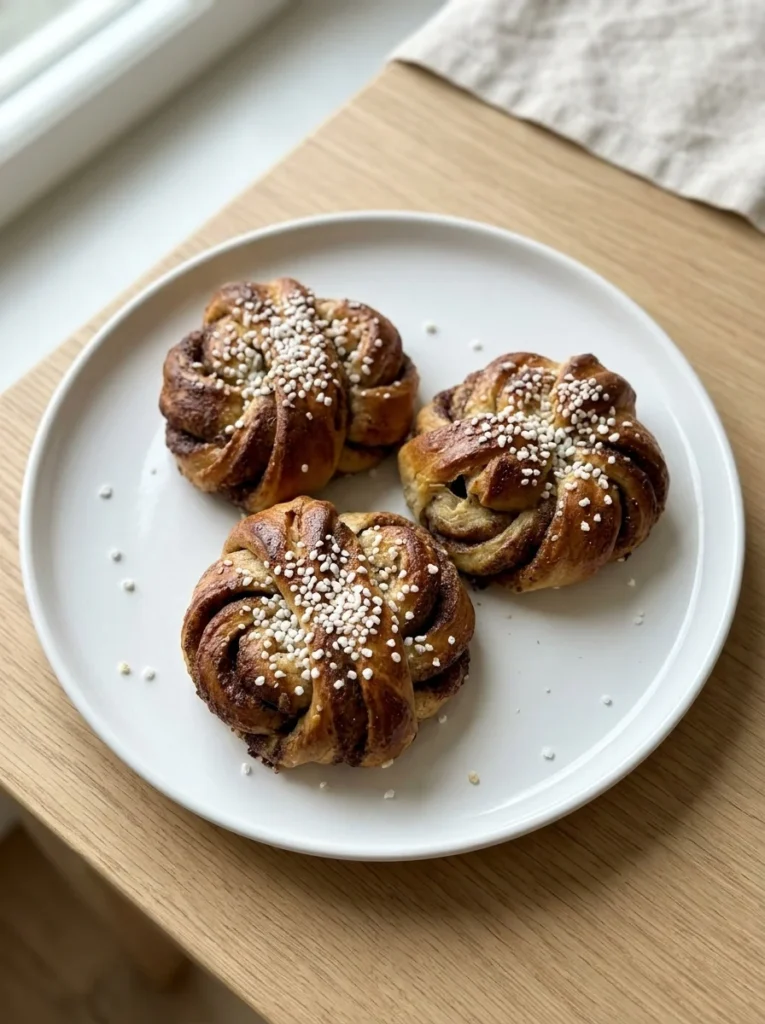
The bun she pushed across the table was still slightly warm. Knotted, glossy, crowned with coarse white sugar that crunched between my teeth before the cardamom hit. I have had plenty of cinnamon buns in my life. This was not that. The cardamom was piney and almost citrusy, and it filled my whole head.
I asked what was in it. Linnea laughed and said, in her flat careful English, that if I wanted to know I would have to help her make the next batch on Thursday. I changed my ferry ticket.
She lives in a red wooden house behind the restaurant. Two dogs, a wood stove, a kitchen table scarred from decades of rolling pins. That is where I learned to twist a kardemummaknut, badly at first, until my sixth or seventh one finally looked like hers.
What Linnea Told Me About Cardamom In Sweden
She was matter-of-fact about it. Cardamom in Sweden is not exotic. It is the default. She reminded me that the spice came in through the medieval trade routes, and that Swedish cookbooks have been calling for it since at least the 1600s. Kajsa Warg was using it in 1755. By the time her grandmother was baking, cardamom was as ordinary in a Swedish pantry as cinnamon is in an American one.
She was also firm on two things. Pre-ground cardamom is a waste of everyone’s time. And these are not cinnamon buns with a spice swap. Kanelbullar are rolled into spirals. Kardemummabullar are knotted. Different shape, different mood, different holiday.
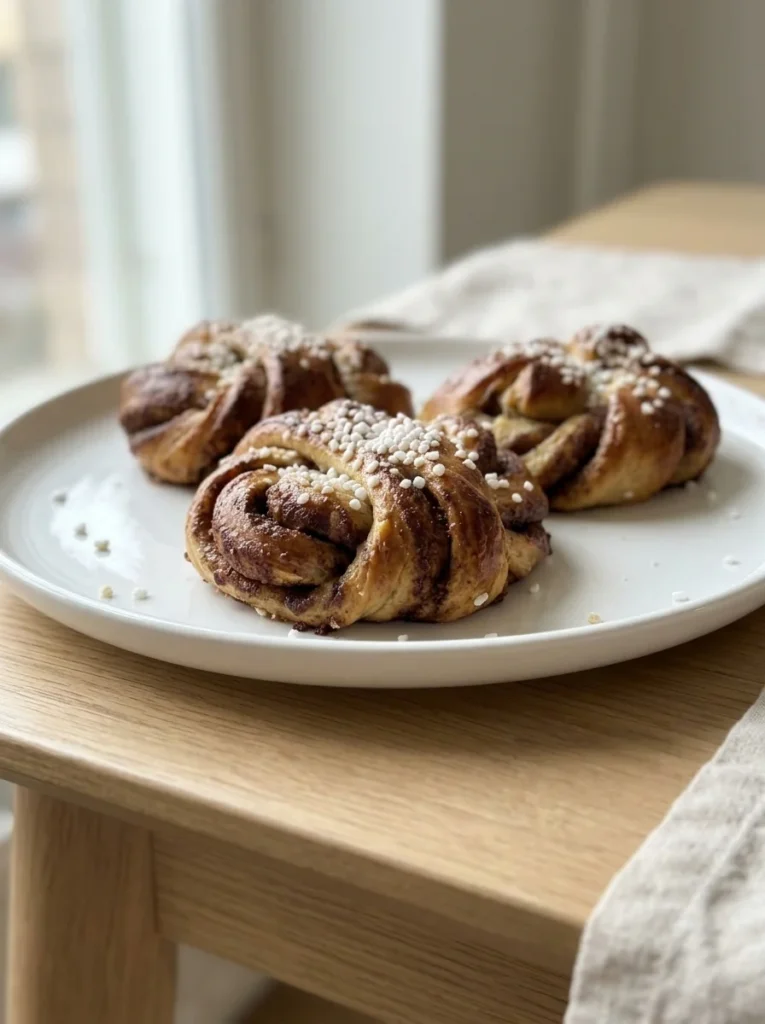
She said the knot matters because the filling ends up in every bite, not just the center. I did not argue.
Bringing Swedish Cardamom Buns Back To My LA Kitchen
The first time I tried them in my own kitchen, on a Sunday morning before the neighbours were up, I made two changes that Linnea would probably raise an eyebrow at. Both earned their place.
First, I switched to active dry yeast in a packet instead of the fresh yeast she uses. Fresh yeast is easy to find in Sweden and a pain in Los Angeles. Active dry works. The dough rose the same, the flavour was the same, and I did not have to drive to a specialty shop before 7 a.m.
Second, I hunt for green cardamom pods at the Iranian grocery on Westwood Boulevard rather than the regular supermarket. Fresher, cheaper, and the seeds inside are dark and oily instead of pale and dusty. I crack the pods in a small mortar my sister gave me one Christmas, the one with the chipped rim. Discard the papery husks. Grind the seeds coarse, not to powder. You want to see flecks.
The pärlsocker was the last problem to solve. Regular sanding sugar melts into the crust. Belgian pearl sugar is too big. I finally found real Swedish pärlsocker at a Scandinavian import shop in Santa Monica. Worth the drive.
What I Used
- Whole milk, warmed to about 110 F
- Active dry yeast, one standard packet
- Granulated sugar for the dough and for a finishing syrup
- All-purpose wheat flour
- Fine sea salt
- Freshly crushed green cardamom seeds, from about 30 pods
- One egg for the dough, one beaten egg for the wash
- Unsalted butter, softened for the dough and very soft for the filling
- Light brown sugar for the filling
- Swedish pearl sugar (pärlsocker) for the crown
The Twist Is The Whole Point
Rolling the dough is the easy part. Twenty inches wide, twelve tall, spread with the cardamom butter right to the edges. Fold in thirds like a business letter. Roll once gently to seal.
Then you cut it into fourteen strips and knot each one. This is where people give up. Do not.
Take one strip. Twist it three or four times along its length so it looks like a rope. Wrap that rope twice around two fingers of your other hand, then tuck the tail up through the middle and press it under the bun. It will look wrong. Bake it anyway. It puffs up in the oven and the twist becomes obvious.
My first tray came out looking like small confused snails. The taste was already right. The shape sorted itself out by the third batch.
Fika Is Not Optional
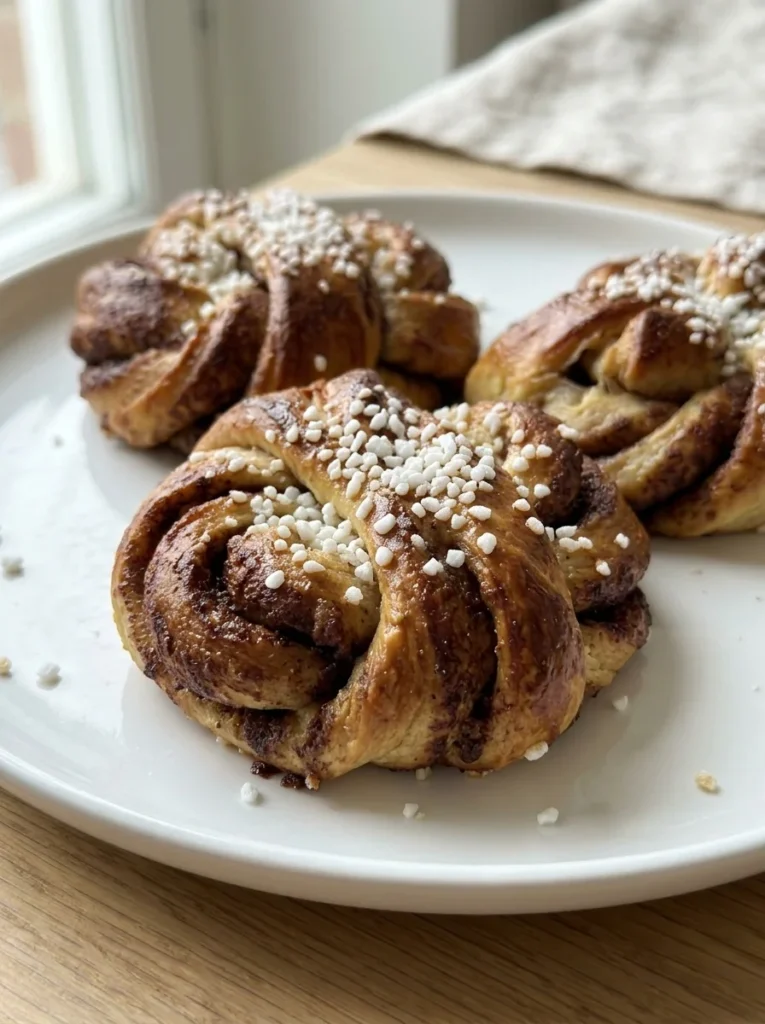
Linnea would not let me eat a bun without coffee in front of me. She said kardemummabullar are built for fika, the Swedish coffee pause, and eating one alone at your desk misses the whole point. Fika is the whole reason the bun exists.
So I make a full pot of strong black coffee. I put the buns on the wooden table that gets the morning light. I sit down. I do not scroll.
One small warning. Do not skip the finishing syrup. The moment the buns come out of the oven, brush each one with the warm sugar water. It gives them the bakery-window shine and, more importantly, keeps them tender the next day. I skipped it once because I was in a hurry. The buns went slightly stale by evening. Never again.
Small Things Worth Knowing
They freeze beautifully for two months. Wrap them tightly, thaw at room temperature, and warm them for four minutes in a 300 F oven. They come back almost as good as fresh.
The cardamom smell will live in your kitchen for a full day. My neighbour knocked on the door the first time. She thought I had lit an unusual candle.
Linnea and I still email. Mostly about weather, occasionally about baking. She sent me a photo last October of Kanelbullens dag at the restaurant, trays and trays of them, cardamom and cinnamon side by side. I have not been back to Skogsbacken yet. I plan to.
Until then, the Sunday batch is enough. Coffee, a warm knot, the kitchen smelling like a spice route. That is the whole business plan.
Swedish Cardamom Buns
Ingredients
Equipment
Method
- Warm the milk in a small saucepan to about 110 F — it should feel like a warm bath, not hot. Pour into the bowl of a stand mixer, sprinkle over the yeast and 1 tablespoon of the granulated sugar, and let sit for 8 minutes until foamy on top.
- Crush the whole green cardamom pods in a mortar and pestle, discard the papery green husks, and grind the dark seeds to a coarse fragrant powder. You will need 2 tablespoons for the dough and 1 tablespoon for the filling.
- To the yeast mixture add the remaining granulated sugar for the dough (about 7 tablespoons), the salt, 2 tablespoons of the crushed cardamom, the egg, and 4 cups of the flour. Mix with the dough hook on low for 3 minutes until a shaggy dough forms.
- Add the 6 tablespoons of softened butter one tablespoon at a time, letting each be absorbed before adding the next. Knead on medium speed for 8 to 10 minutes, adding the remaining 0.25 cup flour only if the dough clings to the bottom of the bowl. You want a smooth, glossy, slightly tacky dough that pulls away from the sides.
- Cover the bowl with a clean kitchen towel and let rise in a warm spot for 60 minutes, or until nearly doubled in size.
- Meanwhile, make the filling. In a small bowl, mash together the 7 tablespoons very soft butter, brown sugar, 1 tablespoon crushed cardamom, and a pinch of salt with a fork until it forms a smooth, spreadable paste.
- Turn the risen dough onto a lightly floured surface and roll into a rectangle about 20 inches wide by 12 inches tall, with a long edge facing you.
- Spread the cardamom butter evenly over the entire rectangle using an offset spatula, right to the edges.
- Fold the dough in thirds like a business letter: bring the bottom third up over the middle, then fold the top third down over that. You now have a long strip about 20 inches wide by 4 inches tall with layers of filling inside. Gently roll it once with the pin to seal.
- With a sharp knife or bench scraper, cut the strip crosswise into 14 equal strips, each about 1.5 inches wide.
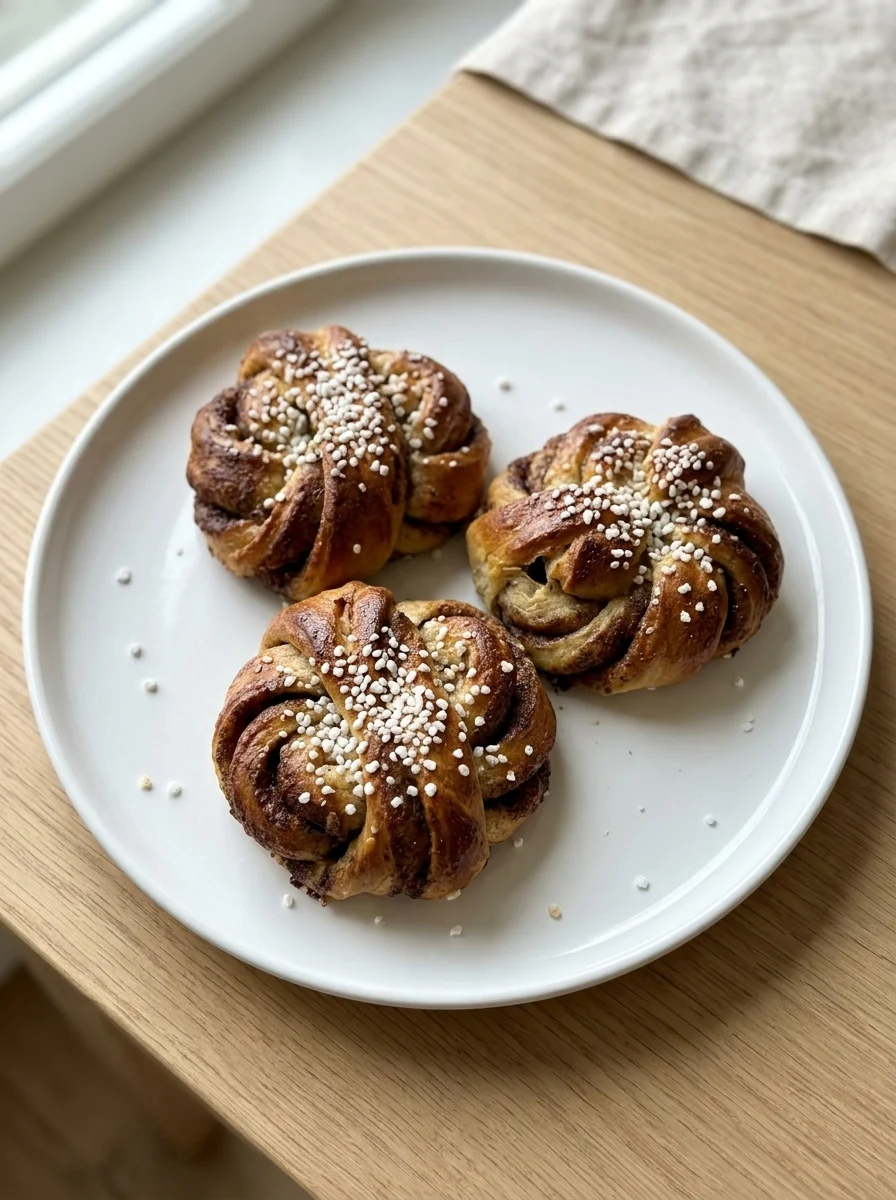
- Shape each bun: hold one strip and give it 3 to 4 twists along its length. Wrap the twisted strip around two fingers of your other hand twice, then tuck the loose end up through the middle and press it under the bun. This is the classic kardemummaknut. Place on a parchment-lined baking sheet, spacing 7 buns per tray.
- Cover the trays loosely with kitchen towels and let the buns proof for 45 minutes, until visibly puffy and pillowy.
- About 15 minutes before baking, heat the oven to 425 F with racks in the upper and lower thirds.
- Brush each risen bun generously with beaten egg, then sprinkle heavily with Swedish pearl sugar, letting it settle into the crevices of the knots.
- Bake for 10 to 12 minutes, rotating and swapping the trays halfway through, until the buns are deep golden brown and the exposed filling is bubbling.
- While the buns bake, make the finishing syrup: combine 3 tablespoons granulated sugar and 3 tablespoons water in a small saucepan, bring to a simmer, and stir just until the sugar dissolves. Remove from the heat.
- The moment the buns come out of the oven, brush each one with the warm syrup for shine and to keep them moist. Let cool on the trays for 10 minutes, then serve warm with hot coffee or black tea for a proper Swedish fika.