
The best seafood lasagna I have eaten came out of a kitchen the size of my bathroom, on Albemarle Street in Baltimore‘s Little Italy, on a Tuesday in December when I had planned to spend the day down at the harbor instead. I took the last stool at the counter because all four tables were full and nobody looked remotely interested in leaving.
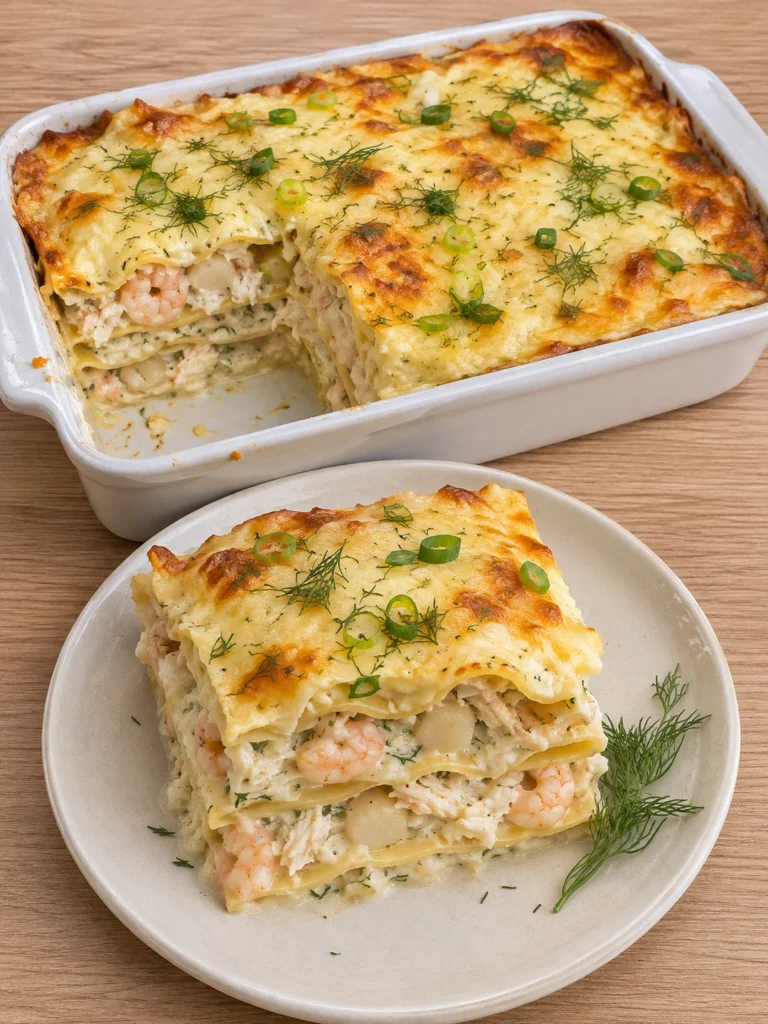
There was no printed list of specials. Rosanna came out of the back, wiped her hands on a dish towel and recited them at me in a flat Baltimore accent, and the fourth thing she said was lasagna with shrimp and scallops and crab, white sauce, no tomato.
I ordered it. She stood there and watched me take the first bite, which is a lot of pressure, and then she pulled out the stool next to mine and sat down.
How a Counter Seat in Little Italy Turned Into a Cooking Lesson
She asked what I was doing the next day. I said the aquarium, probably the water taxi, the normal list. She said come upstairs at eleven instead and I will show you, because the aquarium will still be there Thursday.
Her apartment sits directly above the dining room. Galley kitchen, two working burners, a radio on the windowsill playing oldies the whole time, and four bottles of clam juice already lined up on the counter when I walked in.
She told me she builds this thirty or forty times every December. Christmas Eve orders mostly, families picking up trays for the Feast of the Seven Fishes, plus the Lenten Fridays in spring when nobody at the table is eating meat. It is an occasion dish, she said, because shrimp and scallops and crab in one pan is not a Wednesday.
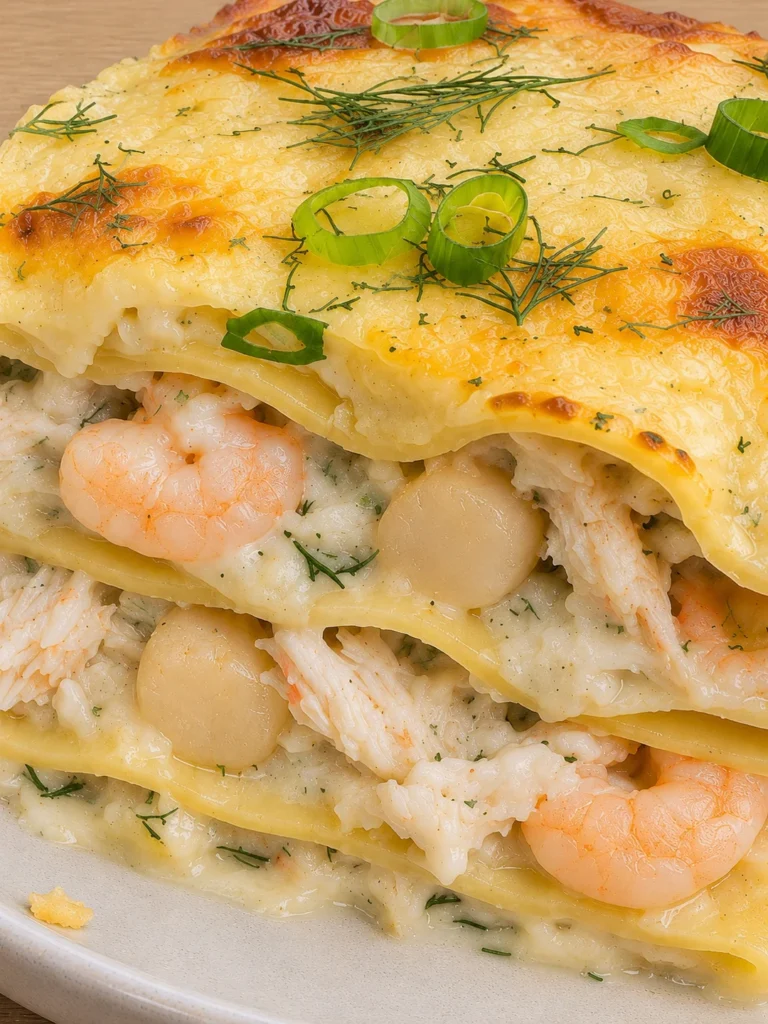
The thing she drilled into me hardest was the poach. She dropped the shrimp and bay scallops into boiling clam juice and broth, counted to about four minutes, and yanked them out while they still looked slightly underdone. They are not finished, she said. The oven finishes them. Cook them through now and you are serving erasers.
Seafood Lasagna Is Not Italian, and That Is the Point
I went looking afterwards, because I assumed this came off a boat somewhere near Naples. Layered pasta is genuinely ancient in Italy, documented by the Middle Ages, with a flour-and-water ancestor turning up in the Roman-era text De Re Coquinaria. Italian coastal cooks do make their own seafood versions, Ligurian lasagne with shrimp and squid and white wine, Neapolitan lasagna di mare with shellfish in a light tomato sauce.
But the pan Rosanna makes is not that. The creamy, cheese-topped, tomato-free one is an Italian-American invention of the twentieth century, built on a bechamel loosened with clam juice and layered with mozzarella and Parmesan. Old Bay seasoning sitting in the sauce is about as New World as a seasoning gets.
She also has no patience for crab snobbery. Imitation crabmeat shows up in the classic mid-century American recipes that made this dish famous, so it is not a shortcut or a corruption, it is part of the history. Use lump crab if the budget says yes. Use the other stuff if it says no.
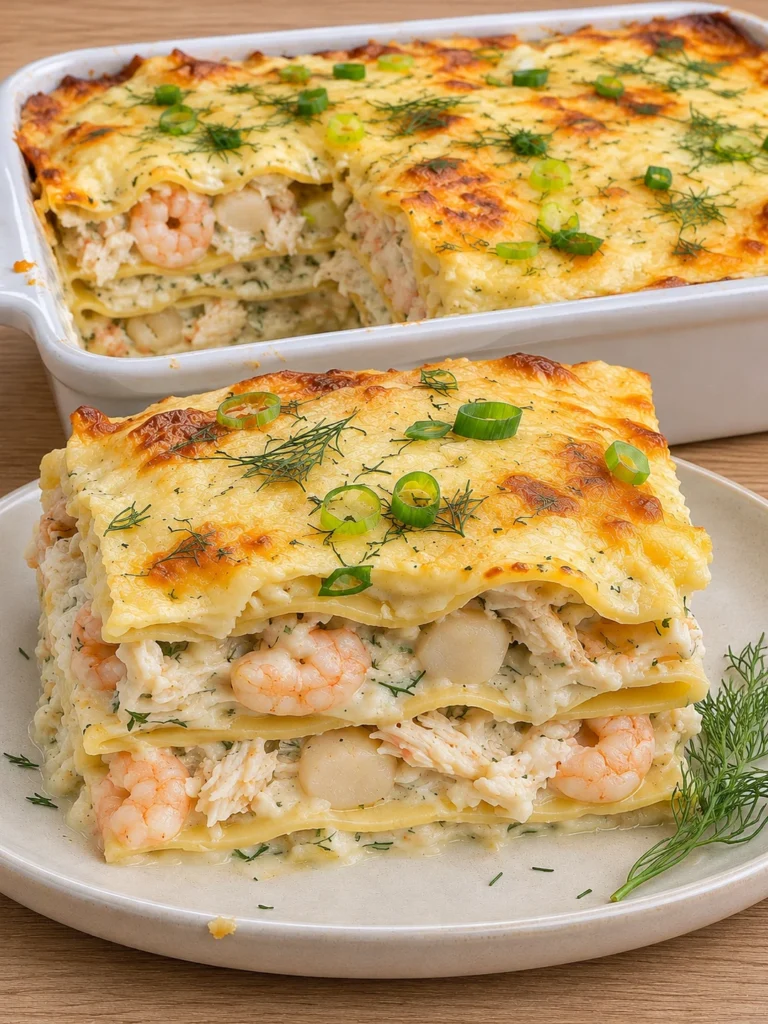
What Goes Into It
- Regular lasagna noodles, nine of them, not the no-boil kind
- Butter, divided, three tablespoons for the poach and six for the sauce
- Olive oil, just a tablespoon
- Green onions, four, whites and greens kept separate
- Garlic, two cloves, minced fine
- Low sodium chicken broth
- Bottled clam juice, eight ounces, or seafood stock if you have it
- Dry white wine, half a cup, optional but I always do
- Small raw shrimp, a pound, the 41 to 50 count size
- Bay scallops, twelve ounces, patted very dry
- Lump crabmeat, eight ounces, picked over
- All-purpose flour for the roux
- Whole milk and heavy cream
- Old Bay, white pepper, salt
- Lemon zest, finely grated
- Fresh dill, chopped, or flat-leaf parsley
- Shredded Parmesan and low-moisture shredded mozzarella
What I Changed Once I Got It Home
Bay scallops are the problem on this coast. Rosanna buys them fresh in winter without thinking about it, and I have never once walked into a shop here and found them fresh, so I buy them frozen from Fish King up in Glendale and thaw them overnight in the fridge.
Then I pat them dry. Then I pat them dry again. The first lasagna I made after that trip was genuinely watery and I spent a day blaming the bechamel before I admitted it was the scallops I had drained for approximately nine seconds.
Clam juice I get at the Italian deli near my place, because the supermarket version was out of stock twice in a row and I got tired of the detour. Straining the poaching liquid and sending all of it into the roux is the whole trick of the dish, and it is not optional. Skip it and you have cream lasagna with seafood sitting in it, which is a different and worse thing.
I use low-moisture shredded mozzarella and I will argue about it. The fresh stuff in water is lovely on a pizza and it floods these layers until the top slumps.
Noodles come out of the pot a full minute before the box says, get rinsed cool, and go flat on an oiled sheet pan so they stop sticking to each other. Dill gets chopped with my one decent chef’s knife, the one with the slightly chipped handle that I keep meaning to replace and never will. Rosanna uses parsley. I prefer dill with the lemon zest, and I think she would forgive me.
The rest at the end is the part people skip. Twenty to thirty minutes on a rack, no foil, no cutting. I always give it the full half hour. Except the very first time, when I gave it about six minutes and served something closer to soup with browned cheese floating on it.
Swaps and Small Decisions
Parsley for dill works fine. The white wine can go if you would rather not open a bottle, though half a cup in the poach and the rest of the bottle in a glass is the obvious move. Pinot Grigio, cold, is what she poured me downstairs.
You can assemble the whole pan a day ahead, cover it and refrigerate, then add ten or fifteen minutes to the bake. That is exactly why it survives as a company dish. Guests arrive, it goes in the oven, you are not standing over a saucepan whisking while people take their coats off.
It was raining the last time I made it, hard enough that I could hear it on the kitchen window over the radio, and that felt about right. Cold leftovers, eaten standing at the counter the next morning. I will not pretend that is the intended serving temperature, but it is my favorite one.
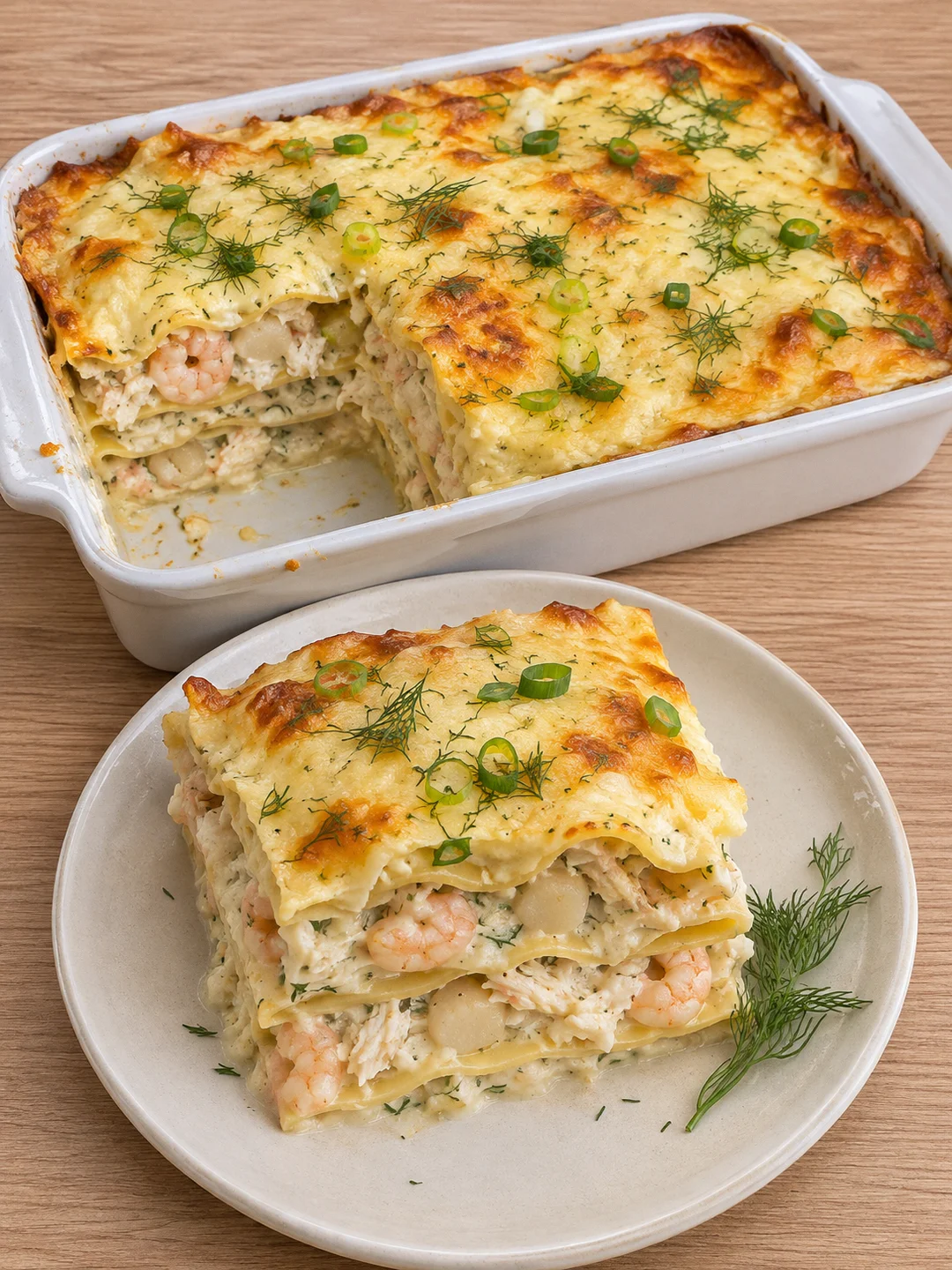
Seafood Lasagna
Ingredients
Equipment
Method
- Bring a large pot of salted water to a boil. Cook the lasagna noodles 1 minute short of the package time, so they are firmly al dente. Drain, rinse under cool water, then lay the sheets flat and separated on an oiled sheet pan so they do not tear or stick.
- Preheat the oven to 350 F and butter a 13x9 inch baking dish.
- In a large saucepan, melt 3 tablespoons butter with the olive oil over medium heat. Add the white parts of the green onions and the garlic and cook 2 minutes, until fragrant but not browned.
- Pour in the chicken broth, clam juice and white wine. Bring to a boil. Add the shrimp and bay scallops and poach 4 to 6 minutes, just until the shrimp turn pink and the scallops firm up. They should still look slightly underdone. Do not cook them through.
- Strain the seafood over a bowl, saving every drop of the poaching liquid. Transfer the shrimp and scallops to a plate, add the lump crabmeat, and set aside. Measure 1.5 cups of the poaching liquid; discard any extra.
- Wipe the saucepan dry. Melt the remaining 6 tablespoons butter over medium heat, whisk in the flour and cook 2 minutes, whisking constantly, until it smells nutty and turns pale blond. Do not let it brown.
- Combine the milk with the 1.5 cups reserved seafood liquid, then add it to the roux in a slow stream, whisking hard after each addition to keep it smooth. Season with Old Bay, white pepper and salt. Simmer 2 to 3 minutes, whisking, until the sauce coats the back of a spoon.
- Pull the pan off the heat. Stir in the heavy cream, lemon zest, 0.75 cup of the Parmesan, the dill and the green onion tops. Taste and adjust the salt. The sauce should be clearly thick, not pourable like milk.
- Spoon about 0.5 cup of the sauce over the seafood and fold gently so it stays moist during baking.
- Spread a thin film of white sauce across the bottom of the dish. Lay down 3 noodles, spread over half the seafood mixture, then ladle over a generous third of the remaining sauce. Repeat with 3 more noodles, the rest of the seafood and another third of the sauce.
- Finish with the last 3 noodles and the remaining sauce, spreading it right to the edges so no pasta is left exposed. Scatter the mozzarella and the remaining 0.75 cup Parmesan over the top.
- Bake uncovered for 40 to 50 minutes, until the edges bubble and the top is golden with a few deep brown spots. If it browns too fast, tent loosely with foil.
- Rest the lasagna on a rack for 20 to 30 minutes before cutting. This is what lets the creamy layers set so the slices hold their shape. Cut into 12 squares and serve warm.