
Greek Avgolemono Soup was not the reason I booked the cooking class. I wanted to learn dolmades, properly rolled, because mine always came apart in the pot. I came home with something else entirely.
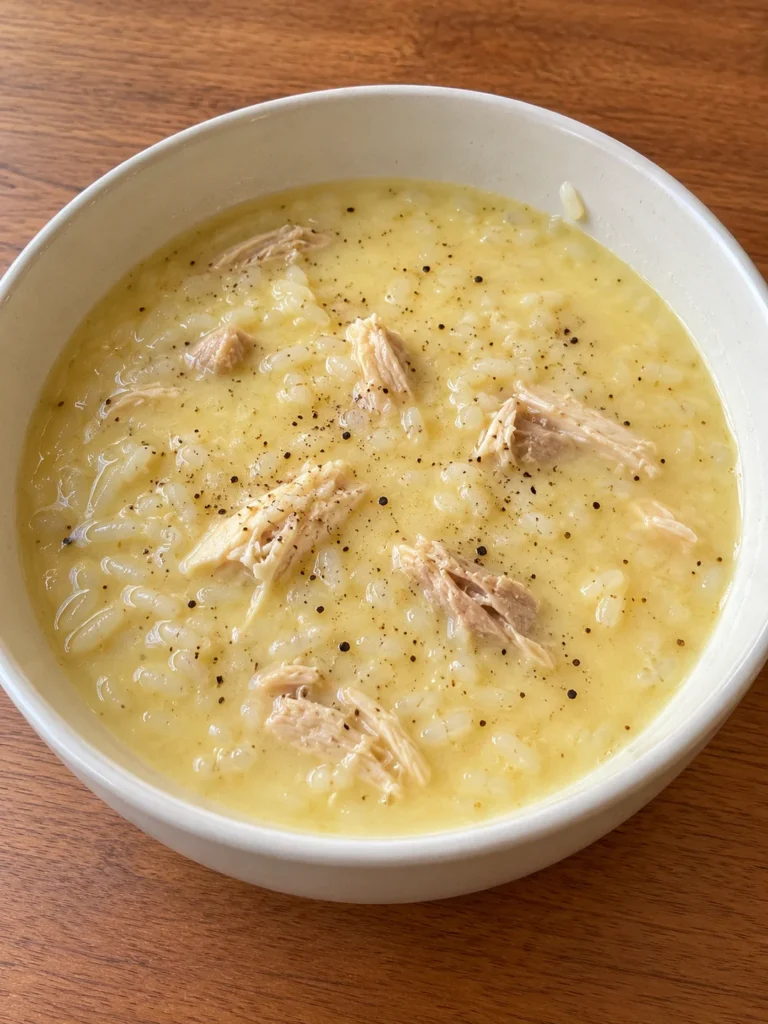
The Class Above the Taverna in Nafplio
The class ran out of an apartment two flights above a taverna in the old town, up a stairwell that smelled like frying zucchini and bleach in equal measure. The teacher was Kyria Fotini, seventy-nine, in house slippers, who had lived in that apartment since she married.
Her grandson Thanasis cooked the dinner service downstairs. He came up twice during the three hours we were there, once to borrow a lemon and once to argue with her about how much salt goes in the broth. She won. She always wins, he told us on the way out, rolling his eyes toward the ceiling.
There were four of us at her table. She boiled a hen in a battered pot with one whole onion and nothing else, skimmed the grey foam off with a slotted spoon she handled like a surgical instrument, and talked the whole time about which neighbours were ill that winter and therefore owed a pot of soup.
I had three days left in Nafplio and I ate kotosoupa twice more before I left. Neither bowl came close.
What Greek Avgolemono Soup Actually Is, and Where It Came From
Avgolemono means egg-lemon. Avgo and lemoni. It is not only a soup, it is a technique and a sauce, used across Greek cooking for dolmades, artichokes, cabbage rolls and lamb fricassee.
What surprised me when I started reading about it afterwards is that it is not an ancient Greek invention at all. Food historians trace the egg-lemon liaison to Sephardic Jewish cooking in Iberia, where it was called agristada, soured with verjuice or pomegranate juice or bitter orange before lemons were common. After the expulsions of the late fifteenth century those communities settled across the Ottoman Mediterranean, and the technique took root in Greek, Cypriot, Turkish, Balkan and Arab kitchens.
Greece took it furthest. Kotosoupa avgolemono became the standard thing you make when somebody is sick, when the weather turns, or when one boiling hen has to feed a whole family twice over. Broth becomes soup, meat becomes the second course. Fotini said being able to tie the avgolemono without splitting it was how her mother-in-law decided whether she could cook.
There is no cream in it. No butter, no flour, no cornstarch. All the body comes from the emulsion of beaten egg and lemon plus the starch the rice gives up into the broth, which is why thin broth makes thin soup and there is no rescuing it later.

What I Used
- A whole chicken, around two and a half pounds, free-range if the butcher has one
- Cold water, enough to cover it by two inches
- One medium onion, peeled and left whole
- One carrot, also whole, which Fotini would consider optional and I usually include anyway
- Salt, more than feels right, plus more at the end
- Short-grain rice, rinsed until the water runs clear
- Three large eggs at room temperature, non-negotiable on the temperature
- A third of a cup of fresh lemon juice, two or three lemons depending on how sad they are
- Plenty of freshly ground black pepper
Bringing Chicken Avgolemono Soup Home
I made it for the first time on a Tuesday in February, rain coming sideways at the kitchen window, which is about as close to Greek winter weather as I get. Chicken avgolemono soup is the only thing I have ever cooked where the shopping list is shorter than the list of things that can go wrong.
The lemons matter more than anything else on that list. I buy mine at the Sunday farmers’ market from the stand that sells them with the leaves still on, because the flavour of the whole pot rests on them. Bottled juice is a false economy here. It tastes flat and slightly metallic and no amount of pepper hides it.
I kept almost everything Fotini did. The one thing I changed was the pot. She used her old aluminium one, I use a heavy stockpot, because my burners run hot and a thin base gives you a hard boil the moment you look away.
Tempering, Told From Inside the Pot
Here is what is actually happening, because understanding it is what stopped me ruining it.
The broth simmers for an hour and a bit at a bare tremble, bubbles breaking maybe once every two seconds. Collagen in the joints is slowly converting to gelatin, which is what gives the finished soup that slight cling on the spoon. Boil it hard and you emulsify the fat into the liquid and the broth goes cloudy and stays cloudy.
Then the rice goes in and starts releasing amylose into the broth, thickening it quietly while it swells. It keeps drinking even after you turn the heat off, so the soup should look too loose at this stage. Mine looked correct once. It was gluey ten minutes later.
The eggs are the part everybody fears. Egg protein sets somewhere around 150 to 160 Fahrenheit, so if you pour beaten eggs into boiling broth they seize into shreds instantly and you have made stracciatella by accident, which is a fine soup but not this one. Tempering raises their temperature gradually so the proteins stay suspended and set into a smooth emulsion instead of lumps.
So the pot comes fully off the heat and stands five to ten minutes. You whisk the eggs until pale and foamy, whisk in the lemon, then ladle hot broth in one ladle at a time, whisking without stopping, for about ninety seconds. Four or five ladlefuls, until the bowl is warm against your palm. Then it goes back into the pot in a thin stream while you stir.
My first attempt curdled. I had not let the pot rest and I poured too fast. The second was perfect and I have not missed since, which makes me think this is less skill than patience.

Rice, Orzo, and the Dill Question
Orzo, kritharaki, works in exactly the same quantity and is just as traditional. Pastina too. Anyone who tells you rice is the authentic version and orzo is not has invented a rule that does not exist. Orzo wants eight or nine minutes, no more.
Dill is the real dividing line. It belongs to magiritsa, the Easter soup eaten in the small hours after the Resurrection service to break the forty-day fast, and it has no business in everyday kotosoupa. I tried it once out of curiosity. It tasted like a different dish wearing this one’s clothes.
Leftovers keep three days and need gentle reheating, low heat, stirring, no simmer. A hard reheat splits what you spent ninety seconds building. Cold straight from the fridge, thick as custard, eaten standing at the counter. Better than it has any right to be.
I think about that stairwell more than I expected to. Fotini sent us off with a tub of the soup each and told us to eat it before midnight, and I ate mine on a bench by the water with a plastic spoon. Some trips give you photographs. That one gave me a pot of soup I now make every February.
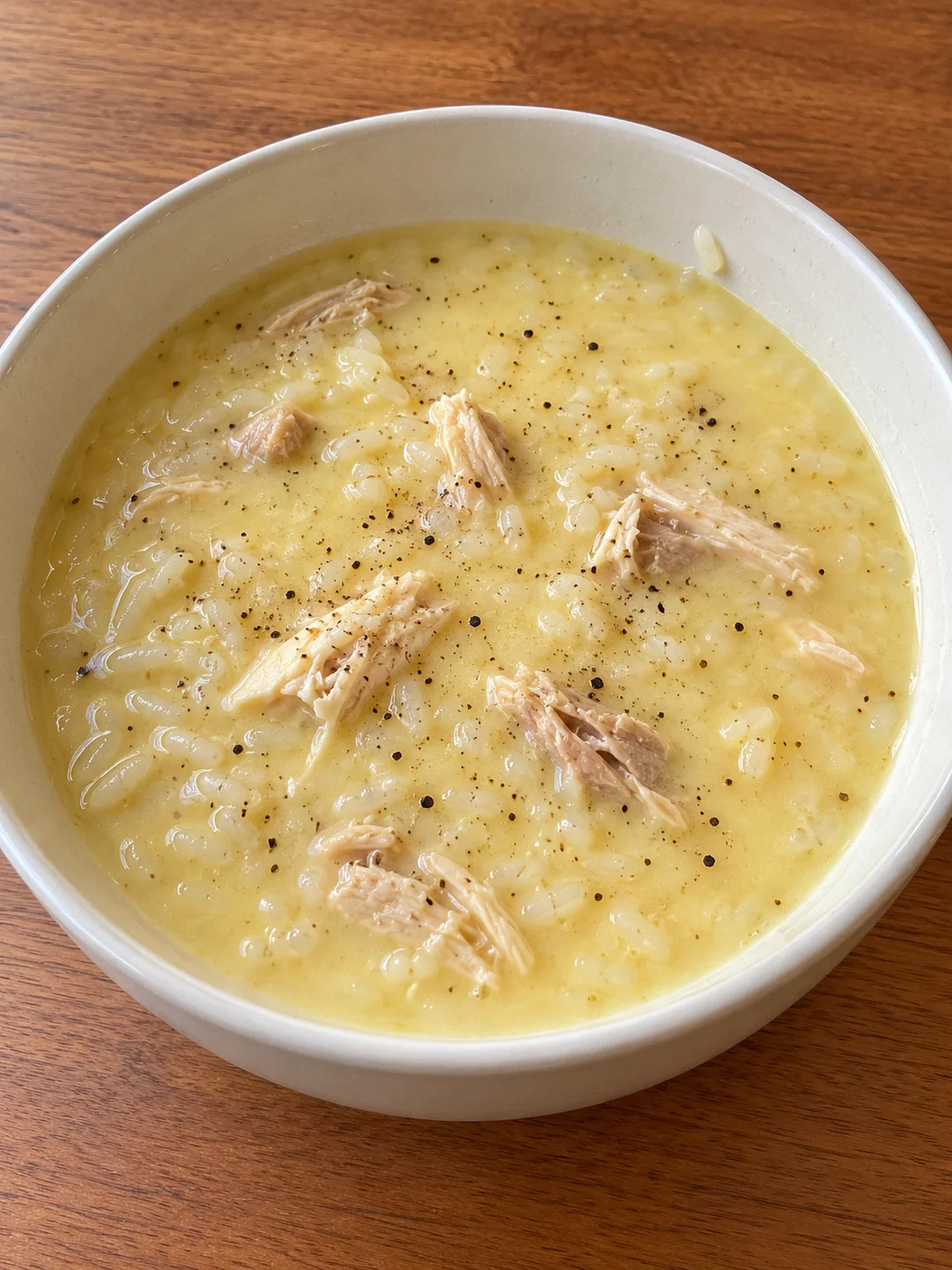
Greek Avgolemono Soup
Ingredients
Equipment
Method
- Rinse the chicken and put it in a large deep pot. Add the whole peeled onion, the carrot if using, 2 teaspoons salt, and enough cold water to cover the bird by about 2 inches.
- Bring to a boil over high heat. As grey foam rises to the surface, skim it off with a slotted spoon and discard it. Keep skimming until the surface runs mostly clear, about 5 minutes.
- Lower the heat so the liquid barely trembles. Simmer uncovered, or with the lid ajar, for 1 hour to 1 hour 15 minutes, until the meat pulls away from the bone with no resistance. Do not let it boil hard or the broth will turn cloudy.
- Lift the chicken out onto a platter and let it cool enough to handle. Strain the broth through a fine mesh strainer into a clean bowl and discard the onion and carrot. You want about 8 cups of clear broth. Top up with hot water if you are short.
- Return the strained broth to the pot and bring it back to a simmer. Add the rinsed rice and cook, stirring now and then so it does not stick, for 15 to 18 minutes until tender. The soup should still look loose and liquid. Add hot water if it tightens up too much, because the rice will keep drinking.
- While the rice cooks, pull the skin off the chicken and shred the meat off the bones into bite-sized pieces. Discard skin and bones.
- Take the pot completely off the heat. Let it stand 5 to 10 minutes. The broth should be very hot but no longer bubbling anywhere. This rest is what keeps the eggs from scrambling.
- Crack the room-temperature eggs into a large bowl and whisk hard for about 1 minute, until pale and foamy. Whisk in the lemon juice.
- Now temper. Ladle hot broth into the egg mixture one ladleful at a time, whisking constantly and without stopping. Add 4 to 5 ladlefuls over roughly 90 seconds, until the bowl feels warm to the touch and the mixture has thinned out.
- Pour the tempered egg mixture back into the pot in a thin, steady stream while stirring the soup continuously. Keep the pot off the heat throughout.
- Stir in the shredded chicken, cover the pot and let it rest 3 to 4 minutes. The soup will thicken slightly and turn pale and velvety. Do not return it to a boil at any point or it will split.
- Taste and adjust with salt and plenty of freshly ground black pepper. Add more lemon juice if you want it sharper. Ladle into warm bowls and serve at once.