
The best Irish Barmbrack I have eaten came out of a wine bar oven in Kilkenny, at half four in the afternoon, between lunch and dinner service. I had been driving since morning. Hungry in that specific road-trip way where anything tastes good, and this loaf did not need the help.

I had left Dublin early and taken the slow roads south instead of the motorway, which added about two hours and was worth every one of them. By the time I reached Kilkenny the rain had settled in properly. I stopped because a hand-lettered board outside a narrow place on Parliament Street claimed the kitchen was open all day, which turned out to be optimistic.
It was a wine bar. The chef, Cormac, was alone behind the counter with flour up his forearms, prodding a dark round loaf on a cooling rack.
A Kilkenny Wine Bar, a Spare Loaf, and Cormac
He said it was not on the menu and not for sale. He was testing a brack for Halloween and had put whiskey into the fruit soak for the first time, which he was still unsure about. Then he cut me a slice anyway and pushed a dish of cold butter across the counter.
The crust was glossy and slightly tacky, the sort that sticks to your thumb when you pick up the slice. Inside it was dense and bready rather than cakey, and the fruit had gone nearly jammy where it met the crumb. Tannin and malt running all the way through it, not just sweetness sitting on the surface.
I asked for a glass of something and he poured a chenin that fought with it, laughed at himself, and swapped me onto tea. He was right. Brack wants tea.
Before I left he wrote the fruit quantities on the back of a receipt and told me the one thing that has stayed with me. Soak it overnight or do not bother at all.
Why Irish Barmbrack Is Bread and Not Cake
The name is bairín breac, speckled loaf, for the sultanas and raisins flecked through the crumb. The barm part is the froth skimmed off fermenting ale, the yeast that raised the loaf before bicarbonate of soda became common in Irish kitchens in the early nineteenth century. So the word itself tells you the original is a yeasted, enriched bread.
Most of what turns up online under barmbrack recipe is actually tea brack, raised with baking powder and baked flat in a loaf pan. That is a fine loaf, moister and cake-like, and it is what gets eaten with afternoon tea all year round. It is not the Halloween one, and it never carries charms.
It is also not soda bread, which is plain and savoury and a completely different idea. The yeast-raised round brack was long a specialty of Dublin and other town bakeries, and the charms come straight out of Samhain, when the line between the living and the dead was thought to be thin and telling fortunes was part of the night’s business. The food historian Regina Sexton has documented the older charm set, ring and pea and bean and rag and button and stick, each with its own verdict on marriage or money or plain misfortune.
One more detail I keep repeating to people. In many districts a brack was also baked on New Year’s Eve, and the man of the house took three bites and flung them at the front door to drive hunger out of the household for the coming year.

What I Used
- 1 1/4 cups sultanas and 1 cup raisins, the plumpest ones I can find
- A third of a cup of mixed candied peel, chopped
- Strong black tea, three Irish breakfast bags steeped in about 1 1/4 cups of water
- 2 tbsp Irish whiskey, technically optional, permanent in mine
- 3 1/2 cups bread flour, plus a little for the counter
- One packet of active dry yeast
- A third of a cup of packed light brown sugar
- 1 tsp fine sea salt
- 2 tsp mixed spice, plus extra cinnamon and a good grating of fresh nutmeg
- 3/4 cup whole milk, warmed to around 105 F
- 4 tbsp softened unsalted butter, and more for the pan
- 1 large egg at room temperature
- 2 tbsp granulated sugar and 2 tbsp water for the glaze
- Six charms, each one wrapped tight in parchment
Baking Barmbrack in My Own Kitchen
The soak happens the night before, in a bowl on the wooden table that gets the morning light. I buy the tea and the mixed peel at the British import shop on Santa Monica Boulevard, because supermarket candied peel tastes of nothing much. Hot tea over the fruit, the whiskey in, a plate on top, and by morning the sultanas have drunk nearly all of it and gone fat and shiny.
Drain, then dry the fruit on paper towel. This matters more than it sounds. Wet fruit slides around in the dough and bleeds dark streaks through the crumb.
Yeast into the warm milk with a spoonful of the brown sugar, and ten minutes of doing nothing while it foams and starts smelling like a bakery. Butter rubbed into the spiced flour with fingertips until it goes to coarse crumbs. The dough comes together shaggy and a bit sticky and stays soft, which is correct for an enriched dough, and I have to talk myself out of adding flour every single time.
Ten minutes of kneading and you can feel the gluten tightening under your palms, the surface going from ragged to smooth to springy enough that a pressed dent fills itself back in. An hour in a warm corner, doubled. Then I knock it flat with my fist, scatter the fruit over the rectangle, fold the whole thing over and knead just two minutes so the fruit distributes without tearing the structure apart.
Charms go in now, pushed deep from different sides, dough sealed over each so nobody can read the loaf from the outside. It proves again in my 9 inch pan, the one with a dent in the rim from a move I would rather not discuss.
In the oven the fruit sugars and the brown sugar brown fast, faster than you expect, so foil goes loosely over the top at thirty minutes. The syrup gets brushed on while the loaf is still hot, twice, and it sinks in a little and sets to that tacky shine. The first time I made this I cut it after forty minutes because I could not wait, and the knife dragged the crumb into a gummy ribbon. Two hours of cooling. Full stop.

The Charms and How I Serve It
Ring means married within the year, coin means money, pea means poverty, bean means no money at all, stick means an unhappy marriage, rag means bad luck. Wrap every one tightly and say it out loud to the table before anybody bites. If children are eating I leave the charms out entirely and tuck the ring under a slice on the plate instead.
Thick slices, cold butter, strong tea. Day-old brack toasted and buttered while warm is arguably the better version, and that is the one I actually look forward to.
I have made it four times since Kilkenny and the whiskey has stayed in every batch. I tell people this is a Halloween loaf. I baked one in March, on a grey Sunday, for no reason at all. What I cannot recreate is the rain on Parliament Street and eight hours of driving behind me, so I make up the difference with a second slice.
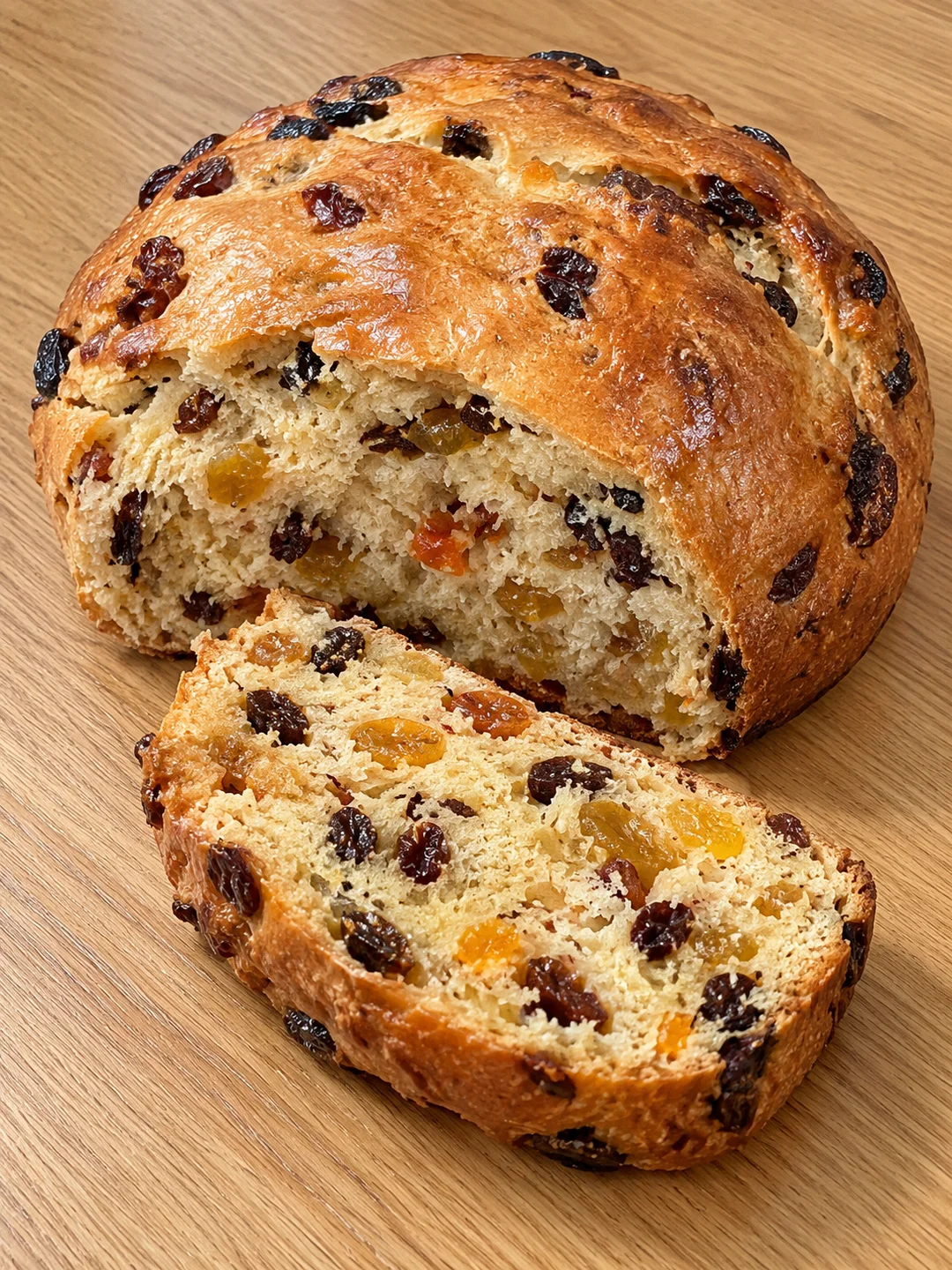
Irish Barmbrack
Ingredients
Equipment
Method
- The night before, put the sultanas, raisins and candied peel in a heatproof bowl. Pour the hot black tea over them, add the whiskey if using, stir once, and cover with a plate. Leave at room temperature for at least 8 hours or overnight. The fruit should swell and most of the tea should disappear.
- Drain the fruit in a sieve set over a bowl and reserve the liquid. Spread the fruit on a plate lined with paper towel and leave it to dry off while you make the dough.
- Warm the milk to 105 F, no hotter. Stir in 1 teaspoon of the brown sugar and sprinkle the yeast over the top. Leave it 10 minutes until foamy and smelling of bread. If nothing happens, the yeast is dead and you need a fresh packet.
- In a large bowl, whisk together the flour, the remaining brown sugar, salt, mixed spice, cinnamon and nutmeg. Rub in the softened butter with your fingertips until the mixture looks like coarse breadcrumbs.
- Pour in the yeast mixture and the beaten egg. Add 2 tablespoons of the reserved tea soaking liquid. Mix with a wooden spoon until it comes together into a shaggy, slightly sticky dough, adding another tablespoon of tea only if it refuses to pull together.
- Turn the dough onto a lightly floured counter and knead for 10 minutes, until smooth, springy and no longer tacky. It should spring back when pressed. Resist adding much extra flour; an enriched dough stays a little soft.
- Put the dough in a greased bowl, cover with a tea towel, and leave in a warm draft-free spot for about 1 hour, until doubled in size.
- Knock the dough back with your fist and flatten it into a rough rectangle on the counter. Scatter the drained fruit over the surface, fold the dough over on itself and knead gently just until the fruit is evenly distributed, about 2 minutes. Push any escaped fruit back into the dough so it does not scorch in the oven.
- Push the wrapped charms deep into the dough from different sides, spacing them out and sealing the dough over each one so no one can see where they lie.
- Shape the dough into a tight round by cupping and turning it against the counter. Set it seam side down in a greased and lined 9 inch round cake pan. Cover loosely and prove for 45 to 60 minutes, until risen to fill the pan and puffy to the touch.
- Heat the oven to 375 F about 20 minutes before the prove is done.
- Bake the brack for 45 to 55 minutes, until deep brown and firm. Cover the top loosely with foil after 30 minutes if it is colouring too fast. Turn the loaf out and tap the underside; it should sound hollow and read 195 F in the center.
- While the loaf bakes, simmer the granulated sugar and water in a small saucepan for 1 minute until clear and syrupy.
- Brush the hot loaf generously with the syrup, going over it twice for the glossy, slightly sticky crust that marks a proper brack. Cool completely on a wire rack, at least 2 hours, before slicing. Cutting it warm will drag the crumb.