
Green Bean Casserole was not the thing I expected to be handed on a lobster boat in Lunenburg, Nova Scotia. I was there in October, staying in the upstairs room of a yellow house two streets back from the harbour, and my host was a fisherman named Dwight who had been hauling traps out of that water for thirty-one years.
He asked if I wanted to see the boat. I said yes, because you always say yes.
The Boat in Lunenburg Harbour
The boat was smaller than I pictured and smelled like diesel and bait and old rope, which is to say it smelled like a working boat. Dwight had a two-burner propane ring bolted near the stern and a plastic crate of groceries wedged under the bench. He was wearing a faded navy fleece with a hole at the elbow and the same orange bib pants he had worn at breakfast.
He set a little enamel dish on the ring with a tin lid over it and told me his wife Marlene had sent it down because the harbour had Thanksgiving the weekend before and there were leftovers. Canadian Thanksgiving is in October. I had genuinely forgotten.
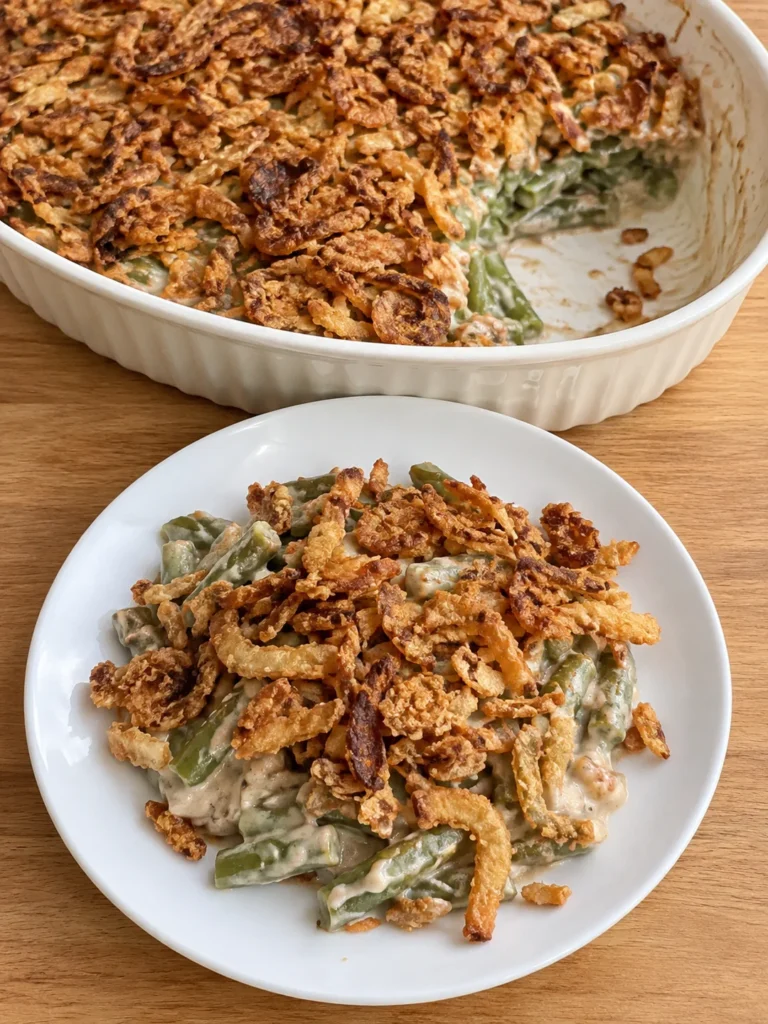
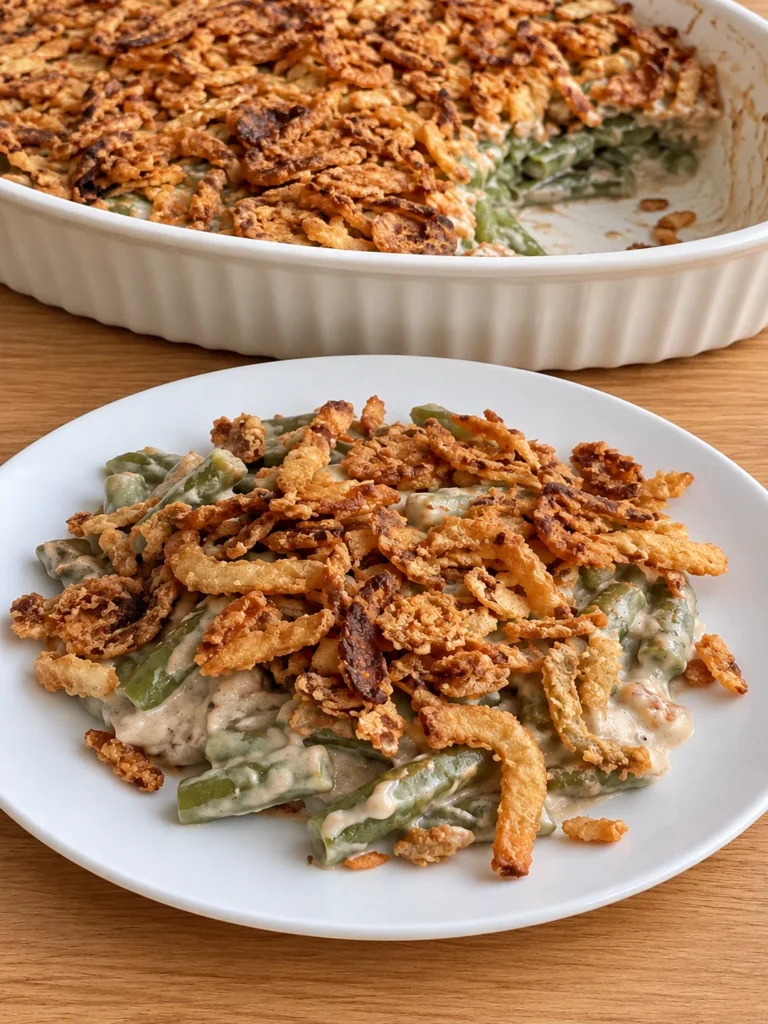
What came out of that dish was green beans in a thick savoury cream, with fried onions on top that had gone deep brown at the edges. I reached for the bowl before it had rested and he put a hand out and said give it five minutes, it tightens. He was right. The sauce had been loose and sliding and then it was not.
I asked him where it came from, expecting some Maritimes story. He laughed and said off the side of a soup can, same as everybody.
It Was Invented in a Test Kitchen in Camden, New Jersey
He was almost exactly right, and the real story is better than any farmhouse origin someone might want to invent for it. The dish was developed in 1955 by Dorcas Reilly, one of the first full-time home economists at Campbell Soup Company in Camden, New Jersey. She was asked for something cheap and fast built on two things already in every American pantry, green beans and condensed cream of mushroom soup.
She tested it close to a hundred times. Earlier versions carried Worcestershire sauce, celery salt, even ham, before she stripped it back to six things. She called it Green Bean Bake, and it went out through an Associated Press feature, not as a holiday recipe at all. It was meant for a Tuesday.
The Thanksgiving part came later, in the 1960s, when Campbell’s started printing it on the soup can label. That is the whole mechanism. A can label turned a weeknight side into something that now shows up at roughly 20 million American Thanksgiving tables a year. Reilly’s handwritten recipe card went to the National Inventors Hall of Fame in Akron, Ohio in 2002.
The detail that surprised me most is the soy sauce. A teaspoon of it is in Reilly’s original, which was an odd pantry item in a 1955 American kitchen, and it is the reason so many later printed versions quietly dropped it. It does not read as soy. It reads as depth, the thing that stops the sauce tasting like plain soup.
What I Used
- One can of Campbell’s condensed cream of mushroom soup, 10.5 oz
- Half a cup of whole milk
- A teaspoon of soy sauce, the original, not a twist
- A dash of ground black pepper
- Four cups of cut green beans, two 14.5 oz cans, drained hard
- One can of French’s fried onions, 2.8 oz, divided roughly two thirds and one third
That is it. Six things. I have seen people try to make green bean casserole from scratch with a homemade mushroom velouté and fresh blanched beans, and it does make a better-tasting dish by modern standards, but it is no longer the actual recipe. The canned soup is not the shortcut. It is the ingredient.
Making Green Bean Casserole in My Own Kitchen
I came home and made it the following week, in the small enamel dish with the chipped corner that I use for everything baked and shallow. Early evening, the window over the sink open because it was still warm, Gillian Welch playing because that is what was already on. The counter was a mess of two open cans and a colander.
The draining is the whole job. I tip the beans into the colander, set a plate on top and lean on it, let them sit a minute, then press again. Watery beans are the only reason this dish ever turns soupy, and the first time I made it I was gentle with them and ended up with something closer to soup with beans in it.
Then the soup, milk, soy and pepper get stirred together right in the dish until there are no pale streaks left. Fold in the beans and about two thirds of the onions. Level it off. Twenty-five minutes uncovered at 350 F, until it bubbles at the edges and the kitchen starts smelling faintly of mushroom.
Here is the part I got wrong the first time. I put all the onions on at the start, and in half an hour they went soft and tasted steamed. They go on in the last five minutes only, after you stir the casserole once to move the sauce around. Five minutes, and then they are properly golden and loud. Watch them. They go from golden to burnt in about ninety seconds.
Then let it rest five minutes. Dwight’s instruction, and it holds in a cast-iron-free LA kitchen just as well as it did on a boat deck.

Swaps I Have Tried and What I Would Skip
Fresh beans, blanched and shocked, are the obvious upgrade and they do taste greener. They are also not the tradition, canned is, and honestly the soft canned bean is what carries that sauce best. I go back and forth. Mostly I use canned, except when I have good beans sitting in the fridge, which is maybe twice a year.
Frozen cut green beans work if you thaw and drain them with the same violence. A handful of sautéed cremini stirred in is good if you want more mushroom. Panko on top instead of fried onions is not good, I tried it, it tastes like a different dish wearing this one’s clothes.
You can assemble it a day ahead without the topping, keep it covered in the refrigerator, and add ten minutes to the first bake. Leftovers hold three days. Reheat uncovered at 350 F with a fresh handful of onions scattered on at the end, otherwise the top is just sad.
Why I Keep Making It
I did not go to Nova Scotia for a casserole invented in New Jersey, and I still think about that dish more than the lobster. Cold leftovers, eaten standing at the counter the next morning. Better than they have any right to be.
Green Bean Casserole
Ingredients
Equipment
Method
- Heat the oven to 350 F.
- Drain the green beans in a colander and press them down firmly to force out the liquid. Let them sit a minute and drain again. This step decides whether the casserole is creamy or watery.
- In a 1 1/2 quart casserole dish, stir the condensed cream of mushroom soup, milk, soy sauce and black pepper together until the mixture is smooth with no pale streaks of soup left.
- Fold in the drained green beans and about two thirds of the fried onions, roughly 1 1/3 cups. Spread the mixture level.
- Bake uncovered for 25 minutes, until the casserole is hot all the way through and bubbling around the edges.
- Pull it out and stir the casserole once to redistribute the sauce, then scatter the remaining fried onions evenly over the top.
- Return to the oven for 5 minutes more, just until the onions turn deep golden. Watch them closely at this stage, they darken fast.
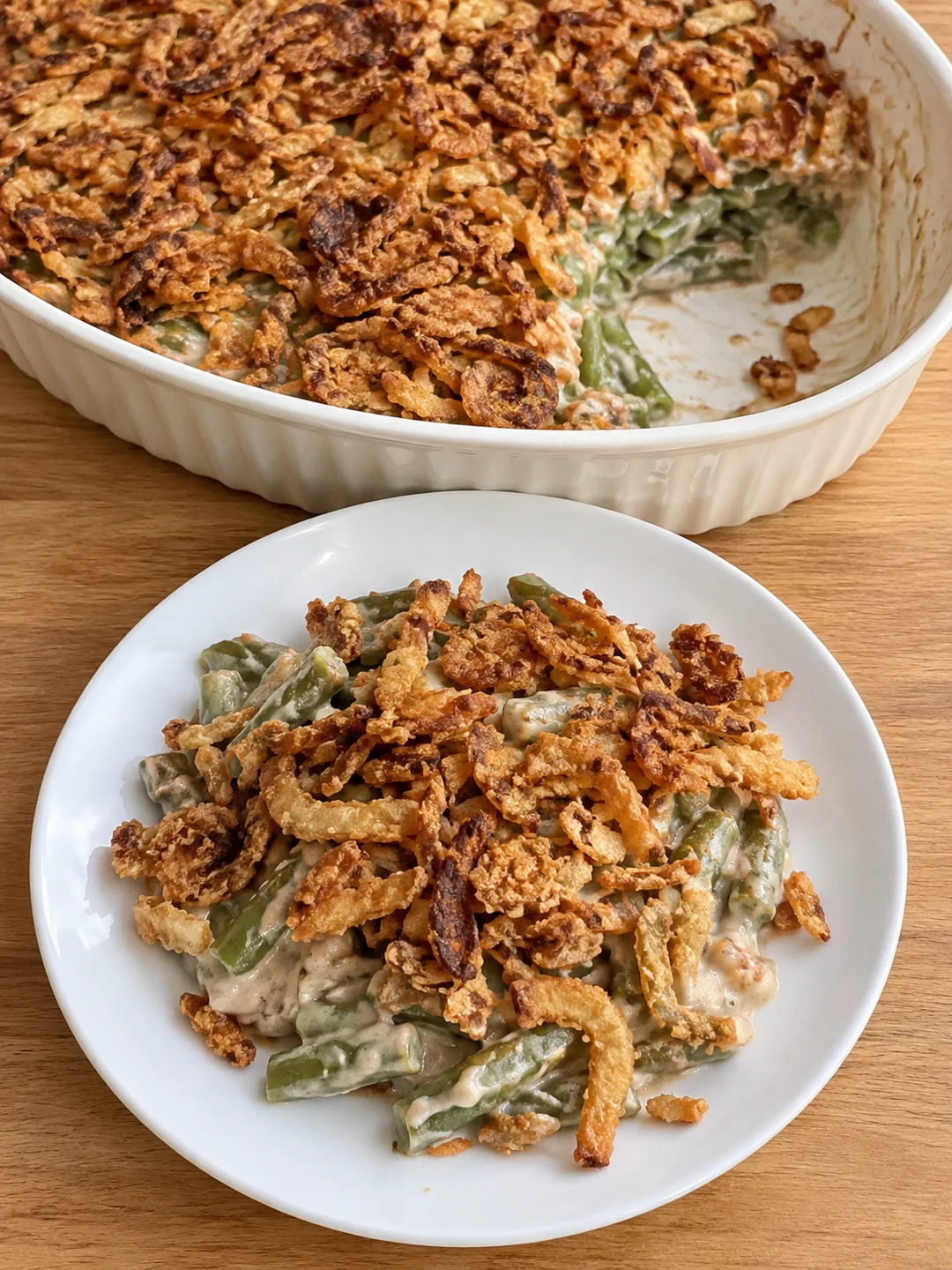
- Let the casserole rest 5 minutes before serving so the sauce tightens around the beans.