
The Stuffed Pumpkin sat on Siranush’s kitchen table for a full fifteen minutes before anyone touched it. Nobody rushed. Her grandson had come up the back stairs from the restaurant below still in his apron, and he sat down too, and we all just looked at it.
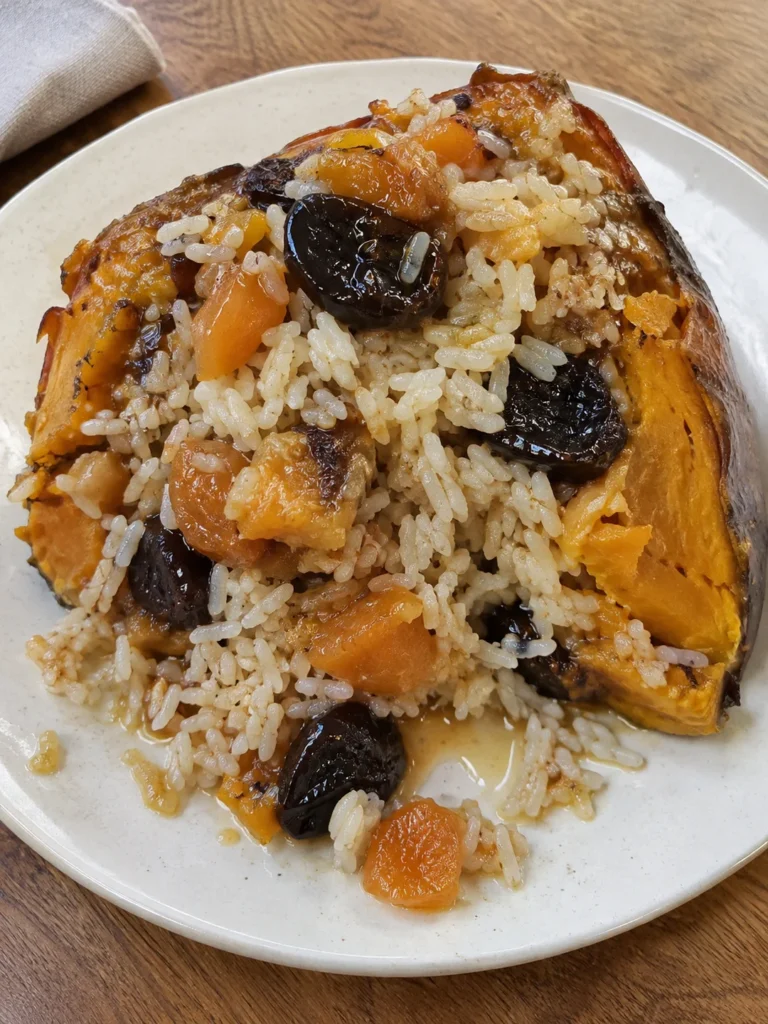
This was in Yerevan, in a third-floor apartment on Pushkin Street with a window that faced a courtyard full of laundry lines. Siranush was seventy-nine and wore a cardigan the color of dried apricots, which I noticed because the apricots were right there on the table in a bowl.
The Apartment Above the Restaurant on Pushkin Street
Her grandson Aram cooked at the place downstairs. He did the dinner menu, the grilled things, the dishes tourists order. But he told me straight away that he did not make ghapama. His grandmother made ghapama, and that was the arrangement.
She had me chop prunes while she watched. I was going too fast and cutting them too small, and she took the knife out of my hand without saying anything, cut three the way she wanted them, and handed it back. Bigger pieces. You want to find the fruit when you eat it, not have it disappear into the rice.
The other thing she corrected me on was the rice. I had drained it and was ready to dump it in the pumpkin and she stopped me. Still too firm, she said, or something like it through her grandson translating. It has to be firm. It is not finished. It finishes inside.
What Ghapama Actually Is
Here is the thing I got wrong before that afternoon. I assumed stuffed pumpkin meant savory. Sausage, cheese, maybe some kind of meat. That is the American version and the French-Canadian one, and it has nothing to do with this.
Ghapama is sweet. It is dessert. Rice, butter, honey, dried apricots and prunes and raisins and walnuts, cinnamon, and that is the whole architecture of it. No meat anywhere near it.
The name comes from Armenian, roughly cooked in a covered pot, and it is one of the oldest dishes in the country’s cuisine. It grew out of the autumn harvest, when you had a pumpkin and you had rice and you had the fruit you had dried through summer. Siranush makes it for New Year’s Eve and again for Armenian Christmas on January 6, which is the stretch of the year it really belongs to. Weddings too. Easter. Birthdays.
And there is a song about it. Hey Jan Ghapama, which Aram sang about four bars of and then stopped, embarrassed. His grandmother finished the line.
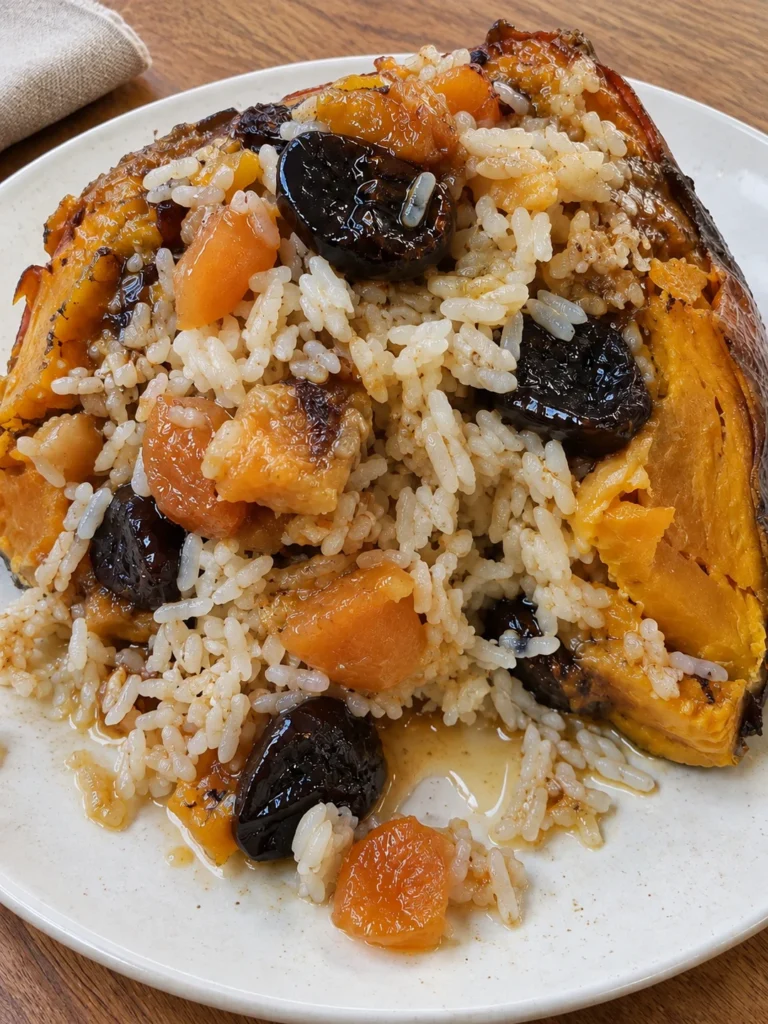
Bringing It Back to My Kitchen
I got home in late October and went looking for the right pumpkin the same week. This is the part where the dish either works or does not, and it has nothing to do with cooking. You need a squat sugar pumpkin with a flat bottom that sits upright on its own without wobbling. I found mine at the Sunday farmers market from a grower who had about forty of them lined up and let me test-stand six before I picked one.
The dried fruit I get from an Armenian grocery over in Glendale, which is where I also finally found the kind of apricots Siranush used. Sharper than supermarket ones. Less candy, more fruit. If yours are very dry, soak them in warm water for ten minutes and drain before chopping.
Scraping out the cavity took longer than I expected. You want the seeds and every stringy bit gone, walls smooth, but the flesh itself left thick. I used a metal spoon and the whole thing took twenty minutes of steady scraping. My wrist complained.
What I Used
- One whole sugar pumpkin, 6 to 7 lb, squat with a flat base
- 1.5 cups long grain white rice, rinsed until the water runs clear
- 6 tbsp unsalted butter, melted, plus a little more for the cavity
- Half a cup of honey, split in two
- 1 cup dried apricots, chopped big
- Three quarters of a cup of pitted prunes, chopped
- Half a cup of raisins, dark or golden
- Three quarters of a cup of walnuts, chopped (almonds are fine)
- 1.5 tsp ground cinnamon
- 3 tbsp sugar
- Half a tsp salt, for the rice water
Where the Stuffed Pumpkin Punishes You
Patience. That is the entire lesson of this dish and I learned it the hard way the second time I made it.
The rice goes in half cooked. Six or seven minutes in boiling salted water, until the grains have swollen but the centers are still firm when you bite one. Drain, spread out, let it cool a little. It will finish inside the pumpkin on butter and fruit juice and steam, and if you cook it fully on the stove you get mush. I cooked mine nine minutes once because I was distracted. Mush.
Then the pumpkin itself. Seventy minutes tented loosely with foil, then twenty to twenty-five more with the foil off. Ninety to ninety-five total, depending on how thick your shell is. A skewer should slide through the wall with no resistance. Mine took ninety-four the first time and eighty-eight the second, same oven, different pumpkin. There is no fixed number and checking is the only way.
Do not pack the filling to the rim either. Leave an inch. The rice swells and it needs somewhere to go.
And when it comes out, let it rest fifteen minutes on the sheet. I know. It smells extraordinary by then and the kitchen has gone warm and cinnamon-heavy and you want to cut it immediately. Wait anyway.
Cutting It Open at the Table
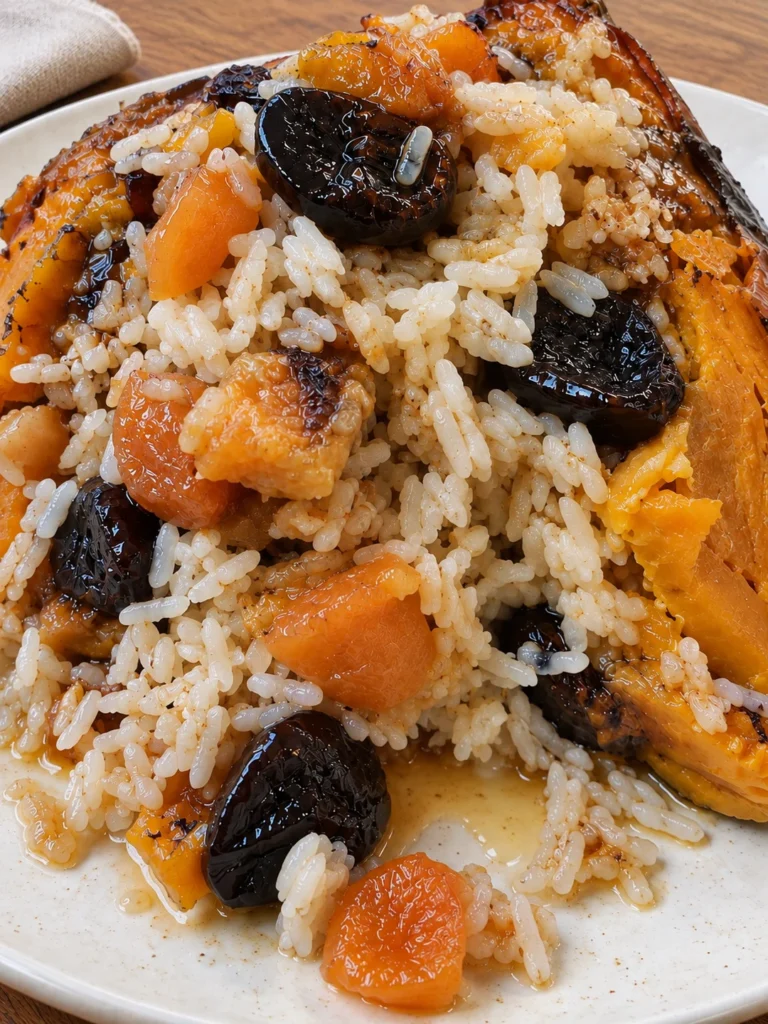
A whole roasted stuffed pumpkin is not a cooking vessel you throw away. That took me a while to understand. You carry it out intact, lift the cap off in front of everybody, and then cut straight down through the shell into eight wedges so each person gets filling and a slab of softened pumpkin flesh together.
The flesh is the point as much as the filling. It goes silky and faintly sweet and slightly firmer at the skin, and eaten with the honeyed rice it is a different thing than either half alone.
Siranush served it on its own with strong coffee, nothing else on the table. I have tried it with other things and it does not need them.
Leftovers keep three days covered. Scoop the filling and flesh together into a baking dish and reheat at 325 F. Though honestly, cold, standing at the counter the next morning, is how I like it best.
I have made this four times now. Every single time I have stood in front of it while it rested and thought about that apartment and the laundry in the courtyard and a seventy-nine-year-old woman taking a knife out of my hand. Some recipes come home with you heavier than others.
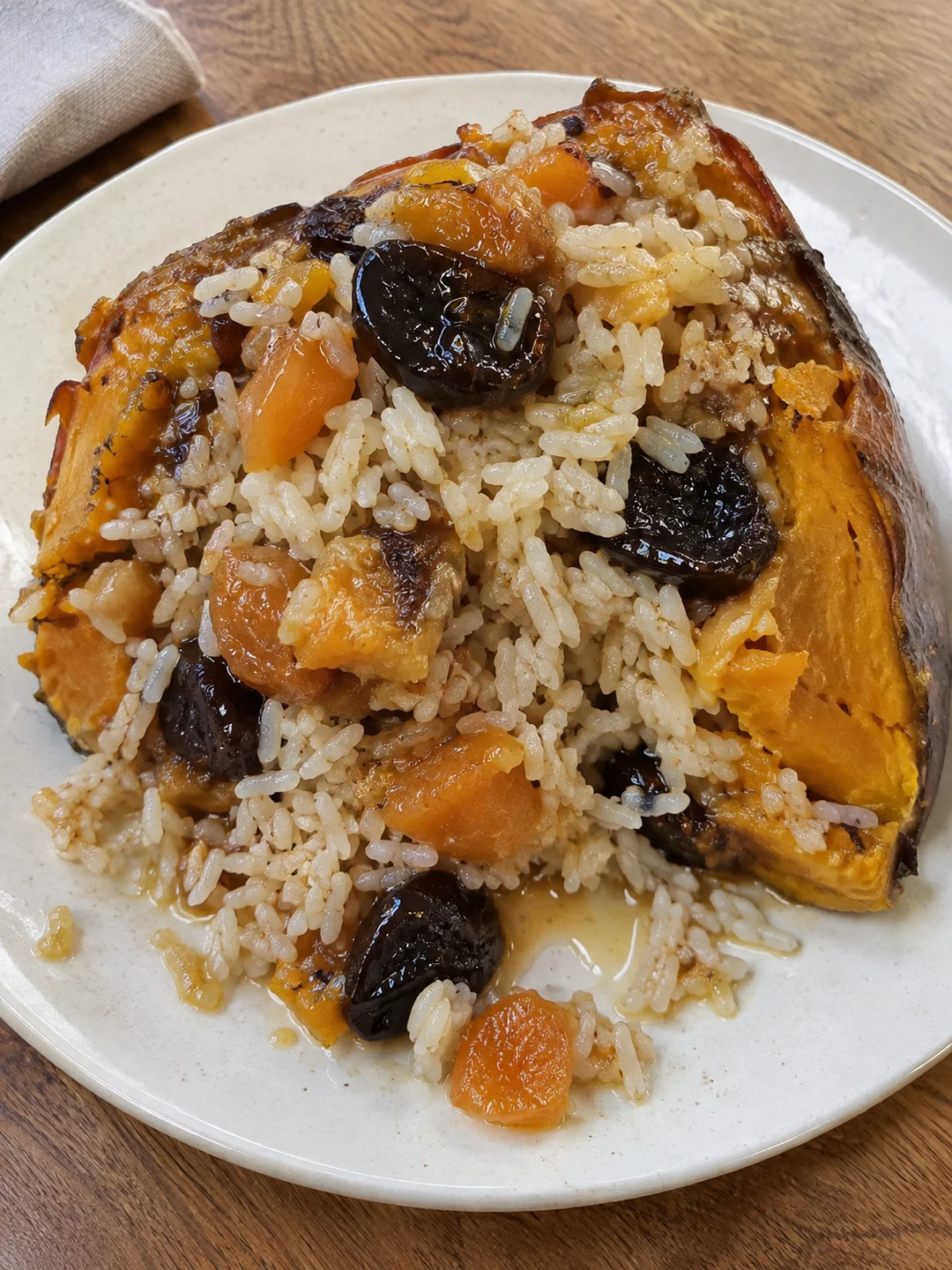
Stuffed Pumpkin
Ingredients
Equipment
Method
- Preheat the oven to 350 F. Wash and dry the pumpkin, then set it on a cutting board and check that it stands level.
- Cut a cap off the top of the pumpkin at a slight inward angle, about 5 inches across, so the lid sits back in place without falling through. Set the cap aside.
- Scrape out the seeds and all stringy flesh with a metal spoon until the cavity walls are clean and smooth. Leave the flesh itself thick and intact.
- Bring 4 cups of water to a boil with the 0.5 tsp salt. Add the rinsed rice and cook for 6 to 7 minutes, until the grains are swollen but still firm in the center. Drain well and spread out to cool slightly.
- In a large bowl, combine the parboiled rice, melted butter, chopped apricots, prunes, raisins, walnuts, cinnamon and sugar. Add 0.25 cup of the honey and fold everything together until the grains are evenly coated.
- Rub the inside of the pumpkin cavity with a little butter, then spoon the filling in. Pack it gently, leaving about 1 inch of space below the rim so the rice has room to swell.
- Pour the remaining 0.25 cup honey over the top of the filling. Set the cap back in place.
- Place the pumpkin on a rimmed baking sheet and cover the whole thing loosely with foil. Bake for 70 minutes.
- Remove the foil and bake 20 to 25 minutes more, until a skewer slides easily through the pumpkin wall and the rice on top is tender. Total baking time runs 90 to 95 minutes depending on shell thickness.
- Let the pumpkin rest 15 minutes on the sheet. Carry it to the table whole, lift the cap, and cut down through the shell into 8 wedges so each serving takes both the filling and a piece of softened pumpkin flesh.