
Greek Moussaka was not on my list the morning I met Eleni outside the meat halls at Varvakios Agora in Athens. I had signed up for a four-hour cooking class and the first ninety minutes of it turned out to be a market walk, which nobody warned me about.
It was August and already too hot at nine in the morning. Eleni moved fast through the fish aisle, past the butchers shouting over each other, and stopped at a cheese stall run by a man named Stamatis who cut her a sliver of kefalotyri off a wheel the size of a car tire.
That sliver is the reason I am writing this.
The Stall That Changed the Class
Stamatis did not speak much English and Eleni translated about half of what he said. The gist was that the cheese we were buying would be grated into the bechamel, not just scattered on top, and that this is where most tourists get it wrong.
He was right. I had eaten moussaka maybe a dozen times before that trip and none of it tasted like what we made three hours later in a kitchen off Athinas Street.
The other thing Eleni told us, standing there with a paper bag of cheese, was that moussaka is not an ancient dish. I had assumed otherwise. It was codified in Athens in the 1920s by a chef called Nikolaos Tselementes, who took an Ottoman-rooted preparation and put a French bechamel on top of it. The name itself comes the Arabic musaqqa’a, and an early version shows up in a thirteenth-century Arabic cookbook.
What Tselementes Actually Did
Tselementes was building a modern Greek culinary identity on purpose. The bechamel was a deliberate French import, not something Greek kitchens were already doing. His structure of fried aubergine, spiced mince, and that blanket of sauce became the version the whole world now recognises.
His influence was so complete that his surname became the ordinary Greek word for cookbook. Eleni said this with a shrug, like everyone knows.
Worth saying clearly because people get it wrong constantly. Greek moussaka and Turkish musakka are two different things. The Turkish one is a loose, stew-like braise with no layers and no bechamel at all.
Bringing It Back to My Kitchen
I made it the first Sunday I was home. Started at eleven in the morning, ate at four, which sounds absurd until you understand that this dish punishes every shortcut you try to take.
The eggplant needs a full hour under salt. Not twenty minutes because you are hungry. A full hour, in colanders over bowls, until they weep out a startling amount of dark liquid. I rushed it once and ended up with oily, slightly bitter slices that soaked up every drop of olive oil in the pan.
The meat sauce is the same story. Forty-five minutes of uncovered simmering, minimum, until you can drag a spoon through it and the trail stays open. If it closes back up, it is not ready, and you will pour bechamel over a soupy mess that slumps on the plate.
What I Used
- Eggplant, about three large ones, sliced lengthwise a third of an inch thick
- Coarse salt for drawing out the moisture
- Russet potatoes, peeled and sliced thin
- Olive oil, more than feels reasonable
- Ground lamb, though beef works if lamb is hard to find
- Yellow onions and garlic
- Crushed tomatoes and tomato paste
- Dry red wine
- Ground cinnamon, whole cloves, a bay leaf
- Butter, flour and whole milk for the bechamel
- Eggs, room temperature, for enriching it
- Fresh nutmeg
- Kefalotyri, grated, half into the sauce and half on top
Sourcing It in a City That Is Not Athens
The kefalotyri I get from a Greek deli in Glendale that also sells decent olives and terrible coffee. When they are out, I use Pecorino Romano, which is the closest thing widely available, though it is sharper and saltier so I pull back on the salt elsewhere.
The eggplant comes from the Wednesday farmers’ market. In late summer they are small and dense and nothing like the waterlogged ones at the supermarket in February. Lamb from the butcher who knows me well enough now to ask how the last batch went.
The one thing I import properly is the cinnamon. Cassia from the regular grocery store is too aggressive here. I order actual Ceylon cinnamon and use a full teaspoon, which sounds like a lot in a meat sauce until you taste it against the lamb.
The Part Where Patience Actually Matters
Bechamel is where I have made my worst mistakes. You melt the butter, whisk in flour, cook it two minutes without letting it colour, then pour in warm milk slowly while whisking.
Then you take it off the heat and let it cool five minutes before the eggs go in. I skipped that once. Scrambled egg suspended in white sauce, which is exactly as unpleasant as it sounds, and I served it anyway because there was no time to start over.
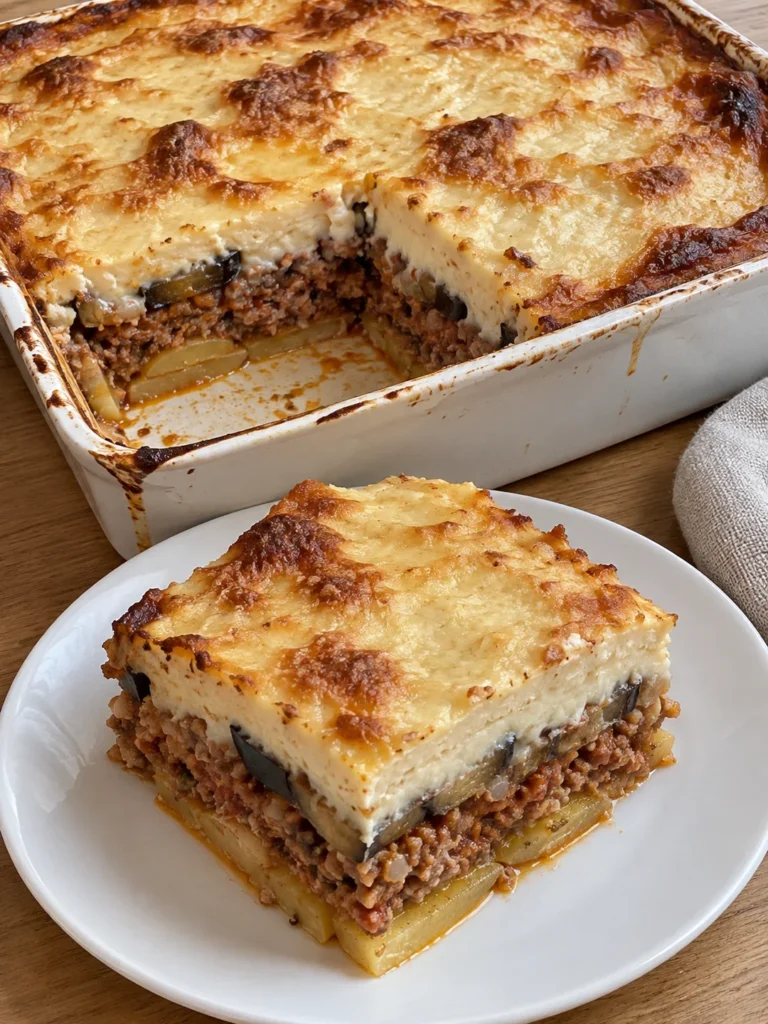
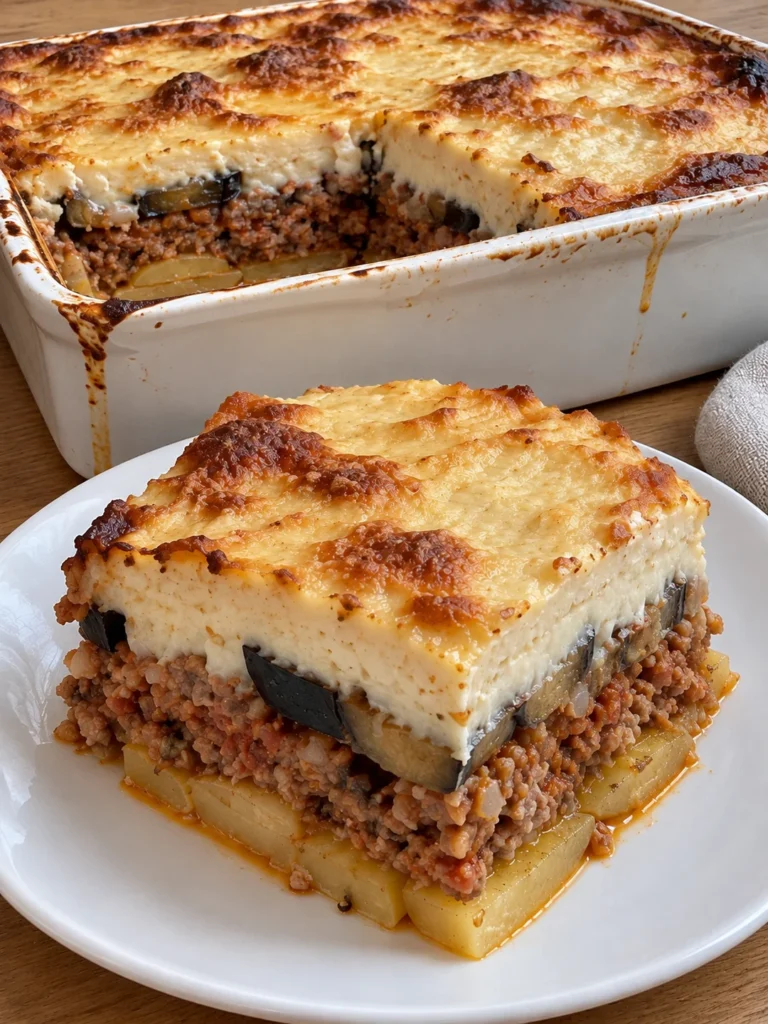
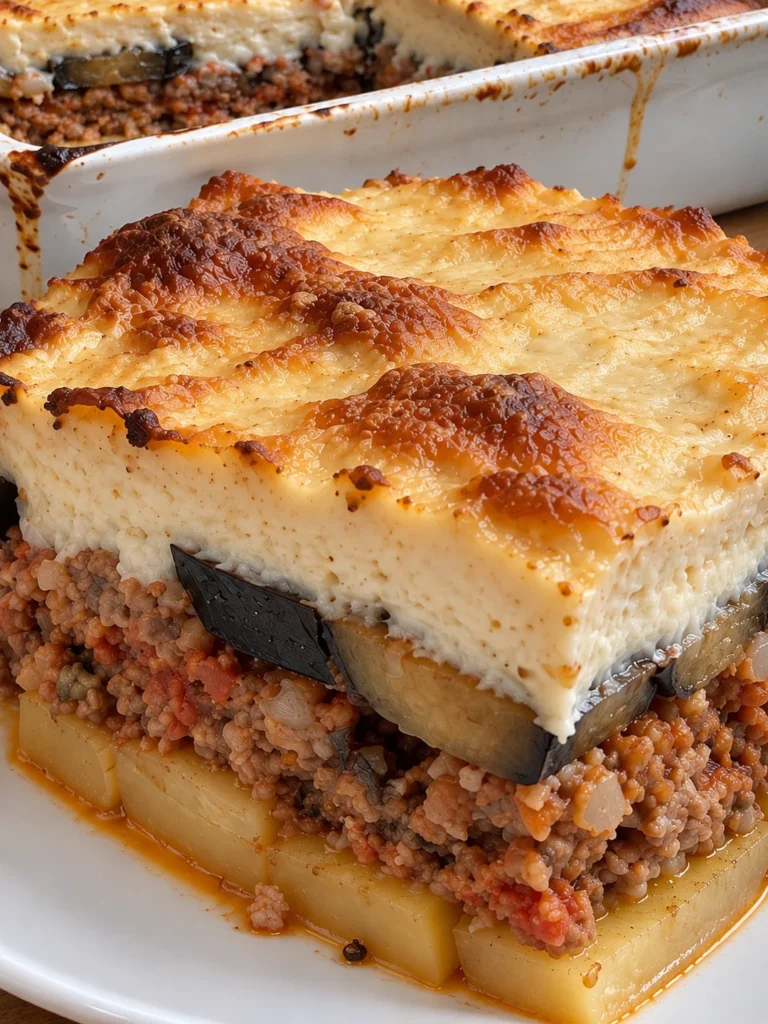
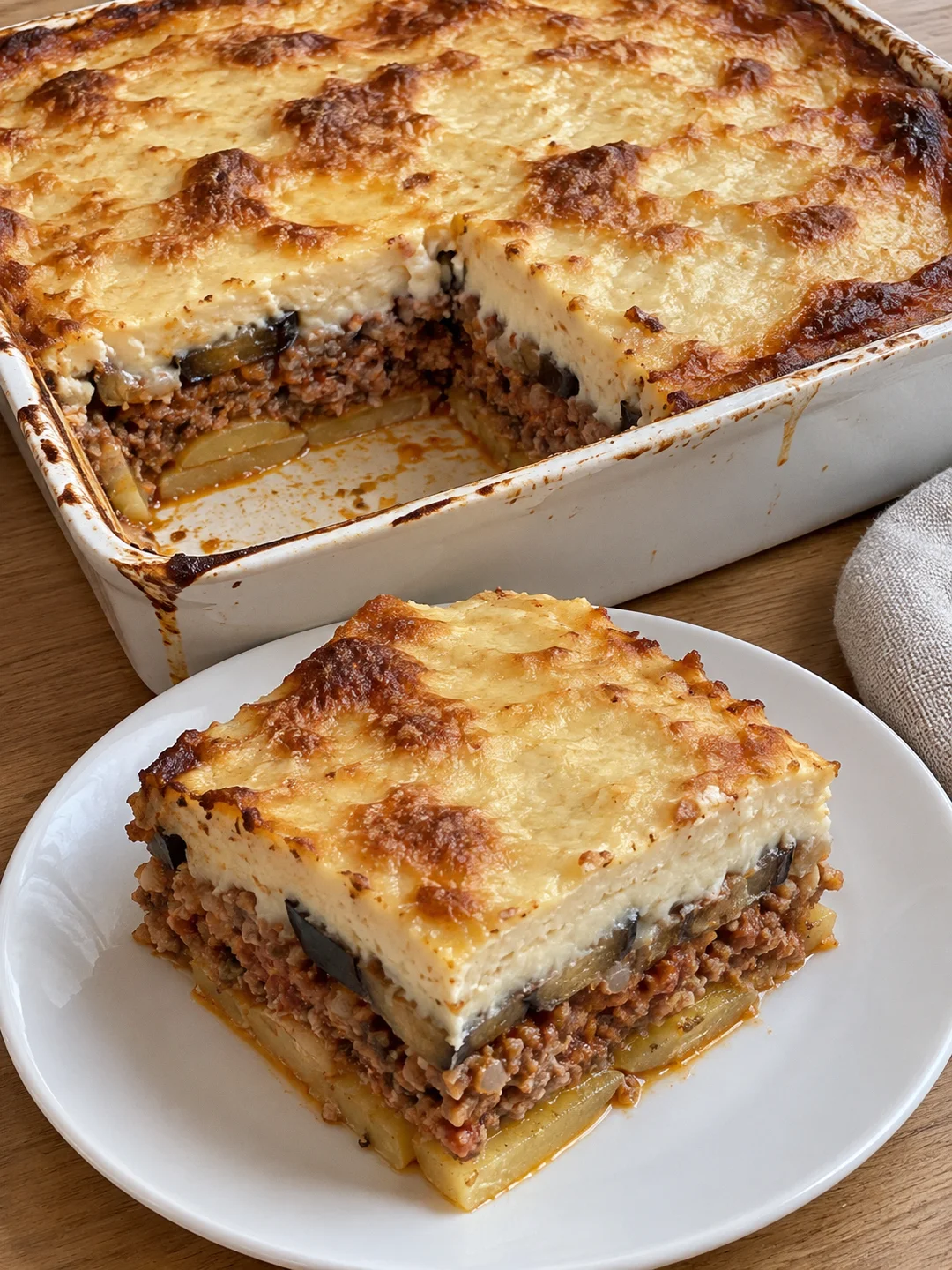
Assembly is fried potatoes on the bottom, half the eggplant, all the meat sauce, the rest of the eggplant, then bechamel smoothed to the edges. Cheese over everything. Forty-five to fifty minutes at 350 until the top puffs and goes deep gold.
And then it rests. Twenty minutes, no negotiating. This is not a suggestion, it is the difference between a square that lifts out clean and a spoonful of sliding layers.
Variations Worth Knowing
Plenty of Greek households, particularly in the south, skip the potato layer entirely. I did it that way once and the eggplant and bechamel came forward in a way I liked. I still usually include the potatoes, though I am not sure I could defend why.
This moussaka recipe scales well and the leftovers are arguably the point. Cold from the fridge the next day, eaten standing at the counter before anyone else is up. Better than the original, honestly.
Serve it with a horiatiki salad, tomato and cucumber and olives and a slab of feta, plus bread for the plate. A Greek red if you have one.
What Stayed With Me
I had the radio on the whole afternoon I made it the first time and did not notice the light change until I pulled the dish out at four. The kitchen smelled like cinnamon and browned lamb and it was worth every hour.
Eleni told us at the end of the class that moussaka is a Sunday dish, not a weeknight one, and that Greeks do not pretend otherwise. I make it maybe four times a year. Each time I think about Stamatis cutting cheese off that enormous wheel.
Greek Moussaka
Ingredients
Equipment
Method
- Lay the eggplant slices in colanders, salting each layer generously with the coarse salt. Set the colanders over bowls and leave for 1 hour. The slices will weep a surprising amount of dark liquid.
- While the eggplant drains, start the meat sauce. Heat 2 tablespoons olive oil in a large skillet over medium-high heat. Add the onions and cook until soft and translucent, about 8 minutes. Add the garlic and cook 1 minute more.
- Add the ground lamb and break it apart with a wooden spoon. Cook until deeply browned and any released liquid has evaporated, about 12 minutes. Do not rush this; browned meat builds the backbone of the sauce.
- Stir in the tomato paste and cook 2 minutes until it darkens. Pour in the red wine and scrape the bottom of the pan clean. Let it bubble away almost completely.
- Add the crushed tomatoes, cinnamon, whole cloves, bay leaf, salt and pepper. Lower the heat and simmer uncovered for 40 to 45 minutes, stirring now and then, until the sauce is genuinely thick and a spoon dragged through it leaves a clear trail. Fish out the cloves and bay leaf. Set aside to cool slightly.
- Rinse the eggplant slices under cold water to remove the salt, then press them firmly between clean kitchen towels until quite dry.
- Heat 1/3 cup olive oil in a large skillet over medium-high heat. Fry the eggplant in batches until golden on both sides, about 3 minutes per side, adding more oil as needed. Drain on paper towels.
- Pat the potato slices completely dry and fry them in the same skillet until golden and just tender, about 4 minutes per side. Drain on paper towels and season lightly with salt.
- Preheat the oven to 350 F.
- Make the bechamel. Melt the butter in a medium saucepan over medium heat, whisk in the flour and cook 2 minutes without letting it color. Pour in the warm milk in a slow stream, whisking constantly, and cook until the sauce thickens enough to coat the back of a spoon, about 8 minutes.
- Remove the bechamel from the heat and whisk in the nutmeg, 1 teaspoon salt and 1 cup of the grated kefalotyri. Let it cool for 5 minutes, then whisk in the beaten eggs in a steady stream, working fast so they enrich rather than scramble.
- Assemble. Oil the baking dish and lay the fried potatoes across the bottom in an overlapping layer. Cover with half the eggplant slices, then spread all the meat sauce evenly over the top.
- Arrange the remaining eggplant over the meat, pressing gently to level the surface. Pour the bechamel over the whole thing and smooth it to the edges with a spatula. Scatter the remaining 1 cup of cheese across the top.
- Bake for 45 to 50 minutes, until the top is puffed, deep golden and set in the center. If it browns too fast, tent loosely with foil.
- Rest the moussaka 20 minutes out of the oven before cutting. This is not optional; it is what lets the layers set so each square lifts out intact.