
Homemade Cranberry Sauce was not what I ordered. I was in Church Point, Nova Scotia, on the Acadian French Shore, in a seven-table restaurant with a menu written only in French and one woman running the entire room.

Her name was Lucille. She took one look at me pointing hopefully at the second line of the menu and brought me the roast turkey plate instead, because that was what everyone else in the room was eating on a wet Tuesday in November.
Next to the turkey, in a small glass jar with a bent lid, was the sauce. Dark ruby, loose, berries still whole and split open. I ate the whole jar and asked for more, which made her laugh at me from across the room.
What Lucille Told Me Over the Counter in Church Point
She came and sat on the stool beside me with a dish towel over her shoulder and explained it in a mix of Acadian French and hand gestures, the universal kind. Pointing at the jar. Pointing at the window, at the bog country past the road. Fifteen minutes, she kept saying, holding up fingers. Quinze.
The part I understood clearly was the warning. She mimed the sauce going stiff in the pan, made a face, then mimed pulling it off the heat early and shrugged happily. Her point was that you stop cooking while it still looks wrong.
The other thing she wanted me to know was that it should not be sweet. She said the word sucre and shook her head. The turkey is rich, the gravy is rich, the sauce is the thing that cuts through all of it.
The History Is a Lot Older Than the Can
I went looking afterward, because I had assumed cranberry sauce was a Pilgrim invention and I was wrong. Cranberries are one of the very few commercially grown fruits actually native to North America, and the Wampanoag and Mi’kmaq were using them for food, medicine and dye long before any European showed up with a pot.
The Mi’kmaq are recorded introducing cranberries to French settlers at Port-Royal, Nova Scotia in 1606, roughly an hour’s drive up the shore from where I was sitting. The French called them pommes de prés, meadow apples, and sweetened them with maple sugar, not cane. That detail reframes the whole dish for me.
Sweetened cooked cranberries turn up in colonial accounts by 1672, described as being boiled with sugar to eat with meat. Amelia Simmons pairs cranberry sauce with roast turkey in 1796. There is no record of it at the 1621 harvest feast at all, mostly because sugar was scarce and expensive. The can came much later, in 1912, out of Hanson, Massachusetts.
What I Used
- 12 oz whole cranberries, fresh or frozen, picked over for the soft ones
- 1 cup granulated sugar, and not a spoonful more
- 1 cup water
- Two wide strips of orange zest, peeled with a vegetable peeler, no white pith
- 3 tbsp fresh orange juice, squeezed from the same orange
- 1 cinnamon stick, optional, and I use it about half the time
- A pinch of salt

Bringing the Nova Scotia Sauce Back to My Kitchen
I made it the following November in eighty-degree weather with the kitchen window wide open, which is the least Acadian cooking environment imaginable. The berries came frozen in a bag from the regular supermarket, because fresh ones have a short, specific season and I had missed the first good week of them.
Frozen is genuinely fine. Do not thaw them, just give the pan an extra minute or two of simmering and nobody will ever know. Dried cranberries and juice are not substitutes, though, because you lose the skins and the pectin that make the texture happen in the first place.
The orange is the one place I deviate hard. Lucille’s version leaned on maple and I have no idea where she got it locally, but the citrus here is absurd in winter, so I buy a heavy Cara Cara at the Wednesday farmers market and use both the peel and the juice. A cranberry sauce with orange is a brighter, slightly bitter thing than the pure maple one, and in my kitchen the oranges are better than any maple syrup I can buy.
I split the berries into two batches too, which was not her method. Three quarters of them go into the boiling syrup and cook for ten minutes until they burst, and the reserved three quarters of a cup goes in at the end for three or four minutes only. You get a sauce that is partly broken down and partly whole berries suspended in it.
The first time I tried this I ignored Lucille entirely and cooked it until it looked like jam in the pan. Big mistake. It set overnight into something you could have cut with a knife and bounced off a plate.
So now I pull it when it coats the back of my wooden spoon, the one that has been permanently stained pink since that first batch, and still looks like warm maple syrup. You need no pectin, no gelatin, no cornstarch. The berries carry more than enough of their own.
Fish out the zest strips and the cinnamon stick, then taste it while it is hot. If it is screaming sour, one more tablespoon of sugar. Not two.

Twists, Swaps and the Can Question
For the oldest Acadian version, the one closest to what the Mi’kmaq showed those settlers at Port-Royal, swap the granulated sugar for three quarters of a cup of pure maple syrup and cut the water back to three quarters of a cup. It goes darker and rounder and slightly smoky.
If your household wants the sliceable kind, it is not a different recipe. Use all the berries at once, simmer until every single one has burst, press it through a fine-mesh sieve, pour it into a mold and chill it until firm. Straining releases more pectin, which is the whole trick behind the ridged slab.
And worth saying, this is not cranberry relish. Relish is raw berries ground with sugar and orange, sharper and less cooked. Different dish, also good.
I serve mine cold. Always cold, never warm, which I will argue about with anyone. It needs at least four hours in the fridge and ideally overnight, because it thickens and the flavor stops being quite so loud.
Why I Make Homemade Cranberry Sauce Every Year Now
I still put a can on the table beside it, because somebody in every group genuinely wants the ridges and I am not going to fight that battle. The jar empties first anyway.
Twenty-five minutes, one pan, and it keeps two weeks covered in the fridge. The leftovers on a cold turkey sandwich the next day, eaten standing at the counter, are better than anything that happened at the actual dinner.
I think about Lucille every November, holding up fifteen fingers at me in a room full of wet raincoats. I never did learn her last name. The sauce is hers though, and I say so every time somebody asks.
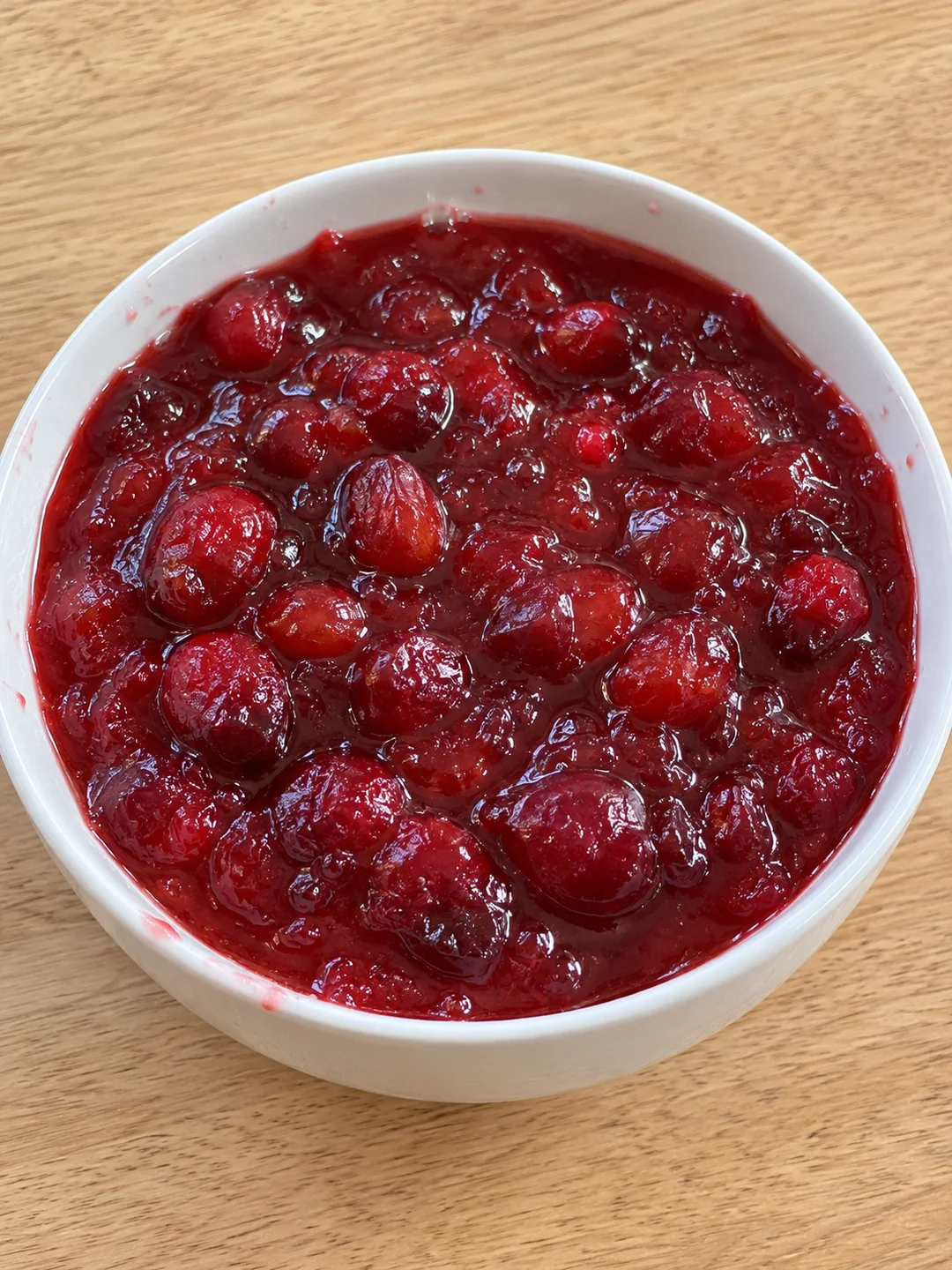
Homemade Cranberry Sauce
Ingredients
Equipment
Method
- Rinse the cranberries in a colander under cold water and pick through them, discarding any that are soft, shriveled or split. Set aside about 3/4 cup of the firmest berries in a small bowl. These go in at the end so some stay whole.
- Peel two wide strips of zest from the orange with a vegetable peeler, taking only the colored skin. Juice the orange and measure out 3 tablespoons.
- Combine the sugar, water, orange zest strips, cinnamon stick and pinch of salt in a medium non-reactive saucepan. Set over medium-high heat and stir until the sugar dissolves completely, about 2 minutes. Bring to a full boil.
- Add the larger portion of cranberries and return the pan to a boil, stirring once. You will hear the first berries crack within a minute or two.
- Reduce the heat to low and simmer gently, stirring occasionally, for 10 minutes. Most of the berries will burst and split and the liquid will darken to deep ruby and look visibly syrupy on the back of the spoon.
- Stir in the reserved 3/4 cup of cranberries and the orange juice. Simmer 3 to 4 minutes more, just until these berries soften and a few begin to split but most hold their shape.
- Pull the pan off the heat while the sauce still looks looser than you want it, roughly the consistency of warm maple syrup with whole berries suspended in it. It will set considerably as it cools.
- Fish out and discard the orange zest strips and the cinnamon stick. Taste. If it is aggressively sour for your table, stir in another tablespoon of sugar while the sauce is still hot, but keep it on the tart side.
- Let the sauce cool in the pan for 30 minutes, then transfer to a serving bowl or jar, cover and refrigerate at least 4 hours and preferably overnight. Serve cold or at room temperature, never warm.