
The first Pierogi Casserole I ever ate came on a warm paper plate at a diner counter off Route 30, somewhere between Greensburg and Irwin, around four in the afternoon.
I had been driving since morning through the kind of grey Pennsylvania day where the sky never quite commits to anything. The handwritten sign by the register said pierogi casserole, three fifty a square, and I ordered it because I genuinely did not know what it was going to be.
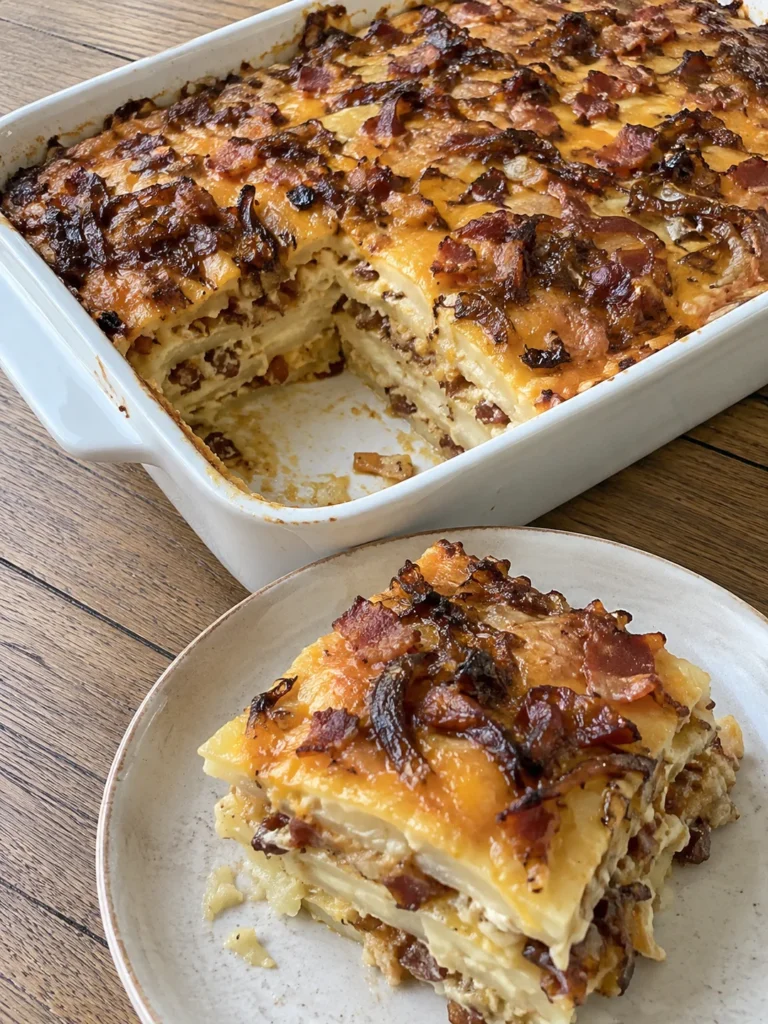
It arrived looking like lasagna that had gotten lost.
The Counter Off Route 30
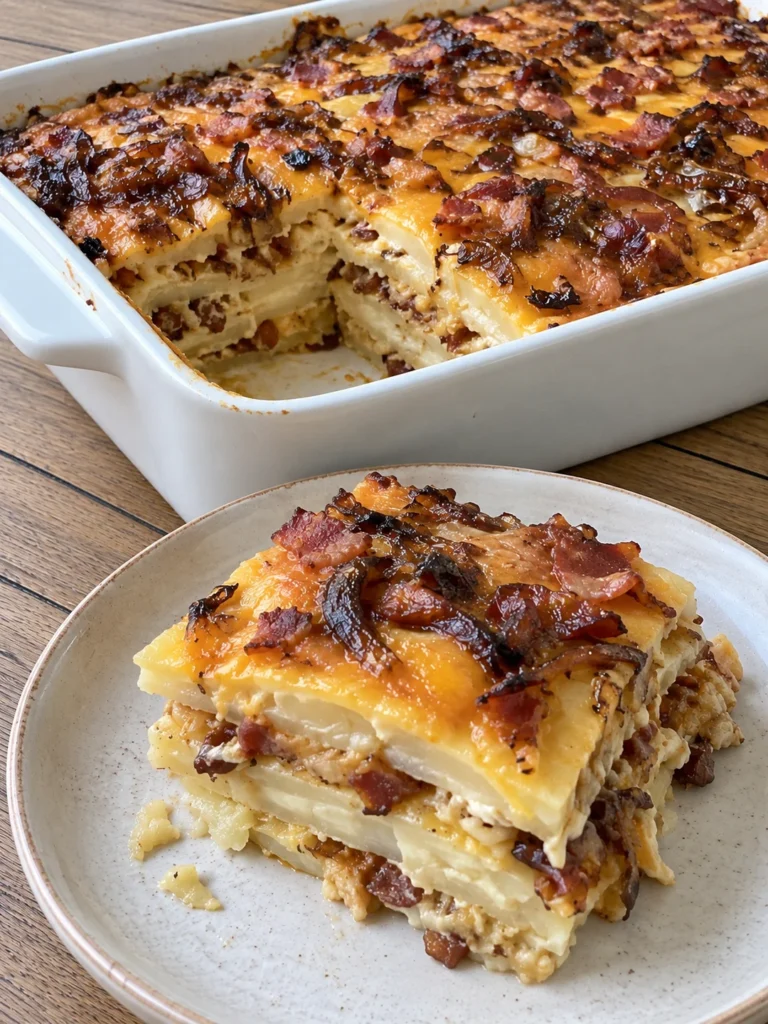
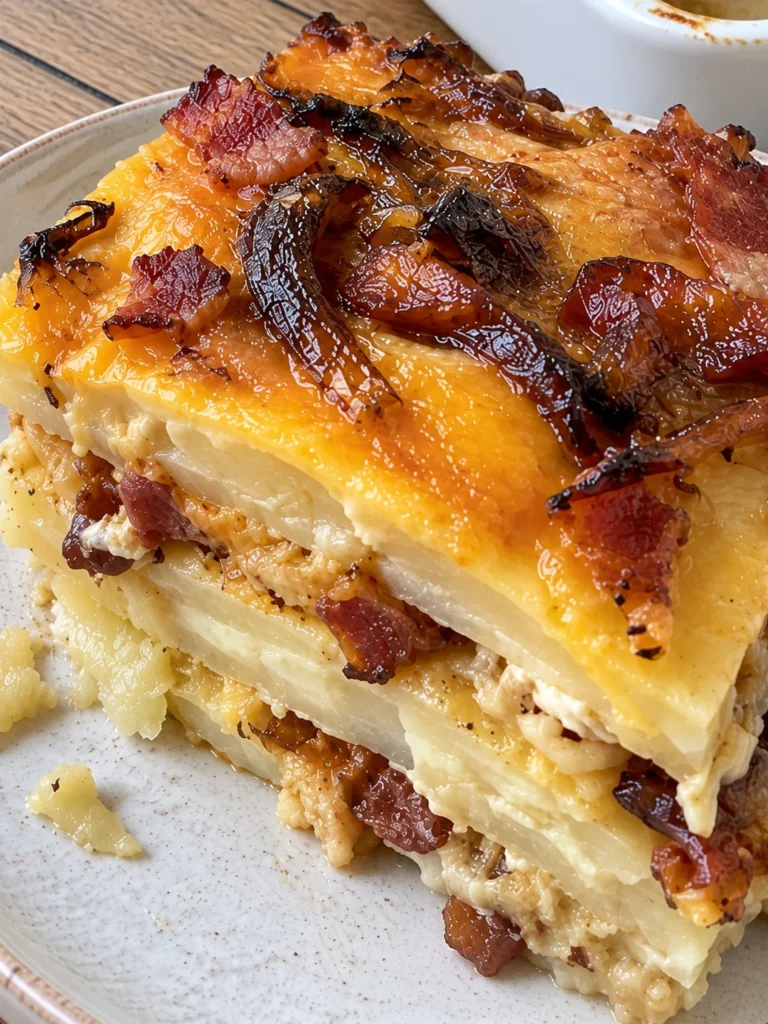
The woman working the counter cut it with the edge of a spatula and it did not slump. Layers held. Potato, noodle, potato again, and a lid of cheddar gone dark brown where the onions had sat on top of it in the oven.
It tasted like eating nine pierogi at once without the dough seam on each one. I finished it, went back out to the car, and sat there for ten minutes not doing anything, radio picking up an oldies station out of Latrobe. That is what road food does when it lands right.
A guy two stools down told me I was eating it in the wrong place and should be in Pittsburgh. He was probably correct. I still have a soft spot for the version I got first.
What Renata Cooked on Sundays in Pittsburgh
I ended up staying three nights at a small hostel in Lawrenceville, and the woman who ran it, Renata, cooked exactly one thing every Sunday for whoever was still hanging around at six. That thing was this.
She had potatoes on the stove before noon and the onions going in a pan so wide it covered two burners. She let me stand next to her and ask a lot of annoying questions while she worked, mostly about the cheese and mostly getting answers about the onions instead.
Twenty-five minutes, low, butter, salt, scrape the bottom. That was the whole lesson and she repeated it about four times, which tells you how many guests before me had rushed it.
She mentioned that plenty of families around there make a pierogi casserole with kielbasa instead of bacon, and that hers changed depending on what the Strip District deli had that week. Some Sundays it was neither. Nobody complained.
Why Pierogi Casserole Is Not Actually a Polish Dish
Pierogi themselves are genuinely old. They turn up in Poland’s first printed cookbook in 1682, and the name traces back to the Old Slavic word pir, which means festivity.
Polish, Slovak and Ukrainian families carried the dumpling into Western Pennsylvania starting around 1830 and in far bigger numbers after 1890, following the steel mills, the coal, the railroads and the pottery factories. Pierogi became parish hall food, sold at church fundraisers, and that is largely how the rest of the country met them after the Second World War.
The casserole is newer and it is North American, full stop. Nobody in Kraków is layering lasagna sheets. It was invented by people who had to feed forty and did not have forty pairs of hands for pinching dough, and Pittsburgh calls it poor man’s pierogies with no embarrassment at all.
It is also not pierogi leniwe, the lazy pierogi you get in Poland, which are twaróg and flour and egg cut into little diamonds and eaten with butter. Different dish, different continent, similar excuse.
What I Used
- Russet potatoes, three pounds, peeled and cut into big chunks
- Regular lasagna noodles, twelve sheets, not the no-boil kind
- Thick cut bacon, chopped
- Three large yellow onions, diced small
- Unsalted butter, more than you expect
- Whole milk, warmed
- Farmer’s cheese, or full-fat cottage cheese drained in a sieve
- Sharp cheddar, shredded, four cups and no pre-shredded bags
- Kosher salt and a lot of black pepper
Building It in My Own Kitchen
The onions are where your attention goes. They start pale and squeaky and loud in the butter, and for the first ten minutes nothing much happens except water leaving them.
Then they collapse. The sugars that were locked up inside start catching on the pan floor, you scrape that brown film back into them, it dissolves, and somewhere around minute twenty-two the whole pan turns the colour of dark honey and smells faintly sweet instead of sharp. The first time I made this at home I pulled them at fifteen minutes because I was hungry. The casserole was fine. Fine is the wrong outcome here.
Potatoes go into cold salted water rather than boiling, so the outsides do not blow apart before the centres give in. Back into the dry hot pot for thirty seconds after draining, which lets the steam walk off and is the entire difference between mashed potato and wet potato.
Cheddar and farmer’s cheese go in while the potatoes are still hot enough to melt them into strings. Season harder than feels reasonable. The noodles contribute nothing but structure.
I do the bacon and the onions in the cast iron, and I dice with my one good chef’s knife, the one with the slightly wonky handle I keep meaning to fix. Farmer’s cheese I buy at a small Eastern European deli on Santa Monica Boulevard where the man behind the counter has never once let me leave without also buying pickles. Everything else is a normal grocery run.
Foil on for thirty-five minutes, foil off for the last fifteen to twenty so the top can brown into that crust. Then rest it. I always give it the full fifteen minutes. Except when I do not, which is most of the time, and then the first slice slides off the spatula in a heap and I eat that one standing up as punishment.
Swaps, and the One Thing I Would Not Change
Leftover mashed potatoes are how most Pittsburgh cooks actually build this. Warm them, loosen with a splash of milk, carry on as written.
Cottage cheese works in place of farmer’s cheese as long as it is full fat and small curd and you drain it properly, otherwise the potato layer goes loose and sad. Sour cream is not standard in the casserole even though it belongs with boiled pierogi, though a few regional versions do fold it into the potatoes.
You need something sharp alongside. Vinegary coleslaw, or green beans with more garlic than is polite. I have skipped the side twice and regretted it twice.
I made it again in February with rain running down the kitchen window and again in August, which was a bad idea in a room with no air conditioning. Renata was right about the onions and right about the resting and right about most things. And the cold square the next morning, eaten standing at the counter with coffee, is still better than the hot one.
Pierogi Casserole
Ingredients
Equipment
Method
- Put the potato chunks in a large pot, cover with cold water by 2 inches, and add a generous handful of kosher salt. Bring to a boil and cook until a knife slides through with no resistance, 15 to 18 minutes.
- While the potatoes cook, melt 4 tablespoons of the butter in a large skillet over medium heat. Add the diced onions and 1/2 teaspoon kosher salt. Cook, stirring every few minutes and scraping the bottom, until the onions collapse and turn deep golden and jammy, 25 to 30 minutes. Lower the heat if they darken at the edges before softening. Scrape into a bowl.
- Wipe the skillet, add the chopped bacon, and cook over medium heat until browned and crisp, 8 to 10 minutes. Lift onto a paper-towel-lined plate with a slotted spoon and leave the fat behind.
- Bring a second pot of salted water to a boil and cook the lasagna noodles according to package directions until just pliable. Drain, rinse briefly with cool water so they stop cooking, and lay them flat on a sheet pan or clean towel so they do not stick.
- Drain the potatoes and return them to the hot dry pot for 30 seconds to steam off moisture. Mash with the warm milk and 2 tablespoons of the butter until smooth.
- Fold the farmer's cheese and 2 cups of the shredded cheddar into the hot mashed potatoes so the cheese melts through. Season with 1 1/2 teaspoons kosher salt and the black pepper. Taste and adjust, keeping it a touch saltier than you think, since the noodles are bland.
- Heat the oven to 350 F. Butter the 9x13 inch baking dish.
- Lay 4 noodles across the bottom, overlapping slightly. Spread half the potato and cheese mixture over them in an even layer, then scatter over half the bacon and half the caramelized onions.
- Repeat with 4 more noodles, the remaining potato mixture, and all but about 1/3 cup of the bacon and 1/3 cup of the onions. Finish with the last 4 noodles.
- Melt the remaining 2 tablespoons butter and brush it over the top noodles right to the edges so they do not dry out. Scatter over the remaining 2 cups cheddar, then the reserved onions and bacon.
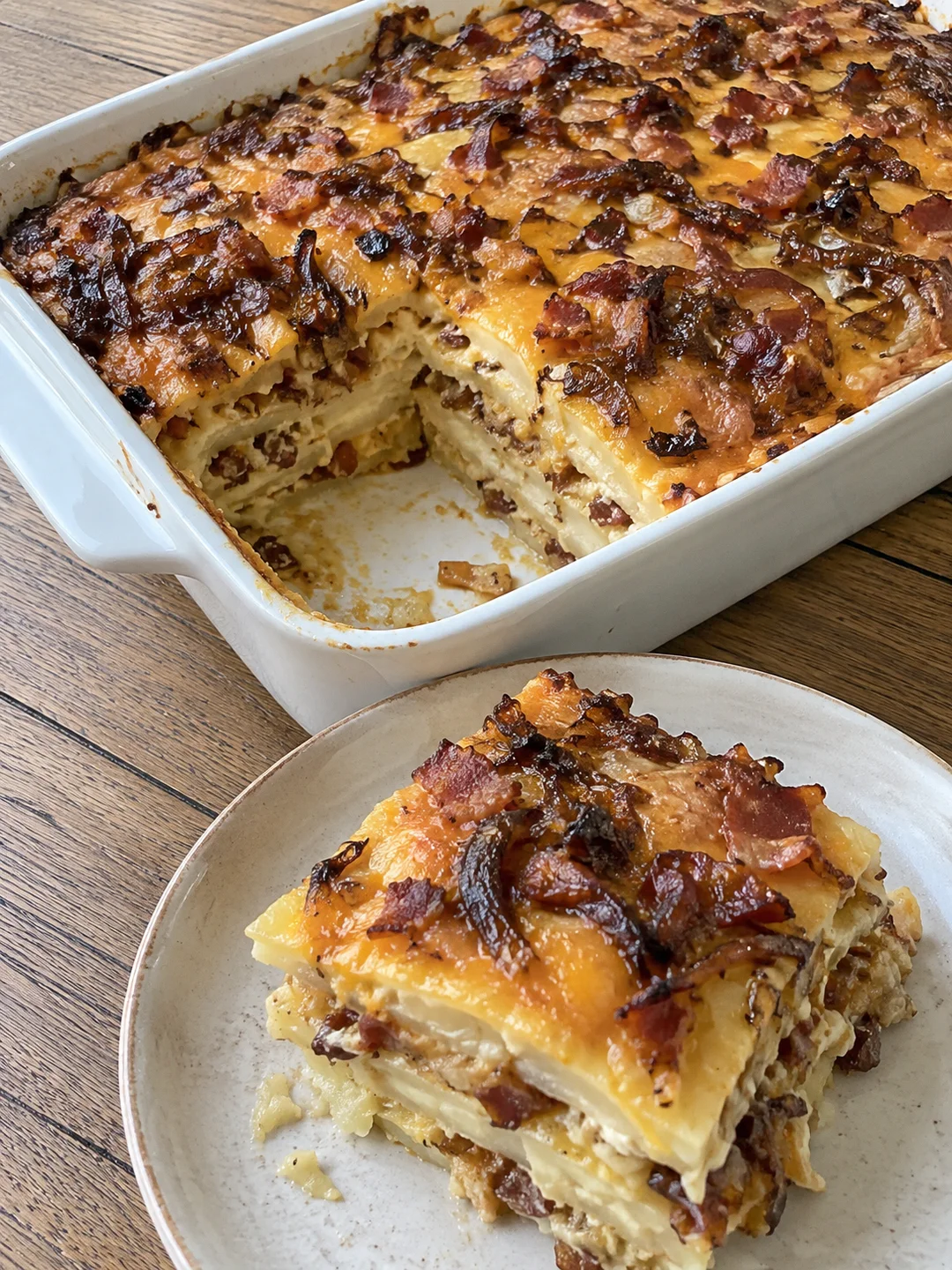
- Cover tightly with foil and bake 35 minutes. Uncover and bake another 15 to 20 minutes, until the cheese is bubbling and the onions on top have browned into a golden crust.
- Let the casserole rest 15 minutes before cutting. It needs that time to set, or the layers will slide apart on the spatula.