
The first Sweet Potato Souffle that made sense to me came out of a wine bar kitchen on a Tuesday night in Charleston, and it was not even on the menu. The place seats maybe eighteen people. I had the counter seat because I arrived alone and early.
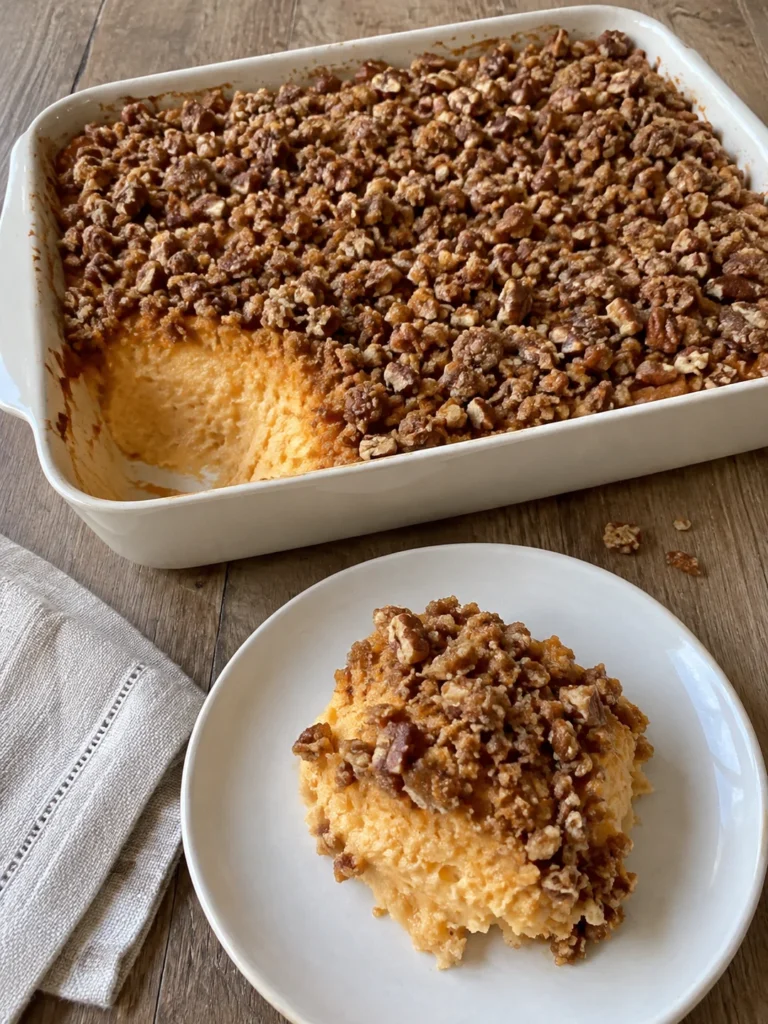
The chef was between courses, fussing over a small dish he kept tasting and frowning at. He slid a spoonful across the counter to me without asking. Warm, whipped, sweet but not cloying, with a brown sugar crust on top that cracked when the spoon went in.
He said he was working out whether he could serve it in October instead of waiting for Thanksgiving like everyone else. His name was Marcus and he did most of the explaining with his hands, tapping the bowl, miming the fold of egg whites, pointing at the oven behind him like it was a person he argued with regularly.
What Marcus Told Me Between Courses
He was very clear that it is not a French souffle. No ramekin. No bechamel base. It does not collapse if you dawdle on the way to the table, which he seemed personally relieved about.
The souffle name just signals the texture. Whipped egg whites folded into the puree at the end, so it eats lighter than a hand-mashed casserole. Same dish family, different handling.
He also told me the marshmallow thing is younger than most people assume. That version came out of a 1917 promotional booklet published in Boston for a marshmallow company, written by Janet McKenzie Hill of the Boston Cooking School Magazine. Southerners apparently resisted it at first, on the grounds that sweet potatoes deserved better than candy.
The pecan streusel developed separately in the South. Both are considered traditional now, which is how food usually works if you wait long enough.
The Part About Sweet Potatoes That Surprised Me
Sweet potatoes are a New World tuber, native to Central and South America. Their place in Southern and African-American cooking descends from Native American foodways, and enslaved Africans are believed to have taken up the sweet potato as a stand-in for the West African yam.
Which means the word yam on a grocery store bin is doing something misleading. Those orange-fleshed things are sweet potatoes, botanically unrelated to true African yams. Marcus rolled his eyes about this at the counter. I have since rolled mine about it too.
The dish sits on the Thanksgiving and Christmas table as a side, next to the roast, even though it is sweet enough to read as dessert. Recipes get inherited and guarded. That part came through in how carefully he talked about it.
Bringing the Souffle Home to My Kitchen
I made it the following week. Bought five sweet potatoes at the Sunday farmers’ market from the stand that also sells persimmons in autumn, and roasted them whole at 400 F.
Do not boil them. Boiling waterlogs the flesh and rinses away the exact sugar you are trying to concentrate. I know this because the first time I made it I boiled them, out of impatience, and ended up with something loose and pale that tasted like a memory of sweet potato.
Roasting takes 60 to 75 minutes and you want the skins weeping a little syrup. A knife should slide through with no argument. Undercooked sweet potato will not mash smooth, ever, no matter how long you beat it.
This is a long cook, so I make it an event. Rickie Lee Jones on the speaker, a bowl of salted almonds, a glass of whatever white is open. By the time the potatoes came out the whole apartment smelled like caramel and the kitchen window had fogged at the corners.
What Goes Into It
- 4 lb fresh sweet potatoes, about five medium, not canned
- 8 tbsp unsalted butter, softened, plus more for the dish
- 3/4 cup packed light brown sugar
- 4 large egg yolks, room temperature
- 4 large egg whites, room temperature
- 1/2 cup heavy cream, or whole milk
- 2 tsp vanilla extract
- 1 1/2 tsp ground cinnamon
- 1/2 tsp ground nutmeg, grated fresh if you have a whole one
- 1 tsp salt
- 1 cup pecans, roughly chopped
- 1/2 cup packed light brown sugar for the topping
- 1/3 cup all-purpose flour for the topping
- 4 tbsp unsalted butter, melted, for the topping
The Fold Is the Only Fussy Part
Everything else is forgiving. The fold is not.
Beat the peeled flesh completely smooth first, then add butter, brown sugar, yolks, cream, vanilla, cinnamon, nutmeg, salt. Beat again until it is light and uniform. Then walk away and let it cool to barely warm.
If you fold cold whites into a hot base you will watch every bit of air you whipped disappear in about nine seconds. I have done it. It was demoralising.
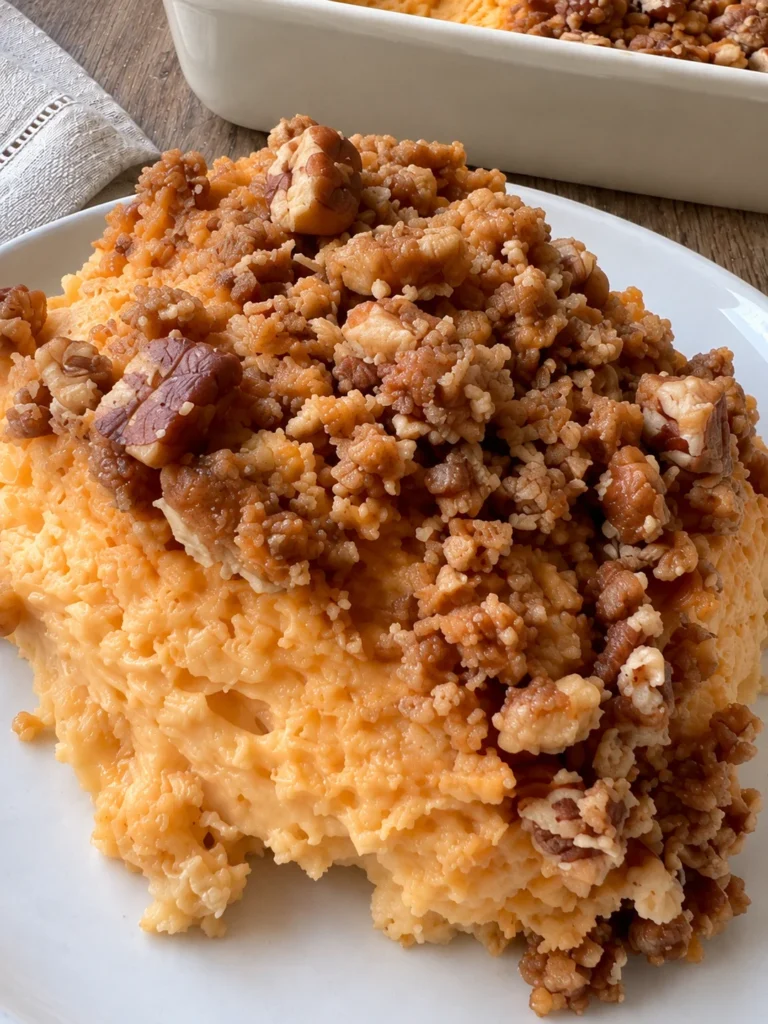
Whip the whites to soft peaks in a grease-free bowl. Soft, not stiff. They should flop over gently when you lift the beater. Fold a third in to loosen the base, then the rest in two goes, cutting down the middle and sweeping up the side with a spatula. Stop the second the white streaks vanish.
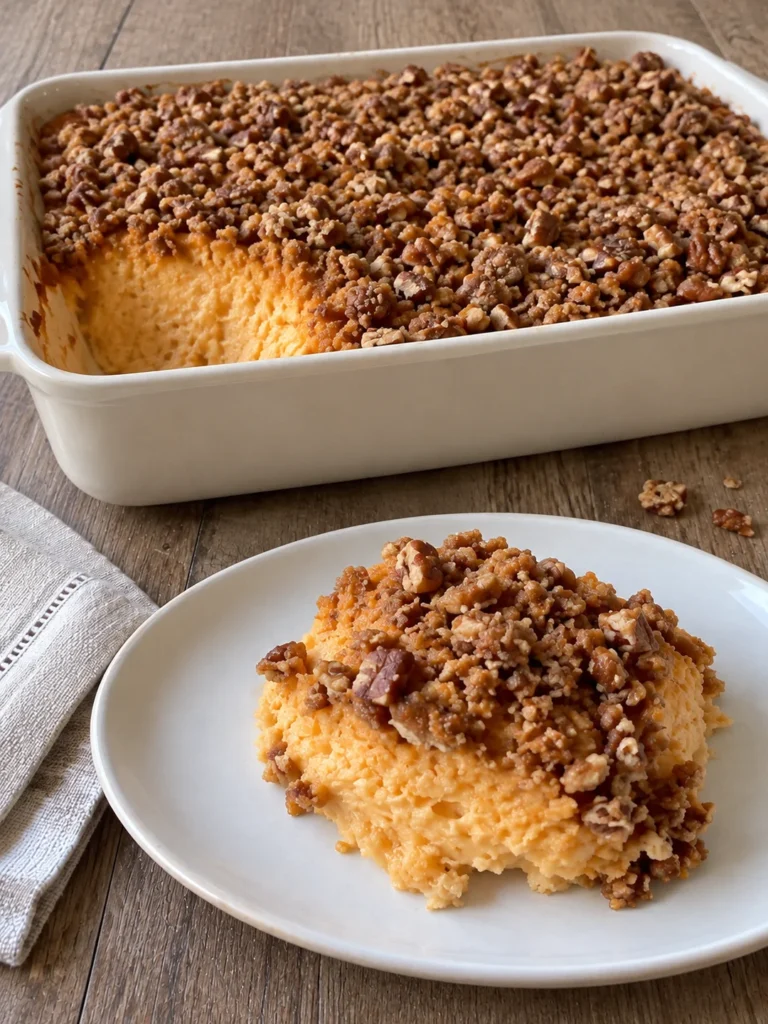
Spread it into a buttered 9×13 without pressing it down. Scatter the pecan streusel edge to edge. Bake at 350 F for 40 to 45 minutes until the edges bubble and the top goes deep gold.
Twists, and the Marshmallow Question
For the Deep South version, skip the streusel entirely and cover the top with miniature marshmallows for the last 10 minutes. For a version that commits to nothing, do both, marshmallows over the streusel for the final 8 minutes.
I go streusel only. The crackling brown sugar lid is the whole reason I fell for this at that counter in Charleston, and the southern sweet potato souffle I keep coming back to is the one where the pecans are doing the work.
You can roast and mash up to two days ahead and refrigerate. Bring it back to room temperature before you build. Leftovers hold four days and reheat at 325 F for about twenty minutes.
Though I mostly eat the leftovers cold. Straight from the dish, standing at the counter, before coffee. Better than it has any right to be.
Marcus never did put it on the October menu, as far as I know. But I think about that spoonful across the counter every time I turn the oven to 400. Some dishes you carry home in your suitcase, and some you carry home in your head.
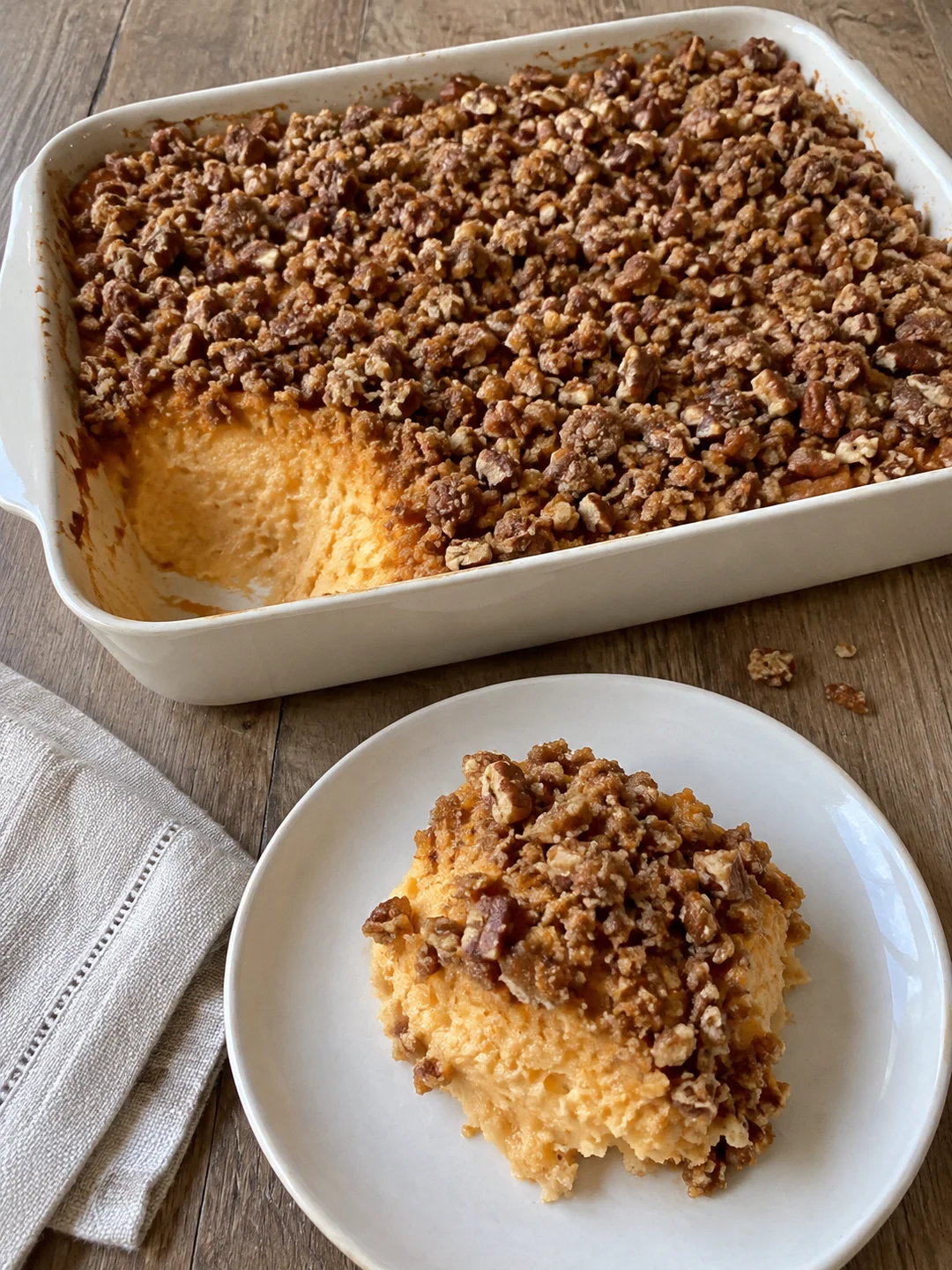
Sweet Potato Souffle
Ingredients
Equipment
Method
- Heat the oven to 400 F. Line a rimmed baking sheet with foil. Prick each sweet potato all over with a fork and set them on the sheet.
- Roast until a knife slides through the thickest part with no resistance and the skins have started to weep syrup, 60 to 75 minutes depending on size. Undercooked sweet potato will not mash smooth, so give them the extra time if you are unsure.
- Let the potatoes cool until you can handle them, then slip off the skins and discard. You should have about 6 cups of flesh.
- Lower the oven to 350 F. Butter a 9x13 inch baking dish.
- Put the peeled sweet potato flesh in a large bowl and beat with an electric mixer until completely smooth, about 2 minutes. Add the softened butter, 3/4 cup brown sugar, egg yolks, heavy cream, vanilla, cinnamon, nutmeg, and salt. Beat until light and uniform, about 2 minutes more. Let the mixture cool to just barely warm.
- In a clean, grease-free bowl, whip the egg whites on medium-high speed to soft peaks. They should hold a shape that gently flops over when you lift the beater, not stand stiff and dry.
- Fold one third of the whites into the sweet potato mixture with a rubber spatula to loosen it. Fold in the remaining whites in two additions, cutting down through the center and sweeping up the side of the bowl. Stop as soon as no white streaks remain.
- Spread the mixture into the buttered dish in an even layer. Do not press or pack it down.
- Make the topping. In a bowl, stir together the chopped pecans, 1/2 cup brown sugar, flour, and melted butter until the mixture clumps together in coarse crumbs.
- Scatter the streusel evenly over the surface, covering it edge to edge.
- Bake for 40 to 45 minutes, until the center is set, the edges are bubbling, and the topping is deep golden and fragrant. A knife inserted in the middle should come out clean.
- Let it rest 10 minutes before serving. Unlike a French souffle, this one will not fall, so there is no rush to the table.