
The first pecan pie cobbler I ever ate came out of a dented foil pan under a tent in Colfax, Louisiana, handed to me in a styrofoam bowl by a woman wearing two oven mitts. It was the first weekend of November and the pecan festival had swallowed the whole town.
A man was playing accordion about twenty feet away and the line for the dessert tent ran past the portable bathrooms and around a truck. I had driven in that morning with no plan beyond eating whatever people handed me.
I did not expect a dessert to reorganize my autumn. I came home and bought a 9×13 dish specifically for this.
Standing in Line at the Louisiana Pecan Festival
The line moved slowly because everyone ahead of me knew everyone else serving. Pies, praline, pecan brittle in paper bags, and then at the far end of the table a pan of something that looked like it had collapsed on purpose.
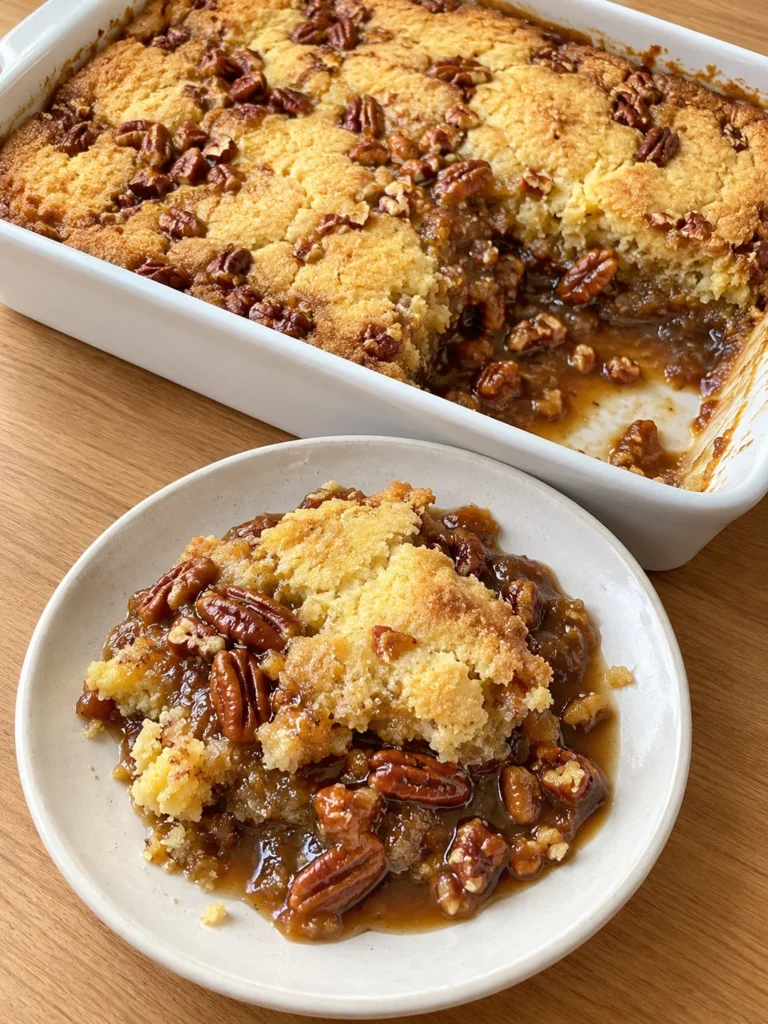
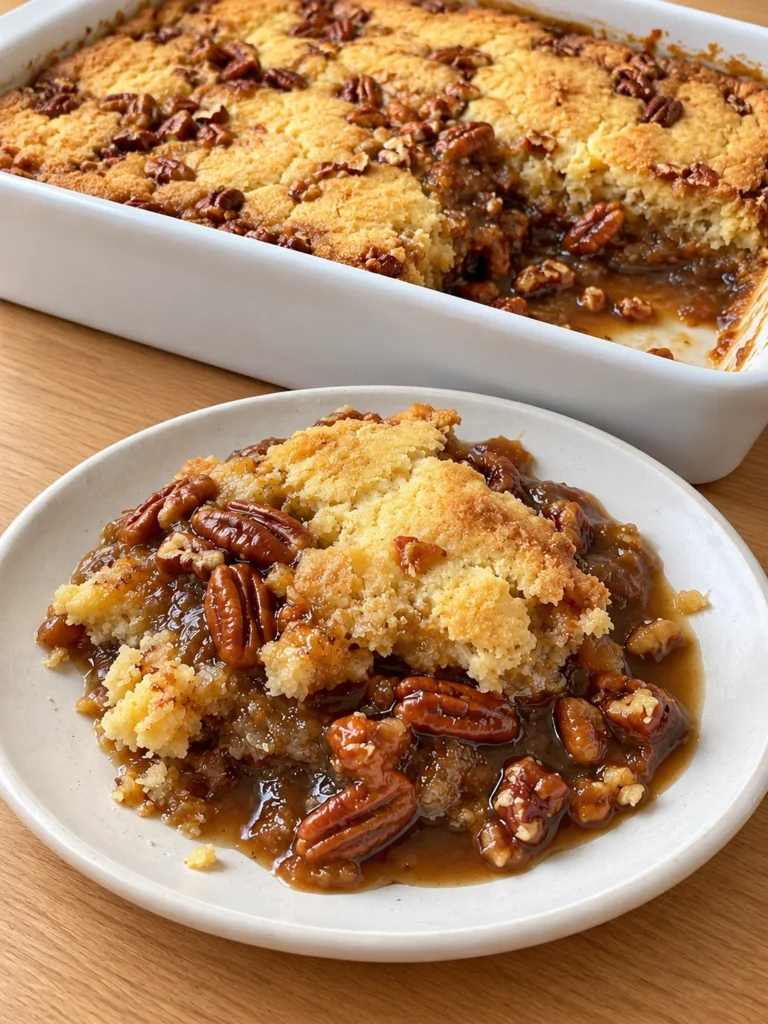
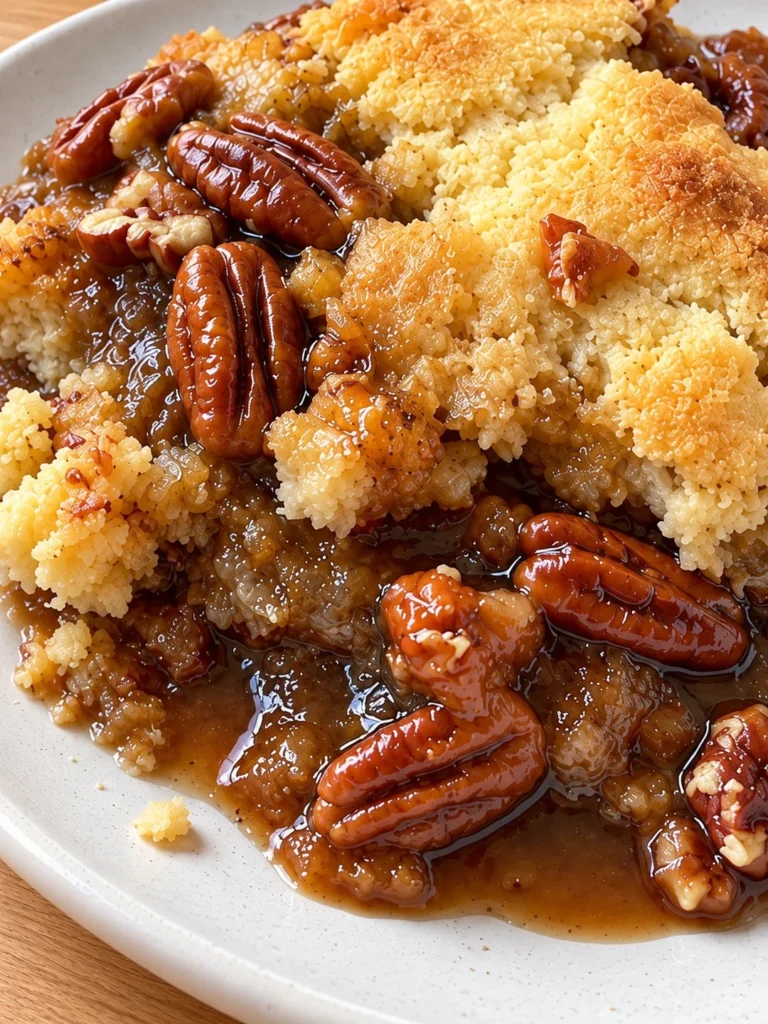
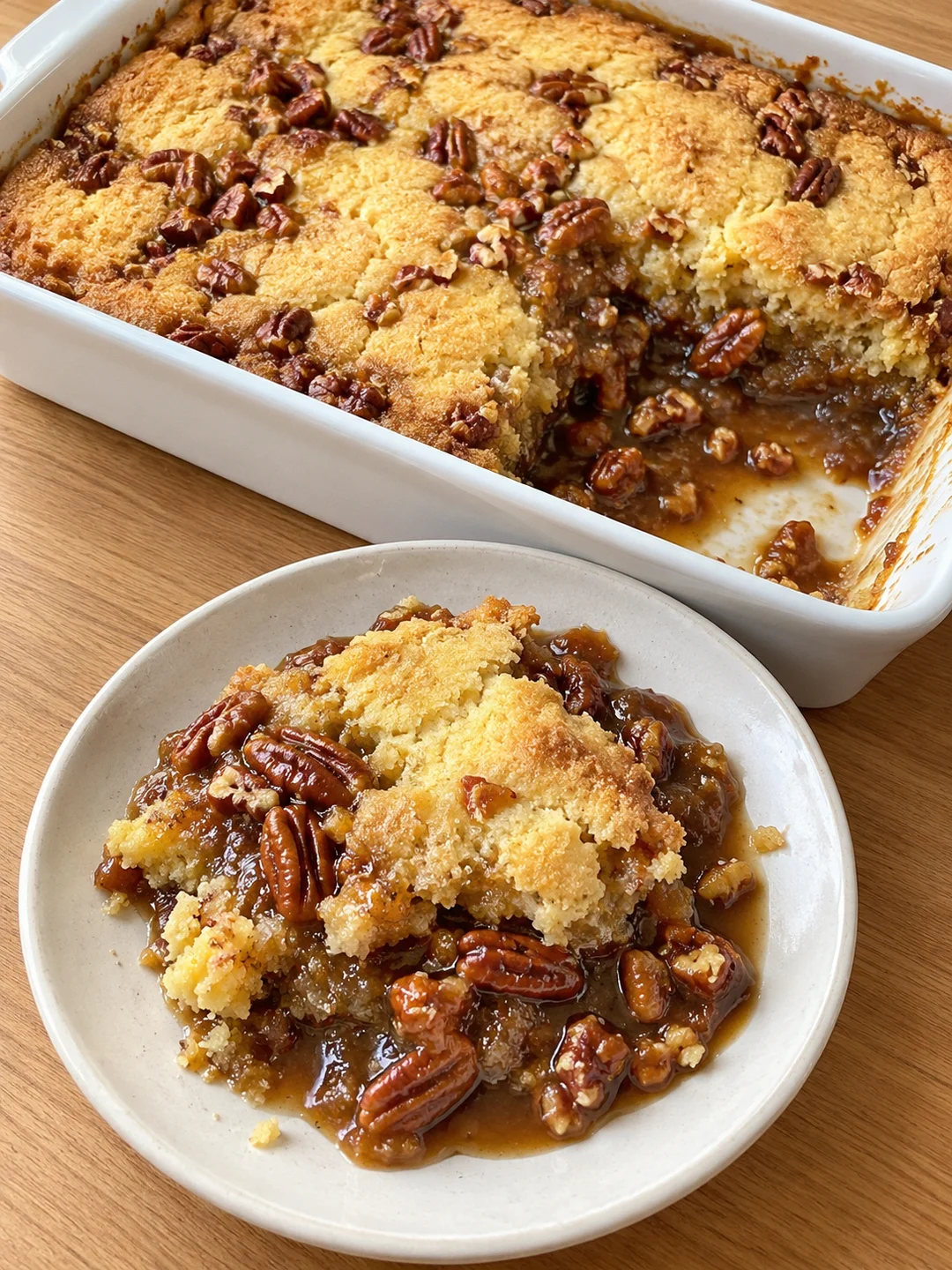
The woman with the oven mitts told me to let her dig down for the bottom, because the bottom is the whole point. What came up was a golden cake lid sitting over dark caramel and soft pecans, loose enough to pool against the side of the bowl.
She dropped a scoop of vanilla ice cream on top without asking. That is not a garnish down there, it is part of the recipe, and I have stopped arguing about it.
I ate it standing up next to a fence, watching two kids argue over a bag of brittle. Warm sauce, cold ice cream, accordion. I went back for a second bowl twenty minutes later and did not feel bad about it.
Odette Wrote It on a Napkin
I was staying three nights in a room at the back of Odette’s house, about fifteen minutes out of town, which is how I had heard about the festival at all. When I came back raving about the cobbler she laughed at me, because of course she makes it, and so does everyone she knows.
She wrote it out on a paper napkin at her kitchen table while the coffee was going. There is a grease spot in the top corner where the napkin sat near her skillet, and the words DO NOT STIR are underlined twice, hard enough that the pen went through in one spot.
I still have the napkin. It lives in the drawer with the takeout menus and I take it out every October.
Pecan Pie Cobbler Is Not Pecan Pie
I assumed this was some ancient antebellum thing passed down through generations. It is not. The cobbler version is a 20th-century home-kitchen invention, a way to get pecan pie flavour into a pan big enough for a church supper without rolling, chilling and crimping a crust for twenty people.
Its two parents are much older. Cobblers came over with English colonists who had no suet and no proper equipment for steamed puddings, so they baked sweet fillings under biscuit dough or batter instead. Pecans are native to North America and were a staple food of Indigenous peoples long before French settlers in Louisiana started folding them into their baking in the 1800s, with the first printed pecan pie recipes turning up in Southern newspapers and cookbooks in the 1880s and 1890s.
The glossy, super-sweet pecan pie most people picture is largely a 1930s thing, pushed by the Karo corn syrup company right on the bottle label. Which is why I feel no guilt at all leaving corn syrup out of this. Brown sugar, butter and boiling water do the work.
Two more things it is not. It has no egg custard and no pastry shell, so you spoon it rather than slice it. And despite the name there is no fruit involved, the word cobbler here refers only to the batter-over-filling, scoop-it-out format.
What I Used
- Unsalted butter, one stick, cut into pieces so it melts evenly
- All-purpose flour, spooned and levelled, not scooped
- Granulated sugar for the batter
- Baking powder and salt
- Whole milk at room temperature
- Vanilla extract, or bean paste if I have it open
- Pecan halves, coarsely chopped, two full cups
- Dark brown sugar, packed hard into the cup
- Boiling water, genuinely boiling, straight off the kettle
- Vanilla ice cream, which is not optional in Colfax and is therefore not optional here
The pecans matter more than anything else on that list. I buy them from the nut stall at the Wednesday farmers market near my apartment rather than the supermarket, because supermarket pecans have usually been sitting long enough to taste faintly of cardboard. Smell them first if you can.
What Happens Under the Crust
The butter goes into the dish alone and into the oven for five or six minutes, until it is fully melted and just starting to smell toasted. Do not tilt the dish when you pull it out. You want that pool flat and undisturbed.
The batter goes on in dollops, thick like pancake batter, floating on top of the butter with gaps showing at the edges. Then the chopped pecans, then the brown sugar in an even blanket all the way into the corners. Then the boiling water, poured slowly back and forth across the whole surface so no single spot gets a crater.
At this point it looks wrong. Soupy, swimming, like you have ruined it. Odette warned me about exactly this moment and she was right.
In the oven the layers trade places. The batter is lighter than the sugar water, so it rises through and sets into a golden cake lid, while the brown sugar, butter and water sink and reduce underneath into a dark caramel with the pecans suspended in it. The edges go thick and bubbling and almost black before the centre catches up.
The first time I made it I stirred the water in, because stirring felt like the obvious thing to do. I got pecan sludge with no crust and no sauce. Honestly it was still edible with ice cream, but nobody would have queued for it.
Two more mistakes worth avoiding. Lukewarm water will not set the caramel bottom, so boil it properly. And leaving it in longer does not improve it, extra oven time just evaporates the sauce and you end up with a dry cake sitting on sticky nuts.
Then you rest it thirty minutes, which is the hardest part. Straight out it looks far too loose. Thirty minutes on a rack and the sauce under the crust thickens into something you can spoon.
Swaps I Have Tried
Swapping two tablespoons of the dark brown sugar for two tablespoons of molasses gives it a deeper, slightly bitter edge that I like in late November. Maple syrup in place of some of the brown sugar works too, though it goes gentler and less caramel-forward. I have seen it made with pecans and nothing else fancy at all, which is probably the most honest version.
Cold heavy cream poured straight over a hot portion is the best thing I have done to it. Hot coffee alongside. Leftovers, spooned out of the fridge at eleven at night, are a different dessert entirely and I am not sure they are worse.
I made it last on a stupidly warm October evening with the windows open and Lucinda Williams going, and for about ten minutes the kitchen smelled like that tent in Colfax. No accordion, no crowd, no man selling brittle out of a paper bag. Still worth the pan.
Pecan Pie Cobbler
Ingredients
Equipment
Method
- Heat the oven to 350 F. Put the butter pieces in a 9x13 inch baking dish and slide the dish into the oven for 5 to 7 minutes, until the butter is fully melted and starting to smell nutty. Take it out and set it on a trivet. Do not tilt or swirl it.
- While the butter melts, whisk the flour, granulated sugar, baking powder and salt together in a medium bowl. Pour in the milk and vanilla and whisk just until smooth, about 30 seconds. The batter will be thick, like pancake batter.
- Spoon the batter in dollops evenly over the melted butter, covering as much of the surface as you can. Do not stir it in. Leave the butter visible around the edges — it will work its way up during baking.
- Scatter the chopped pecans evenly over the batter, then sprinkle the dark brown sugar over the pecans in an even blanket all the way to the corners. Still no stirring.
- Bring the water to a full rolling boil. Pour it slowly and evenly over the entire surface, moving in a back and forth pattern so no single spot gets flooded. The top will look alarming and soupy. This is correct. Do not stir.
- Bake 35 to 45 minutes, until the top is golden brown and set to the touch and the edges are bubbling thick and dark. A few cracks on the surface are fine. If the center still jiggles like liquid under the crust, give it 5 more minutes.
- Rest the cobbler on a rack for 30 minutes before serving. The sauce under the crust thickens into caramel as it cools. Spoon out portions, digging down to pull up the pecan sauce from the bottom, and serve warm.