
Grinch cookies turned up at the end of a dinner I was never supposed to be at. North End Halifax, second week of December, snow coming sideways off the harbour and into my collar.

I had walked over to find a bakery someone had told me about, found it shut, and then noticed the lights on upstairs. Eight people at one long table. A woman in the stairwell waving me up because a guest had cancelled and the food was already counted.
Forty dollars, cash. Scallops, braised cabbage with mustard, a bottle of cider passed down the table. And then the chef came out with a bowl of dough the colour of a highlighter pen and made dessert in front of us while she talked.
The Night Margot Made Grinch Cookies in Halifax
Her name is Margot Doiron. Thirty-one, trained in Montreal, came back east because her aunt owns the bakery downstairs and let her run a supper club out of the kitchen two nights a week in winter.
She rolled the cold dough balls while she explained herself. She said she puts the Grinch cookies on the December menu because adults order them with the exact same face children do, and because the moment the trays come out of the oven there is a thirty second window where you can press the red heart in and have it stick. She let the guy next to me do a tray. He was maybe fifty and he did it with his tongue between his teeth, concentrating.
We swapped numbers over the last of the cider. She still sends me photos of her trays and her aunt’s dog, and I send her mine. Last January she texted me a picture of a flat failed batch with the caption “kitchen too warm.” Even she gets it wrong.
Why Grinch Cookies Are Green and Newer Than You Think
Margot said something at the table that I went and checked later, because it sounded too neat. The Grinch was not green in the book. Dr. Seuss drew him in black and white in 1957, and the sour green came from Chuck Jones’s 1966 animated special, where the colour is said to have been picked off a rental-car paint chip.
So the cookie is green because of a cartoon, not because of the story. And the cookie itself is young. It grew out of two American habits, the mid-century cake-mix dump cookie and the powdered-sugar crinkle, and food bloggers started posting bright green versions in the early 2010s before Pinterest and then TikTok turned them into one of the most-searched novelty Christmas cookies in the country.
No heritage here. No grandmother. A 21st-century internet cookie, and I like it more for being honest about that.
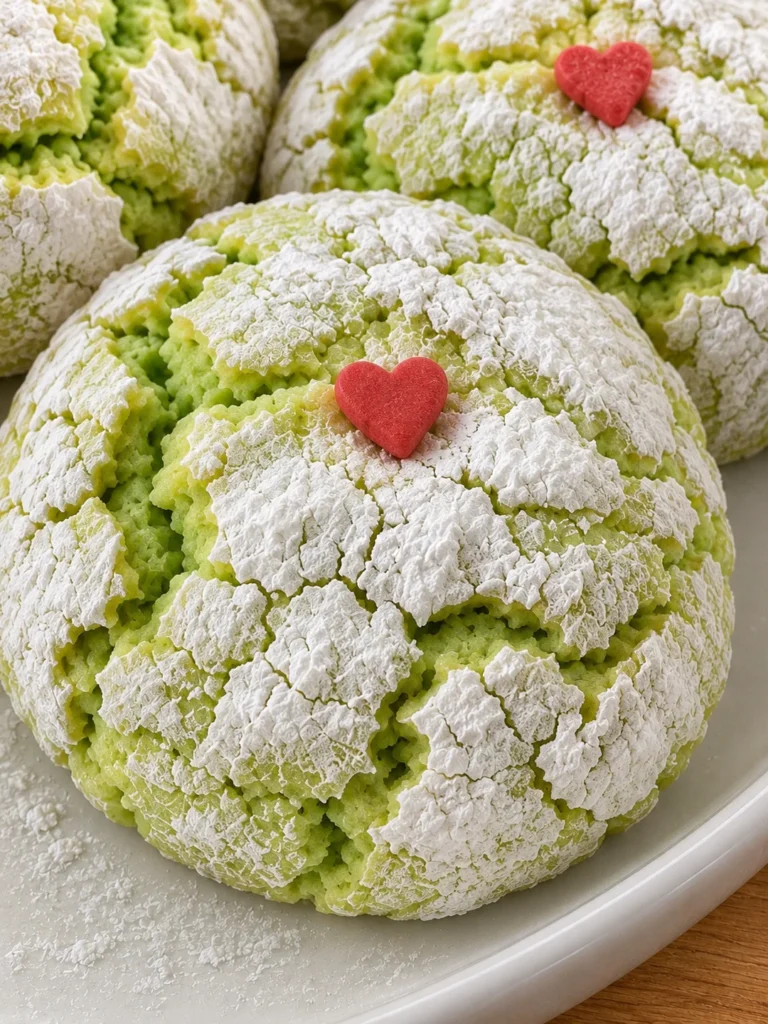
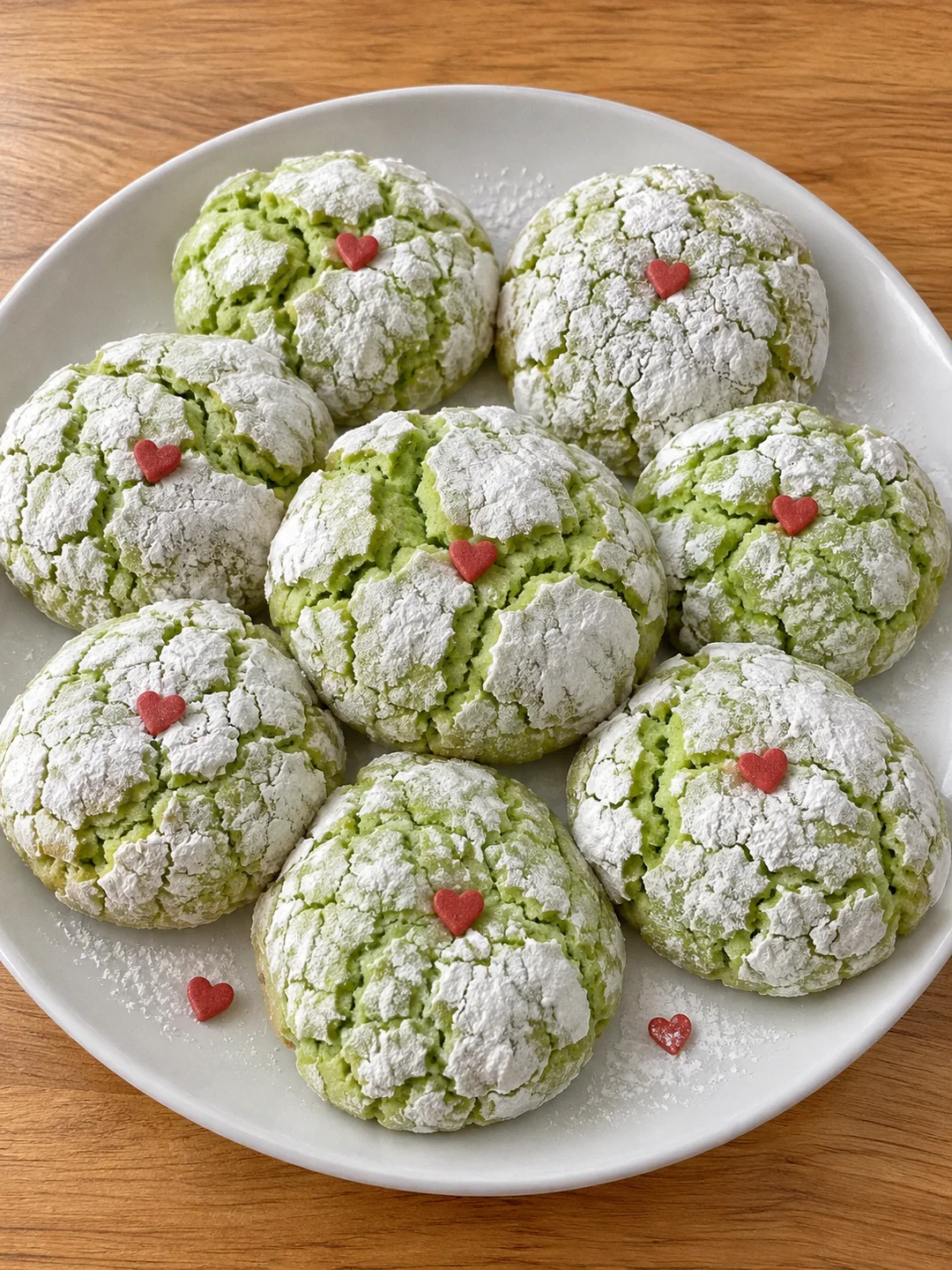
The other thing worth saying is what Grinch cookies are not. They are not green sugar cookies and they are not green chocolate chip cookies. The version people actually mean is the crinkle, cracked white over green, one red heart in the middle for the heart growing three sizes. Margot makes hers from scratch, no cake mix, and I agree with her. The crumb is chewier and you can taste butter instead of box.

What I Used
- All-purpose flour, spooned and levelled, not scooped
- Baking powder and a small amount of baking soda
- Fine sea salt, more than you think a cookie needs
- Melted unsalted butter, cooled a little
- Neutral oil, three tablespoons, which is what keeps them chewy
- Granulated sugar for the dough, plus more for the first roll
- Two eggs at room temperature
- Vanilla extract, and a quarter teaspoon of almond extract
- Green gel food colouring, never liquid
- Powdered sugar, sifted, for the second roll
- Red heart sprinkles, or red hots, or red M&M’s if that is what the shop has
Where This Dough Punishes You
Three places. The colouring, the chill, and the thirty seconds after the oven.
Gel only. Liquid colouring thins the dough and you will keep adding it chasing a bold green, and at some point the cookie tastes faintly bitter and chemical. More colour is not better. Mix the wet batter one shade darker than you want the finished cookie, because green fades in the oven, and then stop.
Then you wait. An hour in the fridge minimum, and this is not a suggestion. The first time I made these I had the oven already hot and I thought I would get away with twenty minutes of chilling. Flat green discs. No cracks at all. I always chill an hour now, except the time I forgot the bowl for two days, which honestly baked better than any batch since.
And the heart. Press it in within about half a minute of the sheet leaving the oven, while the surface is still soft and glossy. On a cooled cookie it sits on top and rolls off. I keep the sprinkles in a little bowl right next to the stove now, lid off, because fumbling with a packet costs you the window.
Baking Them in My Own Kitchen
I make these on a Sunday afternoon in December, which is the only time of year my kitchen is cold enough that the dough behaves. Rain on the skylight last time, radio on, two half-sheet pans, one of them warped at the corner so it rocks and I always load that one second.
I buy the gel colouring at a cake-decorating shop in Culver City where the woman behind the counter sells it by the single pot and talks me out of the cheap sets. Worth the drive. The heart sprinkles I get there too, which saved me from the year I tried to cut hearts out of red fruit leather with a paring knife.
Scoop a level tablespoon, roll smooth between your palms, granulated sugar first, then drop it into the sifted powdered sugar and coat it like a snowball. Generously. A polite dusting disappears in the oven and you get no contrast at all.
Bake one sheet at a time, nine to twelve minutes, and pull them while the centres still look underdone and wet. Do not wait for browning. They finish setting on the hot pan, and that is where the chew comes from.
Swaps That Still Work
A boxed white or vanilla cake mix will get you there, and plenty of people make them that way. It is faster and it tastes like a mix, which some people genuinely want. No judgement.
Skip the almond extract if you dislike it, though a quarter teaspoon rounds out the sweetness in a way I notice. Red hots and red M&M’s both work for the heart if you cannot find sprinkles. And the dough balls freeze beautifully for three months, rolled in both sugars straight from frozen with two extra minutes in the oven.
I ate four of them standing at the counter the first time they came out right, which is more than I will admit to anyone. Margot got a photo. She wrote back one word, “cracks,” with a thumbs up, and that was the whole review I needed.
Grinch Cookies
Ingredients
Equipment
Method
- Whisk the flour, baking powder, baking soda and salt together in a medium bowl and set aside.
- In a large bowl, beat the melted butter, oil and 1.25 cups granulated sugar on medium speed for 1 minute until glossy and well combined.
- Add the eggs one at a time, beating 20 seconds after each. Beat in the vanilla and almond extract.
- Add the green gel food coloring and beat until the wet mixture is a uniform, deep green. Go one shade darker than you want the finished cookie, because the color lightens in the oven. Add gel a little at a time rather than all at once.
- Add the dry ingredients and mix on low just until no streaks of flour remain, about 30 seconds. The dough will be soft and sticky. Do not overmix.
- Cover the bowl and chill the dough in the refrigerator for at least 1 hour, or up to 2 days. This step is not optional. Cold dough puffs and cracks; warm dough spreads flat.
- Preheat the oven to 350 F and line two baking sheets with parchment paper. Put 0.5 cup granulated sugar in one shallow bowl and the sifted powdered sugar in another.
- Scoop level 1 tablespoon portions of cold dough and roll each between your palms into a smooth ball.
- Roll each ball first in the granulated sugar, then drop it into the powdered sugar and roll until it is heavily and completely coated, like a snowball. Coat generously; a thin dusting will vanish as it bakes.
- Arrange the balls 2 inches apart, no more than 12 per sheet. Keep the remaining dough in the refrigerator while each batch bakes.
- Bake one sheet at a time for 9 to 12 minutes, until the tops are puffed and split with white cracks and the centers still look slightly underdone and glossy. Do not wait for the edges to brown.
- Working fast, press one red heart sprinkle into the center of each hot cookie while it is still soft, within about 30 seconds of leaving the oven. On a cooled cookie the heart will not stick.
- Let the cookies set on the sheet for 5 to 10 minutes to finish firming up, then transfer to a wire rack to cool completely. Repeat with the remaining chilled dough.