
The best m&m cookies I have ever eaten came off a chipped white plate at a diner counter in Hackettstown, New Jersey, somewhere around four in the afternoon. I was driving west out of Newark with a rental car that smelled like pine air freshener and a six-hour stretch ahead of me.

I stopped because I needed coffee and because the sign outside promised pie. There was no pie left.
The Counter in Hackettstown
What there was, under a scratched plastic dome by the register, was a stack of cookies the size of my palm with candy shells pressed into the tops. The woman working the counter, Donna, said her daughter made them and that they went faster than anything else she sold.
I ate two standing up before I even sat down. They were thick in the middle in a way that felt almost undercooked, with edges that snapped, and the chocolate inside the candy was still a little soft because the batch had come in an hour earlier.
Here is the part I did not know until later. Hackettstown is where Mars has made M&M’s for decades, which means I was eating candy cookies about ten minutes from where the candy comes out of the machines. Donna shrugged when I said that. To her it was just the plant where half the town worked.
I asked how her daughter made them. Donna said she did not know exactly, but that the candy goes in by hand and the pretty ones go on top, and that was the whole secret as far as she was concerned. She was right about more than she realized.
A Back-of-the-Bag Recipe That Took Over the Country
M&M’s were created by Forrest Mars Sr. and Bruce Murrie and went on sale on September 10, 1941, produced in Newark and sold almost entirely to the U.S. military. The hard sugar shell was the whole point. Chocolate that would not melt in a soldier’s pocket.
Once the candy reached supermarkets after the war, Mars printed a recipe called Party Cookies on the back of the bag, aimed straight at the people already baking Toll House chip cookies. That recipe is the ancestor of essentially every m&m cookie recipe you will find today, including the one I make.
The original was not a butter cookie. It called for shortening, which is why the vintage version is paler and cakier than the thick bakery-style thing most of us picture now. I have made it the old way once, out of curiosity. It was fine. Soft, a little bland, oddly nostalgic even though I have no nostalgia for it. I use butter and more brown sugar than white, which is the modern American adaptation and, I think, the better one.
Chocolate chips are also not original. They are a popular addition, nothing more, and I go back and forth on them.
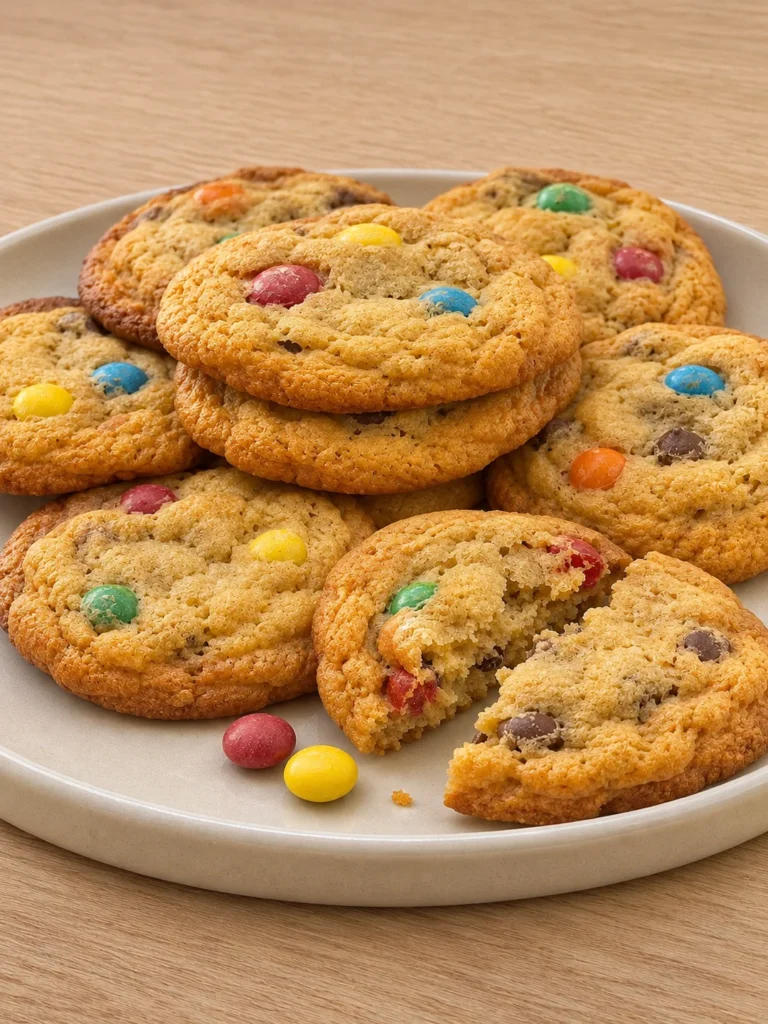
What I Used
- All-purpose flour, 2 1/4 cups, spooned into the cup and leveled with a knife, never scooped
- Baking soda, 1 teaspoon
- Salt, 3/4 teaspoon, fine
- Unsalted butter, 1 cup, softened but still cool to the touch
- Light brown sugar, 1 cup, packed down properly
- Granulated sugar, 1/2 cup
- Two large eggs, left on the counter a while
- Vanilla extract, 2 teaspoons, the real stuff
- M&M’s milk chocolate candies, 1 1/2 cups for folding in
- Another 1/2 cup of M&M’s, held back for the tops
- Semi-sweet chocolate chips, 1/2 cup, optional and honestly skippable
I buy the big share-size bags at the grocery near my apartment because the small bags work out to robbery. Seasonal color packs show up in October and stay through February, which is the only time my cookies look coordinated.
Where Most People Ruin Their M&M Cookies
Flat, greasy cookies are almost never the recipe’s fault. It is warm butter, or flour scooped straight out of the bag so you packed in an extra two ounces without knowing, or dough dropped onto a sheet that just came out of the oven.
The butter one got me first. I creamed it on a September afternoon with the windows open and the kitchen at least eighty degrees, and the mixture never went properly fluffy, it just went slick. The first tray spread into one continuous cookie the size of the pan. I cut it into squares and ate it anyway.
Now I press the butter with a thumb before I start. If it dents and holds the dent, it is ready. If my thumb sinks straight through, it goes back in the fridge for fifteen minutes and I wait.
The mixer stays out of it once the candy appears. Beat M&M’s into dough with a paddle and the shells crack, which bleeds red and blue streaks through everything and makes the finished cookies look bruised. Fold them in with a spatula, slowly, like you are being careful on purpose. Mine is a cheap flexible one with a stained handle that has survived four apartments.
Then the chill. Twenty minutes on the scooped mounds, which firms the butter enough that the cookies climb instead of puddle. I always do this. Except when I do not, which is maybe a third of the time, and those batches are noticeably flatter and I pretend not to notice.
Last thing. Pull them while the centers still look puffy and raw and wrong. Five minutes on the hot sheet finishes the job, and that is where the soft middle comes from. Waiting for the middle to brown gives you a cookie that is correct and boring.
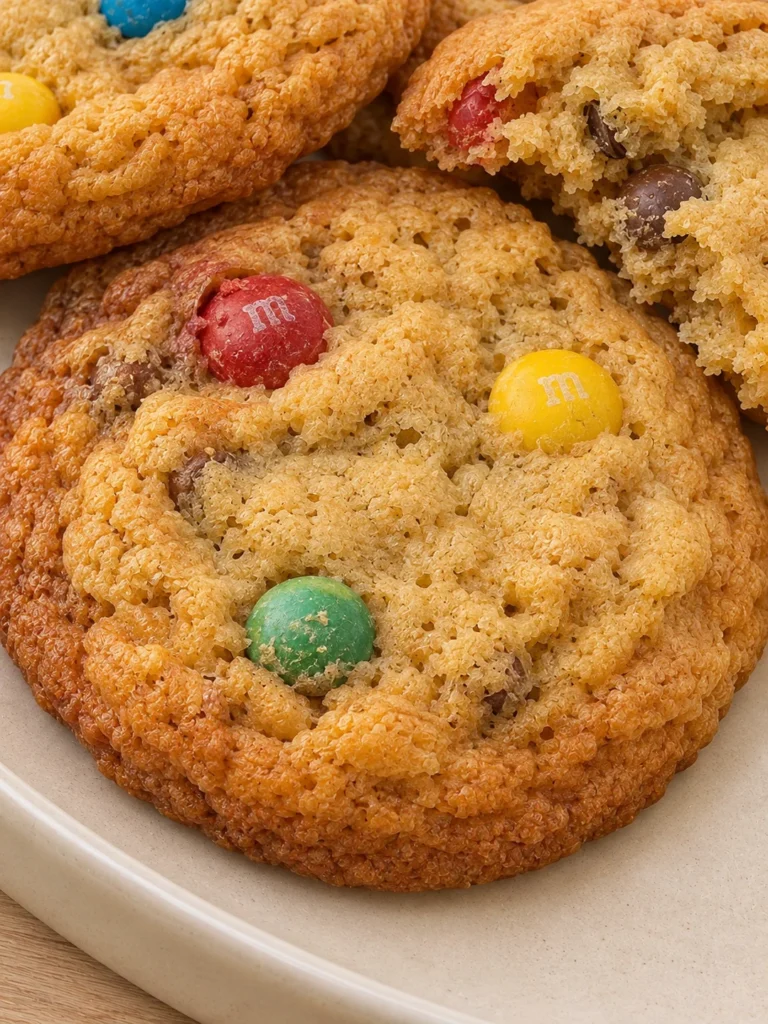
Swaps, and the One Thing I Cannot Recreate
Peanut M&M’s make a chunkier, lumpier cookie that I like more than I expected. Holiday color packs are purely cosmetic and work exactly the same. The dough keeps three days covered in the fridge, and scooped mounds freeze for three months, baked straight from frozen with two extra minutes.
I have also started pressing two cooled cookies around a scoop of vanilla ice cream, which is less a recipe than a decision made at eleven at night.
What I cannot get back is the hunger. Four hours into a drive, running on gas-station coffee, anything warm tastes like a small miracle. My kitchen version is genuinely better than Donna’s daughter’s, I think, in the technical sense. It still does not taste like that first one did.
So I make them on Sunday mornings before the apartment heats up, when there is nothing to earn them with. They are bright and slightly ridiculous and the candy-pressing part is the best five minutes of the whole thing.
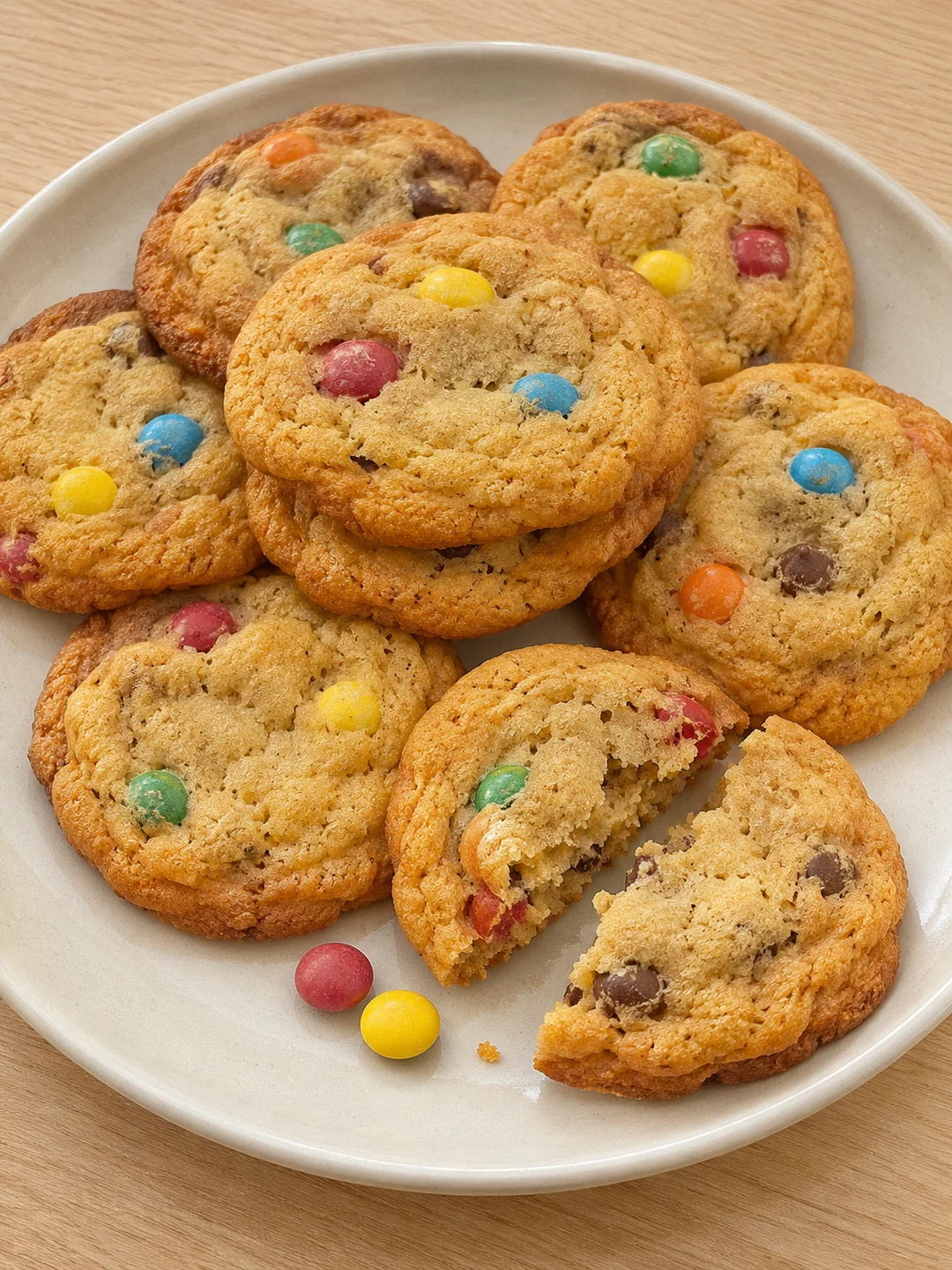
M&M Cookies
Ingredients
Equipment
Method
- Whisk the flour, baking soda and salt together in a medium bowl and set it aside. Measure the flour by spooning it into the cup and leveling the top with a knife; packing it in makes dry, cakey cookies, and too little makes them spread.
- Beat the softened butter, brown sugar and granulated sugar in the mixer on medium speed for 2 to 3 minutes, until pale and fluffy and no longer grainy at the edges. The butter should be cool enough to hold a dent when pressed, around 65 F.
- Add the eggs one at a time, beating 20 seconds after each, then the vanilla. Scrape the bowl down so nothing hides at the bottom.
- Add the flour mixture all at once and mix on low just until the last streaks of flour disappear, about 20 seconds. Stop there. Overmixing builds gluten and toughens the cookies.
- Switch to a rubber spatula and fold in the 1 1/2 cups M&M's and the chocolate chips, if using, by hand. Do not use the mixer for this step, or the candy shells crack and bleed color into the dough.
- Scoop 2 tablespoon mounds of dough onto a parchment-lined baking sheet, close together for now, and chill them in the refrigerator for 20 minutes. This firms the butter so the cookies bake up thick instead of flat.
- Meanwhile, heat the oven to 375 F and line a second baking sheet with parchment.
- Arrange 10 to 12 chilled dough mounds on a lined, cool baking sheet, spaced 2 inches apart. Press 3 or 4 of the reserved M&M's into the top of each mound, letting the colors show, and nudge the edges of the dough back into a round.
- Bake on the center rack for 10 to 12 minutes, until the edges are set and lightly golden but the centers still look puffy and slightly underdone. Do not wait for the middles to brown.
- Let the cookies sit on the hot sheet for 5 minutes to finish setting, then lift them to a wire rack to cool. Repeat with the remaining dough, always on a cool sheet.
- Eat them barely warm, while the chocolate inside the candy shells is still soft. Store cooled cookies in an airtight container for up to 4 days.