
The woman selling texas sheet cake cookies at the Saturday market in Fredericksburg, Texas, had a chalkboard that just said PECAN COOKIES, $2, which was underselling them badly. Her name was Darlene. She sold them out of a flat cardboard box lined with wax paper, one layer only, because stacking ruins the glaze.
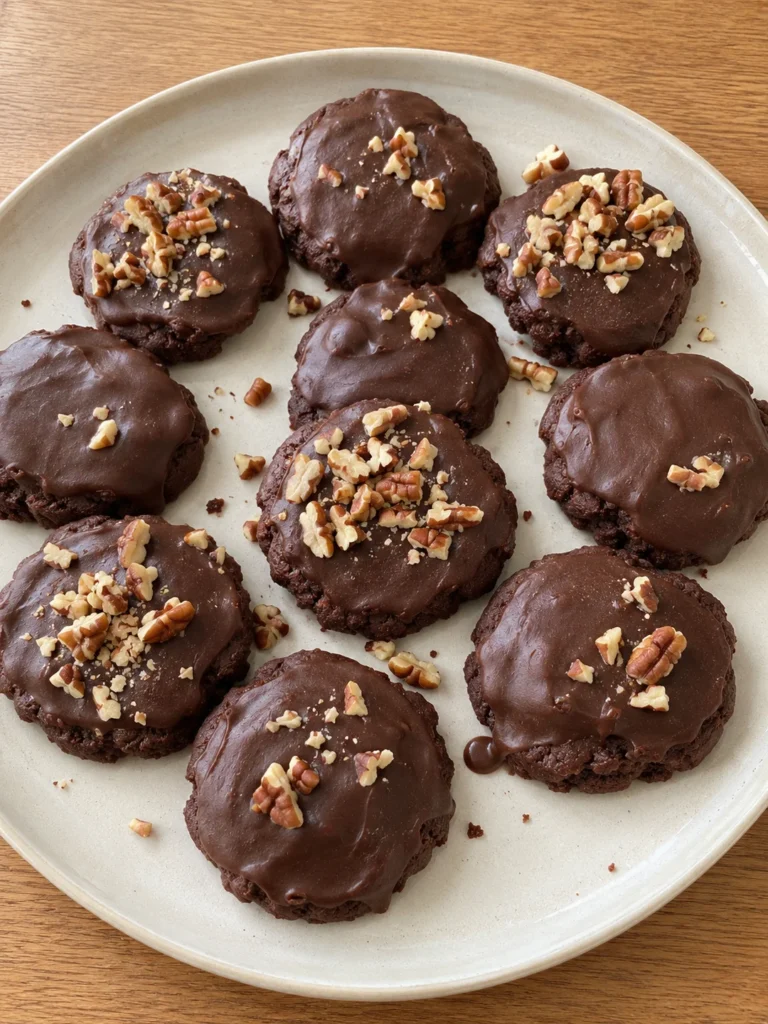
It was October and already hot by nine in the morning. I bought two and ate both before I made it to the end of the row of stalls.
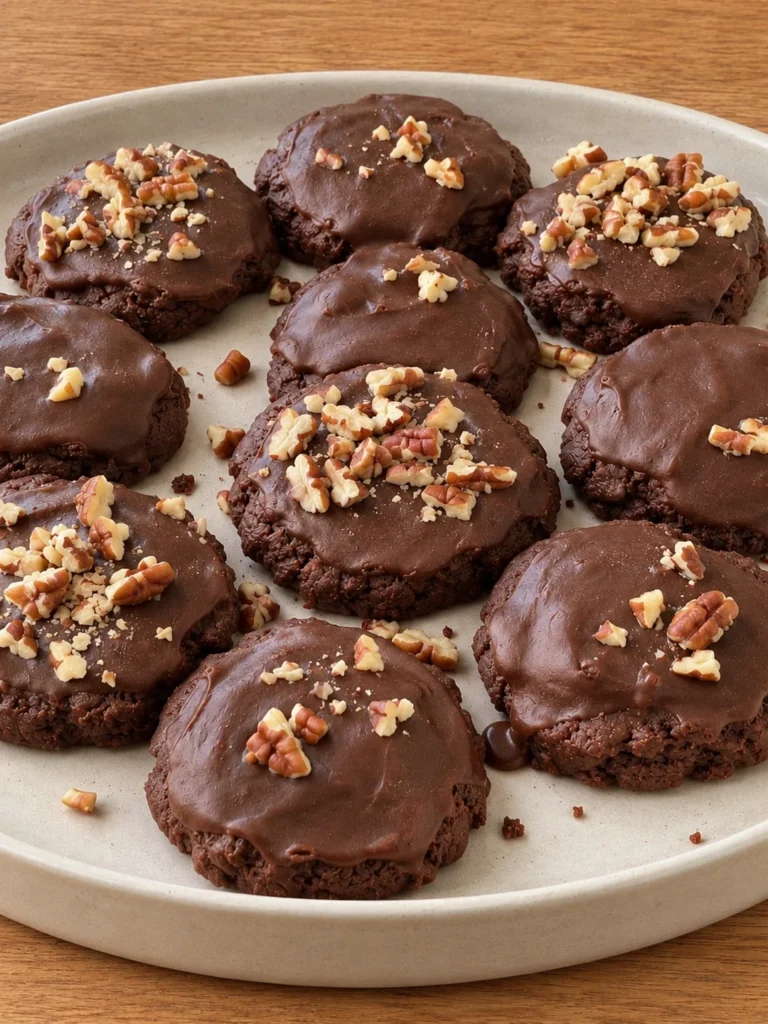
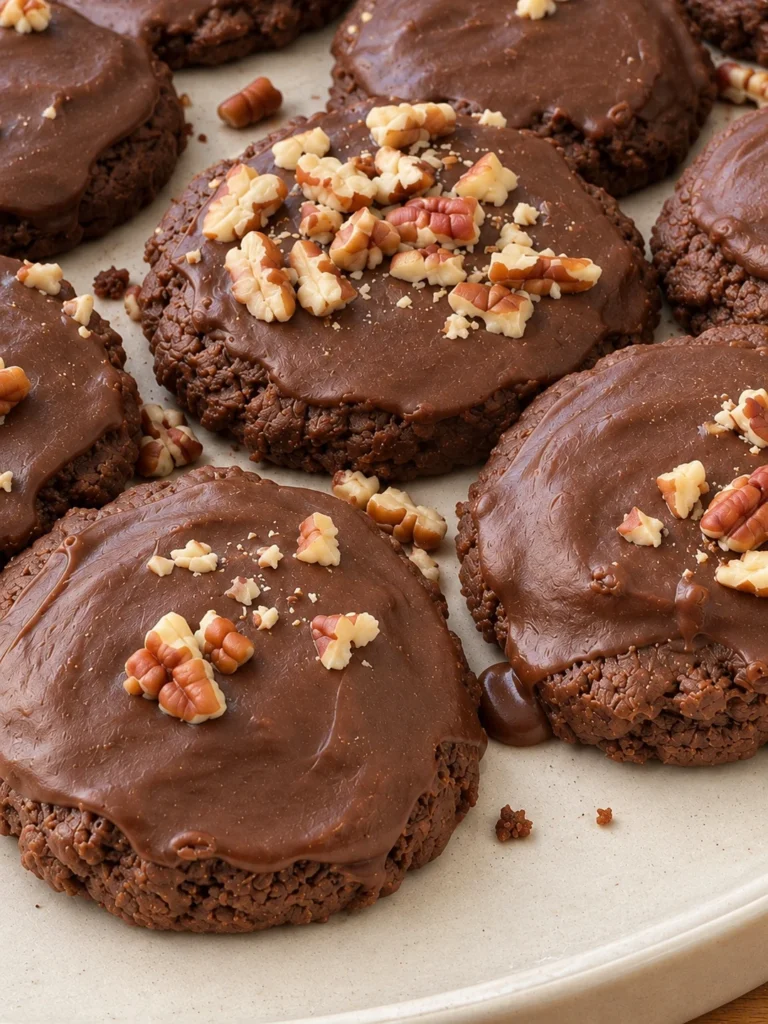
They were not crisp. That surprised me. I had expected something sturdy and bake-sale dry, and instead got a soft, almost cakey crumb under a thin shell of fudge icing that cracked when I bit into it. The pecans on top were still slightly warm.
Darlene, Her Box, and the Napkin
I was staying two nights with a host family outside town, a quiet place with a tin roof and a dog that slept on the porch step. When I mentioned the cookies at dinner, my host Ruth laughed and said she sold at the same market for years and knew exactly which box I meant.
She wrote the method down for me on a paper napkin from the kitchen counter, which by the end had a grease spot through one corner where it had sat too close to the skillet. Cake flour. Melted chocolate, not just cocoa. Eggs and sugar beaten until they are pale and thick, which she underlined twice.
At the bottom she wrote, in smaller handwriting, “ice them warm, not hot.” That line turned out to be the whole recipe.
What Texas Sheet Cake Cookies Actually Are
These are a shrunk-down version of Texas sheet cake, the thin buttermilk-cocoa cake poured into a huge shallow pan and finished with hot cooked fudge icing. The cake is one of the South’s great community desserts, the thing that shows up at church suppers and wakes, which is why people sometimes call it a funeral cake. One pan feeds a crowd and travels without collapsing.
The cookie form is much newer than people assume. It came out of American home-baking blogs in the 2000s and 2010s, a way to get the same crumb and the same glaze without cutting and plating a 13×18 pan. Not an heirloom. A good idea that spread fast.
And the parent cake’s Texas claim is shakier than the name suggests. The Library of Congress traced an early shallow-pan chocolate cake to the Galveston Daily News in May 1936, a pecan-frosted buttermilk version to a Dallas paper in 1957, and a close relative called Mrs. Elkin’s Sheath Cake to the 1967 Huntsville Heritage Cookbook, which is Alabama. The name “Texas Sheet Cake” only settled into print in the 1980s.
People also love saying Lady Bird Johnson invented it or named it. There is nothing in the LBJ archives to support that. “Texas” almost certainly refers to the pan-sized, crowd-feeding scale, and maybe the pecans, not to any one Texan with a mixer.
What I Used
- Cake flour, spooned and leveled, not scooped. Scooping packs it and you get dry cookies
- Unsweetened cocoa powder, for both the dough and the icing
- Baking powder and salt
- Unsalted butter, half for the dough and half for the icing
- Semi-sweet chocolate chips, melted into the butter
- Granulated sugar
- Two eggs, properly room temperature
- Pure vanilla extract, in the dough and again in the icing
- Whole milk for the icing. Not skim, the glaze needs the fat to set glossy
- Powdered sugar, sifted, which I skipped once and regretted
- Chopped pecans, half folded into the dough and half scattered on the wet icing
Bringing Them Back to My Kitchen
I made them the Sunday after I flew back, late morning, windows open, the kitchen still smelling of coffee. Put on Townes Van Zandt, which felt like the correct geography, and ate cold grapes out of the fridge while the dough rested.
That resting bit is not optional and the napkin did not mention it, so my first batch spread into one continuous chocolate sheet across the pan. The dough comes out of the bowl looking far too loose. Fifteen minutes on the counter and it thickens into something you can actually scoop.
I buy pecans at the Wednesday farmers’ market because the ones in the supermarket baking aisle taste like cardboard half the time. Toast them or do not, I honestly cannot tell the difference once they are sitting in fudge.
The Icing Is the Whole Point
This is where most people go wrong, and where Ruth’s two underlines earn their keep. The icing is not buttercream and it is not anything out of a tub. Butter, cocoa and milk heated in a saucepan until it just barely simmers at the edges, then whisked off the heat with sifted powdered sugar and vanilla until it ribbons off the whisk.
It sets into a thin fudge shell. Not a soft frosting layer. That shell is the difference between a texas sheet cake cookie and a chocolate cookie with frosting on it, which is a different and lesser thing.
Timing matters in both directions. Straight out of the oven the cookies are too hot and the glaze slides off the edges onto the rack, which I learned by doing it. Wait too long and the icing in the pan stiffens past pouring. Three minutes on the hot pan, then onto a wire rack for fifteen, then dip.
If the icing does tighten up on you, back over low heat with a teaspoon of milk at a time. It forgives you.
Pulling Them Early, and Other Opinions
Take them out when the centers still look wet and underdone. They look wrong. Trust it anyway, because they firm up on the hot sheet and stay soft for days afterward. Baked until they look done in the oven, they turn into brownie-adjacent pucks and the whole cakey character is gone.
I bake one sheet at a time. Slower, yes, but the bottom rack always ran hotter in my oven and I got tired of losing half a batch.
Pecans are traditional and they tie the thing to Texas’s own crop, but leaving them off does not make the cookies fake. A pinch of flaky salt on the wet icing is genuinely excellent and I do it for about a third of every batch now. A teaspoon of cinnamon in the dry mix with a pinch of cayenne in the icing is the other direction worth taking.
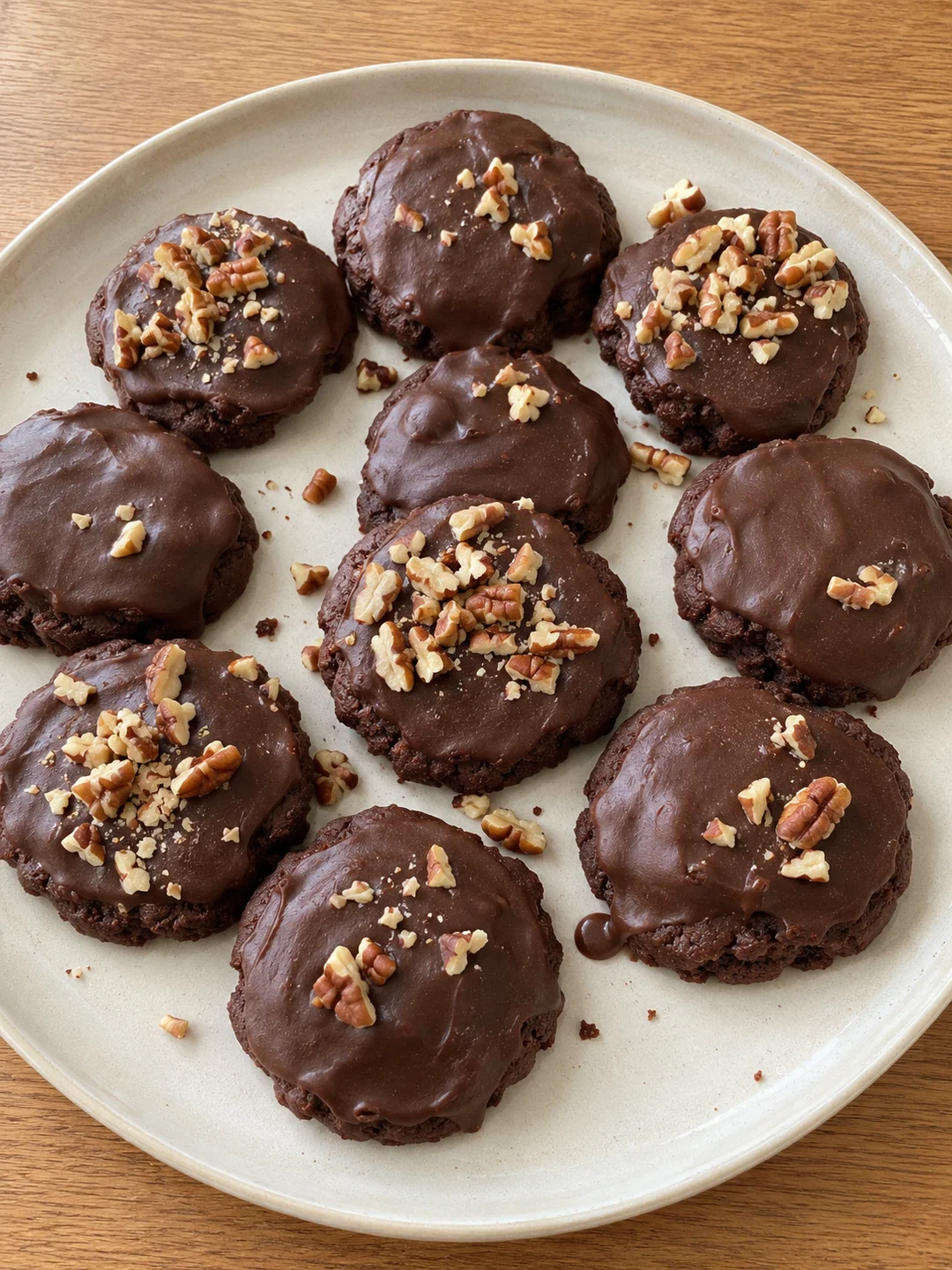
Do not stack them before the glaze sets hard. One to four hours depending on how warm your kitchen is. Darlene’s single-layer cardboard box was not a quirk, it was the correct storage system.
I thought I would make these once, as a souvenir. I have made them four times since October, and the last batch went to a neighbour’s birthday thing where someone asked if they were store-bought, which I am choosing to read as a compliment. Cold, eaten standing at the counter the next morning with coffee. Better than warm, honestly.
Texas Sheet Cake Cookies
Ingredients
Equipment
Method
- Heat the oven to 375 F and line two rimmed baking sheets with parchment paper.
- Whisk the cake flour, 1/3 cup cocoa powder, baking powder and salt in a medium bowl until no streaks of cocoa remain. Set aside.
- Melt 1/2 cup butter with the chocolate chips in a saucepan over low heat, stirring constantly, about 3 minutes. Pull it off the heat the moment it is smooth and let it cool for 5 minutes.
- Beat the granulated sugar, eggs and 2 teaspoons vanilla on medium-high speed for 3 full minutes, until the mixture is pale, thick and roughly doubled in volume.
- With the mixer on low, stream in the warm melted chocolate and beat just until combined and glossy.
- Add the dry mixture and fold with a spatula until no flour is visible, then fold in 2/3 cup of the chopped pecans. The dough will look loose.
- Let the dough rest at room temperature for 10 to 15 minutes. It will thicken to a scoopable, fudgy consistency.
- Scoop tablespoon-and-a-half mounds onto the lined sheets, spacing them 2 inches apart, and flatten each one slightly with damp fingertips.
- Bake one sheet at a time for 8 to 10 minutes. The edges should be set and the centers should still look soft and slightly underdone. Do not wait for them to firm up in the oven.
- Let the cookies sit on the hot pan for 3 minutes, then move them to a wire rack. Cool until just barely warm, about 15 minutes.
- Make the icing while the cookies cool. Melt 1/2 cup butter with 1/4 cup cocoa powder and the whole milk in a saucepan over medium heat, whisking, until it reaches a bare simmer around the edges. Pull it off the heat immediately.
- Whisk in the sifted powdered sugar and 1 teaspoon vanilla until the icing is completely smooth, glossy and thin enough to pour off the whisk in a ribbon.
- Working quickly, dip the top of each cookie into the warm icing, or spoon about 2 teaspoons over each one and let it settle to the edges.
- Scatter the remaining chopped pecans over the wet icing right away, before it starts to skin over.
- Leave the cookies on the rack until the icing sets to a firm fudge shell, 1 to 4 hours depending on your kitchen. Do not stack them before the glaze is set.