
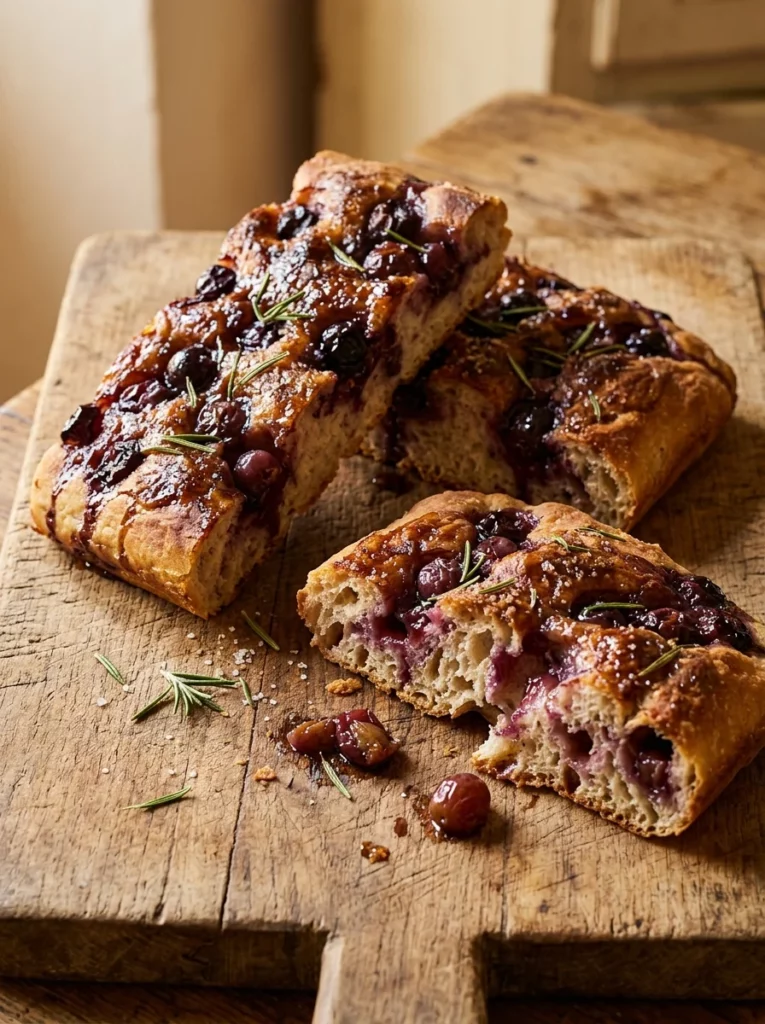
The Tuscan Schiacciata all’Uva that convinced me to buy a plane ticket back to Italy the following autumn was sitting on a chipped white plate in Prato, half eaten, with grape juice bleeding into the crust and staining my thumb purple. The owner of the trattoria was already sitting across from me by then. Kitchen closed. A half empty bottle of red between us. He was explaining, in a mix of slow Italian and wide hand gestures, why the seeds stay in.
A Slow Lunch in Prato at Osteria da Bruno
I had come in on the last train out of Florence, mid September, on the tail end of the vendemmia. The place was called Osteria da Bruno. Formica tables, a nonna in the back working through a mountain of dishes, one waiter who was also the son. I ordered whatever the owner told me to order and did not ask questions.
The schiacciata arrived at the end, not as dessert exactly. Bruno called it merenda, the afternoon snack Tuscan farmhands eat between shifts, and said this was the only month of the year you could get it. He also said the seeds are the whole point. Table grapes give you a wet bread. Wine grapes give you tannin, which is what stops the sugar from becoming cloying. I took notes on a napkin. I still have it somewhere in a drawer with a bunch of other napkins I probably should have thrown out.
What This Sticky Harvest Bread Actually Is
Schiacciata con l’uva, to use the proper name (the word Tuscan is really for our benefit in English), is a September only harvest bread from the countryside around Florence and Prato, with variants down through Chianti and the Maremma. Etruscans were probably baking some version of it for the vendemmia going back to the 8th century BC, which is a nice thing to think about while you press grapes into dough with your fingers.
In its modern form it started as cucina povera, a thrift move to use up the small, seedy wine grapes left after the picking, folded into whatever bread dough was already sitting on the counter. It stayed a country thing. Bakers in Florence and Prato still only put it out for a few weeks between mid September and late October, sold by the slice, and when the grapes run out the sign comes down.
Two quick things it is not. It is not schiacciata alla fiorentina, which is the orange scented Carnival sponge cake dusted with powdered sugar. Entirely different animal. And it is not the plain salted olive oil flatbread known just as schiaccia toscana. This one is sweet, chewy, purple, and strictly seasonal.
Bringing Tuscan Schiacciata all’Uva Back to My Kitchen
Recreating it at home was, in theory, straightforward. Dough, grapes, sugar, olive oil, oven. In practice, sourcing the right grape almost broke it.
Canaiolo and Sangiovese grapes do not turn up at American markets. The closest cousin is the Concord, and even Concords have a short window. I found mine in the second week of September at the Hollywood farmers’ market, at a stand run by a family out of Kern County. Dark, musky, small, with that same seedy backbone Bruno was so insistent about. I bought four pounds. Two for the bread, two for eating on the walk back to the car.
The other change was the oil. Bruno’s kitchen poured a peppery estate Tuscan oil that costs a small fortune to import and, honestly, does not really taste like itself by the time it lands in California. I use a green, grassy Californian one from a producer in Paso Robles instead. Not the same. Close enough, and honest about being its own thing.
What I Used
- Bread flour, roughly a pound, plus a handful for the counter
- Warm water, about a cup, no hotter than a warm bath
- Active dry yeast, one standard packet
- Granulated sugar, a few spoons for the dough and half a cup for layering
- Fine sea salt
- Extra virgin olive oil, a good grassy one, for the dough, the pan, and the top
- Two pounds of small black wine grapes, Concord if you cannot find Canaiolo, unpeeled and unseeded
- Fresh rosemary or a pinch of crushed anise seeds, optional but very Chianti countryside
How I Bake It Now in My Own Kitchen
The dough is nothing dramatic. Yeast, water, a spoon of sugar to wake it up. Half the flour, then the salt and oil, then the rest until you have something soft and slightly tacky. Knead for eight minutes on the wooden board my mum gave me, which is now stained a permanent shade of pinot noir from years of grape breads. Rise for ninety minutes in a warm spot.
Divide into two pieces, one a little bigger than the other. The bigger one goes into a well oiled 9 by 13 pan, stretched to the corners and halfway up the sides. Scatter about two thirds of the grapes across. Sugar. A small pinch of rosemary if you are in the mood.
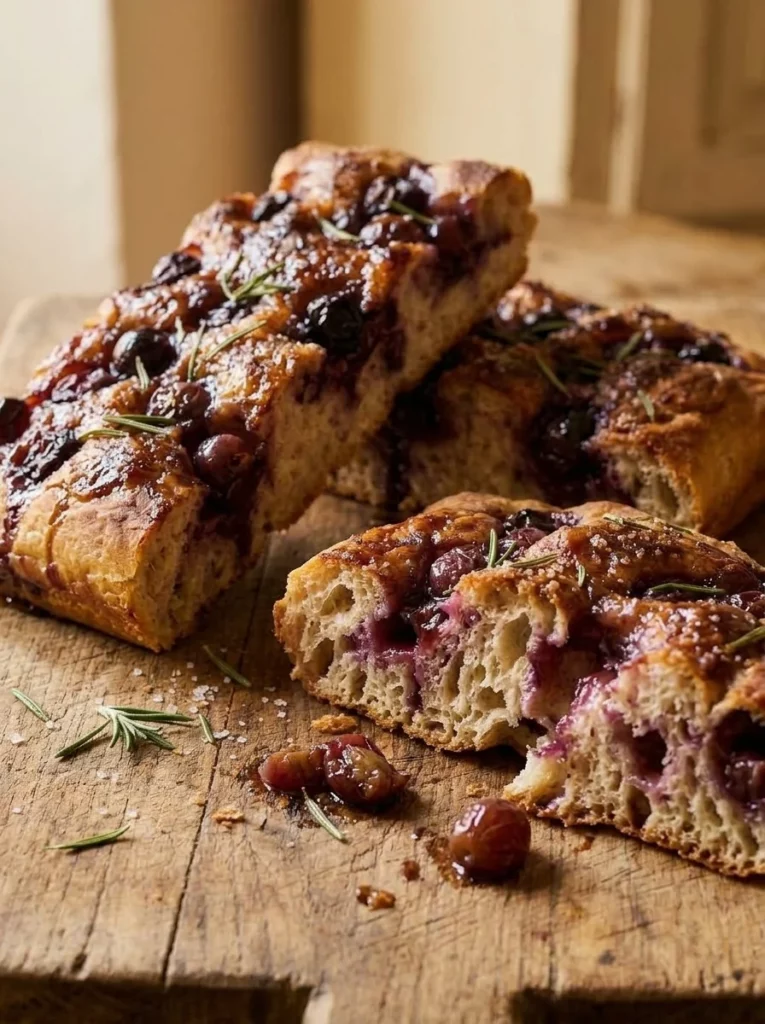
Stretch the second piece thin over the top and then, this is the part I got wrong the first time, press hard with your fingertips. Really squash it. The word schiacciata means squashed, and when you press the top layer down the grapes underneath burst and start doing their work. The first time I made this I was too polite about it. The bread came out flat and dry. Do not be polite.
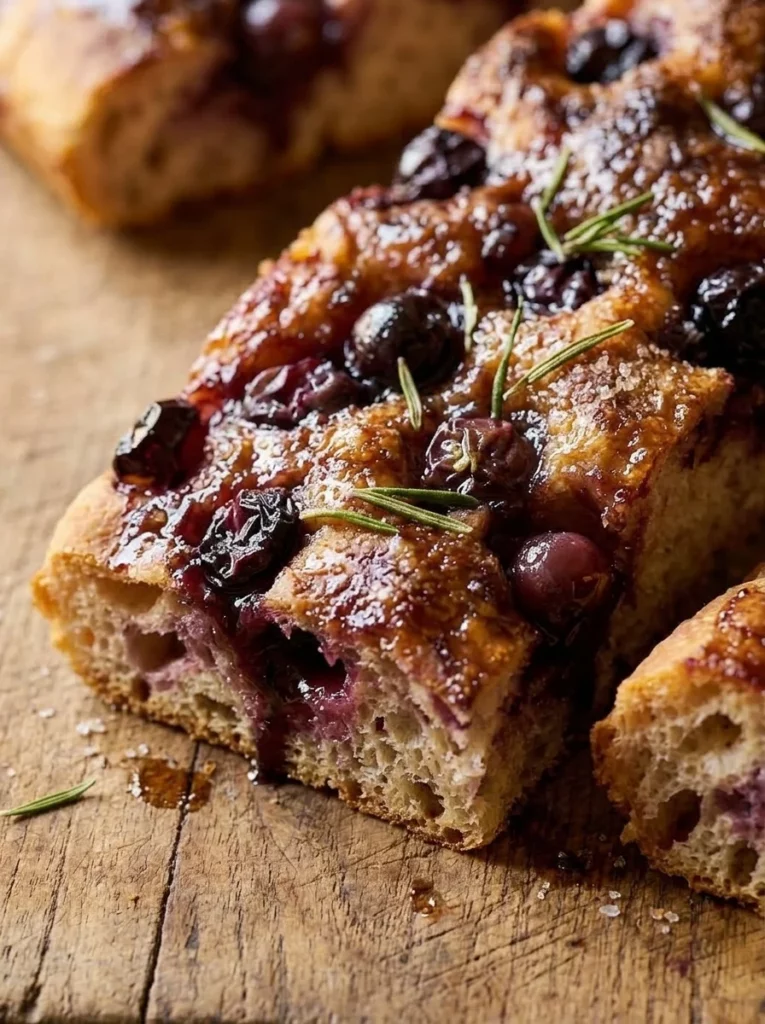
The rest of the grapes go on top with more sugar and a proper drizzle of oil. Rest twenty minutes on the counter, then bake at 400 F for forty to forty five minutes, until the syrup on top has gone from red to dark burgundy and the crust looks almost too dark. If it is running away from you at minute thirty, tent it loosely with foil.
When the Prato Schiacciata Is Right
You will know it is done when the whole kitchen smells like a jam pot on the stove and the juices around the edges have gone glossy and thick. Cool it in the pan for twenty minutes at least. Any less and the syrup runs off the slices and onto the counter, which is a waste.
Eat it warm or at room temperature, cut into rough squares, standing at the counter, with a small glass of young Chianti or vin santo if it is after four. I do this on Saturday afternoons in early autumn with the kitchen window cracked and the neighbour’s dog barking at nothing in particular. I usually tell myself I will save half for tomorrow. I usually do not.
You get one month a year for this bread. Which is annoying and also, I think, correct. Some things should stay tied to the season that made them, and this is one of them.

Tuscan Schiacciata All’Uva
Ingredients
Equipment
Method
- Pour the warm water into a large mixing bowl and stir in the yeast and 1 tablespoon of the dough sugar. Let it sit for 8 to 10 minutes, until it turns foamy on top.
- Add the remaining 2 tablespoons of sugar, the sea salt, 3 tablespoons of olive oil, and about half of the bread flour. Stir vigorously with a wooden spoon until smooth.
- Add the remaining flour a little at a time until you have a soft, slightly tacky dough. Turn it out onto a lightly floured counter and knead by hand for about 8 minutes, until smooth, springy, and elastic.
- Lightly oil a clean bowl, place the dough inside, cover with a kitchen towel, and let rise in a warm spot for about 90 minutes, until doubled in size.
- While the dough rises, rinse the grapes and pull them off their stems. Leave them whole with skins and seeds intact. Pat them dry gently with a towel.
- Preheat the oven to 400 F. Generously oil a 9x13 inch rimmed baking pan with 1 tablespoon of olive oil.
- Punch down the risen dough and divide it into two pieces, one slightly larger than the other. Stretch the larger piece with your hands or a rolling pin to fit the bottom of the pan, coming halfway up the sides.
- Scatter about two-thirds of the grapes evenly over the dough. Sprinkle with 3 tablespoons of the layering sugar and half of the rosemary or anise seeds, if using.
- Stretch the second piece of dough into a thin sheet just large enough to cover the grapes. Lay it on top and press down firmly with your fingertips so the grapes burst slightly into the dough. This pressing is where the bread gets its name, schiacciata, meaning squashed.
- Scatter the remaining grapes across the top, pressing them lightly into the dough. Drizzle with the remaining 2 tablespoons of olive oil, sprinkle with the remaining layering sugar, and scatter the last of the rosemary or anise seeds.
- Let the assembled bread rest uncovered for about 20 minutes, until slightly puffed.
- Bake on the middle rack for 40 to 45 minutes, until the crust is deeply golden and the grape juices have caramelized into a sticky purple syrup across the surface. If the top darkens too quickly, tent loosely with foil for the last 10 minutes.
- Let the schiacciata cool in the pan on a wire rack for at least 20 minutes before slicing. Serve warm or at room temperature, cut into squares or wedges, eaten out of hand.