Take the fillet out of the fridge 30 minutes ahead. Pat it completely dry with paper towels and season all over with the salt and pepper, pressing it into the surface.
Heat the oil in a heavy skillet over high heat until it shimmers and just begins to smoke. Sear the fillet 1 to 2 minutes per side, turning with tongs, until every surface including the ends carries a deep brown crust. This is for flavour, not for sealing in juices.
Transfer the fillet to a plate and let it cool for 10 minutes. Brush it all over with the English mustard while still warm. Set aside to cool completely.
Pulse the mushrooms, shallots and garlic in a food processor in batches until finely minced, almost a paste but not wet puree. Do not overload the bowl or you will get liquid instead of mince.
Melt the butter in the same skillet over medium heat. Add the mushroom mixture and thyme with a good pinch of salt. Cook, stirring often, for 20 to 25 minutes. The mixture will release a lot of liquid, then slowly tighten. Keep going until it is thick, dark and visibly dry, with no moisture pooling when you drag a spoon through. This step decides whether your pastry bakes or steams.
Spread the duxelles on a plate and cool completely, about 20 minutes. Warm duxelles will melt the pastry later.
Lay a large sheet of plastic wrap on the counter. Arrange the Parma ham in two overlapping rows to form a rectangle wide enough to wrap the fillet fully. Spread the cooled duxelles evenly over the ham in a thin layer, leaving a half inch border.
Untie the fillet and lay it along the near edge of the ham. Using the plastic wrap, roll the ham and duxelles tightly around the beef, twisting both ends of the wrap like a candy wrapper to compact it into a firm even cylinder. Refrigerate 30 minutes.
Roll the puff pastry on a lightly floured surface to a rectangle roughly 14 by 12 inches and about 1/8 inch thick. Unwrap the chilled beef log and set it along one long edge.
Brush the exposed pastry with egg wash. Roll the pastry over the beef, pressing out air as you go, and trim away excess so the seam overlaps by about an inch. Press the seam and both ends firmly to seal, folding the ends under.
Wrap the parcel in fresh plastic wrap, twisting the ends tight again, and chill at least 30 minutes and up to overnight. Meanwhile heat the oven to 400 F and set a rack in the middle.
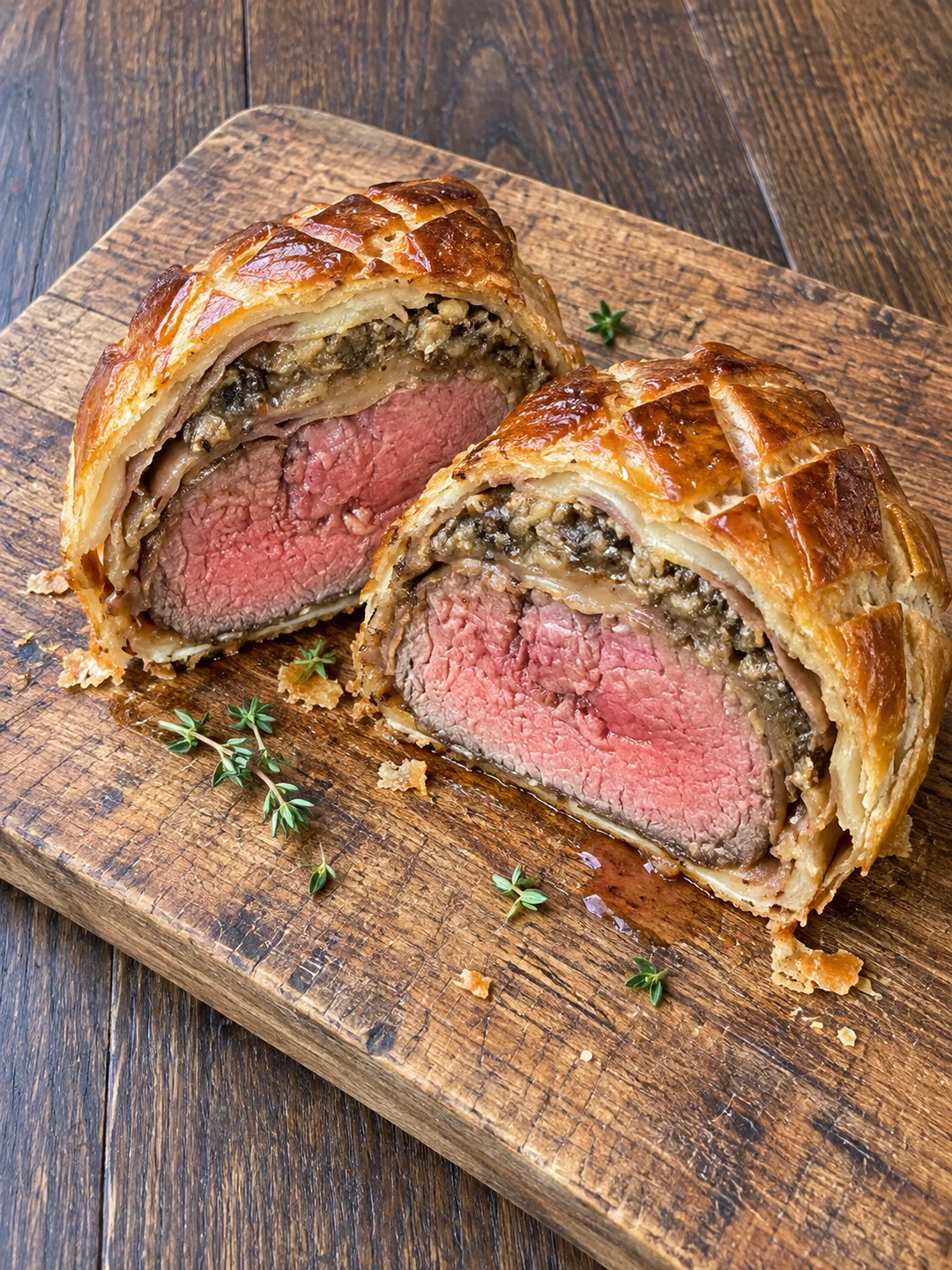
Unwrap the parcel onto a baking sheet, seam side down. Brush all over with egg wash. Score the top lightly with the back of a knife in a diagonal lattice, cutting only the surface. Sprinkle with a little salt.
Bake 40 to 45 minutes, until the pastry is deep golden and an instant-read thermometer pushed into the centre reads 125 F for medium-rare. If the pastry browns too fast, tent loosely with foil.
Rest the Wellington on a board for 10 to 15 minutes. The internal temperature will rise a further 5 degrees and the juices will settle.
Slice into thick rounds about 1.5 inches wide using a sharp serrated knife, sawing gently so the pastry does not crush. Serve immediately.