Go Back
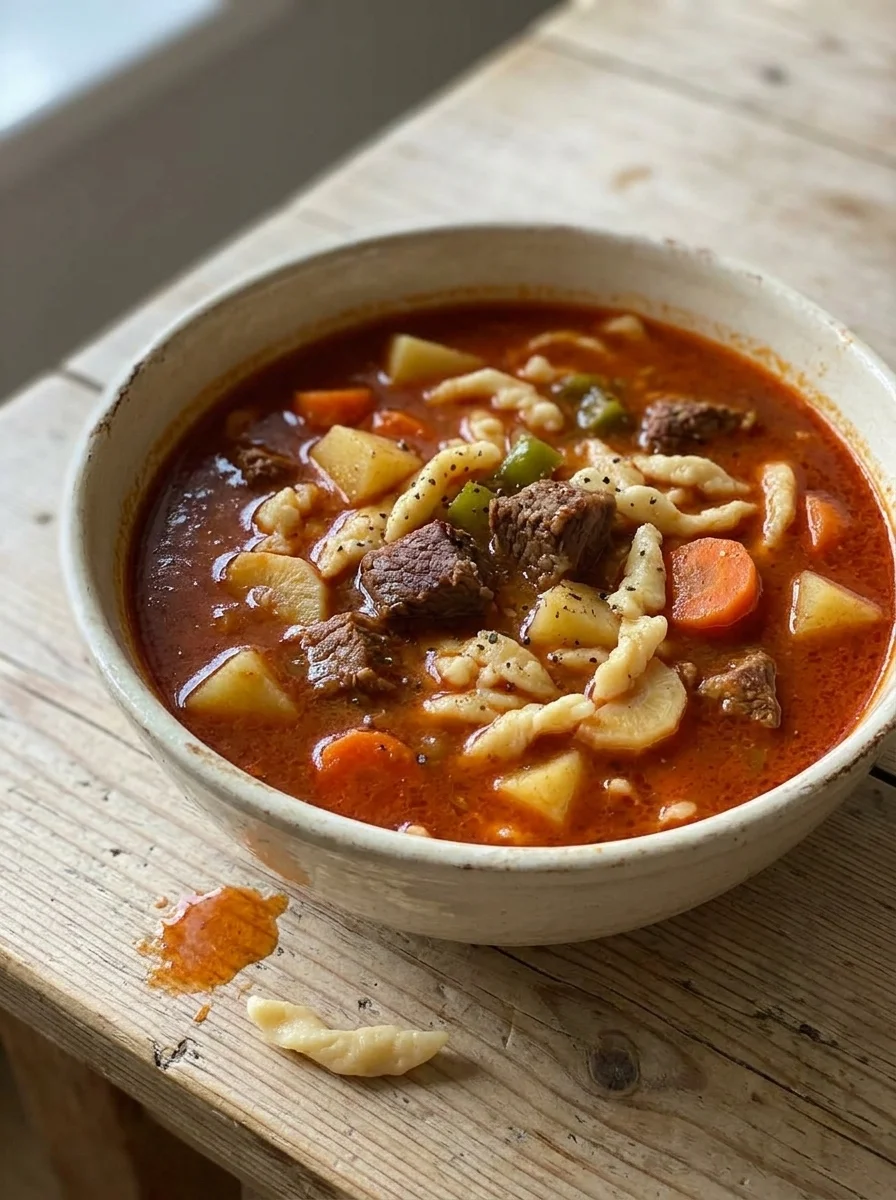
Hungarian Goulash (Gulyás) from the Puszta with Csipetke Noodles

Hungarian Goulash

This is real Hungarian goulash — a brothy, deeply paprika-scented soup that herders once cooked over open fires on the Great Plain. Beef shin turns silky over slow heat, sweet Hungarian paprika perfumes every spoonful, and pinched egg-dough csipetke noodles float alongside potatoes, carrots, and parsnip. No flour, no sour cream, no shortcuts. Just honest, soul-warming cooking from the Alföld.
Prep Time 30 minutes
Cook Time 2 hours 30 minutes
Total Time 3 hours
Servings: 6 People
Course: Soup
Cuisine: Hungarian
Calories: 520

Ingredients
  

  • 2 lb beef shin or chuck trimmed and cut into 3/4-inch cubes
  • 3 tbsp lard vegetable oil works if lard is unavailable
  • 1.5 lb yellow onions finely chopped, about 3 large
  • 3 tbsp Hungarian sweet paprika édesnemes, freshly opened if possible
  • 4 cloves garlic crushed
  • 1 tsp caraway seeds lightly crushed
  • 2 medium green Hungarian pointed peppers seeded and sliced; cubanelle is a good substitute
  • 1 large ripe tomato peeled and diced
  • 2 quarts water hot
  • 1.5 lb waxy potatoes peeled and cut into 3/4-inch cubes
  • 2 medium carrots peeled and sliced 1/4 inch thick
  • 1 medium parsnip or parsley root peeled and sliced 1/4 inch thick
  • 1 tbsp kosher salt plus more to taste
  • 0.5 tsp black pepper freshly ground
  • 1 cup all-purpose flour for the csipetke
  • 1 large egg for the csipetke
  • 1 pinch salt for the csipetke dough

Equipment

  • 1 heavy-bottomed 6-quart pot or Dutch oven cast iron is ideal
  • 1 Wooden spoon
  • 1 Sharp chef’s knife
  • 1 Cutting board
  • 1 small mixing bowl for the csipetke dough
  • 1 Fork

Method
 

  1. Melt the lard in a heavy 6-quart pot over medium-low heat. Add the chopped onions and cook slowly, stirring often, for 15 to 20 minutes until they are glassy, soft, and pale gold. Do not brown them.
  2. Pull the pot completely off the heat. Wait 30 seconds, then stir in the Hungarian sweet paprika along with the crushed garlic and caraway seeds. Stir constantly for about 30 seconds so the paprika blooms in the warm fat without burning.
  3. Return the pot to medium heat. Add the cubed beef and stir to coat every piece in the paprika-onion base. Cook for 3 to 4 minutes, just until the meat loses its raw color.
  4. Add the sliced green peppers and diced tomato. Pour in enough hot water to just cover the meat, about 3 cups. Season with 1 teaspoon of the salt. Bring to a gentle simmer, cover partially, and cook over low heat for 1 hour and 30 minutes, stirring occasionally and adding a splash more water if it looks dry.
  5. While the meat braises, make the csipetke. In a small bowl, combine 1 cup flour, the egg, and a pinch of salt. Mix with a fork, then knead briefly to form a stiff dough. Cover and let it rest at room temperature for 30 minutes.
  6. When the beef is starting to turn tender, add the remaining hot water, the potatoes, carrots, parsnip, remaining salt, and black pepper. Simmer uncovered for another 20 minutes, until the vegetables are almost cooked through.
  7. Pinch off small flat pieces of csipetke dough, roughly the size of a fingernail, and drop them straight into the simmering soup. Cook for 5 to 7 minutes, until the noodles float and the potatoes are fully tender.
  8. Taste and adjust the salt. The broth should be brothy, brick-red, and lightly spoon-coating — never thick. Ladle into deep bowls and serve immediately with crusty white bread on the side.

Notes

  • Pull the pot off the heat before stirring in the paprika — even a few seconds of direct heat turns it bitter.
  • Use Hungarian sweet paprika (édesnemes) if you can find it; Spanish or smoked paprika is not a substitute.
  • Serve with crusty white bread, a glass of Kékfrankos or Kadarka, and a small dish of hot paprika or Erős Pista at the table for heat lovers.
  • Leftovers deepen overnight and taste even better the next day.
  • If you cannot find pale-green Hungarian pointed peppers, an Italian frying pepper (cubanelle) is the closest substitute.