Go Back
Japanese Okonomiyaki, the Osaka Way

Japanese Okonomiyaki

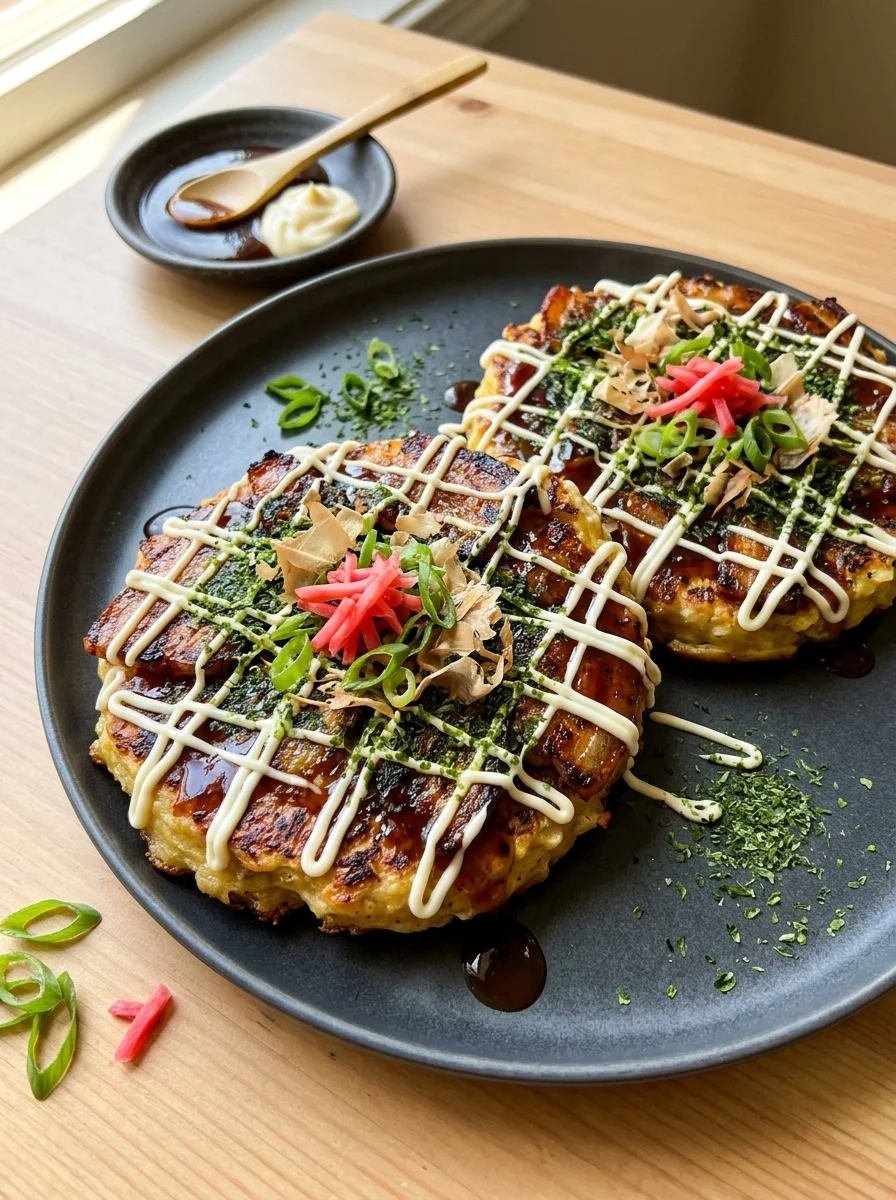
This is the Osaka-style Japanese okonomiyaki I fell for years ago at a smoky teppan counter near Dotonbori. A dashi-loaded batter bound with grated mountain yam turns a mountain of shredded cabbage into a savory pancake that is crisp outside, almost soufflé-light inside, and finished with sweet okonomiyaki sauce, Kewpie mayo, dancing bonito, and green seaweed.
Prep Time 25 minutes
Cook Time 20 minutes
Total Time 45 minutes
Servings: 2 Pancakes
Course: Main Course
Cuisine: Japanese
Calories: 720

Ingredients
  

  • 1 cup all-purpose flour spooned and leveled
  • 0.75 cup cold dashi stock from dashi powder or made with kombu and katsuobushi
  • 2 large eggs one for the batter, one for topping if desired
  • 4 oz nagaimo peeled and finely grated, about 1/2 cup
  • 1 lb green cabbage very finely shredded, about 6 packed cups
  • 4 stalks scallions thinly sliced, whites and greens separated
  • 0.5 cup tenkasu tempura scraps
  • 0.25 tsp fine sea salt
  • 6 oz thinly sliced pork belly cut into 4 to 5 inch strips
  • 2 tbsp neutral oil such as canola, for the pan
  • 3 tbsp okonomiyaki sauce Otafuku brand preferred
  • 2 tbsp Kewpie mayonnaise
  • 2 tbsp katsuobushi dried bonito flakes
  • 1 tsp aonori dried green seaweed flakes
  • 1 tbsp beni shoga pickled red ginger, drained

Equipment

  • 1 Large mixing bowl
  • 1 box grater or microplane for the nagaimo
  • 1 large cast-iron or nonstick skillet about 10 to 12 inches
  • 2 wide metal spatulas for flipping
  • 1 Whisk

Method
 

  1. In a large bowl, whisk together the flour, cold dashi stock, and 1 egg until smooth. Cover and rest in the refrigerator for at least 1 hour, or up to overnight. This step develops flavor and lightens the texture.
  2. Peel the nagaimo carefully and grate it on the fine side of a box grater or with a Microplane into a slippery, foamy pulp. Whisk the grated nagaimo and salt into the rested batter until fully incorporated.
  3. Add the finely shredded cabbage, scallion whites, and tenkasu to the bowl. Using your hands or a spatula, gently fold everything together with a lifting motion until the cabbage is evenly coated. Do not overmix or the cabbage will weep.
  4. Divide the mixture visually in half. Heat 1 tablespoon of the neutral oil in a large cast-iron or nonstick skillet over medium heat until it shimmers.
  5. Mound half of the cabbage mixture into the center of the skillet. Shape it into a round about 6 inches across and 1.5 inches thick with your spatulas. Do not press down. Lay half of the pork belly strips flat across the top, overlapping slightly to cover the surface.
  6. Cook undisturbed for 5 to 7 minutes, until the bottom is deep golden brown and the edges look set. Slide both spatulas underneath from opposite sides, commit, and flip in one confident motion so the pork side is now against the pan.
  7. Cook the pork side for another 5 to 7 minutes, until the pork is crisp at the edges and the pancake feels springy in the center. Do not press. Flip once more so the pork side faces up and cook for a final 1 minute.
  8. Transfer the pancake to a warm plate. Repeat with the remaining oil and cabbage mixture to cook the second pancake.
  9. Brush the top of each pancake generously with okonomiyaki sauce. Drizzle Kewpie mayonnaise back and forth in a tight lattice pattern.
  10. Shower the top with katsuobushi flakes, watching them dance from the residual heat, then sprinkle with aonori. Finish with a small pile of beni shoga and the reserved scallion greens. Cut into wedges at the table and serve immediately.

Notes

  • Grated nagaimo is what gives the pancake its signature airy texture. Do not skip it. Wear gloves when peeling as the raw flesh can irritate skin.
  • Resist the urge to press the pancake with your spatula while it cooks. Pressing squeezes out air and turns it dense and tough.
  • Serve alongside steamed white rice, a bowl of miso soup, or an ice-cold Japanese beer for the full teppanyaki experience.
  • No teppan? A wide cast-iron or heavy nonstick skillet works well. Cook one pancake at a time so it stays thick.
  • Leftovers reheat surprisingly well in a dry skillet over medium heat for 3 to 4 minutes per side.