Ingredients
Equipment
Method
- Pour the milk into a small saucepan and heat over medium until it steams and small bubbles ring the edge, about 4 minutes. Do not boil. Pour it into the mixer bowl and let it cool to warm, about 110 F, roughly 15 minutes. If it is hotter than that it will kill the yeast.
- Meanwhile, stir the yeast and a pinch of the sugar into the 1/4 cup warm water. Let it stand 7 to 10 minutes until foamy and smelling of bread. If nothing happens, the yeast is dead and you need a fresh packet.
- To the warm milk add the 1/3 cup sugar, 4 tablespoons of the melted butter, the beaten eggs, the salt and the bloomed yeast mixture. Whisk to combine.
- Add 4 cups of the flour. Mix on low with the dough hook until a shaggy mass forms, then knead on medium-low for 8 to 10 minutes, adding the remaining 1/2 cup flour a spoonful at a time only as needed. You want a smooth, elastic dough that is soft and slightly tacky to the touch but does not coat your finger. By hand, knead on a lightly floured counter for 12 minutes.
- Shape the dough into a ball, place it in a lightly buttered large bowl, cover with plastic wrap and set it somewhere warm and draft-free. Let it rise until doubled and domed, 1 to 1 1/2 hours.
- Punch the dough down gently and turn it out onto a lightly floured counter. Roll it into a rectangle about 9 by 16 inches and 1/4 inch thick. Let it relax for 2 minutes so it stops shrinking back.
- Brush the whole surface with 3 tablespoons melted butter, going right to the edges. Cut the rectangle lengthwise into 4 strips, then crosswise into 6, giving 24 pieces roughly 2 1/4 by 2 2/3 inches.
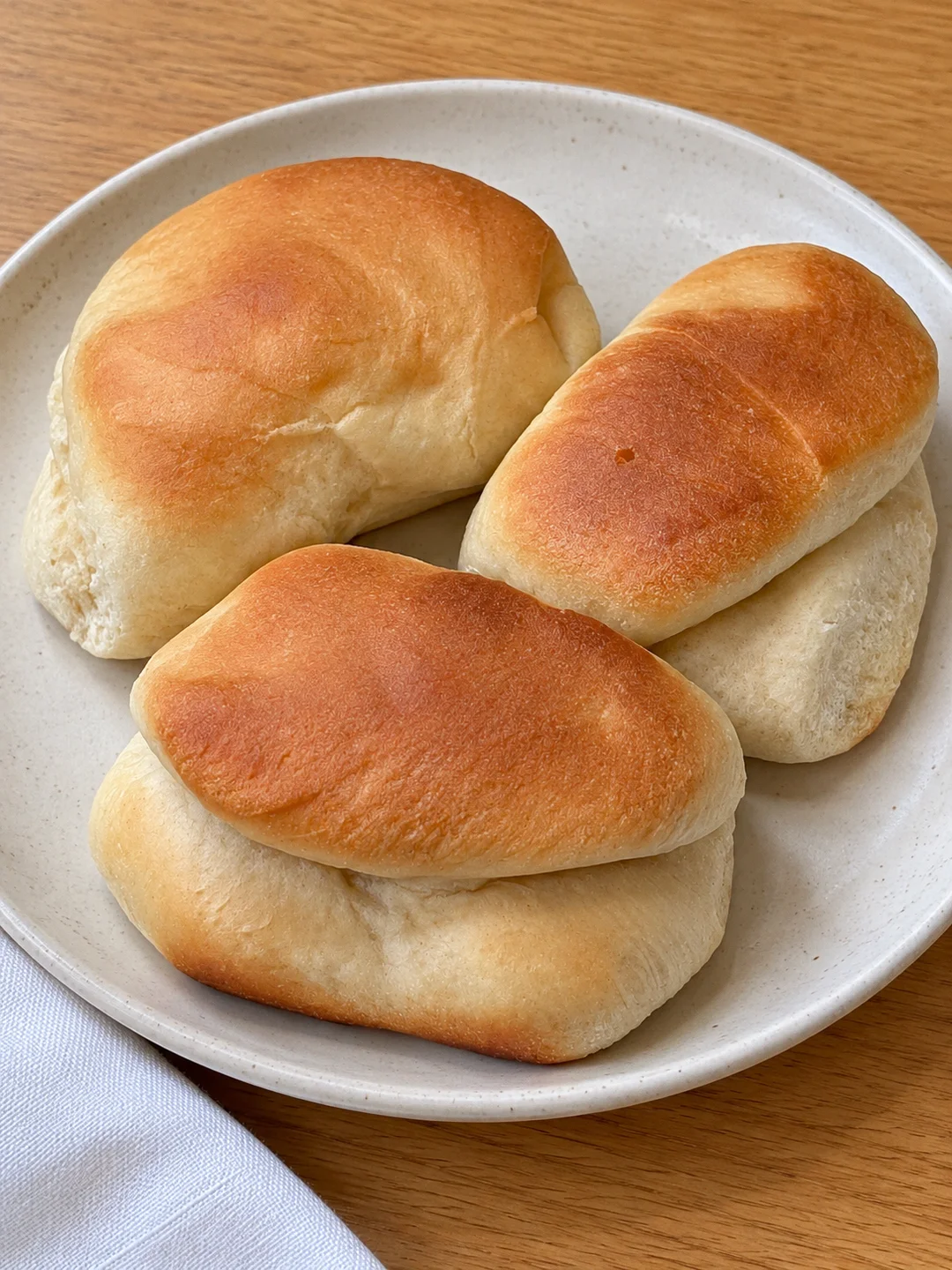
- Fold each piece unevenly, bringing the top half over the bottom so the upper edge stops about 1/4 inch short of the lower edge. Press the fold lightly to set the crease. That offset lip is the pocketbook shape, and the butter trapped inside becomes the tearing seam.
- Arrange the rolls on the parchment-lined sheet pans, folded edge down and about 1 1/2 inches apart, 12 per pan. Cover loosely with a clean towel.
- Let them rise until visibly puffy and light, 30 to 45 minutes. Test by poking one gently: it should spring back slowly. Do not wait for them to double. These over-proof easily, and a long second rise gives flat, coarse rolls instead of delicate ones.
- While they proof, heat the oven to 375 F with a rack in the center.
- Bake for 18 to 22 minutes, rotating the pans front to back halfway through, until the tops are deep golden brown and the bottoms sound hollow when tapped. The internal temperature should read 190 F.
- The moment they come out, brush the hot rolls generously with the remaining 3 tablespoons melted butter and scatter the flaky sea salt over the tops. Let them sit 5 minutes, then serve warm in a napkin-lined basket.