
Bigos out of a steel pot roughly the size of a washing machine drum, ladled into a paper bowl, twelve złotych chalked on a board propped against the leg of the table. January in Warsaw, maybe minus six, and I could see my own breath over the bowl.
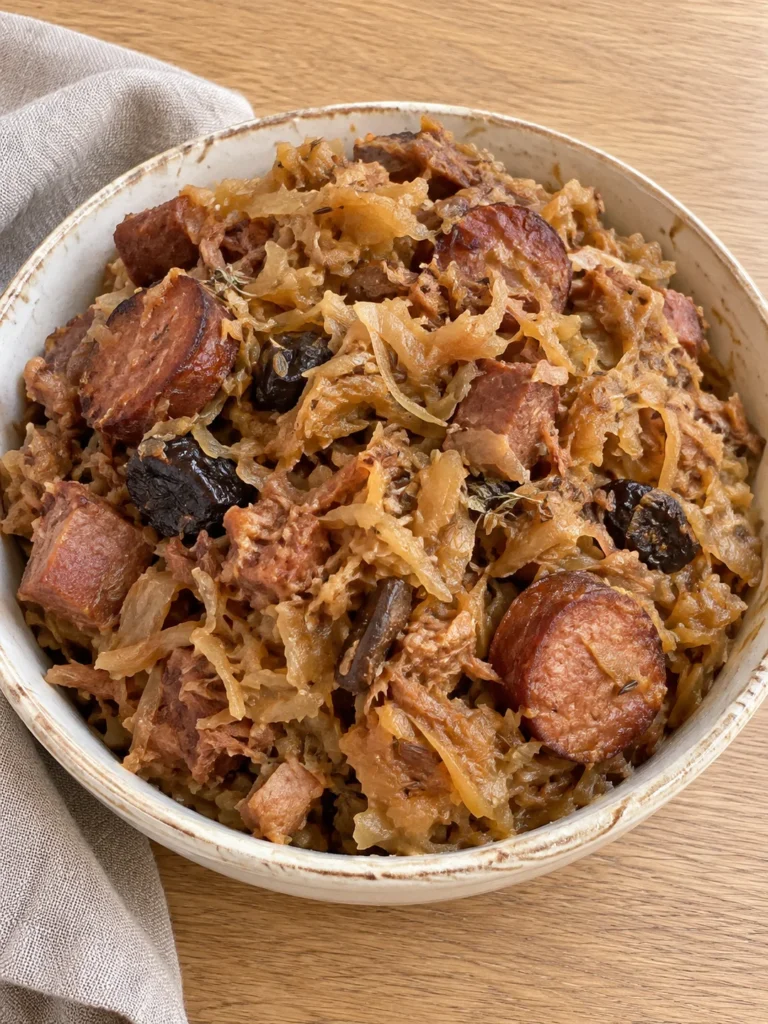
The woman running the stall wore fingerless gloves and kept the lid half on, so every time she lifted it a cloud went up and the whole corner of the market smelled of smoke and sour cabbage. She gave me a slice of rye bread with it, no plate, just balanced on top. I ate standing up with my backpack still on.
The Stall Outside Hala Mirowska
The stall sat along the edge of Hala Mirowska, in among the people selling cabbages and jars of pickles and those enormous bundles of dill. Her name was Halina. I asked what was in it and she listed meats on her fingers, which took a while.
Here is the part that changed my trip. I was staying in a rented room in Śródmieście, and when I told my host Marek about the bowl of bigos, he decided I was not going sightseeing that afternoon. He had sauerkraut in the fridge already, because apparently he always does, and he wanted to show me the version his family makes.
So instead of walking around Warszawa in the cold like I had planned, I spent four hours in a kitchen the size of a hallway, being told repeatedly that I was stirring too fast.
I almost said no to that. Glad I did not.
What Bigos Actually Is, Historically
First thing Marek corrected, and he was almost offended about it. Bigos is not sauerkraut and sausage. Authentic bigos uses several meats at once, fresh pork or game plus smoked bacon plus kiełbasa, and the mixture of them is the entire point of the dish.
Second thing, which I only read up on properly once I was home. The word shows up in Polish writing back in the 1600s, and the earliest version contained no cabbage whatsoever. It was finely chopped meat sharpened with imported vinegar, lemon, sugar and expensive spices, a dish of the szlachta, the nobility, not of poor hunters.
The sauerkraut version came later and started out as the cheap option, nicknamed bigos hultajski, rascal’s bigos. The sour cabbage replaced the costly vinegar. It won, obviously, and by the nineteenth century it was the standard.
And the hunter’s stew name is a bit of a misdirection. It travelled out to hunting parties because it reheated beautifully, not because anyone shot their dinner and threw it in a pot in the woods. Adam Mickiewicz gave it a whole admiring passage in Pan Tadeusz in 1834, which is why Poles talk about it the way other countries talk about a flag.
What I Used
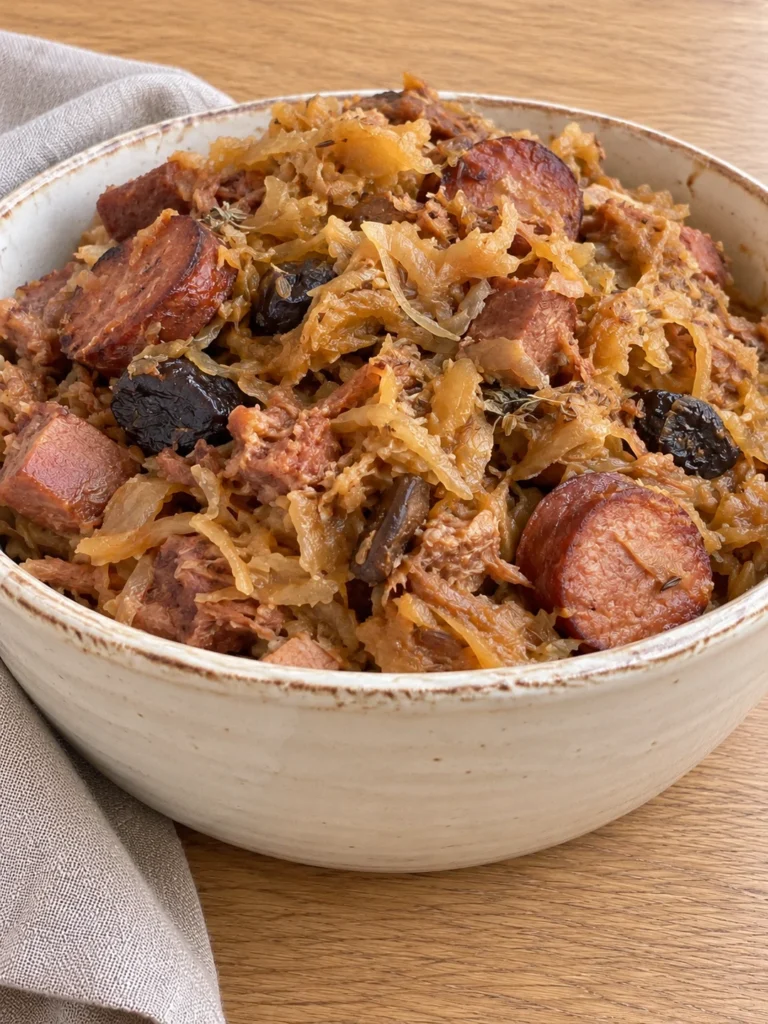
- Dried forest mushrooms, porcini, soaked in hot water. Keep that soaking liquid, it is your stock
- Sauerkraut, the raw refrigerated Polish kind in a bag, about two pounds
- Fresh white cabbage, shredded fine
- Pork shoulder in big cubes
- Smoked bacon, cut into thick lardons, not thin strips
- Polish smoked kiełbasa, sliced thick
- Lard, two spoons. Oil works, lard is better
- Two large onions, diced
- Pitted prunes, halved
- A spoon of tomato paste
- A cup of dry red wine, optional and very old-fashioned
- Bay leaves, allspice berries, crushed juniper, caraway
- Dried marjoram, lots, and more at the end
- Black pepper, and salt only at the very finish
What I Changed Bringing Bigos Home
Marek used kapusta kwaszona from a barrel at his local market, scooped into a bag, properly funky. I cannot get that here, so I buy the refrigerated raw sauerkraut from the Polish deli out in the Valley, the one with the handwritten signs. Shelf-stable jarred kraut is pasteurized and tastes flat in this, and precooked French choucroute is the wrong animal entirely.
My first attempt at home I rinsed the sauerkraut properly, under running water, squeezing it out like I was doing laundry. The stew came out dull and sweetish and I could not work out why. The acidity is the backbone. One quick rinse, a light squeeze, done.
The other change is the meat. Marek’s family version leans on game when someone brings it, venison or boar, which is the prestige rendition and genuinely better. I use pork shoulder because that is what is in front of me, and I lean harder on the smoked bacon to make up the difference.
So the polish bigos hunters stew recipe I cook now is his method with those two swaps and nothing else. No flour. No stock cubes. It thickens by evaporation alone, uncovered, over the last forty minutes, until it mounds on the spoon instead of pouring off it. If it pours, keep going.
I do all of this in my enameled cast iron Dutch oven, the one with the chip on the lid rim from a move two apartments ago. Eight quarts, and this fills it close to the top before the cabbage collapses down.
Day Three Is Not a Suggestion
Marek was blunt about this. Eating bigos the day you make it is eating it unfinished. Cool the pot completely, fridge it overnight, reheat gently, cool it again, and serve it on the third day.
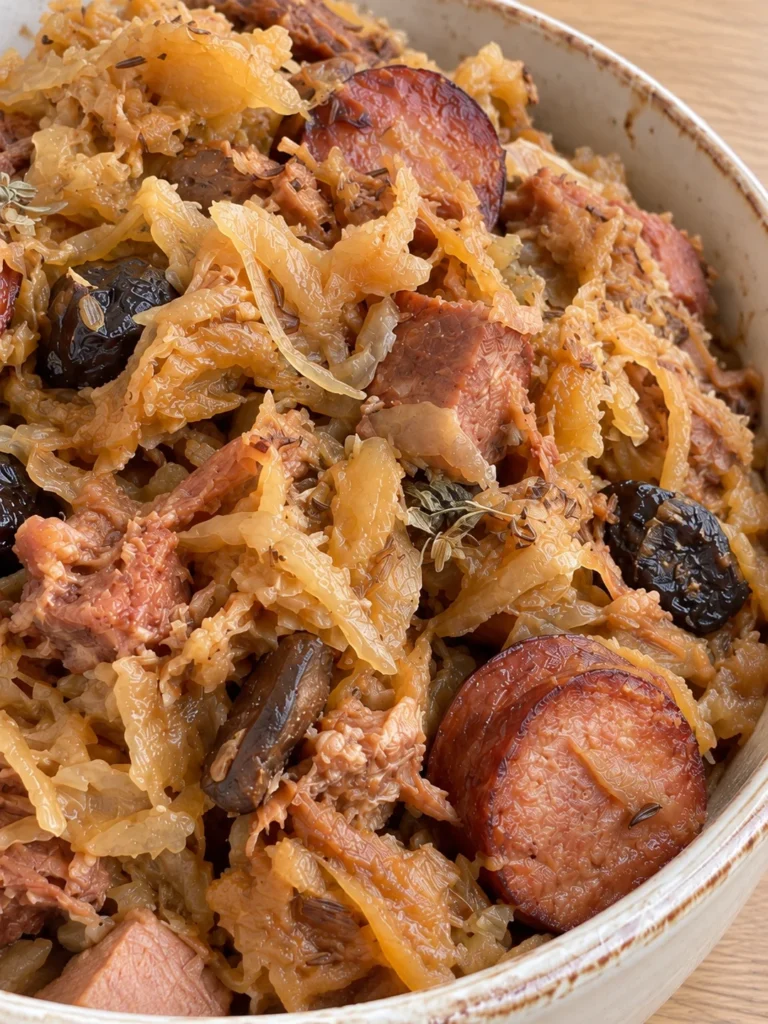
I tested the theory because I am stubborn. Day one it tasted like good cabbage and good meat sitting next to each other. Day three it tasted like one thing. The prunes had gone from fruit to a dark sweetness underneath everything, and the mushrooms had spread through the whole pot.
Offering a guest bigos from the third day is a small point of pride in Poland. Now I understand why.
My favourite way to eat it is not the respectable way. Fry a portion in a dry hot pan until the edges catch and darken, then eat it with dark rye and a pickled cucumber, standing at the counter. Cold straight out of the container also works and I will not be taking questions.
Swaps and Small Things
If you want the proper bigos myśliwski, replace half the pork shoulder with venison or boar and add a couple more juniper berries. The Lithuanian variant leans on apple, which cuts the richness differently.
Skip the wine if you want, it is the older noble flourish rather than a requirement. Do not skip the prunes or the dried mushrooms, though. They are not a modern sweet gimmick bolted on, they are the traditional counterweight to all that sour cabbage, and without them the pot tastes one-note.
Salt genuinely goes in last. Bacon, kiełbasa and sauerkraut all arrive salty, and I have over-seasoned this once, early on, by salting at the start out of habit.
It freezes well for about three months, and ten servings is not as much as it sounds.
I made it most recently on a grey February Sunday with rain on the kitchen window and Niemen playing too loud, and the apartment smelled of it for two days. Halina’s bowl at that market cost less than a coffee and gave me a pot I now cook every winter. Fair trade.
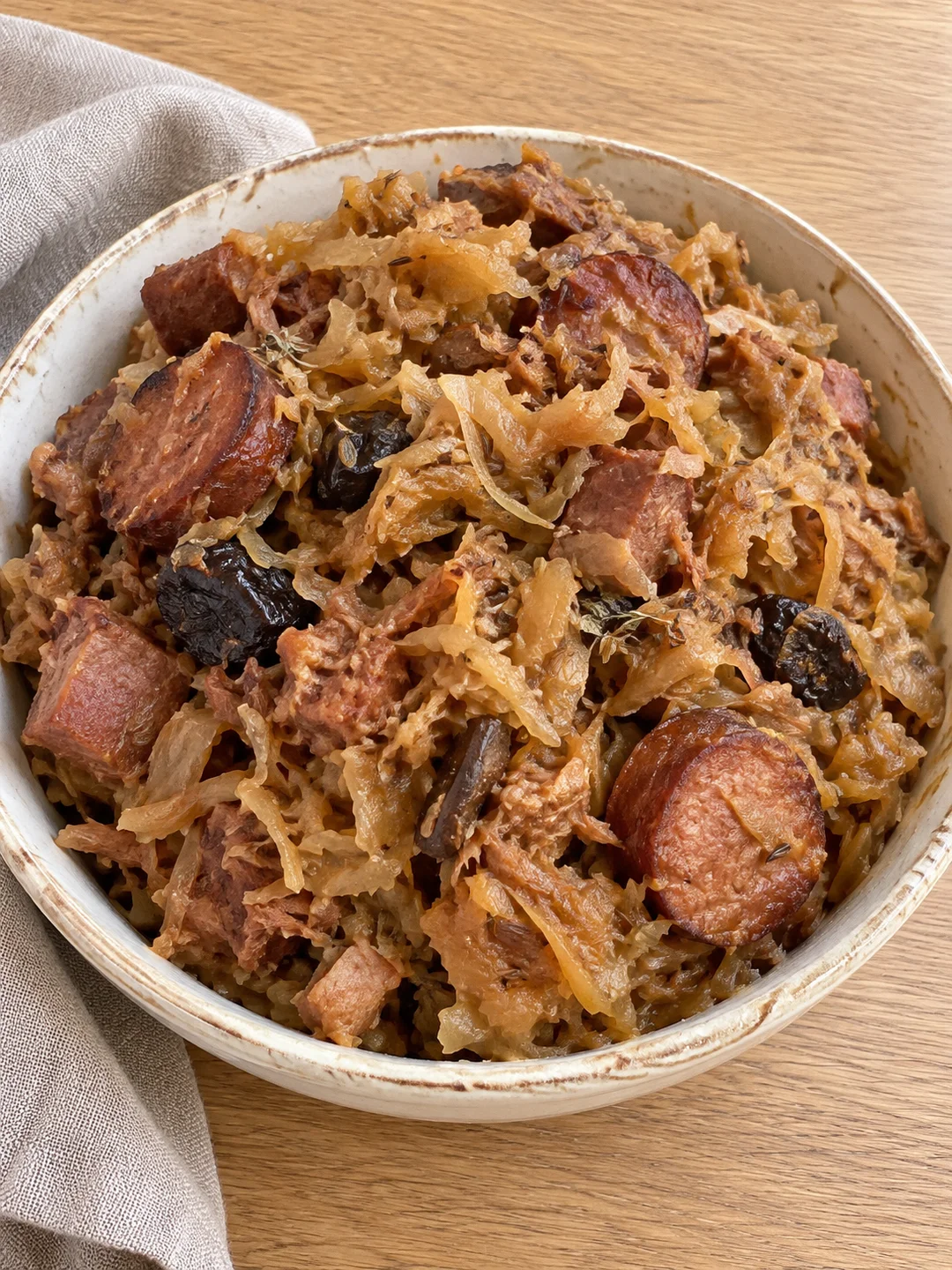
Bigos
Ingredients
Equipment
Method
- Put the dried mushrooms in a small bowl, cover with 2 cups hot water, and leave to soak 30 minutes. Lift them out, chop roughly, and strain the soaking liquid through a fine mesh strainer. Keep both. That liquor is your stock.
- Drain the sauerkraut and give it one quick rinse under cold water, no more. Squeeze lightly and chop any long strands. Do not wash it properly or soak it. The acidity is the point of the dish.
- Put the sauerkraut and shredded fresh cabbage in the Dutch oven with the strained mushroom liquor and 1 cup water. Bring to a simmer, cover, and cook over low heat 45 minutes, until the cabbage is soft and the sauerkraut has lost its raw bite. Stir now and then.
- Meanwhile, render the bacon lardons in the skillet over medium heat until the fat runs and the edges are brown, about 8 minutes. Transfer the bacon to the cabbage pot, leaving the fat in the skillet.
- Add the lard to the bacon fat and raise the heat to medium-high. Brown the cubed pork shoulder in two batches, 5 to 6 minutes per batch, so it takes real color rather than steaming. Move each batch into the cabbage pot.
- Brown the sliced kielbasa in the same skillet for 3 minutes until the edges curl and crisp, then add it to the pot.
- Lower the skillet heat to medium and cook the diced onions in the remaining fat for 10 minutes, until soft and golden. Stir in the tomato paste and cook 1 minute more, then scrape it all into the pot.
- If using the wine, pour it into the hot skillet, let it bubble for 1 minute while you scrape up the browned bits, and tip it over the stew.
- Add the chopped mushrooms, prunes, bay leaves, allspice, juniper, caraway, marjoram and black pepper. Stir everything together well. Do not salt yet.
- Cover and simmer over the lowest heat for 2 hours, stirring every 20 minutes and scraping the bottom so nothing catches. Add a splash of water only if it looks like drying out before the meat is tender.
- Uncover and cook another 30 to 45 minutes, stirring often, so the liquid evaporates and the stew turns thick and almost dry. It should mound on a spoon, not pour. This evaporation is the only thickening bigos gets.
- Fish out the bay leaves and as many whole allspice and juniper berries as you can find. Taste and only now add salt, a pinch at a time, along with a final pinch of marjoram.
- Cool the pot completely and refrigerate overnight. The next day, reheat gently for 30 minutes, then cool and refrigerate again. Serve on day three, when the flavors have fully married.
- To serve, reheat until steaming, or fry individual portions in a dry hot pan for 3 minutes until the edges darken and catch.