
Pumpkin Pancakes were not why I went to Keene, New Hampshire, in the last week of October. I went for the lanterns, thousands of them stacked up on scaffold towers along Main Street, because a friend of a friend had been telling me for two years that I needed to see it once.
I ended up at a family dinner instead. Which is usually how the good food finds me.
Dottie’s Kitchen on the Edge of Keene
The house belonged to Dottie, the grandmother in that family, and her kitchen had a wall oven from some decade I could not place and a griddle pan with enamel chipped off one corner. She wore a flannel shirt with the sleeves shoved past her elbows and kept a dish towel tucked through her belt loop the entire night.
Dinner was pot roast and too much of it. But at some point she asked what time I was getting up, and when I said early, she said come down and I will show you the pancakes, because the festival crowd eats at eight and we eat at seven.
She corrected me twice the next morning. The first time was when I reached for a second scoop of purée out of the can, because more pumpkin obviously means more pumpkin flavour. She moved the can. Purée is heavy and full of water, she said, and if you push past about half a cup the leavening cannot lift it, so you get something brown on the outside and wet in the middle.
The second correction was the stirring. I had the batter almost smooth before she took the spatula off me. Lumps are the point. Ten or twelve strokes and you walk away.
She also cooked them lower and slower than I would have dared. Most recipes tell you medium. Dottie ran that griddle at something closer to medium-low and let each one sit there for nearly three minutes, and I have never gone back to higher heat since.
Why Pumpkin Pancakes Are Not a Colonial Dish
I came home and read about them, because I had assumed the tall fluffy spiced version was some old New England inheritance. It is not, and it is worth saying out loud.
Pumpkins are indigenous to the Americas, with seeds found in Mexico dating back to roughly 5500 B.C., and griddle cakes in the northeastern colonies descend from Indigenous johnnycakes and hoecakes. Through the 1700s and 1800s cooks folded mashed pumpkin into those batters as cheap bulk and cheap sweetness, but those cakes were cornmeal-heavy, barely sweet, and leavened with yeast. The fluffy buttermilk pancake with cinnamon and ginger and cloves is a twentieth-century thing, made possible by chemical leaveners and canned purée on shelves all year.
Two more things that surprised me. Most of the canned pumpkin sold in the United States is actually Dickinson squash, a tan-skinned winter squash rather than the orange jack-o’-lantern kind. And pumpkin pie spice contains no pumpkin at all, just cinnamon, ginger, nutmeg and cloves or allspice.

What I Used
- All-purpose flour, spooned and levelled, about a cup and a half
- Packed brown sugar, three tablespoons, no more
- Baking powder and a little baking soda, because the buttermilk needs something acidic to react with
- Ground cinnamon, the biggest spice in the bowl
- Ground ginger, ground nutmeg grated fresh if I have the whole ones, and a pinch of cloves
- Salt
- Buttermilk, well shaken, one cup and deliberately less than a plain pancake batter would take
- Solid-pack unsweetened pumpkin purée, half a cup
- One large egg at room temperature
- Melted unsalted butter, plus more for the griddle
- Vanilla extract
Cooking Pumpkin Pancakes Back Home
First attempt in my own kitchen, I grabbed the wrong can. Pie filling, already sweetened and already spiced, and the batter came out slack and cloying and browned far too fast. Read the label. Solid-pack purée only.
The second attempt was a Sunday morning in October with the windows open and the building still asleep, and that one worked. This pumpkin pancakes recipe is now the only reason I keep canned purée in the cupboard, and I almost never keep canned purée in the cupboard. Except from September onward, when there are three cans behind the rice.
Here is what is happening while you wait. The moment the buttermilk hits the baking soda, carbon dioxide starts forming in tiny pockets through the batter, and during the ten-minute rest the flour drinks up liquid and the whole thing stiffens into something that holds its shape on a spoon. That is why you do not stir it again. Every stroke after that pops bubbles you spent ten minutes building.
On the griddle, the pumpkin’s water turns to steam and has to climb up through the batter before the centre can set, which is exactly why low heat matters. Give it high heat and the sugars on the bottom go dark before the middle finishes. At medium-low you watch the edges go matte and dry, the surface bubbles start breaking instead of healing over, and the underside turns deep gold rather than brown.
I use the cast iron pan I have had since my first apartment, wiped with butter and then wiped again with a paper towel so there is barely a film left. Too much butter and the batter fries unevenly in patches. A scant quarter cup per pancake, nudged into a round with the back of the ladle, because the batter is far too thick to spread by itself.
They go onto a wire rack in a 200 F oven while the rest cook. Stacking them on a plate traps steam and the bottoms go limp, which I learned the hard way with a plate of eight.

Swaps, Toppings and Keeping Them
No buttermilk in the fridge is not a crisis. Use whole milk, drop the baking soda entirely, and take the baking powder up to two teaspoons.
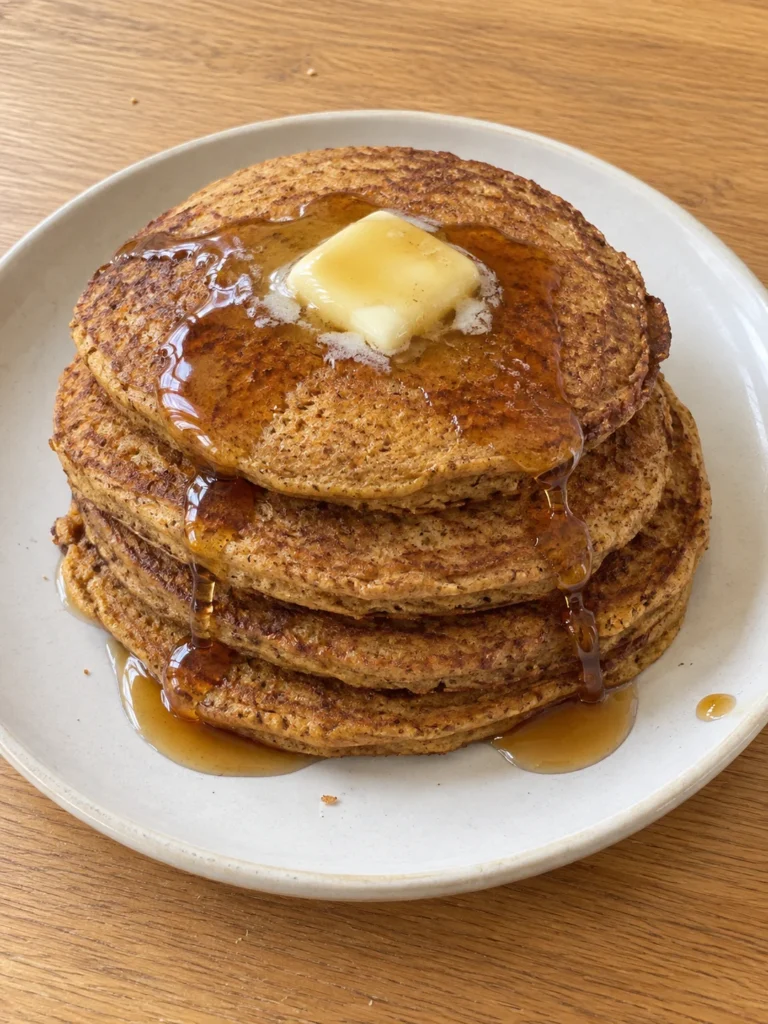
Dottie served hers with maple syrup and a pat of butter sliding off the top and nothing else, and honestly that is still my favourite. Toasted pecans are good. Apple butter is better than it sounds. Strong coffee and a couple of sausages beside them make it a real breakfast rather than a sweet one.
Leftovers keep three days in the fridge or two months in the freezer with parchment between them, and they come back to life in a toaster. Cold ones, eaten standing at the counter. Not as good as hot, but I have done it more than once.
I have not been back to Keene since, and I think about that griddle every autumn when the mornings here finally go cool enough to want pancakes. Dottie would probably tell me my heat is still too high. She would probably be right.
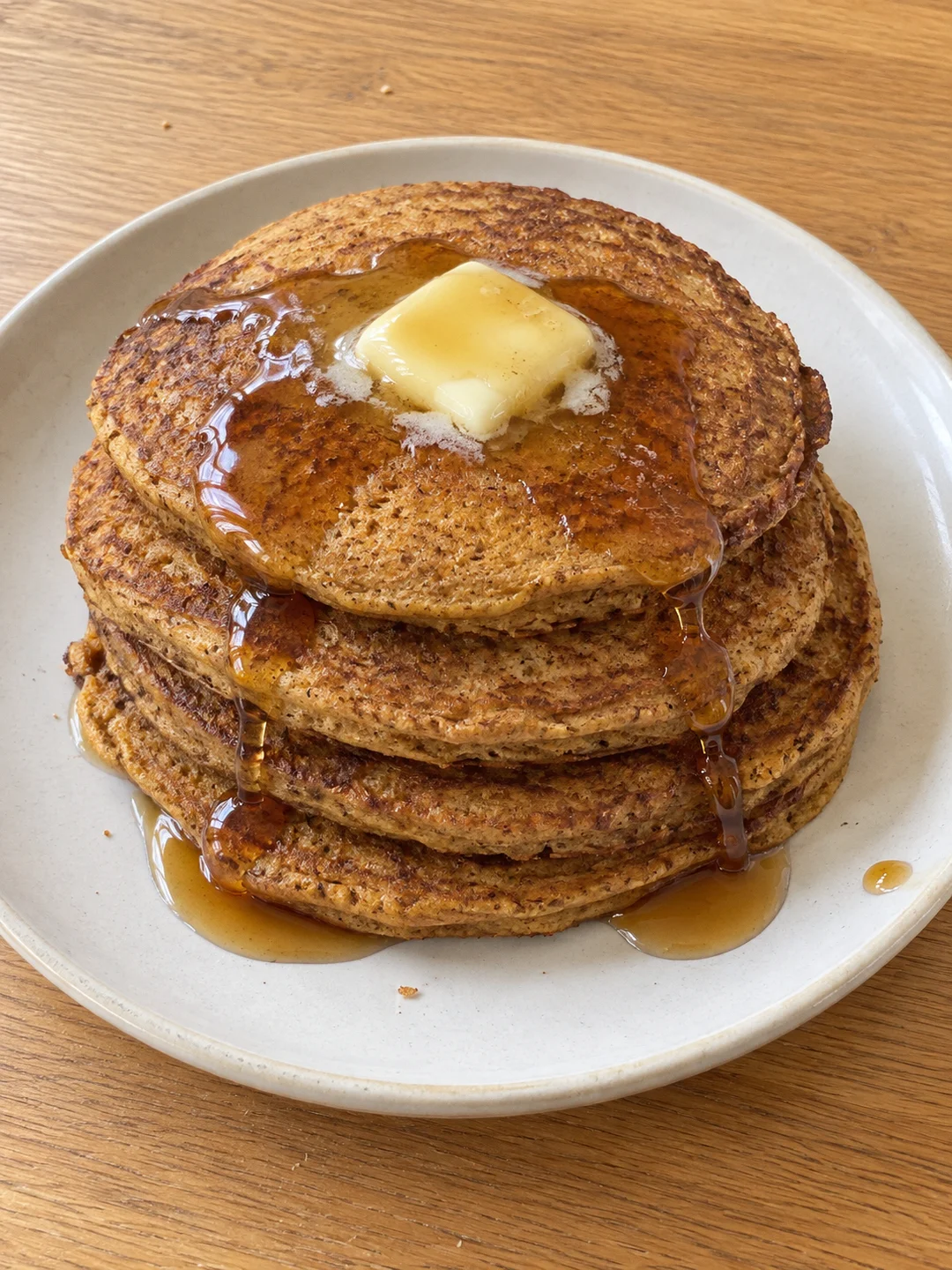
Pumpkin Pancakes
Ingredients
Equipment
Method
- In a large bowl, whisk together the flour, brown sugar, baking powder, baking soda, cinnamon, ginger, nutmeg, cloves, and salt until evenly blended and no lumps of brown sugar remain.
- In a second bowl, whisk the buttermilk, pumpkin puree, egg, melted butter, and vanilla until completely smooth and uniformly orange with no streaks of pumpkin.
- Pour the wet mixture into the dry ingredients and stir with a spatula just until the flour disappears, about 10 to 12 strokes. The batter should be thick and lumpy. Stop mixing while lumps are still visible.
- Let the batter rest on the counter for 10 minutes. It will thicken noticeably as the flour hydrates and the leavening begins to work. Do not stir it again.
- While the batter rests, heat a griddle or large skillet over medium-low heat, about 350 F. Lower heat than usual is essential here because the pumpkin's moisture means the centers need extra time to set. Lightly grease with butter and wipe away any excess with a paper towel.
- Ladle a scant 1/4 cup of batter per pancake onto the griddle, leaving 2 inches between them. Nudge each one into a round with the back of the ladle; the batter is too thick to spread on its own.
- Cook 2 to 3 minutes, until the edges look dry and matte, bubbles break the surface, and the underside is deep golden. Slide a thin spatula fully under each pancake and flip in one confident motion.
- Cook 2 minutes more, until the second side is golden and the center springs back when pressed lightly. If the pancakes are browning before 2 minutes, lower the heat.
- Transfer to a wire rack in a 200 F oven while you cook the remaining batter, regreasing the griddle lightly between batches. Serve hot.