
The Croissant Breakfast Casserole that rearranged my idea of brunch came out of a tray behind a butcher’s glass case in Mile End, Montreal, on a November morning when the rain had turned to something halfway between sleet and spite. Four tables at the back. A chalkboard menu in French with no translation and no apology.
I had gone in for coffee and a place to sit. I left with a recipe written on the back of a butcher paper scrap, in pencil, in handwriting I still have.
The Boucherie in Mile End
The place was a working butcher shop first and a restaurant second, the way a lot of small family places are when the family cannot afford to be only one thing. Rémi ran the counter. His wife Hélène ran the two burners and the oven behind him, and whatever she baked that morning went on the chalkboard until it was gone.
I took the counter seat because it was the only one with heat coming at it. I pointed at the chalkboard word I did not recognize and Rémi laughed and said something fast to Hélène, and three minutes later a square of it landed in front of me on a plate that did not match any other plate in the room.
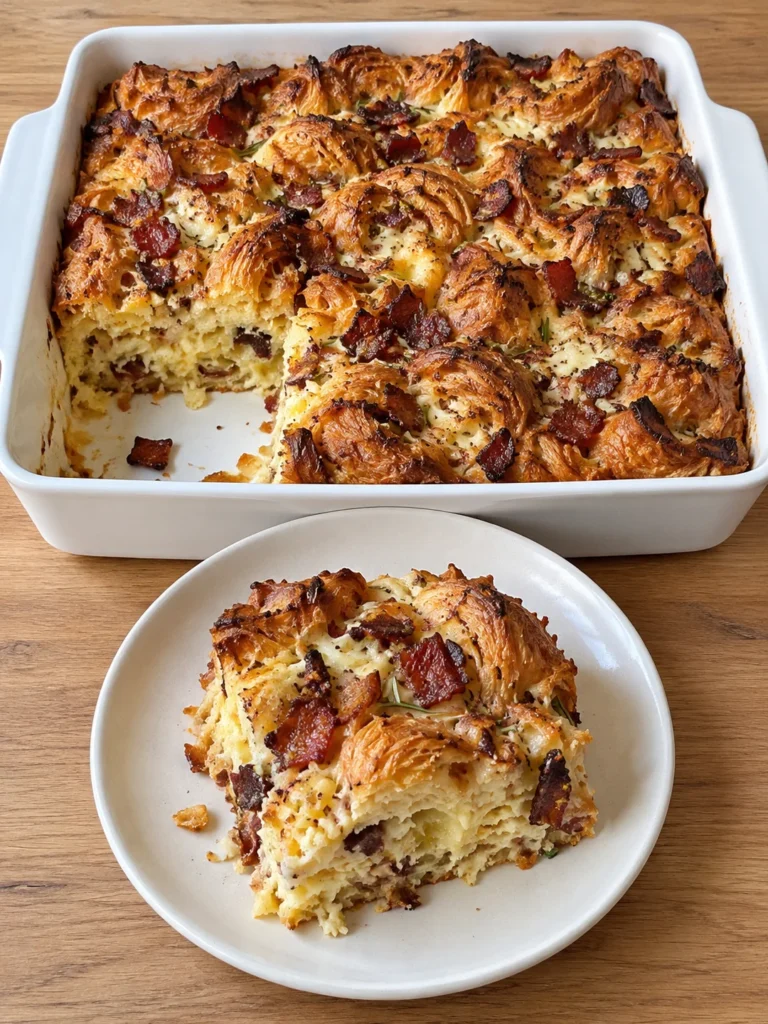
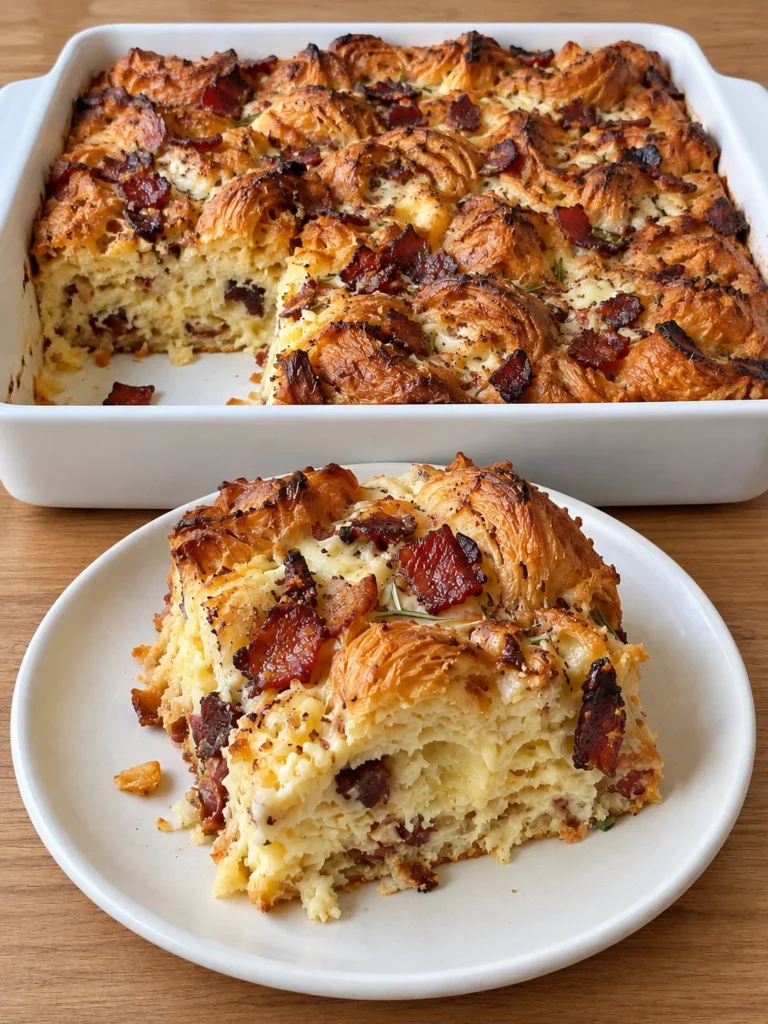
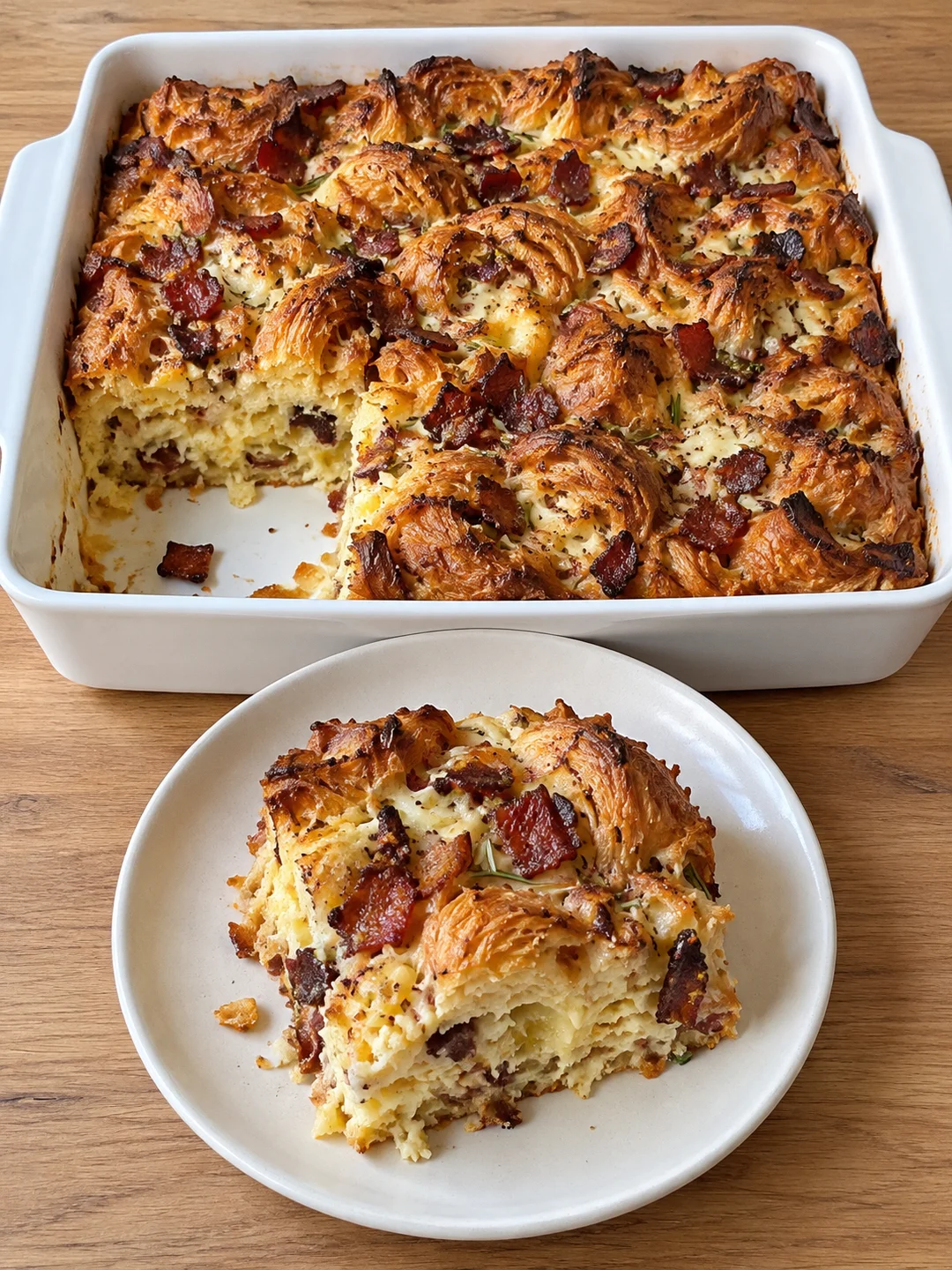
The top had gone dark gold and shattered under the fork. Underneath, custard. Properly custard, not scrambled egg pretending. Bacon in it, rosemary in it, and a nutty cheese I could not name until Rémi held up the rind of the gruyere so I could read it.
What Rémi Told Me While I Waited
He explained it the way butchers explain things, which is to say he started with the meat and worked outward. Thick-cut bacon off the slab, not the thin pre-sliced stuff, cut into pieces about half an inch so they stay chewy instead of dissolving into the eggs.
Then the salt. He was firm about this. Salt the custard, not the croissants, and salt it more than feels polite, because three cups of dairy and twelve eggs swallow seasoning whole.
And then the rest, which he mimed by putting both palms down flat and holding them still. Ten minutes out of the oven before you cut it. Cut it hot and the custard runs and you have made soup with pastry in it. He said the croissants came from the bakery two doors down, always the day before, never that morning.
It Is Not French, and Neither Is the Croissant
I assumed, sitting in a French-speaking city eating a tray of baked croissants, that I had found something French. Wrong on both counts, and I like it better for that.
This is an American dish. It descends from the breakfast strata, a layered bake of bread and cheese under egg custard, and the earliest documented version is a cheese strata of bread, white sauce and cheese from 1902. The name comes from the Latin stratum, meaning layer, which is exactly what you are doing when you stack pastry and bacon and cheese before the eggs go over the top. Strata became a staple of American entertaining after the 1984 Silver Palate Good Times Cookbook put it in front of a generation of hosts, mostly because you could build it the night before and still be sitting down with your guests in the morning.
The croissant swap came much later, and it exists for a thrifty reason. It is a leftover-pastry dish. Even the croissant itself is a traveler, descended from the Austrian kipferl, carried to Paris by the Viennese baker August Zang in 1839 and laminated into its modern shape by French bakers, with the first published French croissant recipe not appearing until 1915.
French home cooks do not make this. Hélène, as far as I could tell, made it because houseguests and cold mornings are a universal problem.
What I Used
- 9 day-old croissants, torn by hand into big ragged chunks
- 12 oz thick-cut bacon, cut into half-inch pieces
- 1 medium yellow onion, diced small
- 1 tbsp fresh rosemary, chopped fine
- 10 oz gruyere, shredded, roughly three and a half cups
- 12 large eggs
- 3 cups half-and-half, and please not milk
- 2 tbsp coarse Dijon or brown mustard
- 2 tsp kosher salt
- 1 tsp black pepper, ground fresh
- a quarter teaspoon of grated nutmeg, optional but I always
- 1 tbsp softened butter for the dish
Baking the Croissant Breakfast Casserole in My Own Kitchen
I buy the croissants a day ahead from the bakery stall at the Sunday farmers’ market and leave them out on the counter uncovered overnight, which my first attempt taught me the hard way. That first time I used fresh, soft croissants and soaked them overnight like the recipe allowed, and what came out was a pale pudding with no top. Mush. If yours are soft, tear them and toast them at 300 F for ten minutes and let them cool.
The bacon goes into my cast iron, the one with the handle worn smooth, and that is the moment the apartment starts smelling like a place people want to be. Then the onion and rosemary into about two tablespoons of the fat, and the rosemary hits the heat and goes sharp and piney for maybe twenty seconds before it settles down. Lift the onions out with a slotted spoon and leave the grease in the pan. I skipped that step once and the bottom of the dish was a slick.
Whisking the custard is the unglamorous part. Eggs until foamy, then the half-and-half, the mustard, the salt, pepper and nutmeg, and keep going until there is not one yellow streak of mustard left floating.
Pour it over slowly and press the tops down with your palm so they are damp but still standing above the liquid line. Twenty to thirty minutes on the counter and that is enough. Longer is not better. Over-soak it and you lose the crisp lid entirely, which is the whole reason this is a breakfast casserole with croissants and not a loaf of sandwich bread.
Then 350 F, uncovered, 45 to 60 minutes, until it puffs and goes deep brown at the ragged edges. Press the middle with a spoon. If liquid rises, give it longer.

Swaps and the Ones That Do Not Work
Breakfast sausage or Italian sausage instead of bacon is fine, smoked gouda or sharp cheddar instead of gruyere is fine, thyme or sage instead of rosemary is fine. What is not fine is milk for the half-and-half. The custard will not set and the dish weeps.
I serve it with cut fruit and too much coffee, and I keep saying I will make a proper fruit salad. I never do.
Leftovers hold three days and reheat at 325 F for fifteen minutes to bring the top back. Although honestly, cold square straight from the fridge, standing at the counter in the morning light. Better than it has any right to be.
I have made this maybe twenty times now and every single time I think about that steamed-up window and Rémi holding up a cheese rind so a stranger could read it. Some trips hand you a dish. That one handed me a whole morning routine.
Croissant Breakfast Casserole
Ingredients
Equipment
Method
- Butter a 9x13 inch baking dish generously, including the corners and up the sides.
- Tear the croissants by hand into chunks about 2 inches across. Tear, do not slice. The ragged edges are what crisp up in the oven. Scatter them evenly in the baking dish.
- Cook the bacon in a large skillet over medium heat, stirring occasionally, until browned and crisp at the edges, 8 to 10 minutes. Lift it out with a slotted spoon onto a paper towel lined plate.
- Pour off all but about 2 tablespoons of the bacon fat. Add the onion and rosemary and cook over medium heat until the onion is soft and translucent, 3 to 4 minutes. Lift the onion out with the slotted spoon, leaving the grease behind in the pan so it does not pool in the casserole.
- Scatter the bacon, onion mixture and shredded gruyere over the croissants, pushing some down into the gaps between the pieces so every layer gets cheese and meat.
- In a large bowl, whisk the eggs until the yolks and whites are fully combined and slightly foamy. Whisk in the half-and-half, mustard, salt, pepper and nutmeg until smooth with no streaks of mustard left.
- Pour the custard slowly and evenly over the whole dish. Press the croissants down lightly with your palm or the back of a spoon so the tops are moistened but still sitting above the custard line.
- Let the dish stand at room temperature for 20 to 30 minutes. Do not soak it longer than that or the croissants saturate and you lose the crisp top. For a make-ahead, cover and refrigerate overnight instead.
- Heat the oven to 350 F. Bake the casserole uncovered on a middle rack for 45 to 60 minutes, until it is puffed, deeply golden on top and set in the center. Press the middle gently with a spoon. No liquid should rise around it. If the top browns too fast, tent it loosely with foil for the last 15 minutes.
- Rest the casserole on a rack for 10 minutes so the custard firms, then cut into squares and serve warm.