
Turkey Pot Pie was not why I booked a week in Damariscotta, Maine. I went for the oysters, in the cold end of November, because a man on a boat once told me the ones from that river taste like cucumber and cold salt. He was right about the oysters.
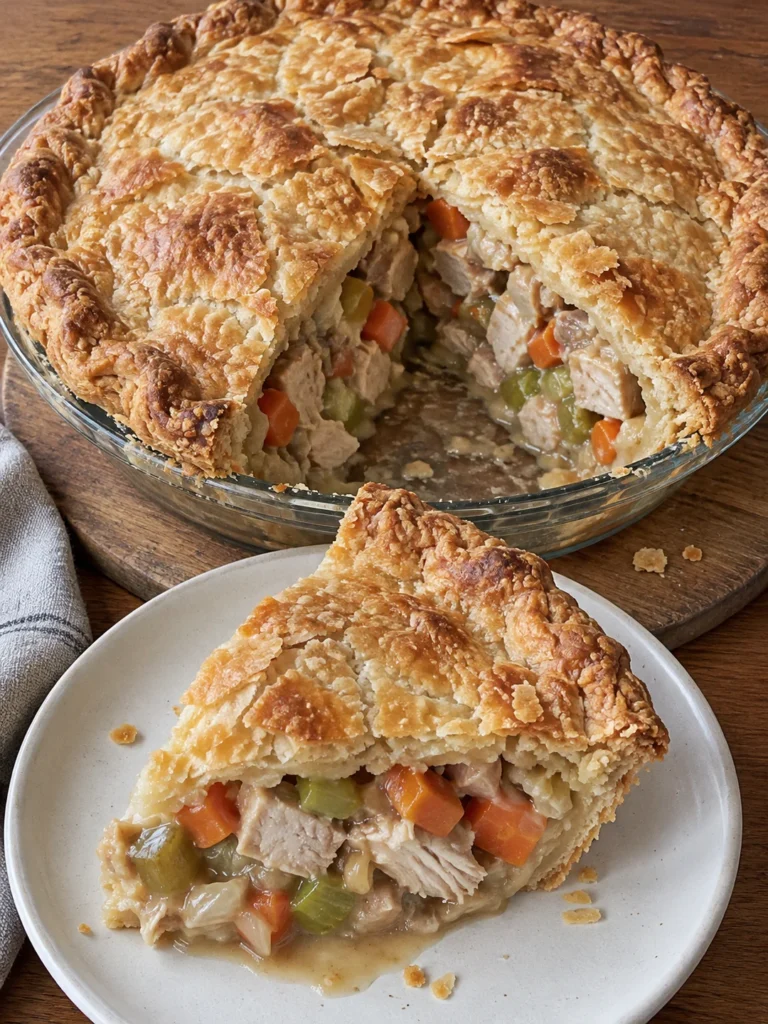
I came home with a pie recipe instead. On a napkin.
Dorrie’s Kitchen in Damariscotta
I was staying in the back bedroom of a shingled house about two miles up from the water, the kind of place where the stairs announce every person on them. My host was Dorrie Pelletier, retired school bus driver, thirty-one winters of icy routes, now binding books in a converted barn behind the house with a nipping press and a space heater.
She had hosted Thanksgiving for eleven people four days before I arrived. There was still a carcass in the fridge, wrapped in a grocery bag, waiting. On Saturday afternoon she pulled it out, broke it apart with her hands over the sink, and told me to sit down and stop hovering.
The kitchen had one window that faced west and by four o’clock the light came in low and orange across a formica table. She simmered the bones with a halved onion, skin still on, two bay leaves, celery. Ninety minutes of almost nothing happening. Then everything happened at once.
When I asked her to write it down she tore a napkin off the stack by the toaster, wrote in ballpoint, and handed it over with a thumbprint of butter already on the corner. That napkin is taped inside my cupboard door. We send postcards now, two or three a year. She sends hers from Boothbay and signs them with just the letter D.
Turkey Pot Pie Is Older Than the Leftovers
Most people treat leftover turkey pot pie as an improvisation, a thing you do because the bird is too big and the fridge is too full. Dorrie did the opposite. She roasts a turkey larger than her table needs specifically so the pie happens, and she told me the second meal is the one she actually looks forward to.
The form is very old. Enclosed savory meat pies go back to Greece and Rome, where the filling baked inside a thick flour-and-water shell that worked as a cooking vessel rather than something anyone wanted to eat. Medieval English cooks called those crusts coffyns, and they were tough, functional, often thrown out.
English settlers brought the pastry-cased version to North America and swapped European game for the birds they found here, turkey chief among them. So turkey was the colonial substitution, not an afterthought bolted onto chicken pot pie centuries later. The first American pie recipe in print showed up in Amelia Simmons’s American Cookery in 1796, and the exact phrase chicken pot pie surfaces in The Kentucky Housewife in 1839.
One thing worth knowing. In Pennsylvania Dutch country a pot pie is not a pie at all. Bot boi is a brothy noodle stew with no crust whatsoever, a staple of church suppers and firehouse fundraisers, and calling the pastry version by that name muddles two separate dishes.
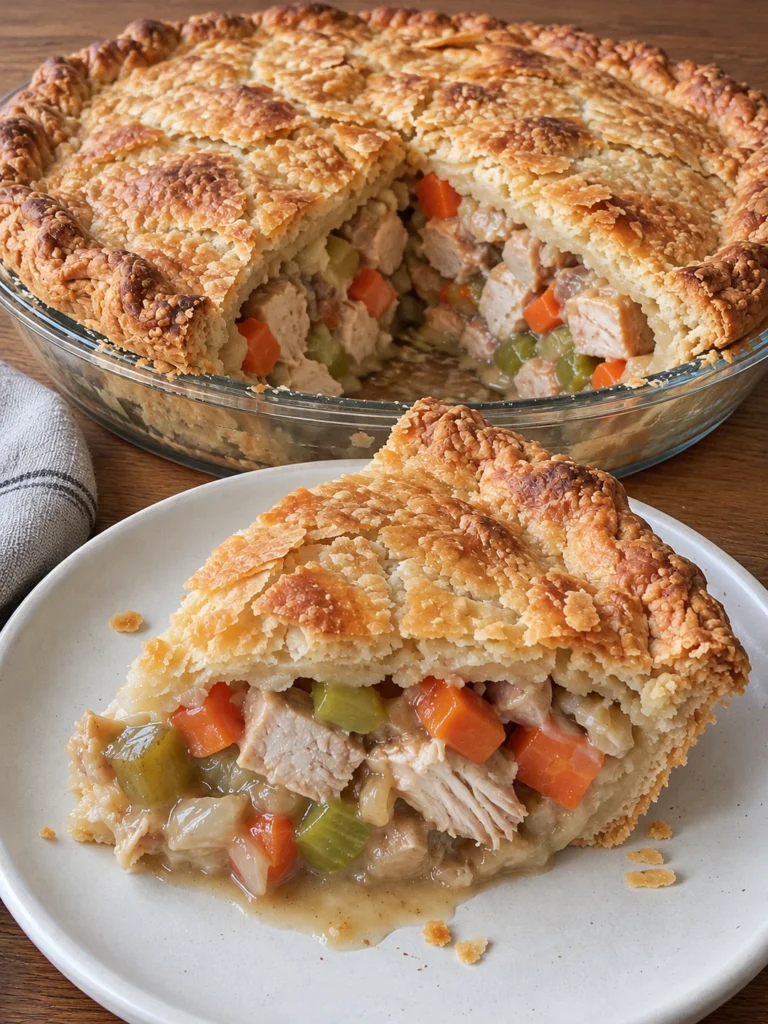
What I Used
- All-purpose flour and a cup of very cold butter for the pastry, cubed straight out of the fridge
- Ice water, six tablespoons to start, more if the dough argues
- One roast turkey carcass, broken into pieces, plus onion, celery and bay leaves for the stock
- Six tablespoons butter for the filling, which sounds like a lot and is not
- Onion, two carrots, two celery stalks, all diced small
- One medium potato in half-inch dice
- Fresh thyme and fresh sage, chopped fine
- Half a cup of flour for the roux
- Three cups of the warm turkey stock
- Three quarters of a cup of heavy cream
- Four cups cooked turkey, white and dark mixed
- A cup of frozen peas, straight from the bag
- Salt, a lot of black pepper, and one egg beaten with water for the wash
Cooking It in My Kitchen in January
I made it properly for the first time on a rainy Sunday, which is the only kind of weather that makes a three-hour pie feel reasonable here. Stock on the back burner for an hour and a half. Windows fogged at the edges. Nina Simone on, then nothing on, because at some point I forgot to restart the record and only noticed when the roux started hissing.
The kitchen looked wrecked by the end. Flour on the wooden table where the morning light usually lands, a strainer full of spent bones in the sink, my one good chef’s knife with the wonky handle sitting in a pile of carrot ends. The glass pie dish is a deep nine inch one I picked up at an estate sale in Pasadena for four dollars.
Two things matter more than everything else. The gravy has to be thick enough to hold a line when you drag a finger through it, because a thin filling means a wet pie and there is no rescuing that in the oven. And the filling must be completely cold before it touches pastry. Warm filling melts the butter in the crust and you lose the flake.
My first attempt I skipped the blind bake. Soggy base, pale and sad, the lid perfect and the bottom unforgivable. Blind baking is not a modern fussy step, it is the historical fix for exactly that problem.
Rest it fifteen minutes on a rack. I know. The gravy sets as it cools and the slices hold instead of flooding the plate.
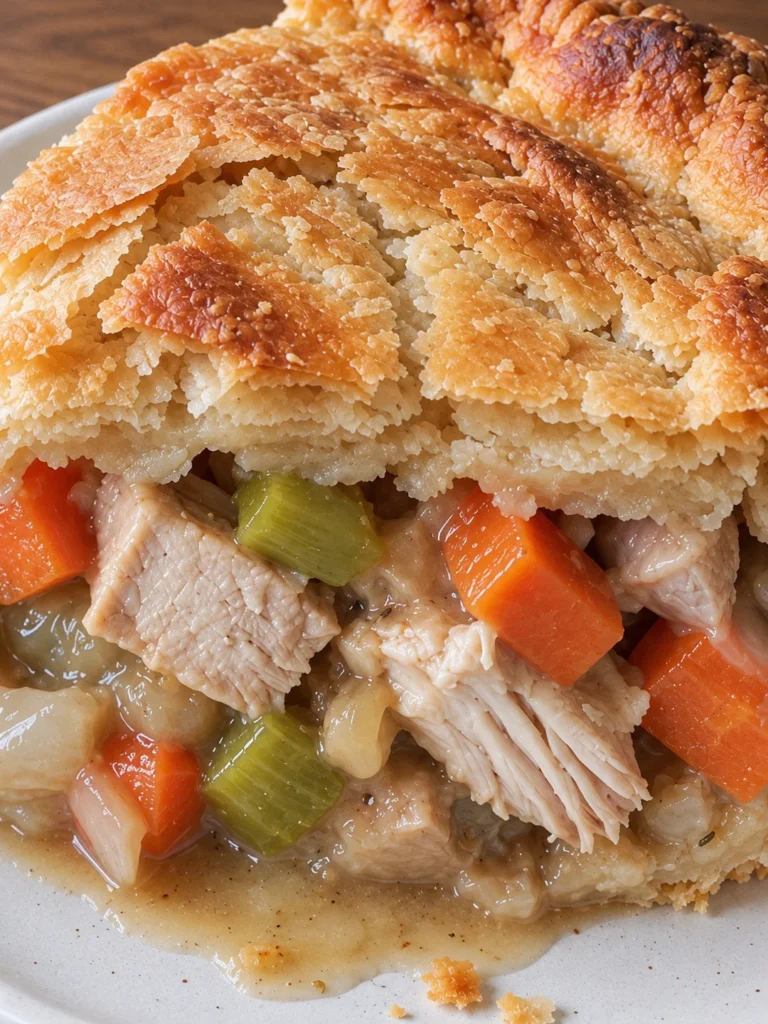
Swaps, and What I Would Not Change
If you have leftover gravy, use it for up to a cup and a half of the stock and drop the flour to five tablespoons. It deepens everything. A top crust alone is perfectly traditional, so if the bottom feels like too much work, butter the dish, pour in the cold filling and cap it.
Half butter and half lard in the pastry gives you a sturdier, flakier shell. I do it when I remember to buy lard, which is maybe one time in three. Frozen peas beat fresh here, and I will not be talked out of that. Fresh ones go dull and khaki in a gravy this rich.
You can also freeze the whole assembled pie unbaked for up to three months and bake it straight from frozen at 400 F for sixty to seventy minutes. I have one in the freezer right now, labelled in marker, for a week I know is coming.
Leftovers hold four days. Cold, eaten standing at the counter, still better than it has any right to be.
Dorrie’s last postcard said the bindery got a new skylight and the oysters were good this year. I wrote back that the pie works in California too, which I do not think she believed. She is welcome to come check.
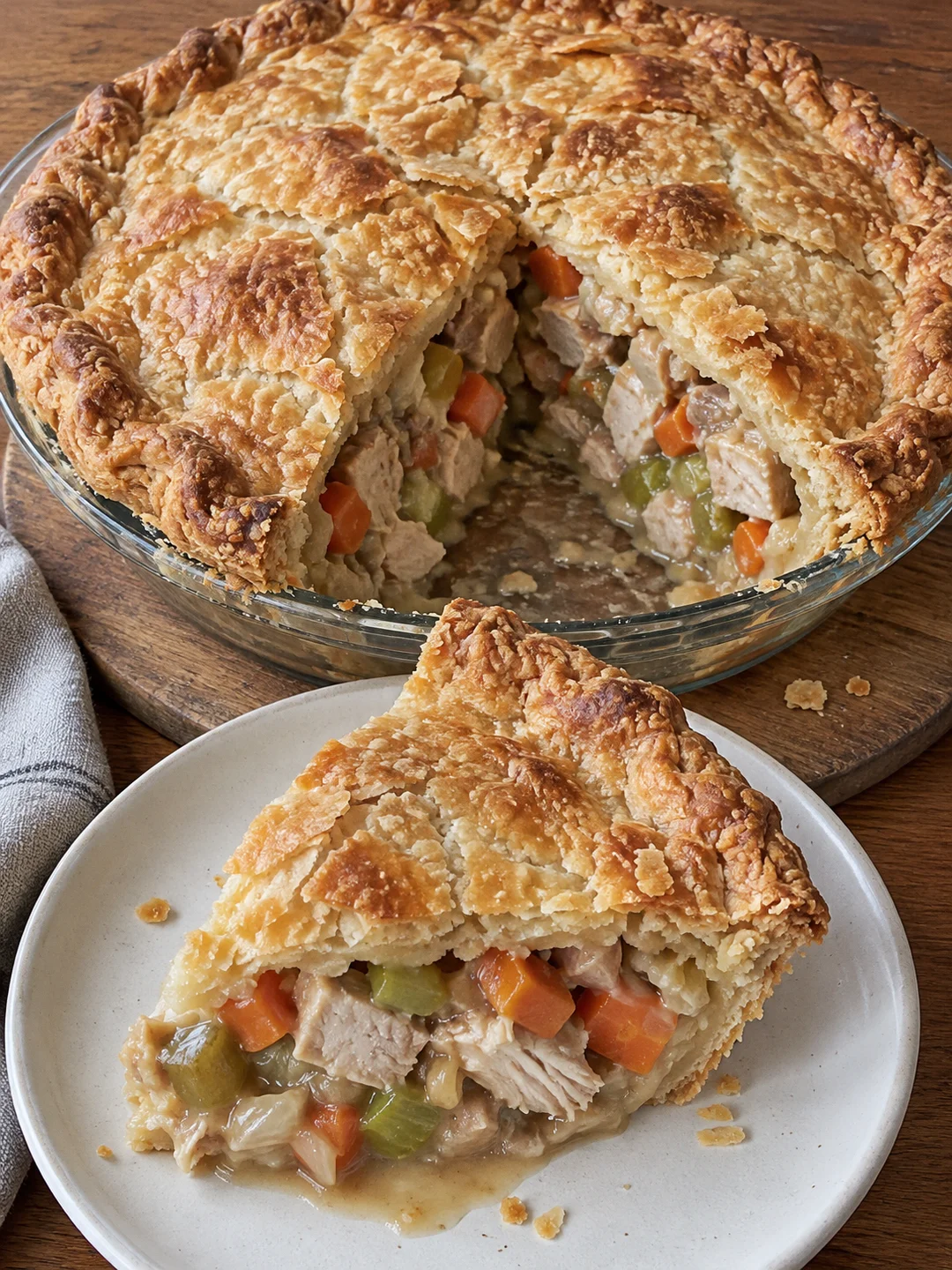
Turkey Pot Pie
Ingredients
Equipment
Method
- Make the pastry first. Whisk 2.5 cups flour with 1 teaspoon salt in a bowl. Add the cold cubed butter and work it in with your fingertips or a pastry cutter until the largest pieces are the size of peas. Sprinkle in the ice water a tablespoon at a time, tossing with a fork, until the dough just holds together when squeezed.
- Divide the dough into two discs, one slightly larger for the bottom. Wrap each in plastic and refrigerate at least 1 hour. This dough can be made a day ahead.
- Make the stock. Put the turkey carcass in a large saucepan with the halved onion, 2 celery stalks and the bay leaves. Cover with 8 cups cold water, bring to a bare simmer, and cook uncovered 60 to 90 minutes, skimming any foam. Strain through a fine mesh strainer and keep 3 cups warm. Discard the bones and spent vegetables.
- Melt 6 tablespoons butter in a large skillet over medium heat. Add the diced onion, carrots and celery with a pinch of salt and sweat 8 minutes until softened but not browned. Add the diced potato, thyme and sage and cook 2 minutes more.
- Dust the vegetables with 1/2 cup flour and stir constantly for 2 full minutes. The roux should smell toasty and coat everything in a pale paste. Do not let it brown.
- Pour in the warm turkey stock a ladleful at a time, whisking out lumps before adding more. Stir in the cream. Simmer gently 8 to 10 minutes until the gravy is thick enough to coat the back of a spoon and hold a line when you draw a finger through it. A thin gravy means a soggy pie.
- Fold in the turkey meat and peas. Season with 1.5 teaspoons salt and 3/4 teaspoon pepper, tasting as you go. Spread the filling in a shallow dish and cool completely, at least 45 minutes, or refrigerate until cold.
- Heat the oven to 425 F with a rimmed baking sheet on the middle rack. Roll the larger disc of dough to a 13 inch circle and line the pie dish, leaving a 1 inch overhang. Prick the base, line it with parchment, fill with pie weights, and blind bake on the hot sheet 15 minutes. Remove the weights and parchment and bake 5 minutes more until the base looks dry.
- Spoon the cold filling into the blind-baked shell and mound it slightly in the center. Roll the second disc to an 11 inch circle, lay it over the top, trim, then fold the bottom overhang up over the lid and crimp firmly to seal. Cut four 2 inch steam vents in the center.
- Brush the lid and crimped edge with egg wash and sprinkle lightly with salt. Return the pie to the preheated baking sheet and bake at 425 F for 20 minutes, then reduce to 375 F and bake 25 to 30 minutes more, until the crust is deep golden and the gravy bubbles visibly through the vents.
- Rest the pie on a rack 15 minutes before cutting. The gravy sets as it cools and slices will hold together instead of flooding the plate.