
The chicken fried rice that ruined every other version for me cost twelve yuan and came in a thin plastic bowl, spoon jammed upright in the middle. Guangzhou, late October, raining the warm sideways way it rains there.
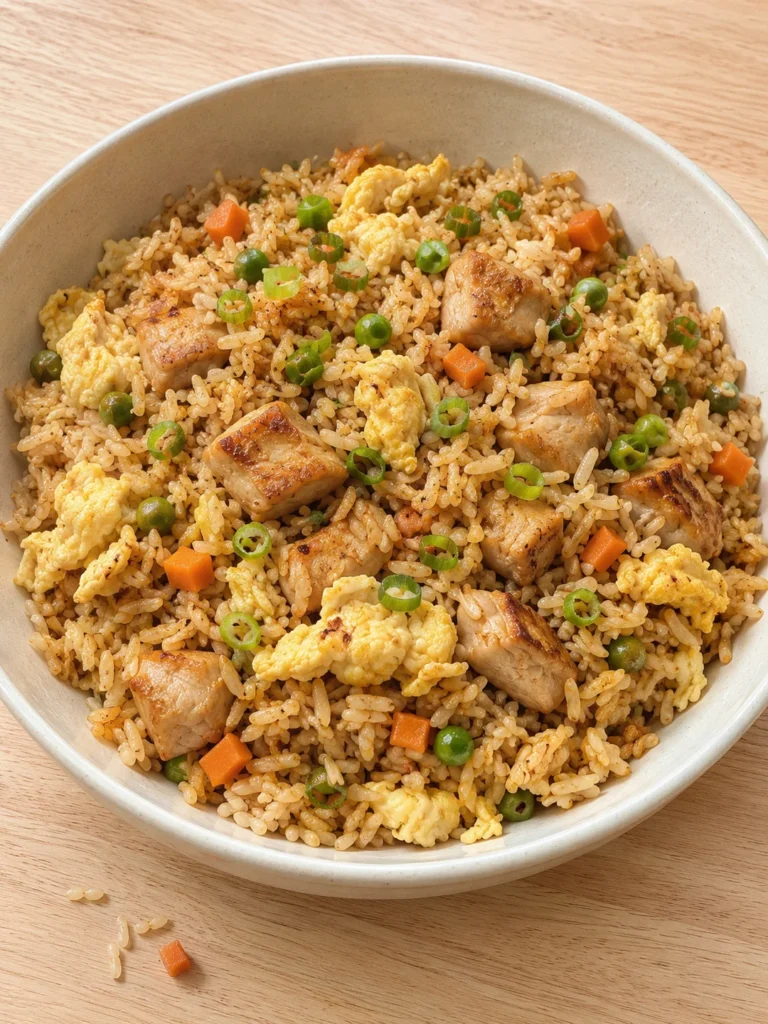
I ate it standing under the cart’s awning with my hood still up and my bag between my ankles. It was pale. Almost beige. I had spent most of my life assuming fried rice was supposed to be brown.
The Cart on Longjin Road West
The man running it was called Mr. Ho, and I only know that because the woman ahead of me in the queue said his name twice while complaining about the weather. He cooked one portion at a time, never two, over a burner that sounded like a small jet taking off.
His hands did two separate jobs at once the whole time. The left shook the wok so the rice jumped in a low arc, the right worked a flat metal spatula, pressing the grains against the hot steel and flipping them before they could catch. Prices were chalked on a board leaning against a crate, and chicken was the cheapest line on it.
There was a smell coming off that wok I could not place. Smoky, but nothing was burning.
Wen Would Not Let Me Go Sightseeing
I was renting a room in Liwan from a woman named Wen, who was in her sixties and had firm opinions about my itinerary. On my third morning I came out with a ticket for the Chen Clan Ancestral Hall in my pocket and made the mistake of telling her about the rice.
She took the ticket out of my hand, set it on the shelf by the door, and told me to wash up. Her kitchen was about two metres wide. One burner, one blackened wok, and a tray of yesterday’s rice sitting uncovered in the fridge as if it had been waiting for me.
She showed me the pressing motion and then made me repeat it until my wrist ached and the grains stopped clumping. The smoky thing I could not name has a name, she said. Wok hei. No sauce in the world fakes it.
I got to the ancestral hall two days later and it was lovely. The rice is what I actually brought home.
Why Chicken Fried Rice Is Not Yangzhou Fried Rice
Fried rice in China traces back to the Sui dynasty, roughly 589 to 618 AD, and the trail begins in Yangzhou in Jiangsu Province, where rice was the staple and nobody wasted a bowl of it. It started as thrift, a way to revive hardened overnight grains with egg, odd vegetables and scraps of meat. It only became a named restaurant dish much later, during the Qing dynasty, credited to Yi Bingshou, the Yangzhou prefecture chief, who added shrimp and diced meat and sausage to the plain version.
So Yangzhou style is defined by a mix of proteins, never by one dominant meat. Chicken fried rice is a different branch of the same family, an everyday single-protein version that became common across southern China and Hong Kong and then travelled the world with Chinese immigrant restaurants. Chicken took over abroad because it was cheap and familiar, not because it was the original.
The other thing worth saying out loud. Traditional Cantonese and Yangzhou fried rice is pale, and the deep mahogany of takeout rice comes from heavy soy sauce or from dark soy added purely for colour. Some classic versions use no soy at all.
What I Used
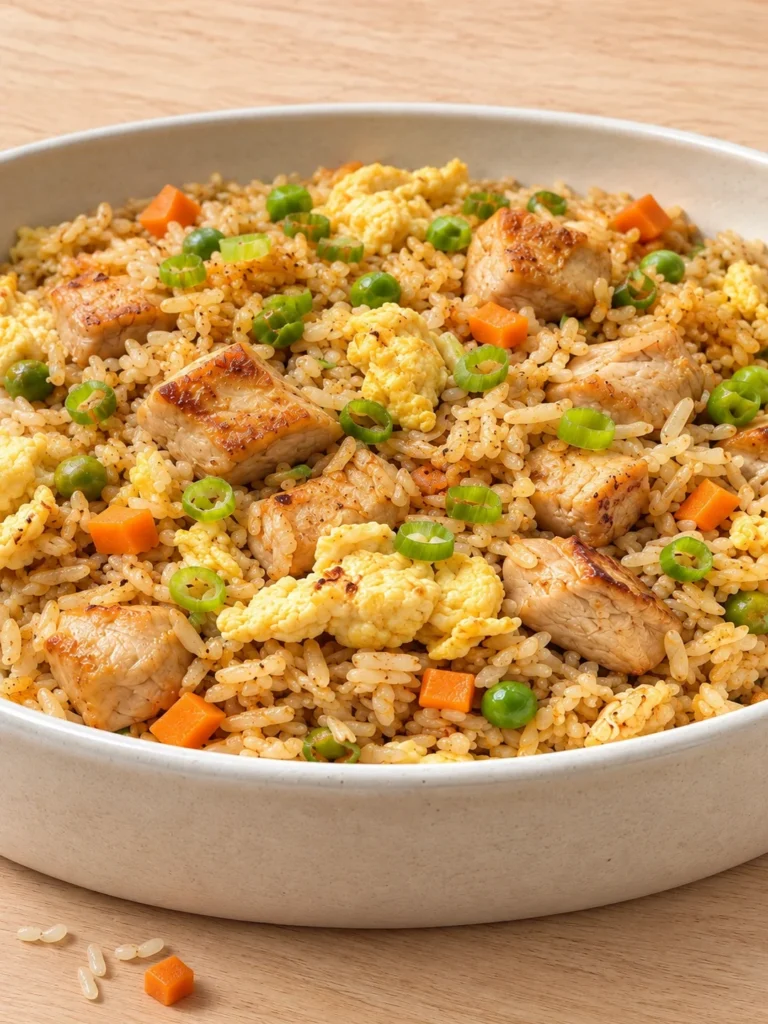
- Day-old jasmine rice, cooked the night before and chilled uncovered on a sheet pan
- Boneless chicken thigh, diced small, never breast if I can help it
- Light soy sauce, some for the marinade and a little more for the rice
- Shaoxing rice wine, split between the chicken and the final splash
- Cornstarch, for velveting
- Ground white pepper, which does something black pepper does not
- Eggs, beaten with a pinch of salt
- Peanut oil, because it takes the heat
- Garlic and scallions, whites and greens kept in separate piles
- Carrot and frozen peas, straight out of the bag
- Oyster sauce and a half teaspoon of sugar
- Dark soy, optional, and I usually skip it
- Toasted sesame oil at the very end
Cooking It in My Own Kitchen
The rice has to be made the day before, spread thin on a rimmed sheet pan and left uncovered in the fridge overnight. This is not a leftovers tip, it is structural. Fresh rice holds too much water inside each grain and it steams itself into paste the moment it hits the pan, which I know because my first attempt back home came out like risotto that had given up.
I buy the jasmine in the big sack at the Chinese supermarket I pass on the way back from the Sunday farmers’ market, and I cook in a carbon steel wok that cost about eighteen dollars and has never once looked good in a photo. My burner is nowhere near Mr. Ho’s. So I cook in two rounds and accept it.
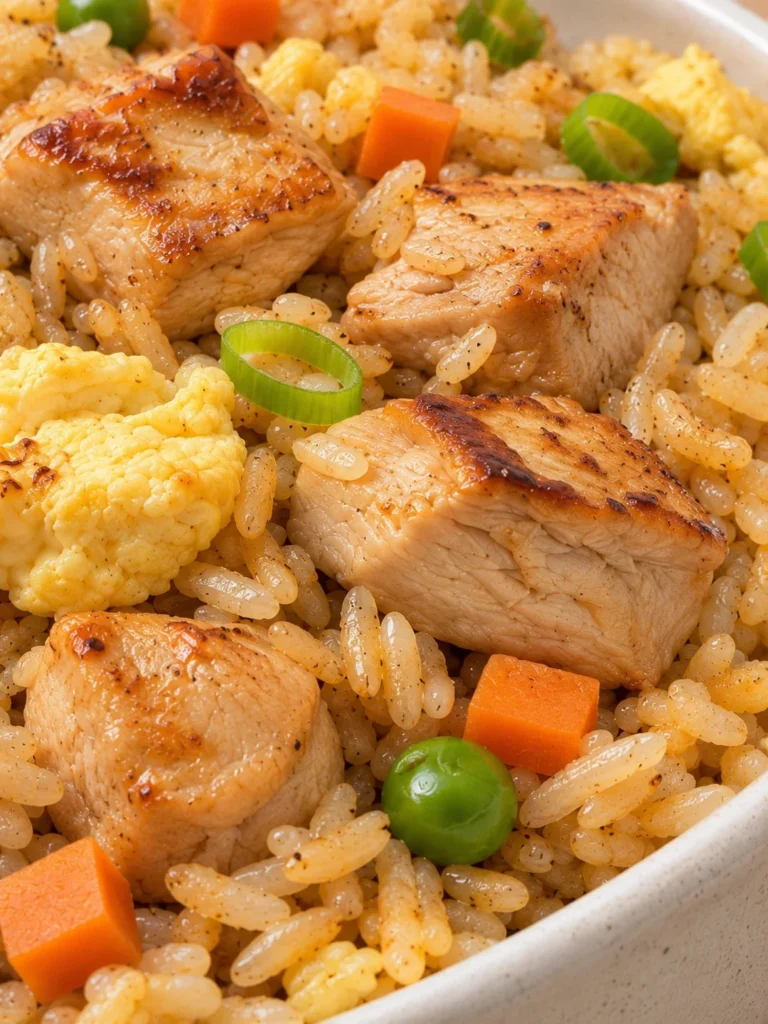
The cornstarch on the chicken matters more than it looks. It sets into a thin gel the second it meets hot oil, sealing the surface so the thigh browns outside and stays juicy inside instead of seizing and going stringy. Ninety seconds untouched, then toss.
The eggs go in next and I pull them while they are still glossy, large soft curds, because they will meet heat again later and nobody wants rubber. Then garlic and scallion whites for thirty seconds, just until the raw edge burns off the garlic. I scorched it the first time and the whole pan tasted bitter, so now I move faster.
Then the cold rice, and this is where you earn it. Press, toss, press again, over and over for three to five minutes while the outside of each grain dries out and lightly toasts against the metal. At some point the rice starts to rattle and dance loose rather than slide in a mass, and a faint smoke smell rises that has nothing to do with anything burning. That is the whole dish right there.
Sauce goes around the hot edge of the wok, never poured over the top, so it hits metal and reduces on the way down instead of pooling and soaking. The Shaoxing goes down the hot wall and flashes to steam. Sesame oil off the heat, scallion greens, two tosses, done.
What I Change
If I only have breast I slice it thin and cut the searing time to two minutes. Peas and carrot are what Wen had, so that is what I use, though frozen corn is fine and I will not pretend otherwise. I keep the seasoning light on purpose, because over-saucing is the most common way this goes wrong at home and salt is not the flavour you are chasing.
In China a plate of this is usually one part of a meal, not a giant entrée, so I serve it with egg drop soup and a plate of greens and chili crisp on the side. Leftovers keep two days and reheat in a dry hot pan, never a microwave.
Cold leftovers, eaten standing at the counter. Honestly better than the first plate.
I think about that cart more than I expected to, the awning dripping and the burner roaring and a stranger charging me almost nothing for the best thing I ate that whole trip. Wen was right to take the ticket off me. Some mornings the rice is the sight worth seeing.
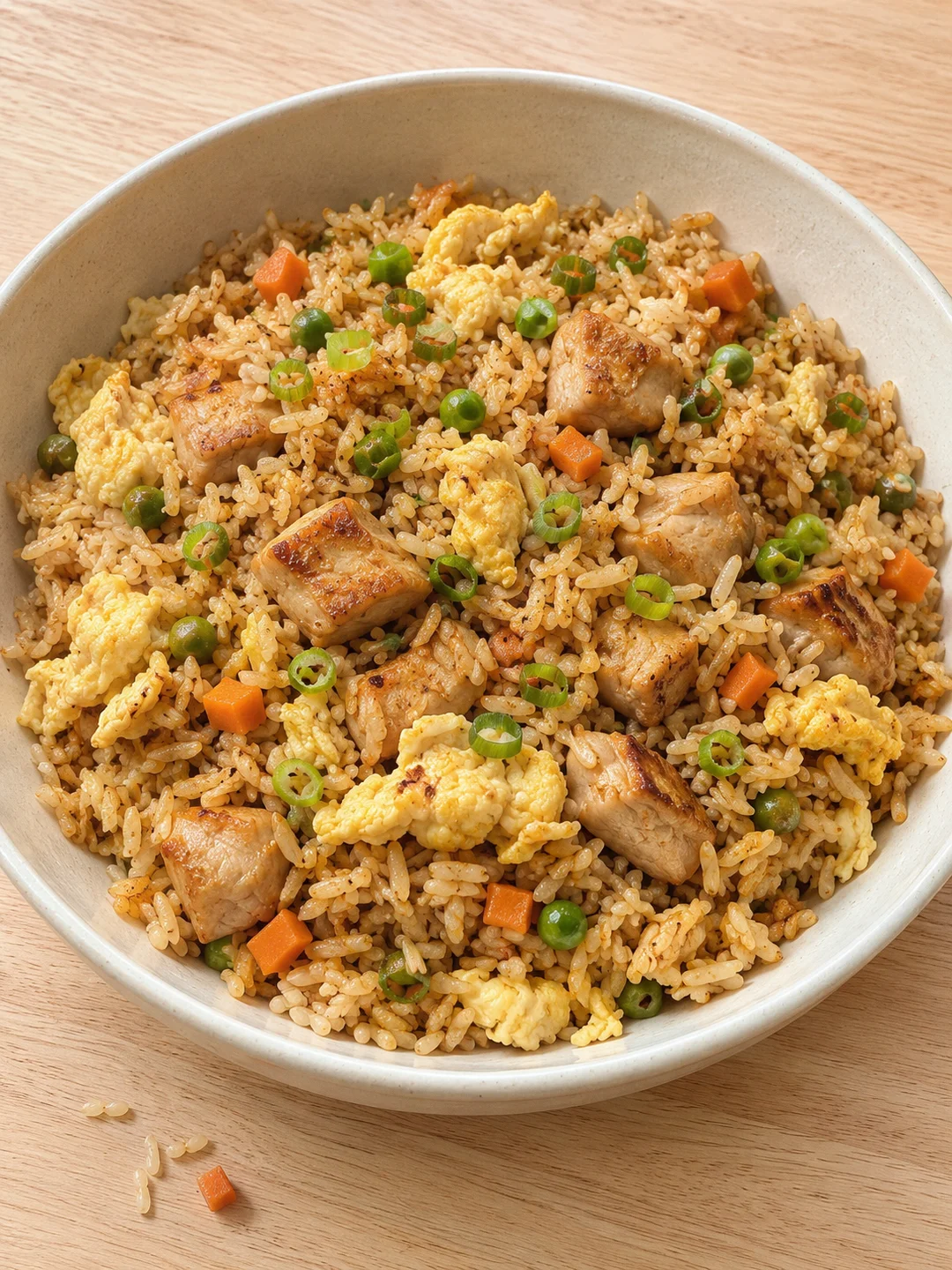
Chicken Fried Rice
Ingredients
Equipment
Method
- The night before, cook the jasmine rice, spread it in a thin layer on a rimmed sheet pan and refrigerate uncovered overnight. In the morning the grains should feel dry and firm. Break up any clumps with your fingers before cooking.
- Marinate the chicken. Toss the diced thigh with 2 teaspoons light soy sauce, 2 teaspoons Shaoxing wine, the cornstarch and 1/4 teaspoon white pepper. Massage it in until the surface feels slick, then leave it 15 to 20 minutes at room temperature.
- Line up everything beside the stove: beaten eggs, minced garlic, scallion whites, scallion greens, diced carrot, peas, and a small bowl holding the 1 tablespoon light soy sauce, oyster sauce, sugar and remaining 1/4 teaspoon white pepper stirred together. Once the wok is hot there is no time to measure.
- Set the wok over the highest heat until it just begins to smoke. Add 1 tablespoon oil, swirl to coat, then spread the chicken in a single layer. Leave it undisturbed 90 seconds to catch color, then toss and cook until golden and cooked through, about 4 minutes total. Scrape it onto a plate.
- Add 1 teaspoon oil to the wok, pour in the beaten eggs and let them set for 10 seconds before scrambling into large soft curds, about 40 seconds. They should still look slightly glossy. Remove to the plate with the chicken.
- Return the wok to high heat with the remaining oil. Add the garlic and scallion whites and toss for 30 seconds until fragrant but not browned. Add the carrot and peas and stir-fry 1 minute.
- Tip in all the cold rice. Press it against the hot metal with the back of your spatula, then toss, then press again. Keep this up for 3 to 5 minutes until the grains dance loose in the wok and you catch a faint smoky smell. This is wok hei and it is the point of the whole dish.
- Pour the seasoning mixture around the edge of the wok rather than over the rice, then splash the remaining 1 teaspoon Shaoxing wine down the hot wall. Toss hard for 30 seconds until every grain is evenly colored. Add the dark soy now if you want a deeper tone.
- Fold the chicken and egg back in, breaking the egg into bite-size pieces, and toss 30 to 60 seconds to heat through. Taste and add salt only if it needs it.
- Kill the heat. Add the scallion greens and the sesame oil, toss twice, and serve straight from the wok while the aroma is still rising.