
The first feijoada I ever ate came in a chipped white bowl at a three-table boteco in Lapa, under a ceiling fan that was mostly decorative. Dona Cida ran the place with her son. There was no English menu because there was no menu, just whatever had been on the stove since morning.
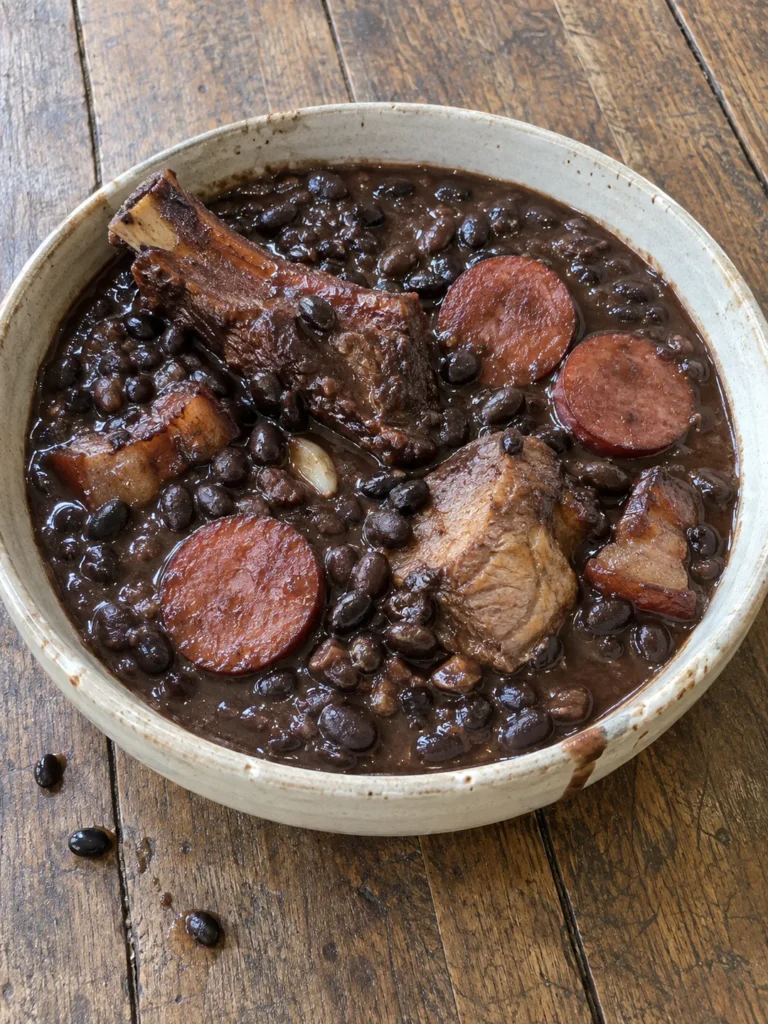
She caught me staring into the pot and waved me over to look properly. Then she pointed at the beans, at a rib, at a dark strip of something I could not identify, and repeated one word until I said it back badly enough to make her laugh.
Carne seca. That was the word.
The Boteco in Lapa Where I First Ate Feijoada
Her son did the translating, half through his phone and half through gestures, and he kept correcting the phone. What he wanted me to understand was that this was a Saturday thing. Not a Tuesday thing, not a restaurant special, a Saturday thing, and the pot had been going since before the shutters went up.
He put down white rice, collard greens cut into ribbons so thin they looked like they had been shaved, farofa in a little bowl, and cold orange slices. I thought the oranges were dessert. They are not. Three bites into that broth you understand exactly what they are for.
I had gone to Rio de Janeiro for eleven days with no plan beyond walking, and I ended up booking a four-hour class later that week that started with a market run through CADEG. The market part was chaos. Twenty of us following one woman past crates of beans and hanging sausage while she shouted the difference between paio and calabresa over the noise.
What Feijoada Actually Is, and What It Is Not
The story you hear most often is that enslaved people invented feijoada out of the pork scraps their owners threw away. It is a good story and it is not true. Historians such as Carlos Augusto Ditadi have picked it apart, and the short version is that pig’s ears and feet were already normal Portuguese eating, documented in Brazil well before that legend showed up.
What it actually is, is a Brazilian version of Southern European pork-and-bean stews that came over with Portuguese settlers. Cousins of cassoulet, cousins of Portuguese feijoada, which is usually white beans and chorizo. The black bean is the Brazilian move, and it is the whole difference.
It spread through Rio in the 1800s because beans were cheap, kept well, and cooked in enormous batches for working people. Brazilian elites called it slave food and would not touch it until the 1930s, when it got promoted into a national symbol as part of a much bigger political story about unity. I did not know any of that in Lapa. I looked it up months later, at my kitchen table, mostly because I wanted to know why everyone kept insisting on Saturday.
What I Used
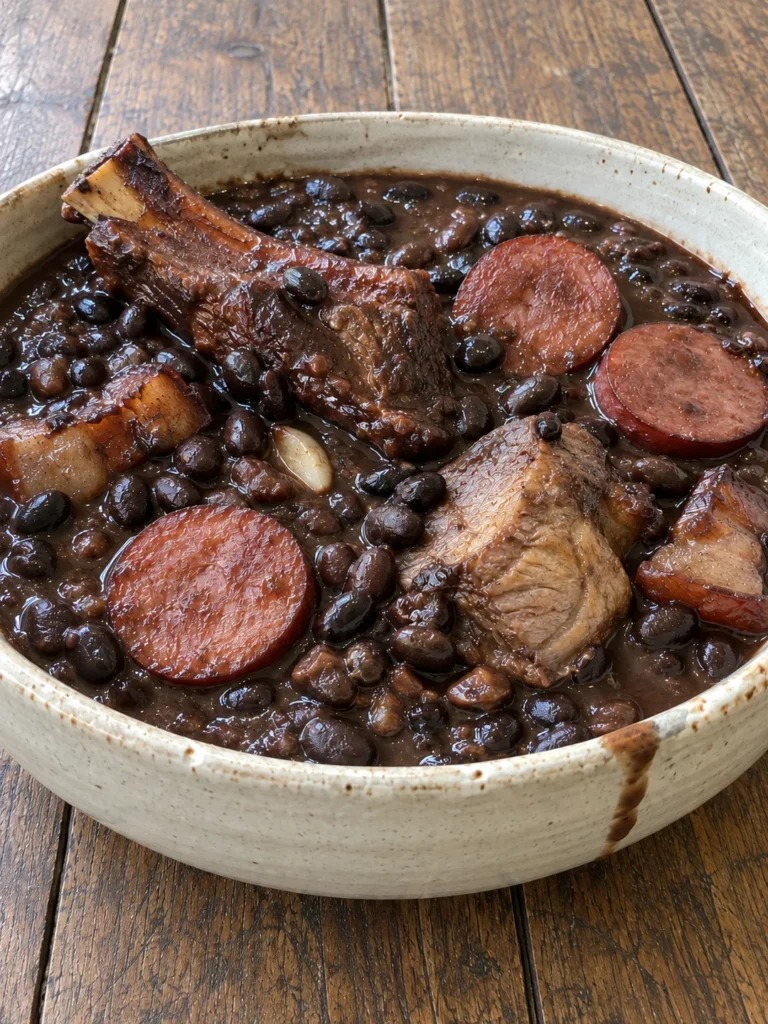
- Dried black beans, two pounds, soaked overnight in a bowl too small so it overflowed a bit
- Carne seca, the salted dried beef, soaked twelve to twenty-four hours with the water changed four or five times
- Smoked pork ribs, cut apart into individual bones
- Paio sausage and linguica calabresa, both in thick rounds
- Pork loin cut into big cubes
- A pig’s ear, cleaned and halved, which is optional and also the reason the broth gets that gloss
- Slab bacon in fat lardons
- Two yellow onions, eight cloves of garlic, three bay leaves
- Neutral oil, black pepper, and salt only at the very end if it needs it
- Rice, collards, farofa and a cold orange, non-negotiable in my house
I get the carne seca and the paio at a Brazilian market off Venice Boulevard where the man behind the counter has never once let me leave with only what I came for.
Where Feijoada Punishes You for Rushing
Two places, and I have failed at both.
The first is the soak. My first attempt, I gave the carne seca about six hours because I wanted to eat that night, and the finished pot was so salty it was basically a dare. You have to change the water four to six times and you have to taste a sliver before it goes anywhere near the beans. Then you parboil it fifteen minutes with the pig’s ear, throw that water out, and taste again. If it still fights back, boil it again.
The second is the simmer. Three hours, maybe three and a half, at the barest movement you can call a simmer. Anything more aggressive and the beans burst before they soften properly, and the broth goes cloudy instead of dark and thick. Most recipes say low heat. I would go lower than whatever you are picturing.
I started at eight in the morning last Saturday. June gloom outside, that flat grey light that makes LA feel like somewhere else entirely, which honestly suited the mood. Stirred it every half hour with a wooden spoon and topped up with hot water whenever the beans peeked above the liquid. My Dutch oven has a chipped lid and it sat slightly ajar the whole time, which turned out to be exactly right.
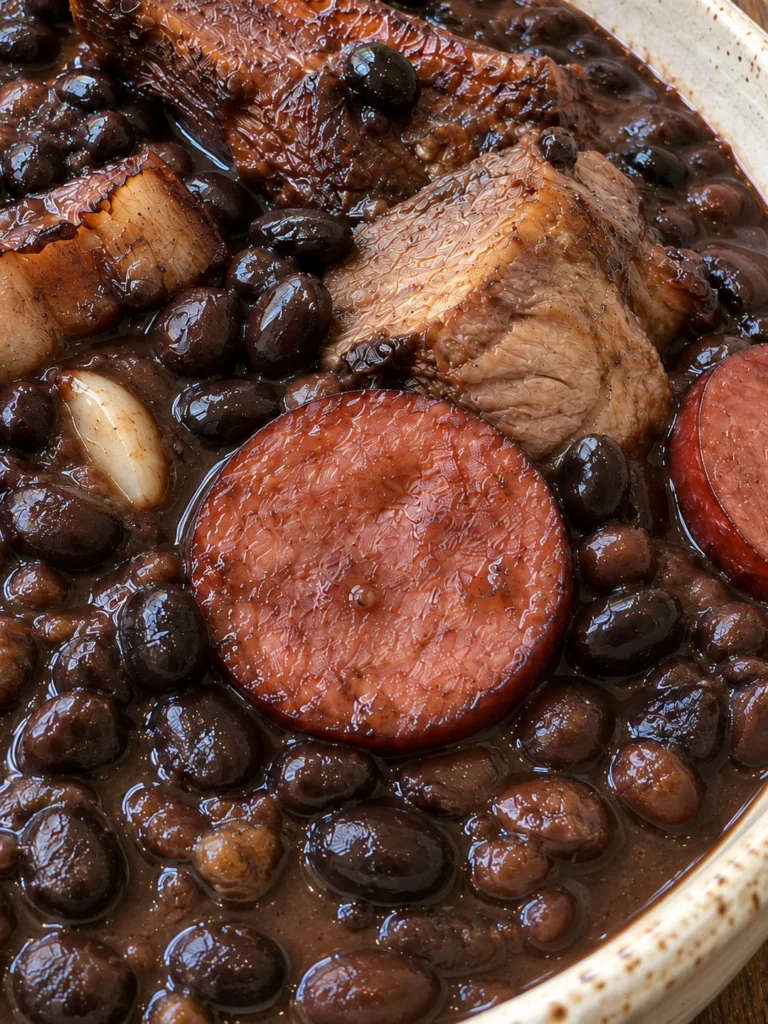
You know it is done when a few beans have collapsed into the broth and the liquid coats the back of the spoon. Fish out the bay leaves. Slice the pig’s ear into strips and put it back in. Then let the pot sit off the heat for twenty minutes, which feels unnecessary and is not.
Swaps and Small Changes
Paio is the hard one to find. Portuguese linguica works, or a mild smoked chourico, and nobody at my table has ever noticed. If the pig’s ear is a step too far, a smoked ham hock gets you most of the body.
For a thicker broth, ladle out a cup of beans, mash them smooth, stir them back in for the last fifteen minutes. I said I would only do that once. I do it every time now.
And it is better on day two. Genuinely better, not politely better. Cool it fully, reheat it slowly with a splash of water, and it will hold four days in the fridge.
Cold leftovers, standing at the counter, eaten with an orange slice in the other hand. That is the version I think about most.
I still cannot get it to taste the way it did in that boteco, and I have stopped trying. Some of that flavour was the fan, the noise, and Dona Cida watching to see if I liked it. What I can do is put a heavy pot on at eight in the morning and let the house smell like Lapa until dinner.
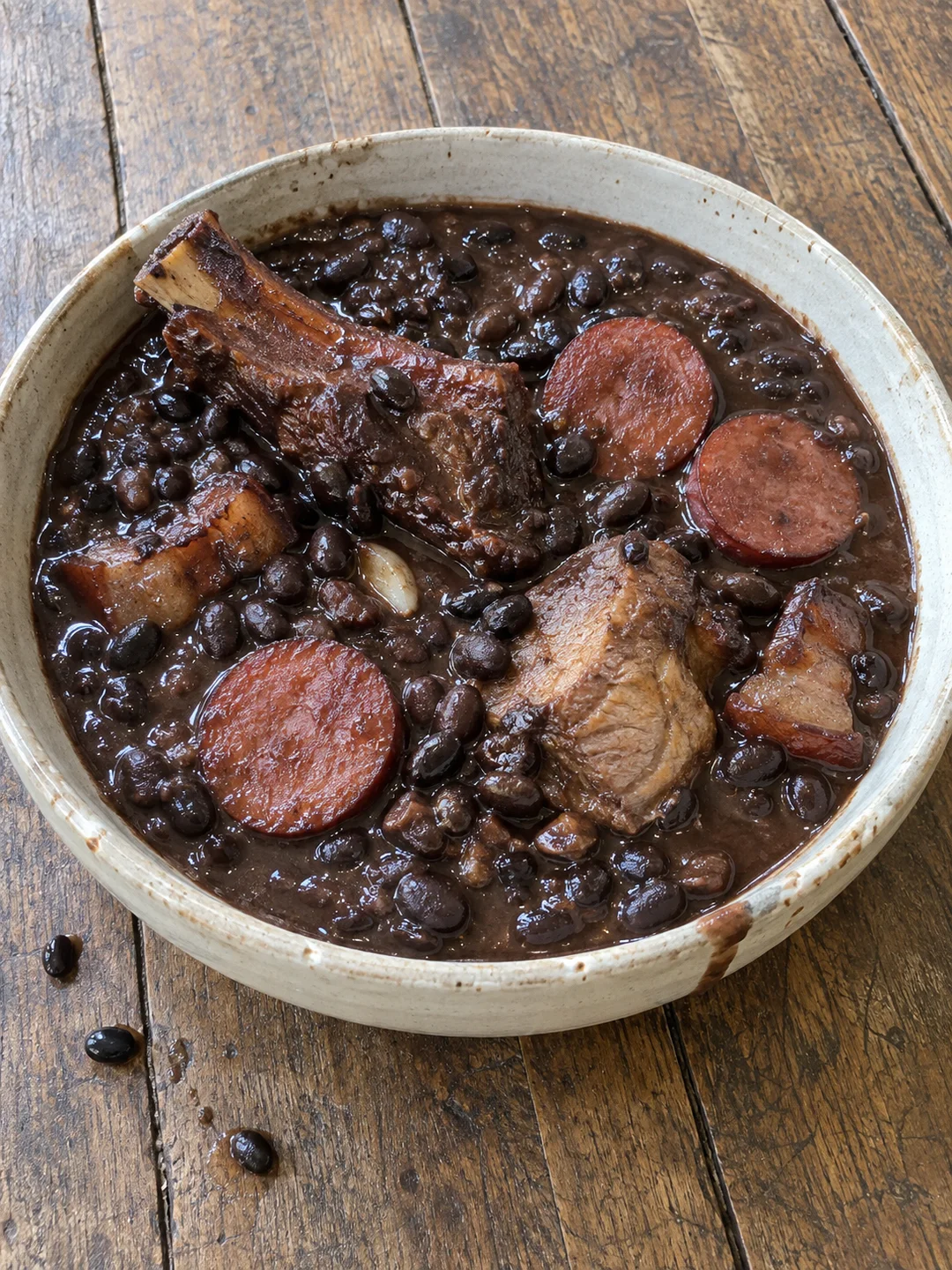
Feijoada
Ingredients
Equipment
Method
- The day before, place the carne seca in a large bowl and cover with cold water. Refrigerate 12 to 24 hours, changing the water four to six times to draw out the salt. In a separate bowl, cover the black beans with cold water by 4 inches and soak overnight at room temperature.
- Drain the carne seca and cut it into 1.5 inch chunks, trimming any hard fat. Put it in a saucepan with the pig's ear, cover with fresh water, bring to a boil and cook 15 minutes. Drain, discard the water, and rinse the meat. Taste a small piece. If it is still very salty, repeat the boil with fresh water.
- Drain the soaked beans and set them aside. Do not discard them if the soaking water looks dark; that color is normal.
- Heat the oil in a large stockpot over medium heat. Add the bacon lardons and cook 6 to 8 minutes, stirring, until the fat renders and the edges crisp. Lift the bacon out with a slotted spoon and set aside, leaving the fat in the pot.
- Raise the heat to medium-high. Brown the pork loin cubes in the bacon fat in two batches, about 4 minutes per batch, until deeply colored on at least two sides. Transfer to a plate.
- Add the paio and calabresa rounds to the pot and sear 3 minutes until the edges caramelize and the fat runs red. Transfer to the plate with the pork.
- Lower the heat to medium. Add the chopped onions to the pot and cook 8 minutes, scraping up the browned bits, until soft and golden at the edges. Stir in the garlic and cook 1 minute more until fragrant.
- Return all the browned meats to the pot along with the parboiled carne seca, pig's ear and smoked pork ribs. Add the drained beans and the bay leaves, then pour in 16 cups of water, enough to cover everything by 2 inches.
- Bring to a boil over high heat, skimming off any gray foam that rises. Reduce to the barest simmer, cover partially, and cook 3 to 3.5 hours. Stir every 30 minutes and add hot water whenever the beans start to peek above the liquid.
- The feijoada is ready when the beans are completely tender and some have collapsed into the broth, the liquid is dark and thick enough to coat the spoon, and the meats pull apart under light pressure. If the broth is still thin, uncover and simmer 20 to 30 minutes more.
- Fish out the bay leaves. Lift out the pig's ear, slice it into thin strips, and return it to the pot. Season with black pepper and taste carefully before adding any salt, as the cured meats usually supply enough.
- Let the pot rest off the heat for 20 minutes before serving so the broth settles and thickens. Ladle beans, broth and a mix of meats into wide bowls.