
The first Pumpkin Dump Cake I ever ate came out of a sheet pan in a tent in Ludwigsburg, Germany, at a pumpkin festival so loud I had to lean across the counter to hear the woman selling it. October, cold enough for a jacket, gravel underfoot, kids screaming on a pumpkin-themed carousel somewhere behind me.
There were squash sculptures the size of cars. There was a stand doing nothing but pumpkin seed oil. And there was Anke, who had a hand-lettered sign that just said American Pumpkin Cake, which is the kind of sign I cannot walk past.
Anke’s Stall at the Ludwigsburg Pumpkin Festival
I got there late, around three, when the lunch crowd had thinned out and her trays were down to corners and edges. She scraped the last three squares onto a paper plate, charged me for two, and then did the thing that makes a trip worth taking. She sat down.
Anke had lived outside Dayton, Ohio for eleven years with her first husband. She came back to Baden-Württemberg with a suitcase, a divorce, and a recipe card she said she got passed to her at a church supper. She makes it every autumn for the festival and she sells out every single day.
She warned me about two things before I had even finished chewing. Never buy the pie filling in the can, buy the plain pumpkin. And never, ever melt the butter.
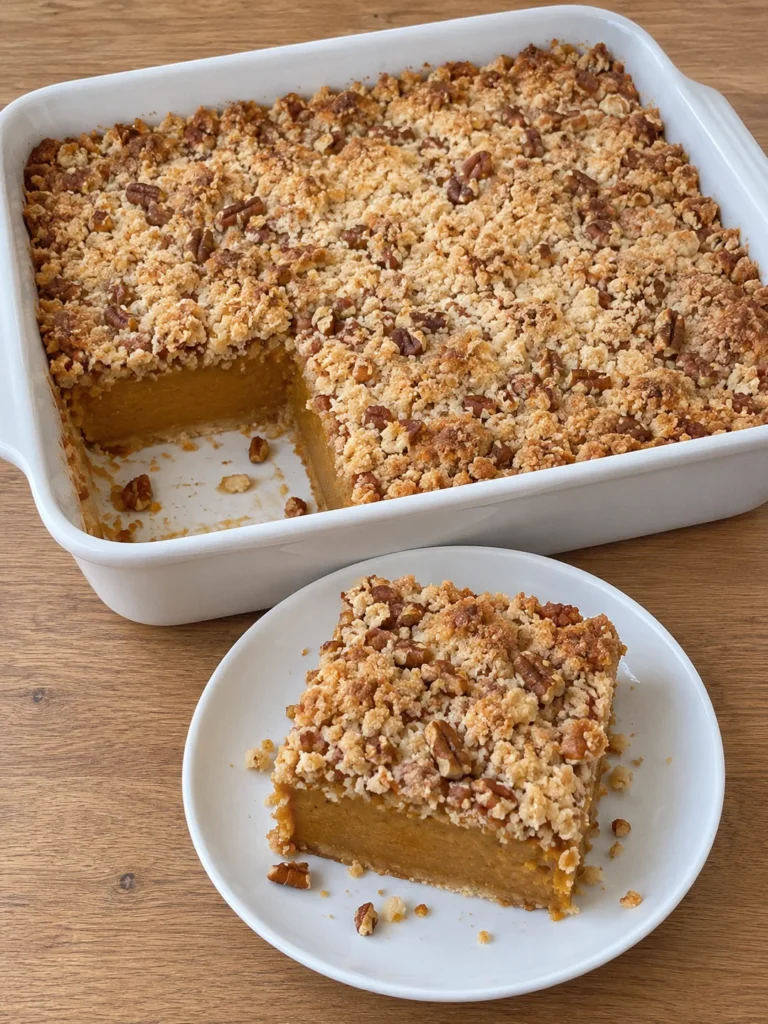
The square itself was still slightly warm. Custard underneath, dense and dark with spice, and then this crumbly golden lid on top that cracked when my plastic fork went through it. Not cakey. Sandier than that, almost like the top of a crumble that got lucky.
Why Pumpkin Dump Cake Is Not Really a Cake
I looked into it properly once I was home, because the name bothered me. It is not a cake in any structural sense. It is a baked pumpkin pie custard with a cake-mix crust sitting on top of it, which makes it a cousin of cobbler, not of layer cake.
Dump cakes came out of the post-war boom in boxed cake mixes in the United States. They circulated through community cookbooks, church cookbooks and small-town newspapers across the fifties and sixties. One of the earliest ones anybody can actually point to ran in the Sapulpa Daily Herald in September 1964, credited to a Mrs. Tom A. Harris, Velma to her friends.
By 1968 a newspaper piece described the recipe as going the rounds in the American mid-west, which is a lovely way to describe a thing spreading by recipe card and word of mouth. The early versions used canned fruit. The pumpkin one came later, once canned puree and pumpkin pie spice were in everyone’s cupboard.
People sometimes treat the boxed mix as a shortcut to apologise for. I disagree. The box is the whole identity of the dish and swapping it for scratch flour and sugar gives you something else entirely.
There is also a Hawaiian version called pumpkin crunch, popularised by chef Sam Choy by the mid-nineties, served flipped over and cut into bars. Same dessert. Different hat.

What I Used
- One 15 oz can of pure pumpkin puree, the plain stuff, nothing pre-sweetened
- One 12 oz can of evaporated milk
- A cup of granulated sugar
- Three large eggs
- Two and a half teaspoons of pumpkin pie spice
- Half a teaspoon of salt
- One box of dry yellow cake mix, 15.25 oz, straight out of the box and not mixed with anything
- A cup of chopped pecans
- A cup of cold butter, two sticks, shaved thin
What Changed in My Kitchen
Anke used a German supermarket cake mix, which runs drier and less sweet than the American boxes. When I made it here with a standard yellow mix the top came out noticeably sweeter, so I pulled nothing out of the custard but I did lean harder on the salt. Half a teaspoon sounds like a lot in a dessert. It is not. It keeps the whole pan from going flat and sugary.
The pecans are mine too. Anke used chopped hazelnuts because that is what is cheap in Swabia in October. I buy pecans from the bulk bins at the farmers market on Sunday morning, and they toast themselves in the oven as the thing bakes, which hazelnuts also do, but pecans go softer and sweeter and sit better against the custard.
And the butter. First time I made this pumpkin dump cake recipe I ignored Anke, melted the butter, and poured it over in a spiral like I was dressing a salad. Dry powdery craters all over the top. Genuinely sad.
Now I shave the cold sticks with the cheese slicer I bought in Oslo and never use for cheese. Thin curls, about an eighth of an inch, laid out in a grid with no bare patches anywhere. The butter melts down through the dry mix slowly and binds it into that crumbly lid instead of soaking it in one spot.
The other rule I will not bend. Do not stir. The mix goes on dry, in an even layer, clumps broken up with your fingers, and it stays there. Stir it in and you get one sweet soggy pudding with no crust at all.

Swaps and Small Variations
Spice cake mix instead of yellow, with double the pecans, is the Southern move and it is very good if you want the whole thing louder. I do it maybe one time in three.
Evaporated milk is not optional for me. Regular milk makes the custard looser and it never quite firms up the way it should. If you are out, just make something else that day.
Caramel sauce over the top is popular and I think it is too much. Cold whipped cream, barely sweetened, is what I do, with coffee, which Anke said was how everyone drank it in Ohio.
Eating It Without the Festival Noise
The pan needs a full hour on the rack before you cut it, so the custard sets and the squares come out clean. I always wait the full hour. Except the first time, when I absolutely did not, and ate a hot spoonful standing at the counter while the marine layer sat grey over the windows.
It is better on day two. The layers tighten, the crust stays crisp in the fridge, and cold squares eaten straight out of the dish with a fork, standing up, are honestly the best version of it. Nobody tells you that part.
What I cannot recreate is the rest of it. The carousel, the cold air, the squash sculptures, Anke sitting down across from me with her apron still on. But I get a very good approximation of that paper plate every October, and twelve people can eat off one pan.
I thought I would make this once, as a souvenir. It is in the oven again this weekend.

Pumpkin Dump Cake
Ingredients
Equipment
Method
- Heat the oven to 350 F. Grease a 9x13 inch baking dish with butter, bottom and sides.
- In a large bowl, whisk the pumpkin puree, evaporated milk, granulated sugar, eggs, pumpkin pie spice and salt until completely smooth with no streaks of egg. It should look like thin pie filling.
- Pour the custard into the prepared dish and tilt the pan so it settles level.
- Open the cake mix and sprinkle it dry and evenly over the entire surface of the custard. Break up any clumps with your fingers as you go. Do not stir it in. The layers must stay separate or the top will not crisp.
- Scatter the chopped pecans evenly over the cake mix.
- Slice the cold butter into thin shavings, about 1/8 inch thick, and lay them across the whole surface in an even grid. Leave no bare patches. This is what moistens the mix into a crumbly crust as it melts.
- Bake uncovered for 50 to 60 minutes, until the top is deep golden and crisp and the center no longer jiggles when you nudge the pan. If the top browns fast before the center sets, tent loosely with foil for the last 10 minutes.
- Cool on a rack at least 1 hour before cutting so the custard firms up. Cut into squares and spoon out with the crust side up.