
The best Chicken and Dumplings I have ever eaten came out of a battered steam pan at the National Cornbread Festival in South Pittsburg, Tennessee, with a brass band two booths over and a line forty people deep ahead of me.

I had come for cornbread. Obviously. The dumplings were an accident of standing in the wrong queue for twenty minutes and being too stubborn to leave it.
Behind me in that line was a family who had driven in from Jasper, three generations of them, and the grandmother asked me if I was from somewhere else. I said California. She laughed and told her grandson to make sure I got a bowl before the pan ran dry.
The Line in South Pittsburg, Tennessee
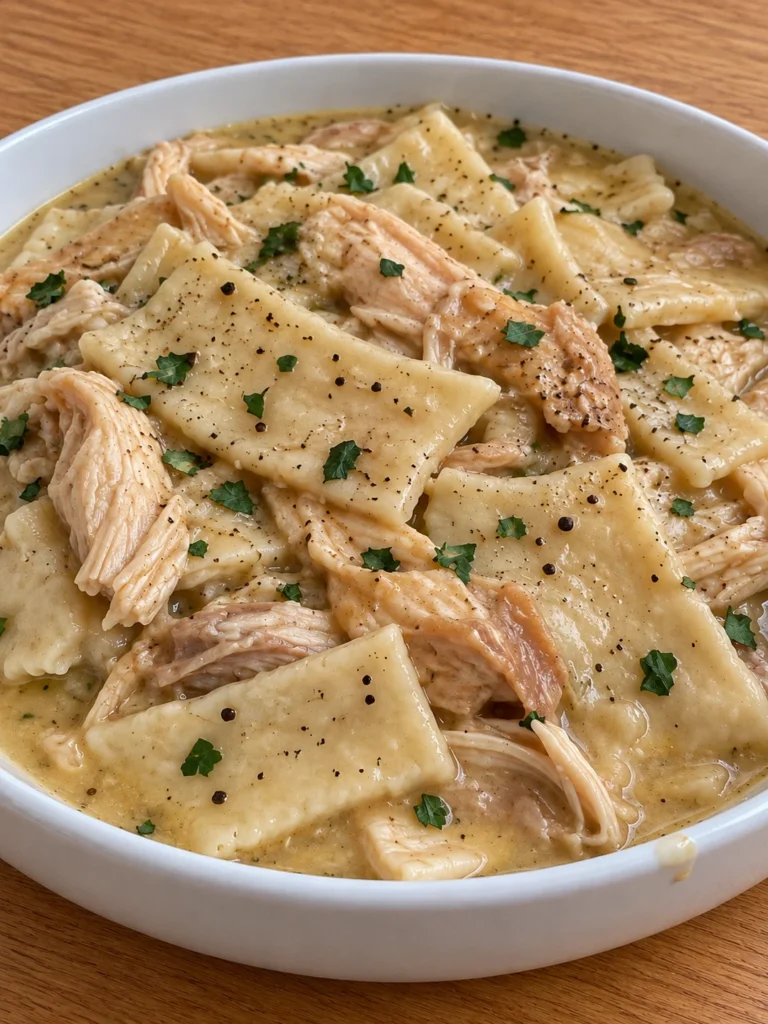
Festival food is usually an idea of a dish rather than the dish itself. This was not that. The gravy was thick enough to hold the spoon upright and the dumpling strips were flat, wide, and faintly chewy, nothing like the fluffy biscuit blobs I had always assumed the words meant.
I ate it standing up, in April heat, with a paper napkin stuck to my wrist. Then I got back in line and did it again, which the grandson noticed and found extremely funny.
The pan was being refilled from a cooler by a woman in her sixties with flour still on her forearms. Arlene. She ran a six-table place on Elm with her son on the register, and she had been cooking since five that morning.
After Closing Time in Arlene’s Kitchen
I asked her, badly and too eagerly, how she thickened it. She told me to come by the restaurant the next evening after they locked the door, because she was not explaining anything in that noise.
So at nine the following night I was standing in a kitchen that smelled like old fryer oil and hot flour, watching her roll dough on a steel table under one fluorescent tube. Her son was mopping. A radio on the shelf was playing something with a lot of pedal steel in it.
She did two things that changed how I cook this. She rolled the dough thin, thinner than I expected, and cut it with a pizza wheel into rough rectangles. And she dropped those strips into the broth with all the dusting flour still clinging to them.
That flour is the whole trick. No cream, no slurry, no can of soup. The dumplings thicken their own gravy as they cook, and Arlene looked genuinely offended when I asked about cornstarch.
The other thing she said, twice, was do not stir it. Nudge it. A hard boil tears the strips into paste.
What Chicken and Dumplings Actually Is, and Is Not
I went down a research hole when I got back. The dish traces to older British and Central European habits of boiling dough in meat broth, carried over by English, German, Pennsylvania Dutch, and French Canadian settlers and reworked across the South and Midwest through the 1800s.
Chicken only became the default meat later in that century. Mary Randolph’s Virginia book from 1824 gives suet dumplings with stewed meat, the Kentucky version from 1838 uses mutton, and it is Marion Cabell Tyree in 1879 who records stewed chicken with dumplings as poultry got cheaper.
Everyone tells you it is a Depression dish. It is not, or not originally. In the 1800s a laying hen was a working asset, so killing one for the pot made this a Sunday dinner or a holiday meal rather than a thrift meal, which is why it still shows up at Christmas and New Year tables and church potlucks across the region.
And it is not one dish. Southern flat slick dumplings and Northern fluffy drop dumplings are separate traditions with loyal defenders, and in eastern North Carolina chicken and pastry is considered its own thing entirely. Arlene’s was firmly the flat kind, and that is the one I brought home.
What I Used
- One whole bone-in bird, three to four pounds, skin on. A stewing hen if the farmers market has one
- About three quarts of cold water, enough to cover it by an inch
- A large yellow onion, halved, and three ribs of celery in big pieces
- One carrot, chunked. Optional, I usually include it
- A bay leaf and a few sprigs of thyme
- Salt and a lot of freshly ground black pepper, for the broth and again at the table
- Three cups of all-purpose flour, White Lily if you can get your hands on it, plus more for rolling
- Six tablespoons of shortening, lard, or cold butter cut small
- Three quarters of a cup of ice water or whole milk
- Chopped parsley to finish, which Arlene does not do and I do anyway
Rolling the Dumplings in My Own Kitchen
I make this on grey Sundays, which we get maybe six of a year here, and I start the pot before anyone sensible is awake. The bird goes in cold water with the onion and celery and the bay leaf, comes up to a boil, then drops to barely moving for an hour and a half.
The smell at that stage is thin and clean and a little boring. It gets interesting about forty minutes in, when the celery goes sweet and the thyme comes up over everything.
I strain it, skim most of the fat but leave a gold slick on top, and salt the broth harder than feels right. Arlene was emphatic about that. The flour pulls the salt straight out of the liquid, so if it tastes correct before the dumplings it will taste flat after.
The dough takes four minutes. Flour, salt, fat rubbed in with your fingertips until it looks like coarse meal, then liquid stirred with a fork just until it holds. Do not knead it. I kneaded it the first time, like bread, and got dumplings with the texture of a bicycle inner tube.
Rest it fifteen minutes under a towel, roll it to about an eighth of an inch on a well-floured board, cut strips with a pizza wheel. Mine is a cheap one with a loose rivet that I keep meaning to replace.
Then the good part. The strips go in one at a time, the kitchen fills with that warm raw-flour steam, and in fifteen minutes the broth goes from thin to something that coats a spoon. The chicken folds back in at the end, off the heat for ten minutes, and it tightens up further while it sits.
Swaps, Flour, and One Mistake Worth Avoiding
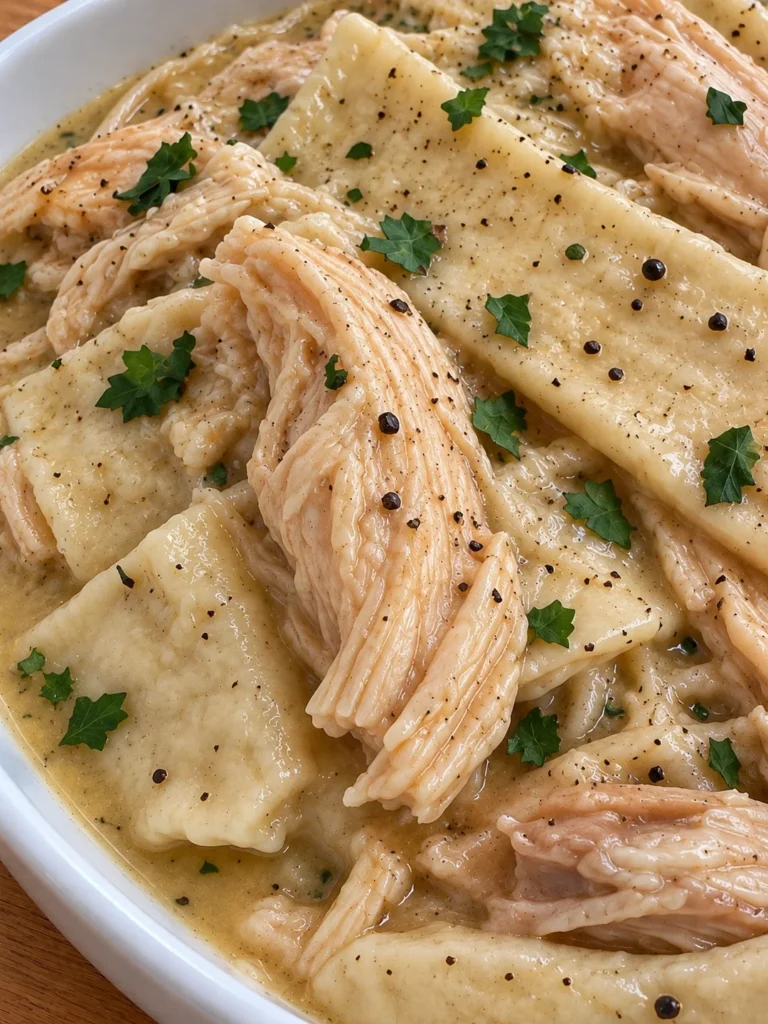
Self-rising flour gives you puffier, tenderer dumplings. All-purpose gives the denser, almost al dente slick that cooks in Tennessee and Alabama argue for, and that is the version I prefer. Do not use both leaveners, you get strange rubbery edges.
Skip boneless breast completely. It dries out and gives the broth no body, and the gelatin from the bones is half of why southern chicken and dumplings tastes the way it does. I get a proper bone-in bird from the poultry stand at the Sunday farmers market and ask for a hen if they have one.
Leftovers set up overnight into something closer to a casserole. Loosen with a splash of broth over low heat. It does not freeze, I tried, the dumplings turn to wallpaper paste.
What I cannot recreate is the brass band and the paper napkin and Arlene’s son mopping around my feet. The bowl still lands though, especially with cornbread and a bottle of hot sauce on the table. I think about that line in South Pittsburg every single time I roll the dough out.
Chicken And Dumplings
Ingredients
Equipment
Method
- Rinse the chicken and put it in a large heavy pot. Add the onion, celery, carrot, bay leaf, thyme, 2 teaspoons salt, and 1 teaspoon black pepper. Pour in enough cold water to cover the bird by about 1 inch, roughly 3 quarts.
- Bring to a boil over medium-high heat, then drop the heat to a bare simmer. Skim off the gray foam that rises in the first 10 minutes. Cover partially and simmer 1 hour 15 minutes for a young chicken, or up to 2 hours for a stewing hen, until the meat pulls away from the bone with no resistance.
- Lift the chicken out onto a sheet pan and let it cool until you can handle it. Strain the broth through a fine mesh strainer into a bowl and discard the vegetables and herbs. Skim most of the fat off the surface with a shallow spoon, leaving a thin golden slick for flavor.
- Return the broth to the pot. You want about 10 cups. Taste it and salt it hard, until it tastes slightly too seasoned on its own. The dumplings will pull that salt right out. Add more black pepper too.
- Pull the chicken meat off the bones in large pieces, discarding skin, bones, and cartilage. Keep the meat covered at room temperature while you make the dumplings.
- Whisk the 3 cups flour and 1.5 teaspoons salt in a large bowl. Add the shortening and rub it into the flour with your fingertips until the mixture looks like coarse meal with a few pea-sized bits left.
- Pour in the ice water or milk and stir with a fork just until a shaggy dough forms and pulls together. Add a tablespoon more liquid only if dry patches remain. Do not knead it. Overworking the dough makes tough, rubbery dumplings.
- Press the dough into a flat disc, cover with a towel, and let it rest 15 minutes. This relaxes the gluten and makes rolling far easier.
- Flour your work surface generously. Roll the dough out to about 1/8 inch thick, flouring the top as needed. With a pizza cutter or sharp knife, cut it into strips about 1 inch wide and 2 inches long. Leave the dusting flour on them, that flour is what thickens the gravy.
- Bring the seasoned broth to a gentle boil. Drop the dumpling strips in one at a time, separating them as you go so they do not stick in a clump. Add them all before the first ones set.
- Simmer uncovered 15 to 20 minutes, nudging the pot with a gentle stir only two or three times so the dumplings do not stick to the bottom. Never let it reach a hard rolling boil or the dumplings will break apart. The broth will thicken into a loose gravy that coats a spoon.
- Slide the pulled chicken back in, fold it through gently, and simmer 5 minutes more just to heat it through.
- Take the pot off the heat and let it stand, uncovered, 10 to 15 minutes. The dumplings finish swelling and the gravy tightens to its final body. Taste once more for salt and pepper.
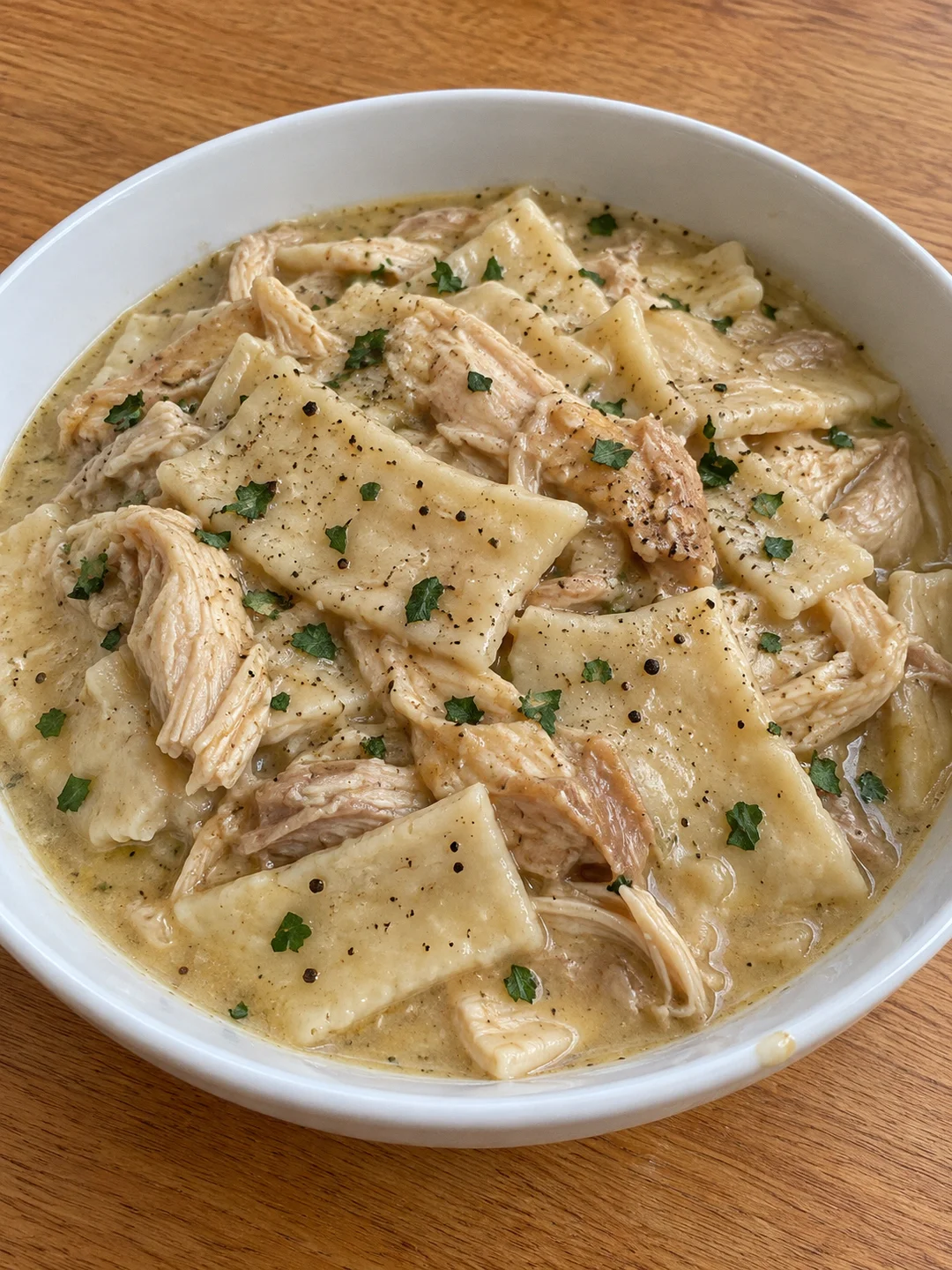
- Ladle into warm shallow bowls, scatter parsley over the top if using, and serve immediately with plenty of black pepper at the table.