
The Brunswick Stew that ruined every thin, soupy version for me came out of a dented stockpot on a card table in Lawrenceville, Virginia. Four dollars a cup, chalked on a little board propped against the leg. The vendor had a dish towel wrapped around the pot handle because the metal had gone too hot to touch.
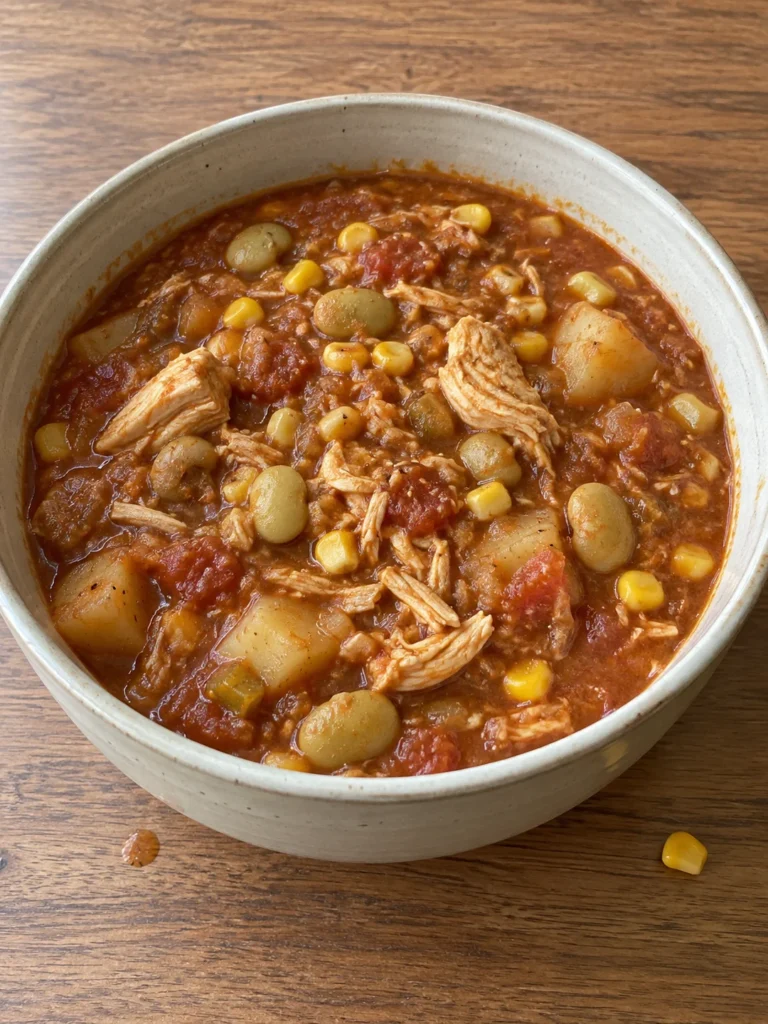
His name was Maynard Pollard and technically he was there to sell cornbread. The stew was what the line was for.
I had pulled off Route 58 for gas and ended up staying three hours. That is how most of my best eating happens.
Five In the Morning With Maynard Pollard
He told me to come back before the stall opened if I wanted to see how the cornbread got made, so I did, 5 am, parking lot behind his shop still dark and smelling of wet asphalt. The oven was already roaring. He poured buttermilk into cornmeal with one hand and swirled drippings around a black skillet with the other, and the whole thing took maybe four minutes.
While it baked he talked about the pot instead. Stir down to the bottom every fifteen minutes once it thickens, he said, because scorched stew tastes burnt all the way through and there is nothing you can do to rescue it.
Then he showed me the doneness cue, which is the only one that matters. Stand a wooden spoon upright in the middle of the pot. If it holds for a few seconds you are finished, and if it slumps over you keep reducing uncovered and check again later.
Four hours minimum. He actually laughed when I asked about shortcuts.
Who Actually Invented Brunswick Stew
Virginia dates the dish to 1828 and to Jimmy Matthews, an enslaved camp cook working for Dr. Creed Haskins of Brunswick County, who simmered squirrels with onions, seasonings and stale bread to feed a hunting party. The Virginia General Assembly formally named Brunswick County the birthplace in 1988, which tells you how seriously people take this.
Brunswick, Georgia argues otherwise. There is a plaque on an old iron pot down there claiming the first batch was cooked on St. Simons Island on July 2, 1898, except no Georgia reference predates the 1890s and the earliest one describes the dish as an old Virginia stew. That settles it for me, though I would not say so out loud in Glynn County.
Hunt down a georgia brunswick stew recipe and you will usually find it treated as a side, ladled next to a plate of barbecued pork rather than standing on its own. In Virginia it is the whole dinner, and it is cooked by teams of people taking turns on the paddle at church suppers and firehouse fundraisers. Brunswick County even crowns a Stewmaster at its annual festival.
Two things it is not. It is not Kentucky burgoo, which leans on mutton and tastes smokier where this is brighter and much more tomato-forward, and it is not German, despite the town names borrowing the Duchy of Brunswick-Lüneburg.
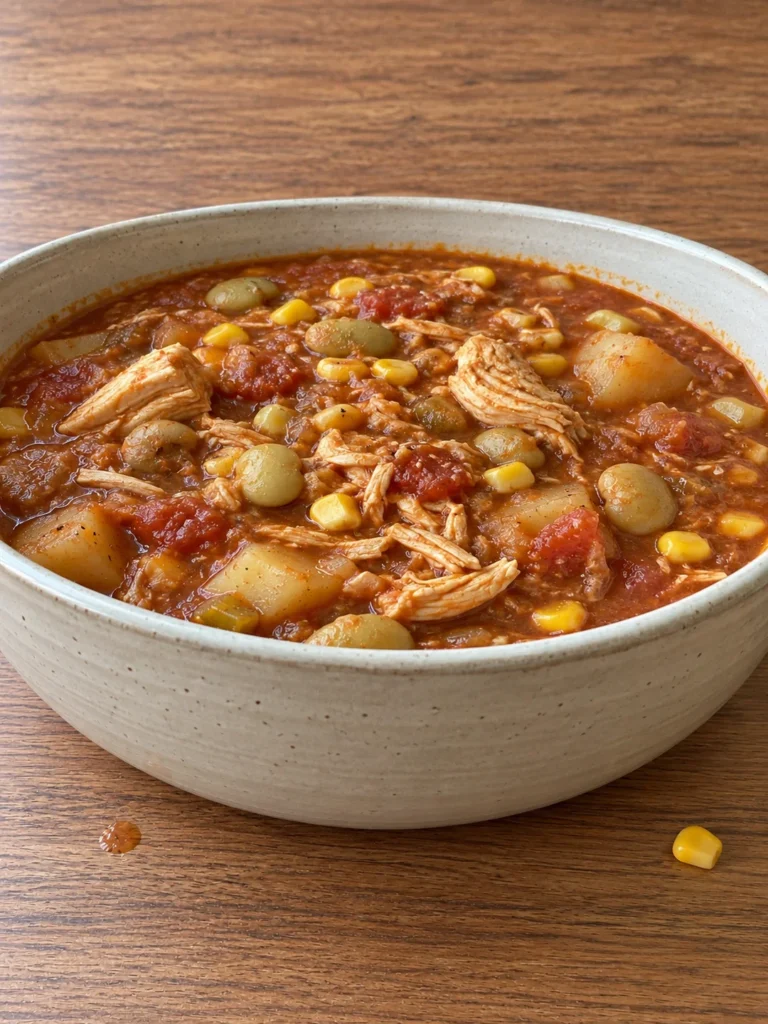
What I Used
- A 5 lb whole chicken, cut into pieces, skin on and bone in
- About 3 quarts of water, enough to cover
- 6 slices of bacon, chopped
- 2 large yellow onions, diced
- 3 lb ripe tomatoes, peeled and chopped, or two 28 oz cans crushed
- 1.5 lb Yukon Gold potatoes in 1 inch cubes
- 1 lb butterbeans, which is to say frozen baby lima beans
- 3 cups corn kernels, cut off about five ears
- 4 tbsp unsalted butter
- 1 cup stale crumbled cornbread
- 1 tbsp kosher salt and 2 tsp black pepper, plus more of both later
- 1 small whole dried red pepper, or a teaspoon of hot sauce at the end
Bringing Brunswick Stew Home to My Kitchen
The pot matters more than anything on that list. Mine is an 8 quart cast-iron Dutch oven with a chip in the lid from a move I would rather not revisit, and it holds low heat so evenly that I can walk away for a stretch without panicking.
The original stew was never a chicken dish. Squirrel and rabbit only gave way to chicken and pork once game got scarce, and I am not going to pretend I have a squirrel source. A whole bird, broken down, simmered bare and uncovered for close to two hours, gets you there. Skim the gray foam in the first twenty minutes and then leave it alone.
Keep every drop of that stock. That is the single change I would defend hardest against anyone reaching for a carton of broth.
Tomatoes are where I diverge. In August I buy them at the Wednesday farmers market and peel them over the sink while the radio plays, because fresh ones give the pot a sharper top note. I always peel fresh tomatoes for this. Except in February, when I open two cans instead, which is honestly most of the times I make it.
Fresh butterbeans are a fantasy where I live, so frozen baby limas go in with the potatoes and nobody has ever noticed. The corn I do insist on cutting off the cob, and it goes in last for twenty minutes only, so the kernels still pop a little against the soft everything else. I almost added smoked paprika the second time around. Actually no, the bacon already handles that job and the stew does not need help.
One confession. The first time I made this I answered the door mid-simmer, stood there talking for twenty-five minutes, and came back to a bottom layer that had caught. The whole pot tasted of ash. Now I set a timer and I stir like Maynard told me to.
Swaps and the Parts Worth Fussing Over
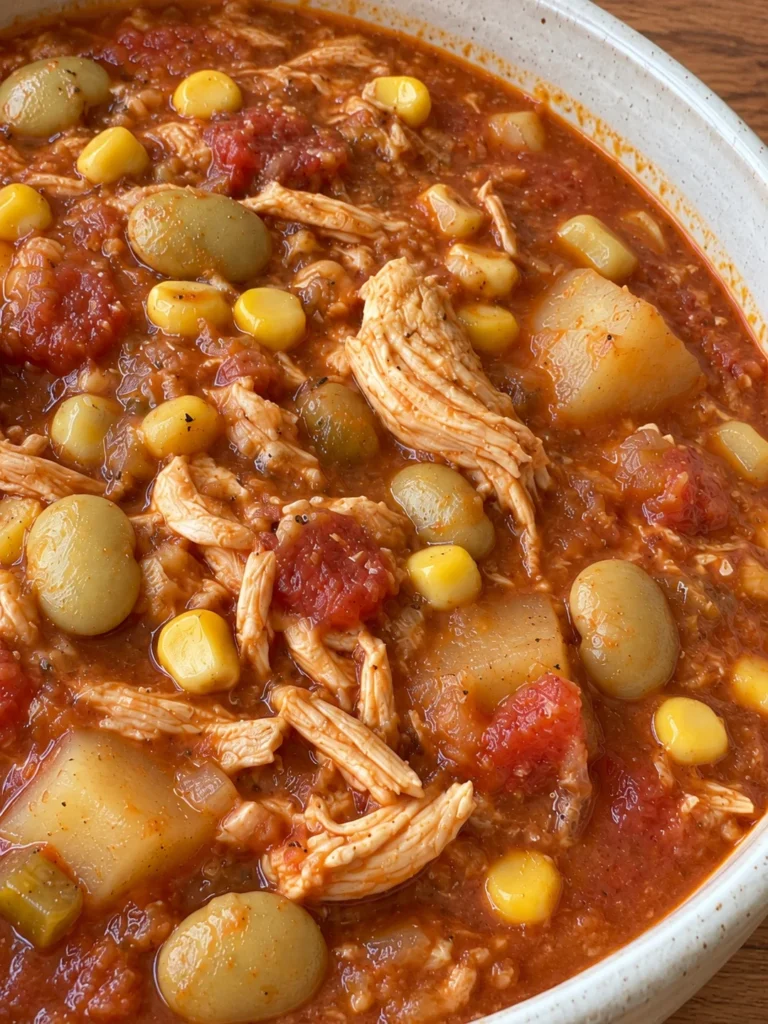
Rabbit is the traditional stand-in if you can get hold of it, and two pounds of it in place of two pounds of chicken simmers exactly the same way. The dried red pepper can be swapped for hot sauce stirred in at the very end, which gives you more control. You can skip the crumbled cornbread entirely and just reduce longer, and the texture goes looser but stays honest.
What I would not change is the uncovered simmer, the hours, and the corn going in last. Those three are the recipe. Everything else is negotiable.
It is better the next day, which I did not expect and now plan around. Cold leftovers, eaten standing up at the counter. Still thick enough that the spoon does not move.
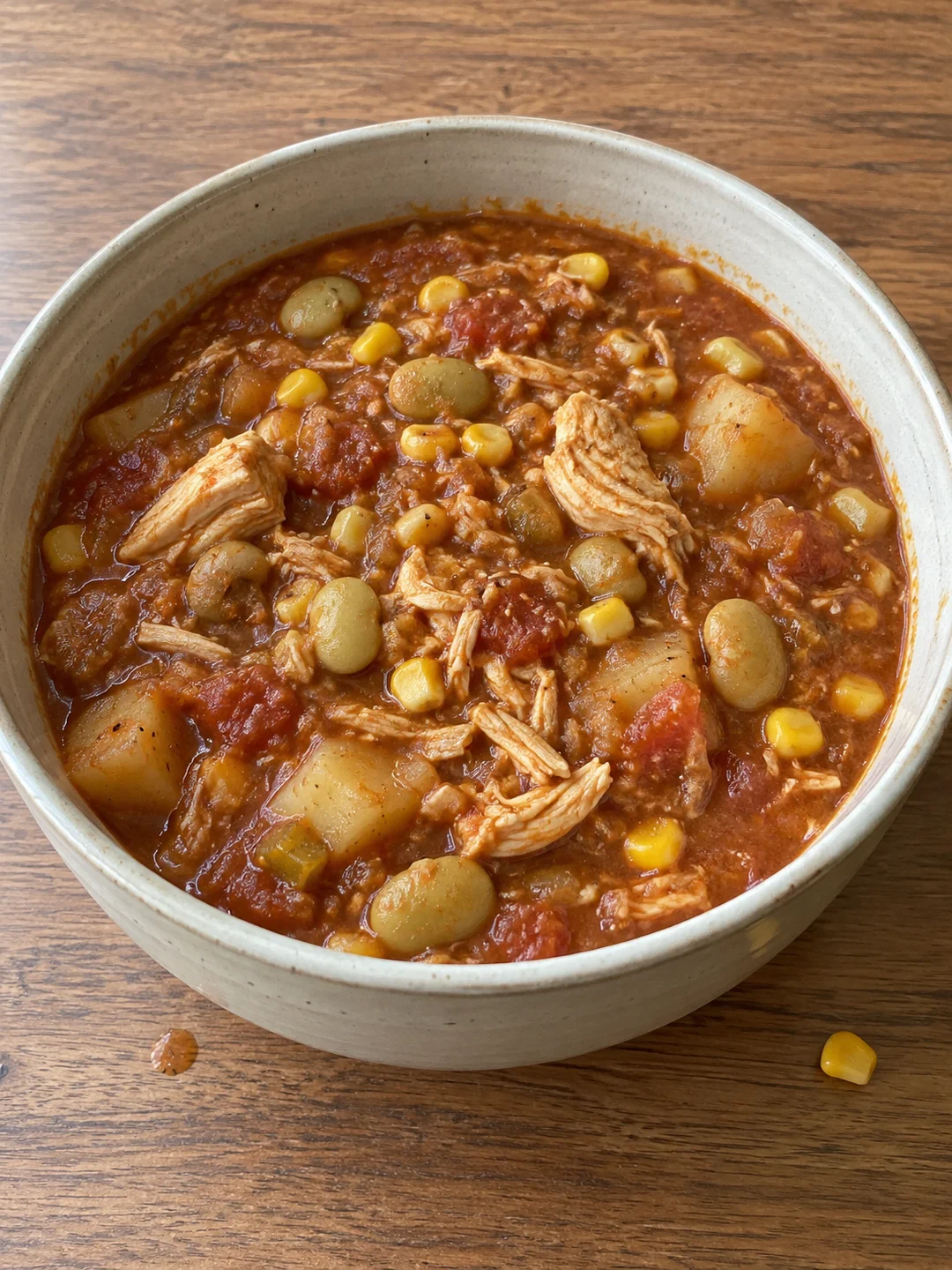
Brunswick Stew
Ingredients
Equipment
Method
- Put the chicken pieces in the pot and add water to cover by about 2 inches, roughly 3 quarts. Add 1 tablespoon salt. Bring to a boil over high heat, then drop to a bare simmer.
- Simmer uncovered for 1 hour 30 minutes to 2 hours, skimming the gray foam off the top during the first 20 minutes. The meat is ready when it pulls away from the bone with no resistance.
- Lift the chicken out with tongs into a large bowl and let it cool enough to handle, about 15 minutes. Keep every drop of the stock in the pot. This is the backbone of the stew.
- Pull the meat off the bones and shred it with your fingers into rough bite-size pieces. Discard the skin and bones. Set the meat aside.
- Skim the fat off the surface of the stock, leaving a thin slick behind for flavor. You should have about 2 quarts of stock. Top up with water if it has reduced further.
- Add the chopped bacon and diced onions to the stock. Simmer for 20 minutes until the onions go soft and the bacon fat melts into the broth.
- Stir in the tomatoes, the whole dried red pepper and the black pepper. Simmer uncovered for 1 hour, stirring every 15 minutes and reaching the spoon all the way to the bottom so nothing catches.
- Add the potatoes and butterbeans. Return the shredded chicken to the pot. Simmer another 1 hour 30 minutes, still uncovered, stirring often. The potatoes will break down and thicken the stew on their own.
- Stir in the butter and the crumbled cornbread. The stew should be visibly thick by now, the kind that holds a furrow behind the spoon.
- Add the corn last. Simmer just 20 to 25 minutes more so the kernels keep their bite.
- Stand a wooden spoon upright in the center of the pot. If it holds for a few seconds, the stew is done. If it falls over, keep simmering uncovered and check again every 15 minutes.
- Fish out the dried red pepper. Taste and correct the salt and black pepper, adding hot sauce now if you want more heat. Let the stew rest off the heat for 15 minutes before serving.