Go Back
Brunswick Stew from Brunswick County, Virginia

Brunswick Stew

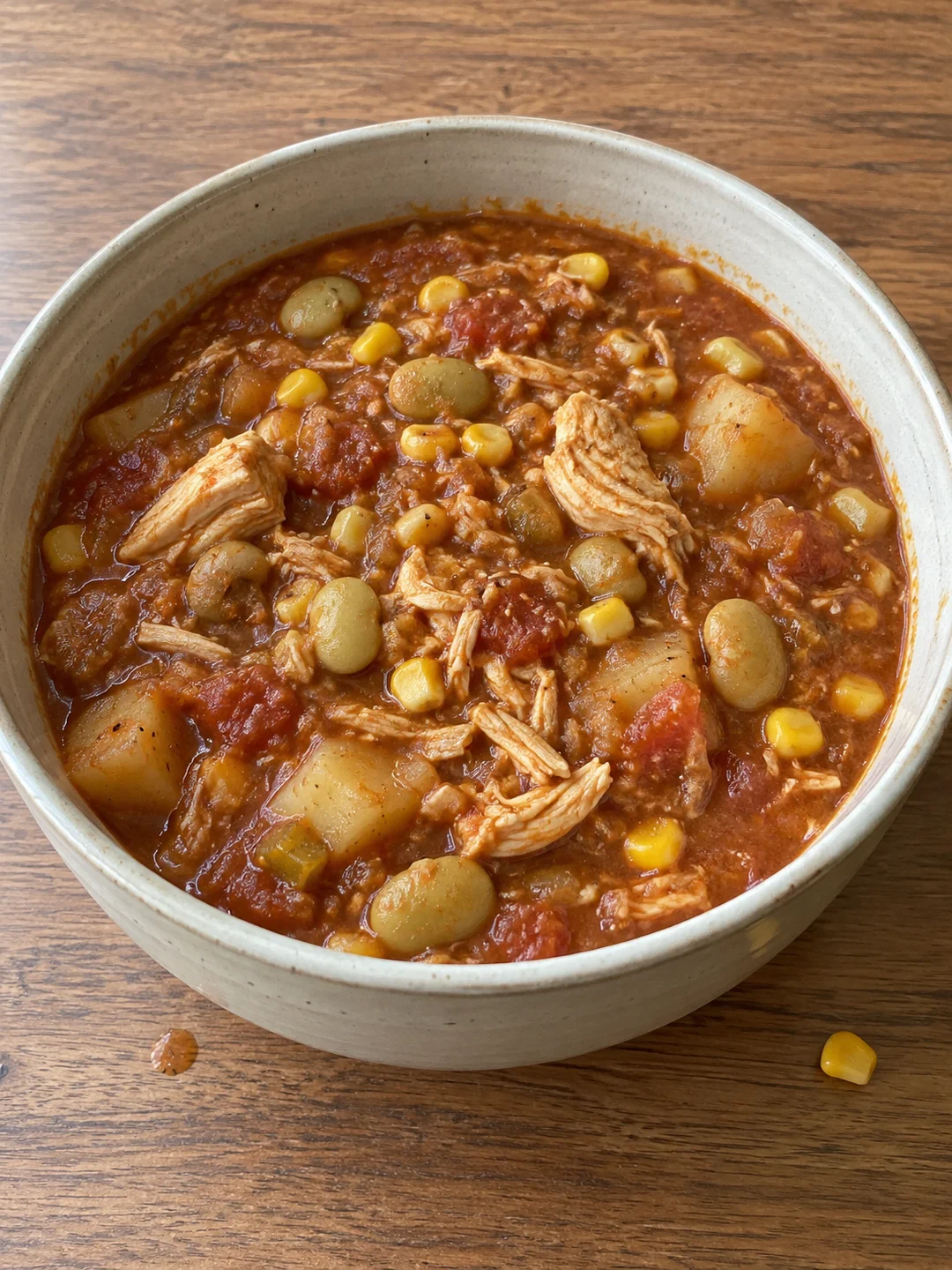
A proper Virginia Brunswick Stew: chicken simmered until it slides off the bone, then shredded back into its own rich stock with tomatoes, butterbeans, potatoes and corn. Hours of slow reduction turn it thick enough that a spoon stands upright in the pot. Bacon and butter carry the savor, and crumbled cornbread tightens the finish.
Prep Time 30 minutes
Cook Time 4 hours 30 minutes
Total Time 5 hours
Servings: 10 People
Course: Main Course
Cuisine: American
Calories: 520

Ingredients
  

  • 5 lb whole chicken cut into pieces, skin on, bone in
  • 3 quarts water enough to cover the chicken
  • 6 slices bacon chopped
  • 2 large yellow onions diced
  • 3 lb ripe tomatoes peeled and chopped, or two 28 oz cans crushed tomatoes
  • 1.5 lb Yukon Gold potatoes peeled and cut into 1 inch cubes
  • 1 lb butterbeans fresh or frozen baby lima beans
  • 3 cups corn kernels cut from about 5 ears, or frozen
  • 4 tbsp unsalted butter
  • 1 cup crumbled cornbread stale, for thickening
  • 1 tbsp kosher salt plus more to taste
  • 2 tsp black pepper freshly ground
  • 1 small dried red pepper whole, or 1 tsp hot sauce

Equipment

  • 1 large heavy Dutch oven or cast-iron pot at least 8 quart capacity
  • 1 long wooden spoon or paddle for stirring the bottom
  • 1 Large bowl for shredding the meat
  • 1 Tongs

Method
 

  1. Put the chicken pieces in the pot and add water to cover by about 2 inches, roughly 3 quarts. Add 1 tablespoon salt. Bring to a boil over high heat, then drop to a bare simmer.
  2. Simmer uncovered for 1 hour 30 minutes to 2 hours, skimming the gray foam off the top during the first 20 minutes. The meat is ready when it pulls away from the bone with no resistance.
  3. Lift the chicken out with tongs into a large bowl and let it cool enough to handle, about 15 minutes. Keep every drop of the stock in the pot. This is the backbone of the stew.
  4. Pull the meat off the bones and shred it with your fingers into rough bite-size pieces. Discard the skin and bones. Set the meat aside.
  5. Skim the fat off the surface of the stock, leaving a thin slick behind for flavor. You should have about 2 quarts of stock. Top up with water if it has reduced further.
  6. Add the chopped bacon and diced onions to the stock. Simmer for 20 minutes until the onions go soft and the bacon fat melts into the broth.
  7. Stir in the tomatoes, the whole dried red pepper and the black pepper. Simmer uncovered for 1 hour, stirring every 15 minutes and reaching the spoon all the way to the bottom so nothing catches.
  8. Add the potatoes and butterbeans. Return the shredded chicken to the pot. Simmer another 1 hour 30 minutes, still uncovered, stirring often. The potatoes will break down and thicken the stew on their own.
  9. Stir in the butter and the crumbled cornbread. The stew should be visibly thick by now, the kind that holds a furrow behind the spoon.
  10. Add the corn last. Simmer just 20 to 25 minutes more so the kernels keep their bite.
  11. Stand a wooden spoon upright in the center of the pot. If it holds for a few seconds, the stew is done. If it falls over, keep simmering uncovered and check again every 15 minutes.
  12. Fish out the dried red pepper. Taste and correct the salt and black pepper, adding hot sauce now if you want more heat. Let the stew rest off the heat for 15 minutes before serving.

Notes

  • The spoon test is the real doneness cue. Stand a wooden spoon in the center of the pot. If it stays upright for a few seconds, the stew is ready. If it slumps, keep reducing uncovered.
  • Stir down to the bottom every 15 minutes once the stew thickens. Scorched stew tastes burnt all the way through and cannot be saved.
  • Serve it with cornbread, plain white bread slices, coleslaw or saltine crackers alongside. In Georgia it gets ladled next to barbecued pulled pork, but in Virginia it stands on its own as the main course.
  • Rabbit is the traditional stand-in or addition if you can get it. Substitute 2 lb rabbit for 2 lb of the chicken and simmer it the same way.
  • It tastes better the next day. Cool, refrigerate up to 4 days, or freeze up to 3 months. Reheat gently over low heat with a splash of water.
  • Skip the cornbread thickener if you prefer and just reduce longer. The texture will be looser but still honest.