
The best Punjabi Gulab Jamun I have eaten came out of a kadhai in Amritsar at eleven in the morning, and I was not even hungry when it arrived.

I had booked a three-hour food walk through the lanes off Hall Bazaar mostly for the kulcha and the lassi. Our guide, Harpreet, kept telling us to pace ourselves, which nobody does.
He saved one stall for the end. A narrow halwai shop with a marble counter and trays stacked behind glass, and a man named Jaswant working a wide iron kadhai of ghee with a flat slotted ladle he never seemed to put down.
The Stall Harpreet Saved for Last in Amritsar
The smell hit before the shop did. Hot ghee, cardamom, and that faint sugar-burn edge that syrup gets when it has been sitting warm all morning.
Jaswant was frying in no hurry at all. The balls went in pale, sank, came up slowly, and he swirled the ghee around them with the back of the ladle rather than poking at them. Harpreet said the whole trick was that he refuses to turn the heat up, even with a queue out the door.
They came to us in little steel bowls, still warm, two each, syrup clinging and pooling. Spongy is the word everyone uses and it is not quite right. They were heavy. You could feel the weight of the syrup inside them when you pressed with the spoon, and the rose was barely there, more a smell than a flavour.
I ate both and then stood there for a minute feeling slightly undone by a sweet. That happens maybe twice a trip.
A Grease-Stained Napkin and the Part Nobody Writes Down
I was staying four nights with a family in a homestay in the Ranjit Avenue area, and when I came back raving about it, my host Baljeet laughed at me for being surprised. She had been making them for weddings in the family for decades.
She did not give me a printed card. She wrote it out on a paper napkin at the kitchen table while the pressure cooker hissed behind her, and by the time she finished there was a ghee thumbprint across the syrup instructions. I still have it, folded in the back of my passport wallet.
What she wrote down was mostly temperatures and warnings. Khoya must be the soft kind. Knead briefly. Syrup thin and only warm. Fry slow or you waste the milk.
Her exact words at the end, which I did not understand until my third batch at home, were that the frying is not the cooking. The soaking is the cooking.

What Punjabi Gulab Jamun Actually Is
It is not a doughnut and it is not a fritter, which is how most people abroad describe it. The body is khoya, milk reduced for hours over a low flame until it is a soft dense solid, and the flour is there only to hold it together. Flour-forward versions go heavy and then refuse to drink the syrup, which is the whole point of the thing.
The sweet came out of medieval India under the Mughals, where Persianate court cooking met the dairy-heavy sweet-making of the north. Its ancestor is the Persian and Arab luqmat al-qadi, fried dough in syrup, carried into the subcontinent from around the thirteenth century. Indian cooks swapped out the plain dough for khoya and scented the syrup with rose, cardamom and saffron.
Even the name is the fusion written down. Gulab is Persian, gul for flower and ab for water, after the rose syrup. Jamun is the Hindustani name for the Java plum, which the dark oval sweets resemble.
In Punjab it is the default sweet of good news. Weddings, engagements, births, exam results, Diwali, Eid. At a Punjabi wedding it comes hot out of the kadhai at the dessert counter, often under chilled rabri, and how much of it is on offer gets read as a measure of the host’s generosity.
What I Used
- Soft khoya, the chikna or dhaap grade, cold from the fridge. Dry danedar khoya will give you tough jamuns that stay dry inside
- A little fresh paneer, optional, for extra softness
- Maida, a quarter cup, and a teaspoon more in reserve
- A scant pinch of baking soda. Genuinely scant
- Whole milk, a couple of spoonfuls, plus more by the teaspoon if the dough cracks
- Ghee for deep frying, and quite a lot of it
- Sugar and water in equal measure for the syrup
- Green cardamom pods, crushed, husks and all
- Saffron strands
- Rose water, a teaspoon, no more
- Lemon juice, so the syrup does not crystallise
The khoya and the ghee I buy on Pioneer Boulevard in Artesia, where there is a stretch of Indian grocers and the khoya in the chiller actually turns over fast enough to be soft. Saffron I carry home from trips because the small jars here cost more than the flight sometimes feels like it did. Rose water is easy to find anywhere and the cheap stuff is fine.

Making Punjabi Gulab Jamun on a Sunday Morning
I make these early, before the apartment heats up, because the ghee makes the kitchen close in on you by noon. Sunday morning light comes across the wooden table where I roll the balls and it catches every crack in them, which is genuinely useful.
Syrup first, five to seven minutes, cardamom and saffron in. Then off the heat and left uncovered to come down to just warm. My first ever batch burst in the pan because I dropped them into syrup still near a boil, and I sat there looking at twenty sad split spheres wondering what I had done to Baljeet’s napkin.
The khoya goes onto the big holes of a box grater with one bent corner, then flour and soda over the top, then three minutes of pressing with the heel of my hand. Stop the second it is smooth. Over-kneading and extra flour are the two reasons these go dense and both are tempting.
Rolling is the part I actually enjoy. Palms greased, twenty balls, each one rolled until there is no seam anywhere, because any seam opens in the ghee.
Then the thermometer clipped to the side of the pot and a long patient stretch at 300 to 325 F, with whatever is playing getting about six songs deep. Nusrat, usually. The balls go in, I leave them alone for a minute, then swirl the ghee around them the way Jaswant did until they are deep mahogany, and straight into the warm syrup from there.
Two hours minimum of soaking, turned once halfway. I say two. I have gone three and liked them more.
How I Serve Them
Warm, two or three to a bowl, with some syrup spooned over. Cold and dry out of the fridge is how most people meet gulab jamun abroad and it does them no favours, so I warm leftovers gently so the syrup loosens and clings again.
Chilled rabri poured over is the wedding-counter version and the hot-and-cold contrast is worth the extra work. A scoop of vanilla or kulfi does the same job in a tenth of the time. Pistachios slivered over the top, a few saffron threads if I am feeding people I want to impress.
I went to Amritsar for the Golden Temple and the kulchas and came home thinking about syrup temperature. That napkin has survived two more trips now, folded smaller each time. Some recipes you bring back and some bring you back.
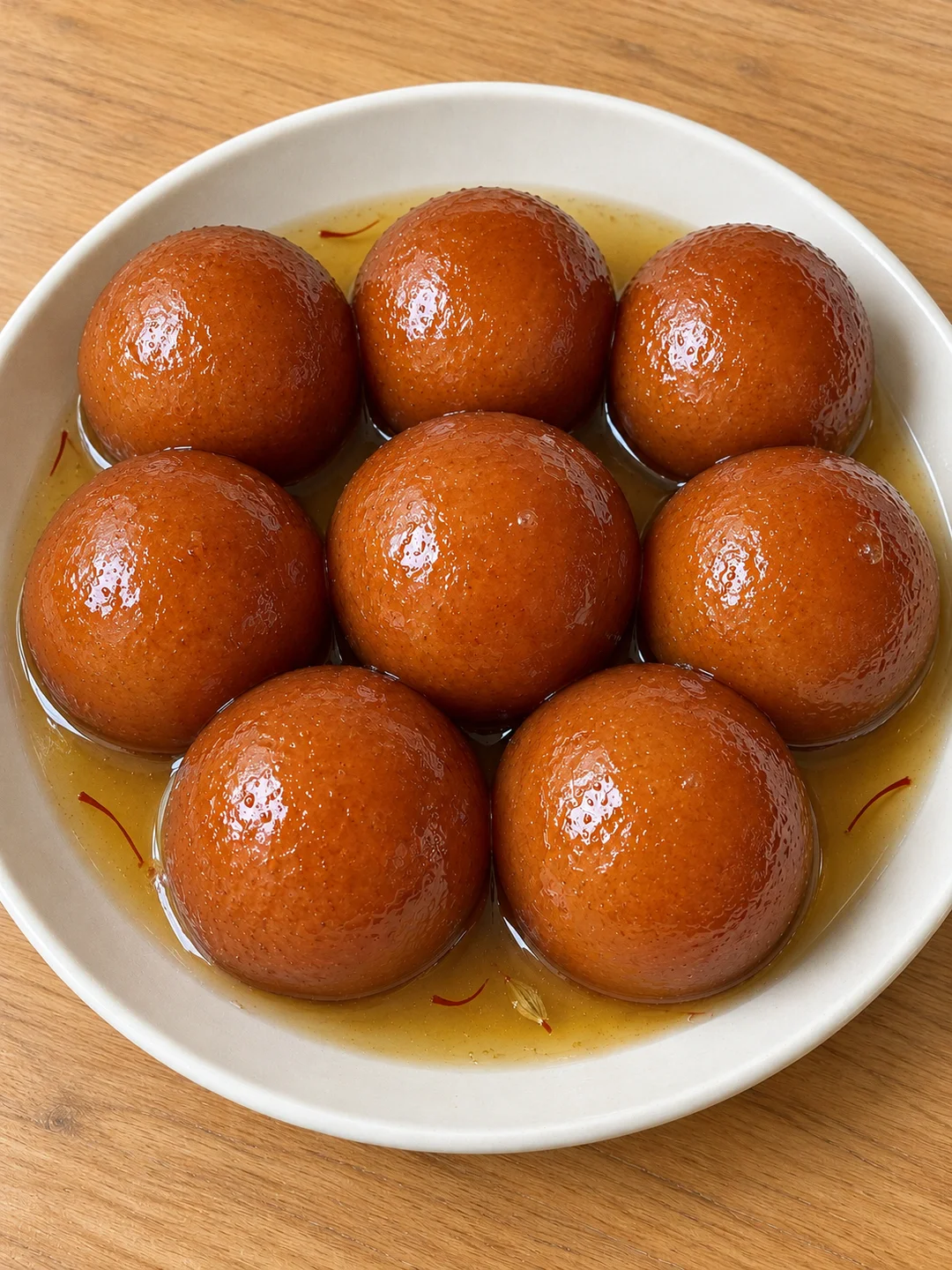
Punjabi Gulab Jamun
Ingredients
Equipment
Method
- Make the syrup first. Combine the sugar and water in a heavy saucepan over medium heat. Stir until the sugar dissolves, then add the crushed cardamom pods and saffron strands.
- Simmer the syrup 5 to 7 minutes, until it is just slightly sticky but still runny. This is one-string consistency: a drop pressed between finger and thumb pulls a single short thread. Do not reduce it further or the jamuns will never drink it in.
- Stir in the lemon juice and rose water, then turn off the heat and set the pan aside uncovered. You want the syrup at 100 to 130 F when the jamuns go in, warm to the finger but nowhere near boiling.
- Grate the cold khoya on the large holes of a box grater into a wide bowl. Grate or crumble in the paneer if using. Sprinkle the flour and baking soda over the top.
- Bring the mixture together with the heel of your hand, pressing and folding for about 3 minutes until it turns into a smooth, soft dough with no visible grains. Add milk 1 teaspoon at a time only if it feels dry. Stop as soon as it is smooth. Over-kneading is what makes hard jamuns.
- Grease your palms lightly with ghee. Divide the dough into 20 pieces and roll each into a perfectly smooth, seamless ball about 1 inch across. Any crack or seam will split open in the ghee. Keep them under a damp cloth as you work.
- Heat the ghee in a deep kadai to 300 to 325 F. Test with one ball: it should sink, then rise slowly within 30 to 40 seconds without browning fast. If it browns immediately the ghee is too hot, so pull the pan off the heat and let it drop.
- Slide in 5 or 6 balls at a time. Do not touch them for the first minute, then keep them moving gently by swirling the ghee with the back of the slotted spoon so they roll and color evenly.
- Fry 6 to 8 minutes total, until a deep even golden-brown, almost mahogany. They will puff and float. Patience here is the whole recipe: slow frying sets the center so it can absorb syrup.
- Lift the jamuns out, drain them for a few seconds, then drop them straight from the ghee into the warm syrup. Repeat with the remaining batches, checking the ghee temperature between each.
- Let the jamuns soak at least 2 hours, turning them once midway so both sides swell evenly. They are ready when they have nearly doubled, feel heavy and spongy, and a cut one is saturated right to the center.
- Serve warm or at room temperature, two or three per bowl with a few spoonfuls of the syrup clinging to them.