
The first Soul Cakes I ever ate came out of a paper bag at Shrewsbury Market Hall, still warm, dusted so heavily with sugar that I had most of it down the front of my coat within a minute.

The woman who sold them to me was Gwenllian Pryce. Gwen, on the second meeting. She bakes two days a week on a stall near the fish counter, speaks Welsh at home and in the shop and presumably in her head, and her English runs out somewhere around the third sentence.
We managed anyway. Mostly by pointing.
Gwen, Shrewsbury Market, and a Lot of Pointing
I was in the Marches in the last week of October on a loop that was supposed to be about castles and turned into a loop about bakeries, as these things do. I asked Gwen what the cross on top was for. She tapped her chest twice, then pointed at the ceiling, and sold me two more.
Before I left the stall she wrote an address on the side of a paper bag and held up four fingers, which I eventually worked out meant Thursday. Her kitchen is outside Oswestry, up a lane with a cattle grid, and the whole lesson took about twelve minutes and not one complete sentence in a language we both spoke.
She creamed the butter with a hand mixer that sounded like it was about to retire. She pressed the knife into each round, deep, and held up two fingers at the oven door, then mimed cutting again. I nodded like I understood. I did not understand until the first time I skipped that step at home and pulled out eighteen plain sugared discs with no mark on them at all.
Gwen and I still send voice notes. Hers are in Welsh, which I run through a translator that renders about sixty percent of it as farm equipment. Every year in late October one arrives, and I know exactly what it means regardless.
Why Soul Cakes Have a Cross on Top
These are not a Halloween novelty, and they are not an ancient pagan Samhain bake that somebody later Christianised. They belong to Allhallowtide, the three days of 31 October, 1 November and 2 November, and they were baked specifically for All Souls’ Day to remember the dead.
The custom is called souling and it is documented in England by 1511. Soulers, mostly children and the poor, went door to door singing the Souling Song and were given cakes, ale, apples, pears or small coins in return for praying for the household’s departed. Each cake eaten was believed to release one soul from purgatory, which is a remarkable amount of weight to put on a spiced biscuit.
So the cross is not decoration. It marks the cake as alms, given in exchange for prayers. That is also why they get confused with hot cross buns, and they should not be. Hot cross buns are yeasted and bready and belong to Good Friday. Soul cakes are small, flat, unyeasted, closer to a rich spiced shortbread than to anything you would call cake in the modern sense.
Souling was strongest along the Welsh border, through Shropshire, Cheshire, Staffordshire and up into Lancashire and Yorkshire. It lasted in England into the 1930s and in Shropshire until the 1950s. It is widely seen as the ancestor of trick-or-treating, though there was never any trick. You earned your cake. In Cheshire the Antrobus Soul Cakers still perform their souling play every year, and Sheffield still has caking night.
Worth saying too that not every soul cake looks like Gwen’s. The Lancashire harcake is an oatmeal and ale parkin, a completely different bake under the same name.

Baking Soul Cakes in My Own Kitchen
I make them the last weekend of October, which in my kitchen means the windows are open, the Santa Ana wind is doing its thing, and the butter has gone soft on the counter in about nine minutes flat. One year it was practically liquid and the dough came out greasy. Now I weigh it out and go straight to the mixer.
The saffron goes into three tablespoons of warm milk in the smallest saucepan I own, the one with the loose rivet, and sits there turning a startling orange while I do everything else. I buy the threads from a Persian market on Westwood Boulevard where they sell it in proper quantity rather than in those pinch-sized jars that cost more than the butter.
By the rolling stage the wooden table is covered in flour in the morning light and I usually have Fairport Convention on, which is either very appropriate or very predictable. My rolling pin has one handle that spins and one that does not. The knife I use for the crosses is a blunt-tipped table knife I bought for fifty cents at a flea market in Pasadena, purely because the back of the blade is thick and leaves a clean deep line.
The soul cakes recipe below is essentially my written-out version of those twelve minutes of mime, tested enough times that I trust it. I re-cut the crosses at eight minutes, every time. Except the batch I left in while answering the door, which closed up and spread and tasted exactly the same.

What I Used
- Whole milk, just three tablespoons, warmed until it steams
- A pinch of saffron threads, lightly crushed between my fingers
- Unsalted butter, properly soft but not melting
- Caster sugar, plus more for dusting the cakes while hot
- Two egg yolks at room temperature, no whites
- All-purpose flour
- Mixed spice, the British blend, which I order online because nobody near me stocks it
- Ground ginger, more than you think
- Freshly grated nutmeg and ground cinnamon
- A little baking powder and fine sea salt
- Currants, soaked ten minutes in warm tea if they look tired
Variations, and One Thing Not to Do
If you have no saffron, leave it out. Do not reach for turmeric. The cakes will be paler and taste identical, and the turmeric will taste like turmeric, which is not what you want here.
Raisins work in place of currants, though they are bigger and the rounds crack more when you cut them. I have seen people add orange zest. I do not, mainly because the ginger and mixed spice are already doing plenty and the saffron gets lost.
They firm up overnight in a tin, which is when I actually prefer them. Cold, slightly harder, dunked in very strong tea at seven in the morning. Gwen would serve them with mulled ale and a bowl of apples and pears, a candle lit on the table, which is the proper way and I have done it exactly twice.
The traditional lantern alongside, for what it is worth, was a carved turnip. Pumpkin came much later and has no business anywhere near this plate.
I started making these because a woman in a market hall pointed at her chest and then at the ceiling. Four years on I bake them on 2 November whether or not anyone else is coming over, light the candle, and think about a few people. That is more than I expected from a biscuit.
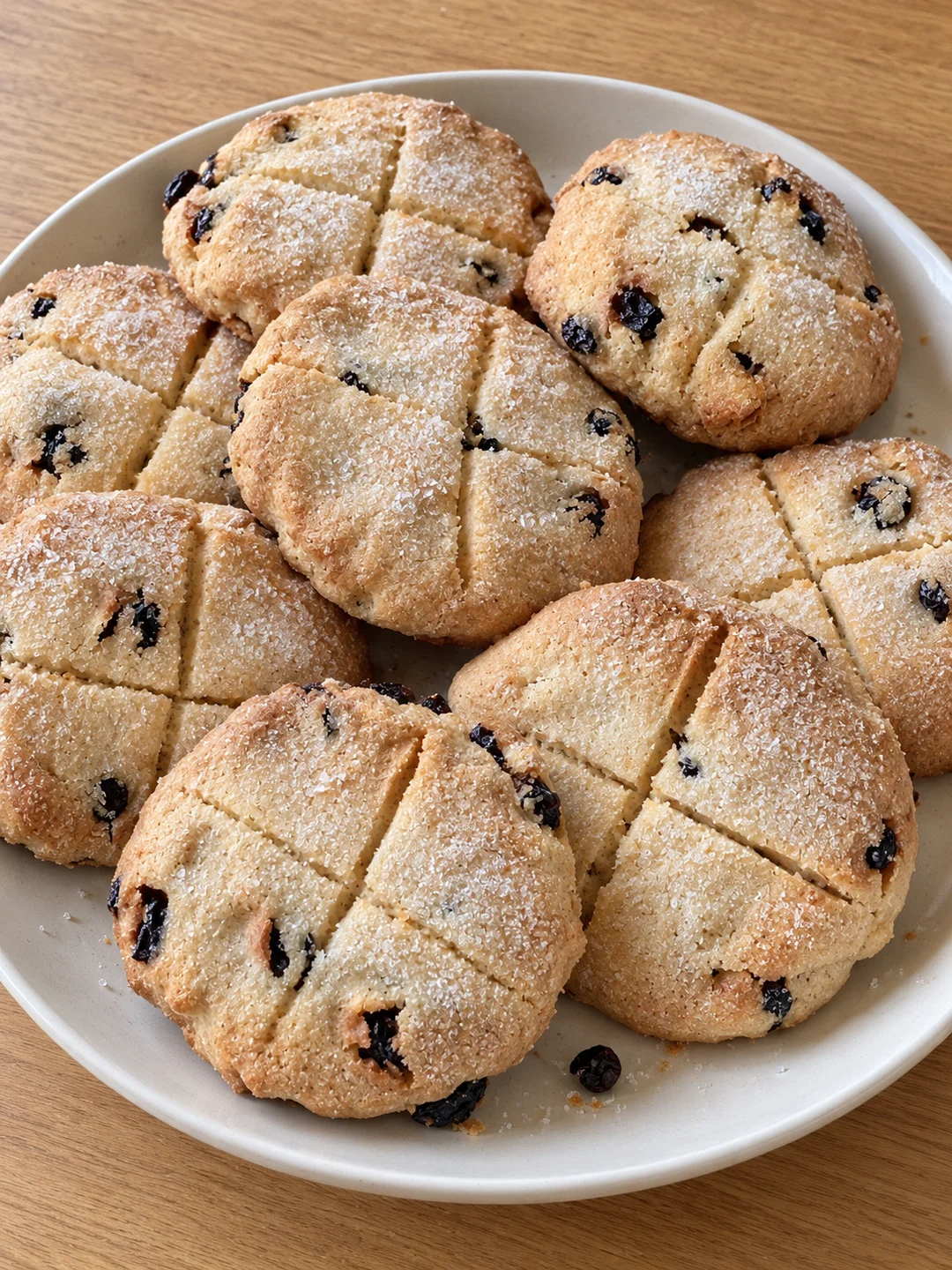
Soul Cakes
Ingredients
Equipment
Method
- Warm the milk in a small saucepan until it steams but does not boil. Take it off the heat, crumble in the saffron threads, and leave to steep for 15 minutes. It will turn a deep yellow-orange.
- Heat the oven to 350 F and line two baking sheets with parchment paper.
- Beat the softened butter and 1/2 cup caster sugar together in a large bowl for 3 to 4 minutes, until pale and noticeably lighter in texture. Scrape down the bowl once.
- Beat in the egg yolks one at a time until fully combined and glossy.
- Sift the flour, mixed spice, ginger, nutmeg, cinnamon, baking powder and salt over the butter mixture. Work it in with a wooden spoon or your fingertips until the mixture looks like coarse crumbs.
- Pour in the saffron milk and bring the dough together with your hands. It should be firm and slightly tacky, like a rich shortcrust. Add a teaspoon more milk only if dry crumbs remain in the bowl.
- Fold in the currants, working them evenly through the dough. Do not knead beyond this point or the cakes will toughen.
- Turn the dough onto a lightly floured surface and roll it out to a scant 1/2 inch thick. Keep it thicker than a biscuit, thinner than a scone.
- Cut out rounds with a 2.75 inch cutter and lift them onto the baking sheets, spacing them about 1 inch apart. Gather and re-roll the scraps once to make about 18 cakes in total.
- Prick each round two or three times with a fork. Then press a deep cross into the top with the back of a blunt table knife, going down about halfway through the dough. This is the mark of alms for the dead, so make it clear and confident.
- Bake for 8 minutes, then open the oven and re-cut the crosses so they stay visible as the cakes spread. Return to the oven for a further 6 to 7 minutes, until pale gold at the edges and just set in the middle. They should still feel slightly soft when pressed.
- Dust the cakes generously with the remaining caster sugar while they are still hot, then slide them onto a wire rack. They firm up as they cool.
- Serve warm or at room temperature on All Souls' Day, with mulled ale or strong tea, a bowl of apples and pears, and a candle lit for anyone you are remembering.