
Northern Chinese Cabbage Dumplings were not the reason I booked a cooking class in Harbin. I went for the cumin lamb and the sour cabbage stew, got both, and have thought about neither since.

The dumplings were the surprise. Three hours of rolling and pleating in a cold kitchen off Guogeli Street, and I walked back to my guesthouse with flour in my eyebrows and a dinner I now make at home at least twice a month.
The Harbin Class That Rearranged My Dumpling Hierarchy
The instructor was a woman called Mrs. Sun. She ran the class out of a ground-floor room with a concrete floor, a long steel table and a single pot that could have boiled laundry, and her son translated the parts that mattered, which were almost all warnings.
It was February and roughly minus eighteen outside. The windows had fogged over completely within ten minutes of the pot going on, and the room smelled of raw scallion and ginger with a sour vinegar note underneath, because the dipping bowls were already poured before we started.
She let eight of us roll our own wrappers badly. Mine came out thick at the rim and thin in the middle, which is precisely backwards, and she turned one over in her palm, said something short, and her son said she asked if I wanted my filling in the water or in the dumpling.
Fair.
The second thing she corrected was my stirring. I had been going at the pork in whatever direction my wrist fancied, and she took the chopsticks, held them at an angle and worked them one way only, round and round, until the meat went pale and tacky and climbed the side of the bowl. That one detail is the whole filling. Stir randomly and you get crumbly mince. Stir one direction with cold water beaten in by the splash and you get something that plumps up inside the wrapper and holds its juice.
Why Northern Chinese Cabbage Dumplings Are Boiled and Not Fried
Properly these are zhurou baicai jiaozi, pork and napa cabbage boiled dumplings, also called shuijiao. They belong to the wheat-growing north, Shandong and Hebei and the Northeast, where jiaozi are not a snack or a starter but the actual carbohydrate of the meal. You do not put rice next to them. Mrs. Sun found the idea funny.
Boiling is the default, and this took me a while to accept because almost every version I had eaten before was pan-fried. Guotie, the crisp-bottomed kind, is traditionally what you do with yesterday’s leftovers. They are also not gyoza, which came later in Japan with much thinner skins and finer filling, and not wontons, which are square and egg-rich and live in broth.
The history goes back something like eighteen hundred years, to the Eastern Han. Legend credits the physician Zhang Zhongjing with wrapping stewed lamb and warming spices in dough to treat frostbitten ears one terrible winter, parcels called jiao’er, tender ears, which is where both the name and the crescent shape supposedly come from. Legend, not documentation, and the original filling was lamb rather than pork and cabbage. Actual dried dumplings have been dug out of Tang dynasty tombs in Turpan, which I find more convincing than the story and somehow less charming.
Napa cabbage became the standard filling for a dull and excellent reason. It is cheap, sweet, and it keeps all winter in a cellar or buried in snow. In Dongbei, where fresh greens disappeared for months, households fermented whole heads in clay vats into suan cai, which is where the region’s sour cabbage dumpling comes from. And baicai, cabbage, puns on a hundred fortunes, which is why the filling turns up at New Year’s Eve, eaten at midnight when the old year joins the new.

What I Used
- All-purpose flour, about three cups, plus more for the trays
- Cold water for the dough, one cup, maybe a splash more
- Napa cabbage, half a medium head, chopped down to grains of rice
- Salt for the cabbage, and more for the filling
- Ground pork with twenty to thirty percent fat
- Fresh ginger, minced fine
- Four scallions, whites and greens
- Light soy sauce
- Shaoxing rice wine
- Toasted sesame oil
- Ground white pepper and a little sugar
- Six tablespoons cold water, beaten into the pork
- Dried shiitake, optional, soaked and chopped, soaking liquid saved
- Chinkiang black vinegar for dipping, and raw garlic if you are brave
Making Them at My Own Table
I do this on Sunday mornings, early, because the wooden table in my kitchen gets a long slab of light until about eleven and rolling forty wrappers takes exactly that long. Radio on low, usually something I am not listening to. Flour everywhere by the end, including the floor, which I have stopped pretending to prevent.
I get the napa at the big Asian market near Alhambra, where the heads are enormous and cost almost nothing, and I buy ground pork shoulder with the fat still in it. Lean pork is not a healthy upgrade here, it is just a dry dumpling. Ask the counter for shoulder rather than taking whatever sits pre-packed in the case.
The first batch I made at home tore in the pot and the water went cloudy with filling. My fault entirely. I had shredded the cabbage, salted it, and then given it a polite little squeeze instead of wringing it like a wet towel until nothing more came out. Now I squeeze handful by handful over the sink until my forearms ache and I end up with a tight damp lump about the size of an orange.
My rolling pin is a plain wooden dowel with no handles that I bought in Chinatown for three dollars, and it works better than the proper one I own. Press down and outward, turn the dough with the other hand, keep the rim thinner than the middle. The middle is the part that has to survive the boil.
Then the pot. Big, rolling boil, half the dumplings in, a nudge with the slotted spoon so they do not weld to the bottom. When it comes back up, a cup of cold water goes in. Three times. Skins go taut and faintly see-through, they float, they are done, and the whole thing takes about eight minutes.

Dips, Swaps and the Day After
Neat soy sauce in a saucer is not the dip. The soy is already in the filling. You want black vinegar on its own, or vinegar with a little soy and slivered ginger, and in the Northeast crushed raw garlic goes in the bowl while in Shandong people eat whole raw cloves between dumplings. I have tried that. Once.
Shiitake in the filling is a good addition and the soaking liquid is better than plain water for beating into the pork. Usually I skip them. Except when I have them soaking anyway for something else, which is most weeks.
Wrap extras, freeze them separated on a floured tray, then bag them and boil from frozen with two or three minutes more. And ladle a little of the starchy cooking water into small bowls to sip at the end, which Mrs. Sun did without explaining and which turned out to be the part I remember most.
Cold leftovers pan-fried the next morning, bottoms crisp, eaten standing at the counter. Arguably better than the first night. I would not say that in Harbin, but it is true in my kitchen.
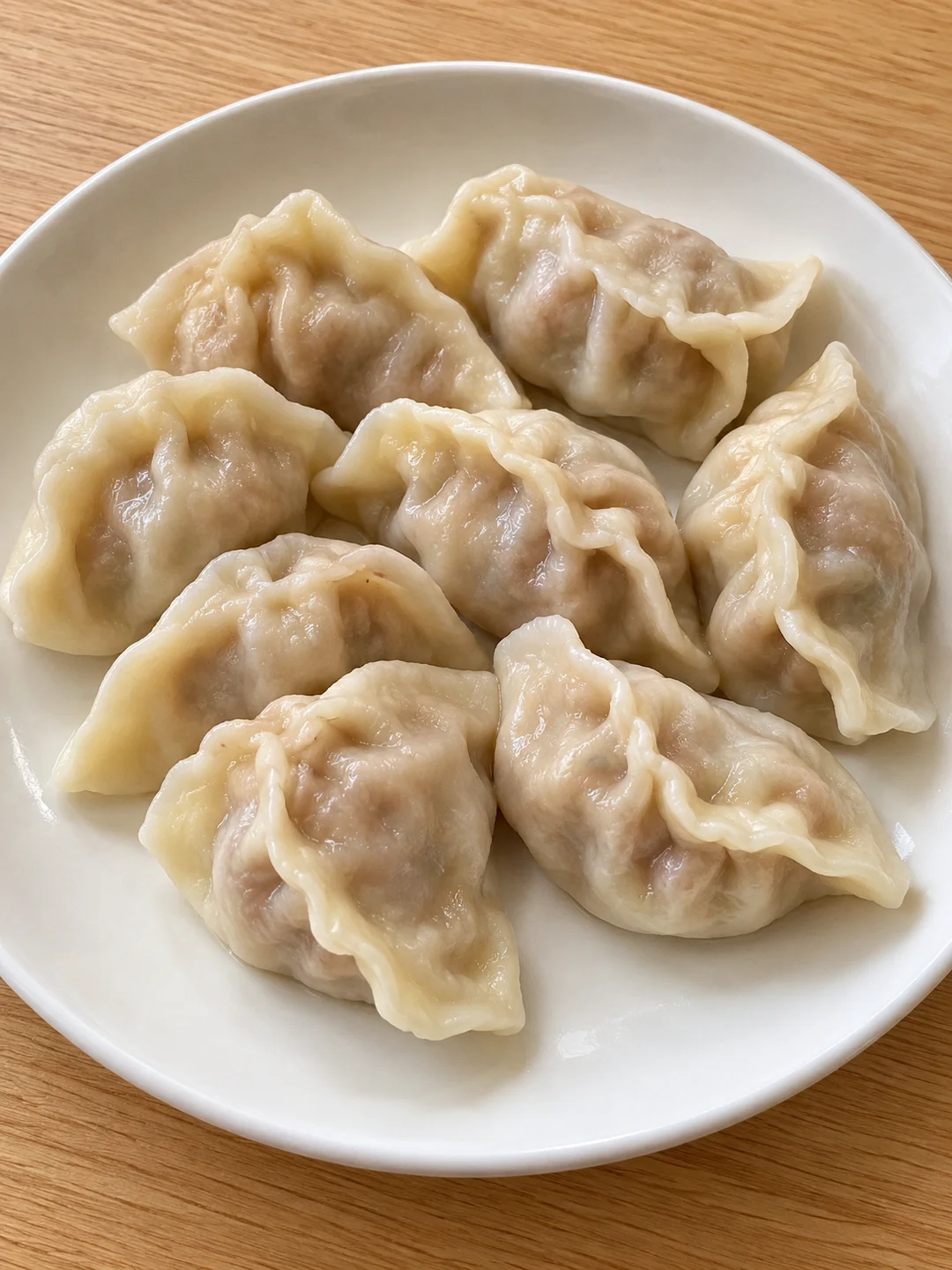
Northern Chinese Cabbage Dumplings
Ingredients
Equipment
Method
- Put the flour in a large bowl. Pour in 1 cup cold water in a steady stream while stirring with chopsticks or your fingers until the flour gathers into shaggy lumps. Add another tablespoon or two of water only if dry flour remains at the bottom.
- Knead the dough on an unfloured counter for 8 to 10 minutes, until it is smooth, firm and no longer tacky. It should feel stiffer than bread dough. Cover the bowl with a damp towel or plastic wrap and rest at room temperature at least 30 minutes, up to 1 hour.
- While the dough rests, halve the napa cabbage lengthwise, cut out the dense core, slice the leaves into fine shreds, then chop the shreds very finely until the pieces are no bigger than a grain of rice. Toss in a colander with 1.5 tsp salt and leave 20 minutes over a bowl or the sink.
- Take the cabbage up by the handful and squeeze hard, wringing out as much liquid as you can. Keep squeezing until no more water comes out. You should end up with a tight, barely damp mass of about 1 cup. Loosen it with your fingers and set aside.
- Put the ground pork in a bowl with the ginger, soy sauce, Shaoxing wine, sesame oil, white pepper, sugar and 0.75 tsp salt. Stir vigorously in one direction only with chopsticks or a wooden spoon for 2 minutes.
- Still stirring in the same direction, add the 6 tbsp cold water or shiitake soaking liquid a splash at a time, letting the meat absorb each addition before the next. Keep going 3 to 5 minutes until the pork turns pale, sticky and holds together as a cohesive paste.
- Fold the squeezed cabbage, the scallions and the chopped shiitake if using into the pork, stirring in the same direction just until evenly combined. Cover and refrigerate while you roll the wrappers.
- Divide the rested dough in half. Roll each half into a rope about 1 inch thick, then cut crosswise into pieces about 0.75 inch long, roughly 40 to 44 pieces total. Keep them under a towel and press each into a small disc with your palm.
- Roll each disc into a round about 3.5 inches across, pressing down and out with the pin while turning the dough with your other hand. Work the rim thinner than the center so the base survives boiling. Dust lightly with flour only if the dough sticks.
- Hold a wrapper in your cupped palm and place about 1 tablespoon of filling in the center. Fold into a half-moon and press the edges together firmly from the middle outward, pleating the front edge if you like, squeezing out all air. Set the finished dumplings on a floured tray, not touching.
- Bring a large stockpot of water to a vigorous boil. Slide in half the dumplings, nudging them gently with the back of a slotted spoon so they do not stick to the bottom or each other.
- When the water returns to a full boil, splash in about 1 cup of cold water. Repeat twice more as the pot comes back to a boil, three splashes in all. The dumplings are done when they float, the skins look taut and translucent and the filling is firm, 6 to 10 minutes total.
- Lift the dumplings out with a slotted spoon, letting them drain, and serve immediately while the second batch cooks. Reserve a little of the starchy cooking water to sip at the end of the meal.