
The parmesan crusted chicken that got into my head came off a flat-top cart on Ninth Street in South Philadelphia, a little after one on an October afternoon. Nine dollars, written in blue chalk under the word CUTLET.
The man running the cart was Sal. He had a stack of pounded breasts under plastic wrap on his left and a wide dish of crumbs the color of wet sand on his right, and he pressed each cutlet into that dish with the heel of his palm like he was setting a tile into mortar.
He handed mine over in butcher paper with a lemon wedge balanced on top. No sauce. I ate it leaning against a produce stall two doors down while the paper went translucent and hot in my hand.
The Cart on Ninth Street in South Philadelphia
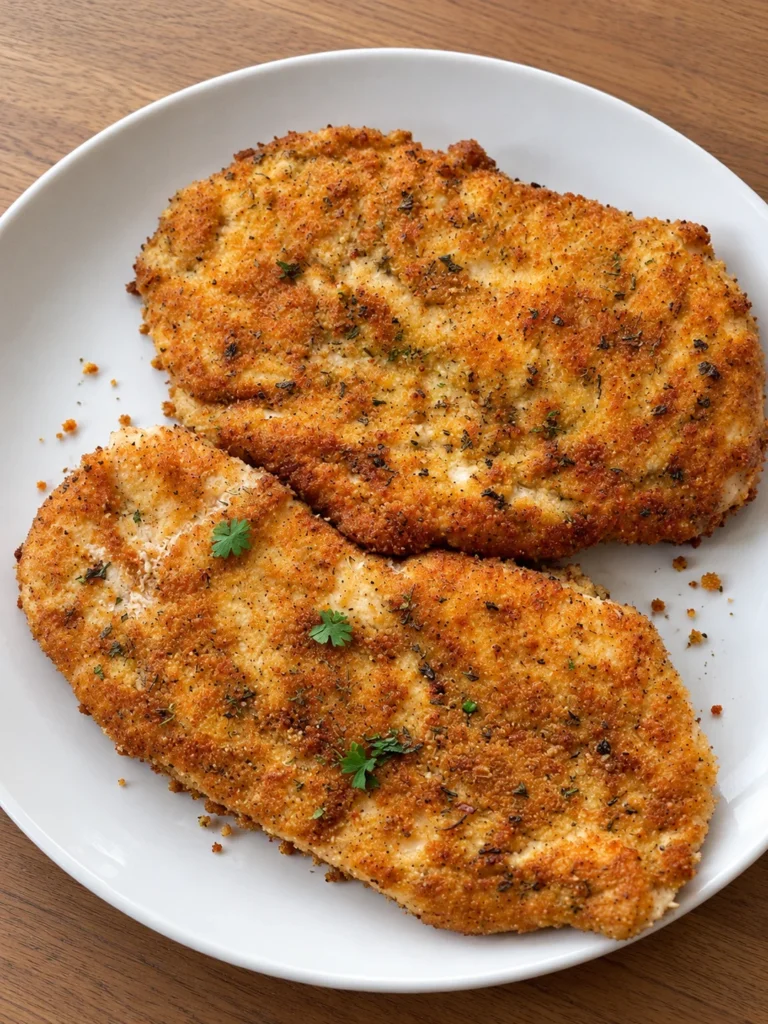
What surprised me was how dry it was. Not dry like overcooked. Dry like a cracker, the crust fused into one continuous golden sheet that came away in shards when I bit through it.
There were maybe six people waiting behind me, most of them clearly on lunch break, none of them talking much. Sal worked two cutlets at a time and never more, which I understood later is the only way the oil stays hot enough.
I asked him what was in the crumbs. He said cheese, parsley, pepper, and then he said the thing I have repeated to people ever since. If you can see the cheese on the finished cutlet, it was the wrong cheese.
Rosa’s Sunday Cutlets in Bella Vista
I was staying four blocks away in a rowhouse hostel in Bella Vista, the kind with a narrow kitchen and a staircase that announces everybody. The woman who ran it, Rosa, cooked on Sunday afternoons for whoever had not checked out yet.
Her Sunday thing was cutlets. A whole hill of them, cooked in batches of two, stacked on a wire rack on the counter while she kept going, and she salted each one the second it left the pan.
She let me stand there and watch. The detail I would never have guessed on my own was the waiting. Once the cutlets are breaded she leaves them alone on the rack for a solid ten minutes before they go near the oil, because the egg starts to grip and the crust stops peeling off in the pan.
She also refused to sauce them. There was a bowl of marinara on the table and it stayed on the table.

Where Parmesan Crusted Chicken Actually Comes From
This is an Italian-American dish, not an Italian one, and the research is clear about the lineage. Its ancestor is cotoletta alla milanese, a bone-in veal chop pounded thin, breaded and shallow-fried in butter, first recorded at a Milanese banquet in 1134, along with its chicken cousin cotoletta di pollo.
When southern Italian immigrants settled the New York, New Jersey and Philadelphia corridor in the late 1800s and early 1900s, cheap boneless chicken breast replaced expensive veal. The real shift was the cheese moving into the breadcrumbs instead of being layered on top, the way it is in cotoletta alla bolognese.
The earliest known printed American reference to a breaded chicken parmesan style dish turns up in 1944 in Maryland, and by the 1950s these cutlets were standard on Italian-American restaurant menus. In Italy the breaded chicken cutlet stayed plain and cheese-free, a family weeknight thing, and Italians generally file crumb crust plus tomato plus melted cheese under American invention.
So it is also not the dish people keep calling it. Saucy, blanketed, mozzarella-topped chicken parmesan is a separate animal, and this one lives or dies on staying crisp.
What I Used
- Two large boneless skinless chicken breasts, halved horizontally into four thin cutlets
- A wedge of real Parmigiano-Reggiano, about three ounces, grated myself
- Fine dry breadcrumbs, though I use panko when I want a louder crunch
- All-purpose flour for the first dish
- Two eggs, beaten, in the second dish
- Fresh parsley, chopped fine
- Garlic powder, or two cloves grated on the fine side of the box grater
- Salt and a lot of black pepper, split between the chicken and the crumbs
- Olive oil for the pan, plus a knob of unsalted butter for color and smell
- Lemon wedges, non-negotiable
I get the Parmigiano from an Italian deli where the guy will saw a wedge off the wheel and complain about the weather while he does it. Pre-grated cheese does not work here and I know because I tried it once in a hurry. The crust went sandy and slid off the chicken in patches, like sunburned skin.

Frying Parmesan Crusted Chicken at Home
I pound the cutlets to a quarter inch between two sheets of plastic wrap, using the flat side of a mallet I have had for years and the butt of my one good chef’s knife for the stubborn corners. Even thickness matters more than thinness. A thick cutlet burns its crust while the center is still cold.
Then dry. Really dry, both sides, paper towels, because any moisture steams out through the coating and lifts it.
In the pan the sequence is worth watching. The oil goes shimmery around three hundred and fifty, the crumbs hit it and start sizzling in a steady fine hiss, and the butter foams and then quiets down. For the first thirty seconds nothing visible happens at all.
Underneath, though, the egg is setting into glue and the grated Parmigiano is doing the thing powdered cheese cannot. The fat in it melts, runs into the gaps between crumbs, and then stiffens as the water cooks off, which is what turns loose crumbs into one hard shell. Two to three minutes a side. One flip only, because every poke loosens the crust.
Finished cutlets go on a wire rack, never paper towels. Paper traps steam and softens the bottom, and I would rather lose a little oil than the crackle. Salt them while they are hot.
Swaps, Twists and the Oven Question
You can bake these on a rack at 375 for twenty to twenty-five minutes with a two minute broil at the end for color. It works. It is not the same, and I only do it when I am cooking for more than four people and cannot face frying in relays.
Panko instead of fine crumbs gives a coarser, noisier crust. A pile of dressed arugula straight on top of the hot cutlet is how I eat it most often, the leaves wilting slightly at the edges. Roasted asparagus if there is asparagus. Spaghetti aglio e olio if I am feeling ambitious, which I usually am not on a Tuesday.
One warning worth repeating. Parmigiano-Reggiano is made with animal rennet, so this is not a vegetarian-friendly cheese no matter how the label reads.
I make these more than I expected to, usually late, usually with something scratchy playing in the next room. The best one I ever had was wrapped in paper on Ninth Street, and the second best was cold out of my own fridge the next morning, eaten standing at the counter. Rosa would probably approve of that.

Parmesan Crusted Chicken
Ingredients
Equipment
Method
- Lay each chicken breast flat and slice it horizontally into two thin cutlets. Place the cutlets between two sheets of plastic wrap and pound with a mallet to an even 1/4 inch thickness. Even thickness matters more than anything else here: a thick cutlet burns on the outside before the center is done.
- Pat both sides of every cutlet completely dry with paper towels. Season all over with 1 teaspoon of the salt and 1/2 teaspoon of the pepper.
- Set up three shallow dishes. First, the flour. Second, the beaten eggs. Third, the breadcrumbs tossed with the grated Parmigiano-Reggiano, chopped parsley, garlic powder, and the remaining 1/2 teaspoon salt and 1/2 teaspoon pepper. Rub the cheese and crumbs together with your fingers so they combine evenly.
- Dredge a cutlet in the flour and shake off everything loose. Dip it in the egg and let the excess drip back into the dish for a few seconds. Lay it in the crumb mixture and press firmly on both sides with your palm so the cheese and crumbs fuse to the surface. Repeat with the rest.
- Transfer the breaded cutlets to a wire rack and let them rest 5 to 10 minutes. This sets the crust so it does not peel away in the pan.
- Heat the olive oil in a large skillet over medium heat until a pinch of crumbs sizzles steadily on contact, about 2 minutes. Add the butter if using and let it foam.
- Lay two cutlets in the pan without crowding them. Fry undisturbed for 2 to 3 minutes until the underside is deep golden brown, then flip once and fry another 2 to 3 minutes. The chicken is done at 165 F on an instant-read thermometer.
- Move the finished cutlets to a clean wire rack, not paper towels, so steam escapes and the bottom stays crisp. Sprinkle with a little salt while hot.
- Wipe the skillet if the crumbs have darkened, add fresh oil, and cook the remaining two cutlets the same way.
- Serve immediately, unsauced, with lemon wedges at the table for squeezing over each portion.