
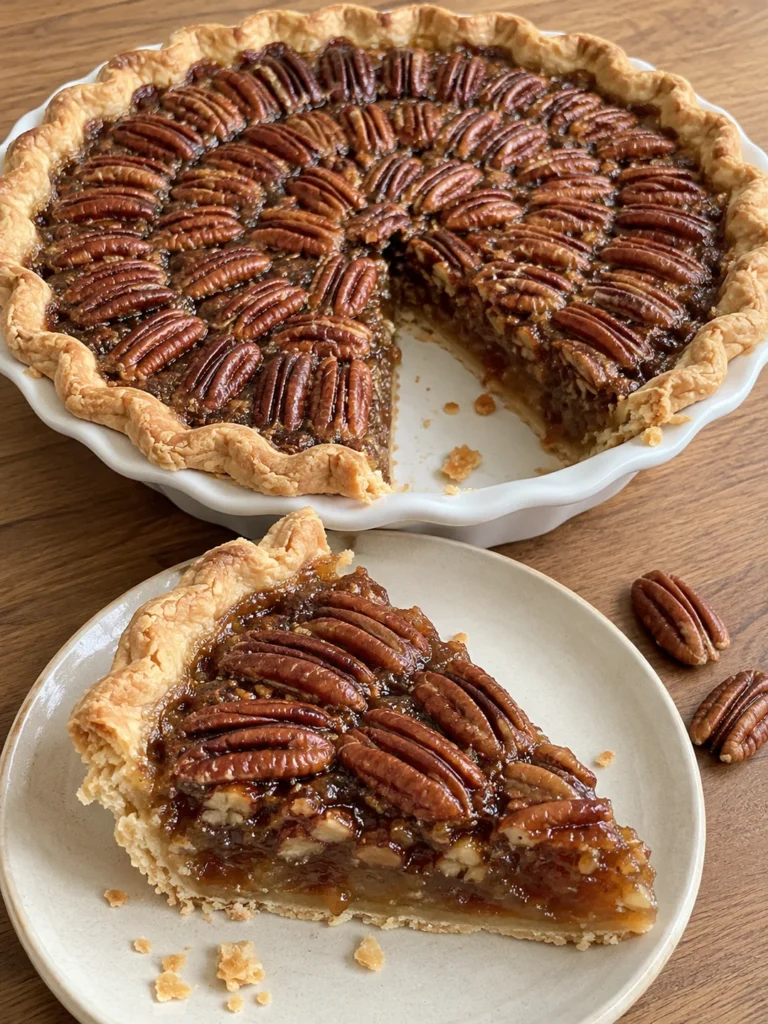
The first real Pecan Pie I ate was handed to me on a chipped saucer at a roadside lunch counter outside Slidell, Louisiana, at two in the afternoon, long after the kitchen had closed. I was the only car left in the gravel lot. The owner brought two forks and sat down across from me without asking.
Her name was Yvette. Faded Saints shirt, reading glasses pushed up into her hair, a dish towel still over one shoulder. She wanted to know where I was driving and whether I had eaten anything decent in Mississippi, and then she wanted to know what I thought of the pie.
I said it tasted like toffee more than sugar. She said that was the cane syrup, and that if I was still in town the next day I should come by the house around nine and she would show me, because explaining it was a waste of breath.
Yvette’s Kitchen, and the Pecan Pie Rules She Corrected Me On
Her kitchen was small and yellow, a window unit rattling in the frame, a formica table with a seam of silver tape along one edge. There was a transistor radio on top of the refrigerator playing something gospel and low. She had the flour already measured out when I arrived, which I took as a comment on my punctuality.
She corrected me twice. The first time was at the eggs. I had the whisk going like I was making a sponge cake and she put two fingers on my wrist and said stop, you are putting air in it, air makes it foam and split.
The second time was at the end. The pie came out puffed and glossy with the center still wobbling, and I reached for a knife. She laughed at me. Four hours, she said. Everybody who complains about a runny pie is a person who could not wait.
Cane Syrup, and Why Slidell Gets Mentioned at All
Here is the part I only pieced together later, back home, reading about it properly. Pecan pie is not the antebellum heirloom it gets sold as. Food historians have been fairly blunt about this. The syrup pie we all picture is a twentieth-century thing, and the corn syrup version went national because a 1925 recipe calling for Karo showed up in a Dallas church cookbook and Karo’s own marketing ran with it through the late twenties and thirties.
What came before that was cane syrup, sorghum, molasses, or a plain milk custard thickened with yolks. An anonymous New Orleans cookbook published in 1900 printed a version with eggs, sugar, Louisiana cane syrup, butter and pecans, and noted that a little lumber town out of Orleans seemed to be the original home of pecan pie. That lumber town was Slidell. Which I did not know while I was sitting in the gravel lot eating it.
Worth saying too that the pecan itself is native to North America and was a staple for Indigenous peoples here long before anybody wrote a recipe down. The word comes through French from the Algonquin pacane. Yvette knew that part. She said it like everyone should.
What I Used
- All-purpose flour, a teaspoon of sugar and salt for the crust
- Very cold unsalted butter, cubed, half a cup for the pastry
- Ice water, four tablespoons, maybe five
- Two cups of pecan halves, the freshest I can find
- Three large eggs at room temperature
- A cup of dark cane syrup, Steen’s if you can get it
- Light brown sugar, packed
- Four tablespoons melted butter for the filling
- Vanilla extract and a good half teaspoon of salt
Making Pecan Pie in My Own Kitchen
I order the Steen’s in the can and it lives in the cupboard next to the fish sauce, which tells you something about how my shelves are organized. The pecans I buy loose at the Sunday farmers’ market from a vendor who sells them out of a cooler and will let you taste one first. Stale pecans ruin this. They go flat and slightly like cardboard and no amount of toasting brings them back.
The pie plate is a plain glass one I bought at a swap meet for two dollars and it has never let me down. Not deep dish. Deep dish turns the filling into a pudding with a crust around it. My rolling pin has one handle that has gone loose and clicks, and I keep meaning to fix it.
Blind-baking is the step I used to skip. I was wrong. Twenty minutes in the freezer, parchment, beans to the rim, eighteen minutes at 400 F, and the shell comes out smelling like shortbread and stays crisp under all that syrup. Skip it and you get a pale damp layer at the bottom that nobody enjoys and everybody politely eats.
Then the smells stack up in order. First the pastry. Then the pecans on their own sheet for six or seven minutes, which fills the kitchen with something like warm wood. Then the filling goes in and bakes, and after about forty minutes the whole apartment smells of molasses and browned butter, which is the point at which I start opening the oven for no reason.
My first attempt at homemade pecan pie cracked straight across the middle because I had whipped the eggs out of habit. Yvette’s fingers on my wrist, forty minutes too late. The second one was fine.
Substitutes, and the Things People Get Wrong
If cane syrup is not findable, sorghum works, light molasses thinned with a couple of tablespoons of water works, and yes, light corn syrup works. Corn syrup gives you a sweeter, milder, blonder pie. Not wrong, just a different pie. I prefer the cane version because it goes faintly smoky and almost bitter at the edges and stops the whole thing from tasting like candy.
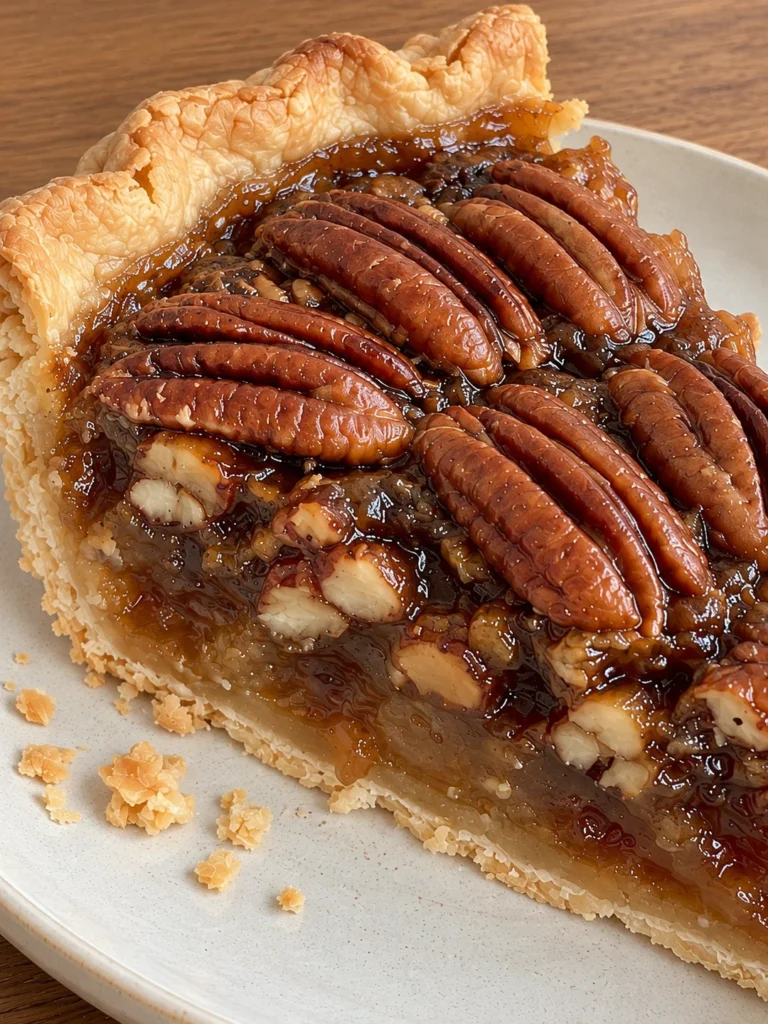
Two other things. Pecan pie is not chess pie, which is a butter and sugar custard set with cornmeal or flour and usually has milk in it. And the nuts are meant to stay whole on top as a toasted raft, not ground into a paste. No lattice, no top crust.
Doneness is a feel, not a clock. Outer two inches firm, a two inch circle in the middle wobbling like set gelatin. If it ripples like liquid, give it another eight or ten minutes and stop worrying.
Four Hours Later
I baked it on a Sunday morning in October with the kitchen window open and the air already too warm, which meant chilling the dough disc twice instead of once. Fine. The slice held its shape, the crust shattered under the knife in the right way, and I ate it standing at the counter with black coffee because the whipped cream was a step too far at nine in the morning.
I still think about that gravel lot. Yvette gave me her pie and then gave me her Saturday, and the only thing she asked was that I not cut it warm.
Pecan Pie
Ingredients
Equipment
Method
- Make the crust. Whisk the flour, 1 teaspoon sugar and 1/2 teaspoon salt in a large bowl. Add the cold cubed butter and cut it in with a pastry blender until the mixture looks like coarse gravel with some flat, flaky pieces of butter still visible, about 2 minutes. Do not work it to a powder.
- Sprinkle in 4 tablespoons ice water, one tablespoon at a time, tossing with a fork after each. Squeeze a handful of dough. If it holds together, stop. If it crumbles apart, add up to 1 more tablespoon water.
- Press the dough into a flat disc, wrap it, and chill 1 hour. It needs the rest, so do not skip it.
- Roll the chilled disc on a floured counter into a 12 inch round, about 1/8 inch thick. Lift it into the 9 inch pie plate and settle it into the corners without stretching. Trim the overhang to 1 inch, fold it under, and crimp the edge with your thumb and forefinger. Freeze the shell 20 minutes.
- Preheat the oven to 400 F. Line the frozen shell with parchment, fill it to the rim with dried beans or pie weights, and blind-bake on a rimmed baking sheet for 18 minutes. Remove the parchment and weights. The crust should look dry and pale blond. Reduce the oven to 350 F.
- While the crust bakes, spread the pecan halves on a second baking sheet and toast them in the oven for 6 to 7 minutes, until they smell nutty. Set aside.
- Make the filling. In a medium bowl, beat the eggs with a whisk just until the yolks and whites are blended and no streaks remain, about 20 seconds. Stop there. Over-beaten eggs foam and crack the top.
- Add the cane syrup, brown sugar, melted butter, vanilla and 1/2 teaspoon salt. Stir with the whisk, do not whip, until the sugar dissolves and the mixture is smooth and glossy, about 1 minute.
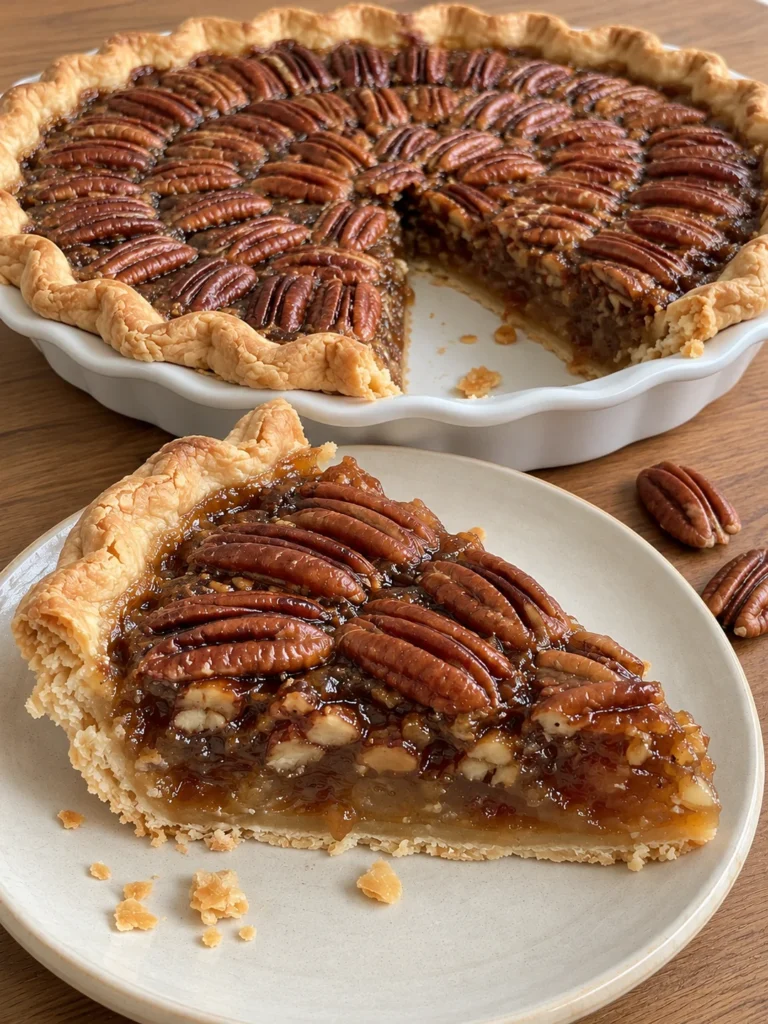
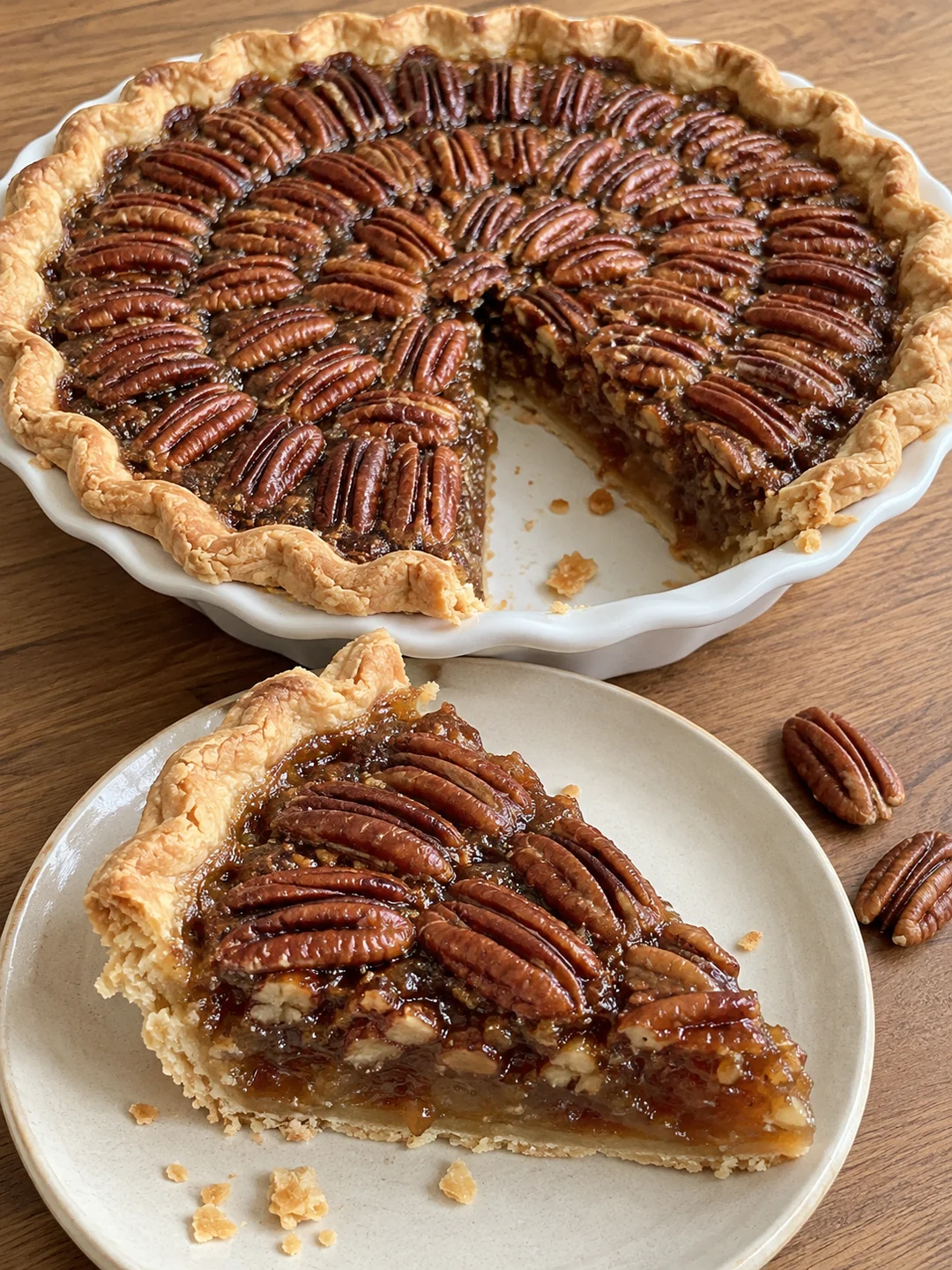
- Pour the filling into the warm blind-baked shell. Scatter the toasted pecans evenly over the surface. They will float into a single layer and toast further as the pie bakes, so there is no need to press them down. For a show top, arrange them in concentric rings, rounded side up.
- Fit a crust shield or a ring of foil over the rim. Bake at 350 F on the rimmed baking sheet for 50 to 65 minutes. Start checking at 50 minutes.
- The pie is ready when it is slightly puffed and the outer 2 inches are firm, while a 2 inch circle in the center wobbles like set gelatin when you nudge the pan. A liquid ripple means it needs another 8 to 10 minutes.
- Cool the pie on a wire rack, completely undisturbed, for at least 4 hours. The eggs finish setting as it cools, and this is the only thing standing between you and a runny slice.
- Cut with a thin sharp knife, wiping the blade between slices, and serve at room temperature.