
The first Corn Casserole I ever ate came out of a foil pan on a folding table at the Norfolk County Fair in Simcoe, Ontario, on a cold Friday night in October. A generator was humming behind the livestock barn and the whole field smelled like roasted cobs, diesel and wet straw.
I had been in town eight days by then, renting a room above a garage from a woman named Marlene who made coffee at six whether I was awake or not. She drove me out to the fair because she said I would not understand the place otherwise.
The Night I Tasted Corn Casserole in Simcoe
The line for the church supper tent moved slowly, mostly because everybody in it knew everybody else. Marlene pointed at a tray going past and told the woman serving to give me the corner piece, the one with the darkest top.
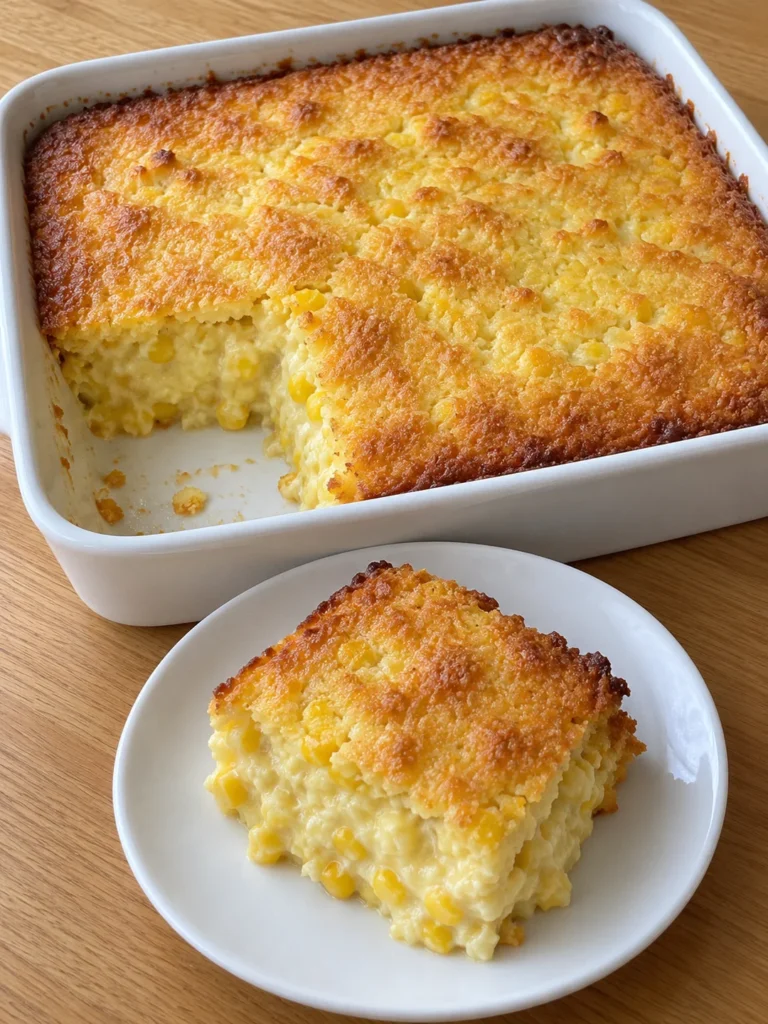
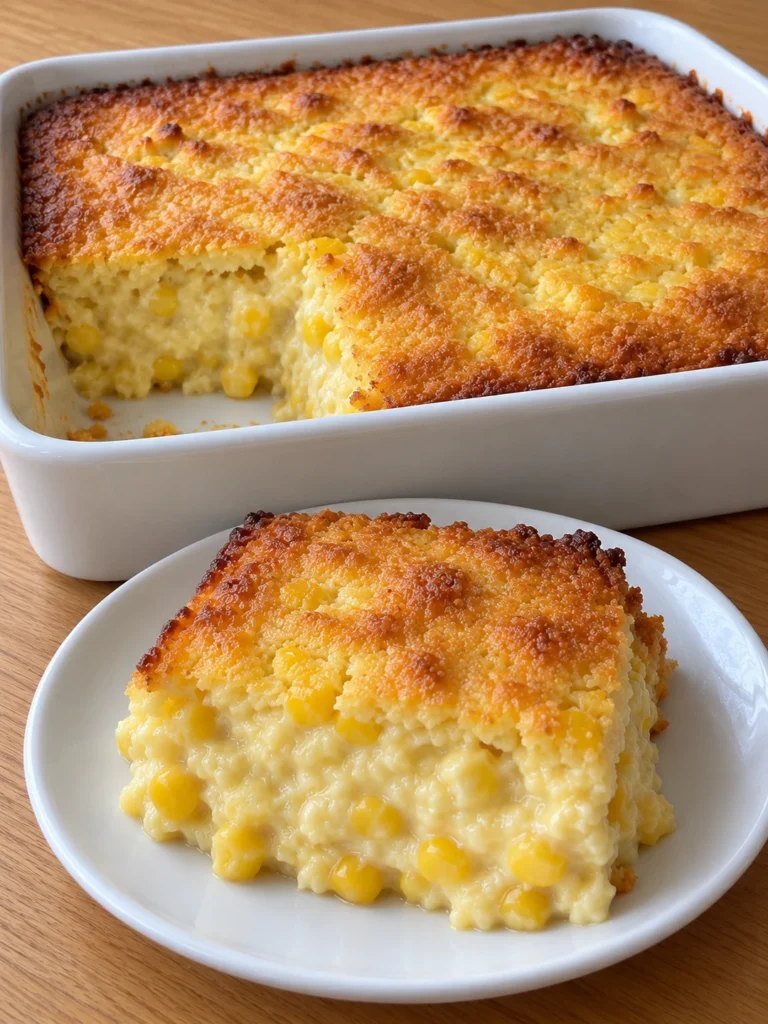
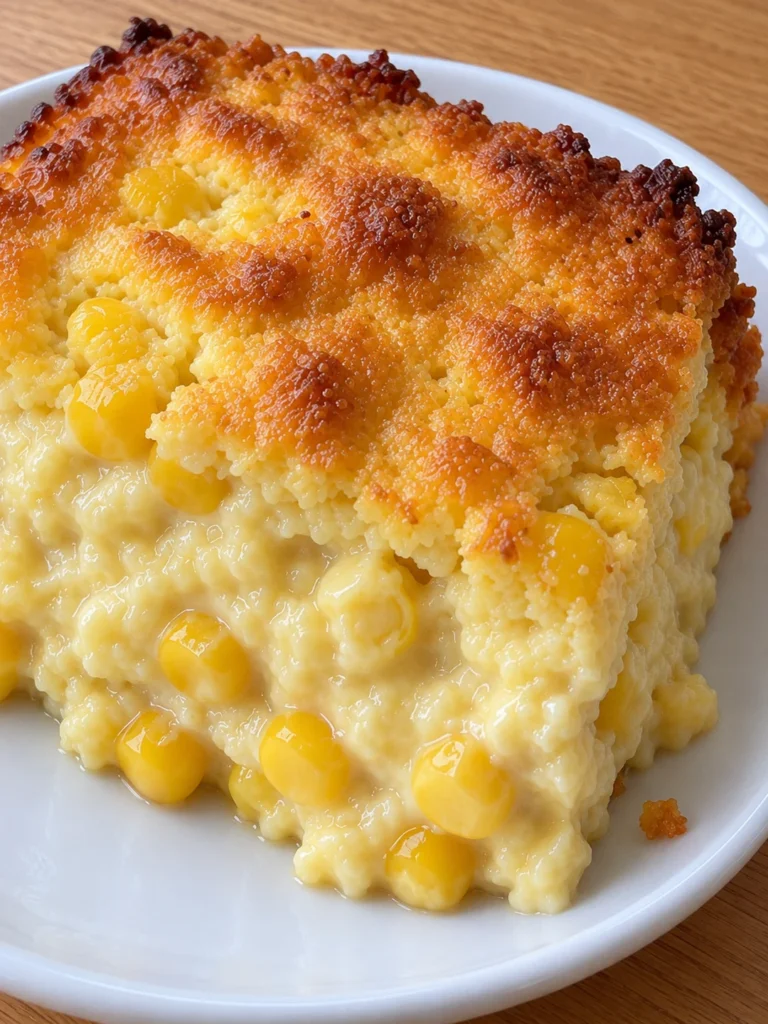
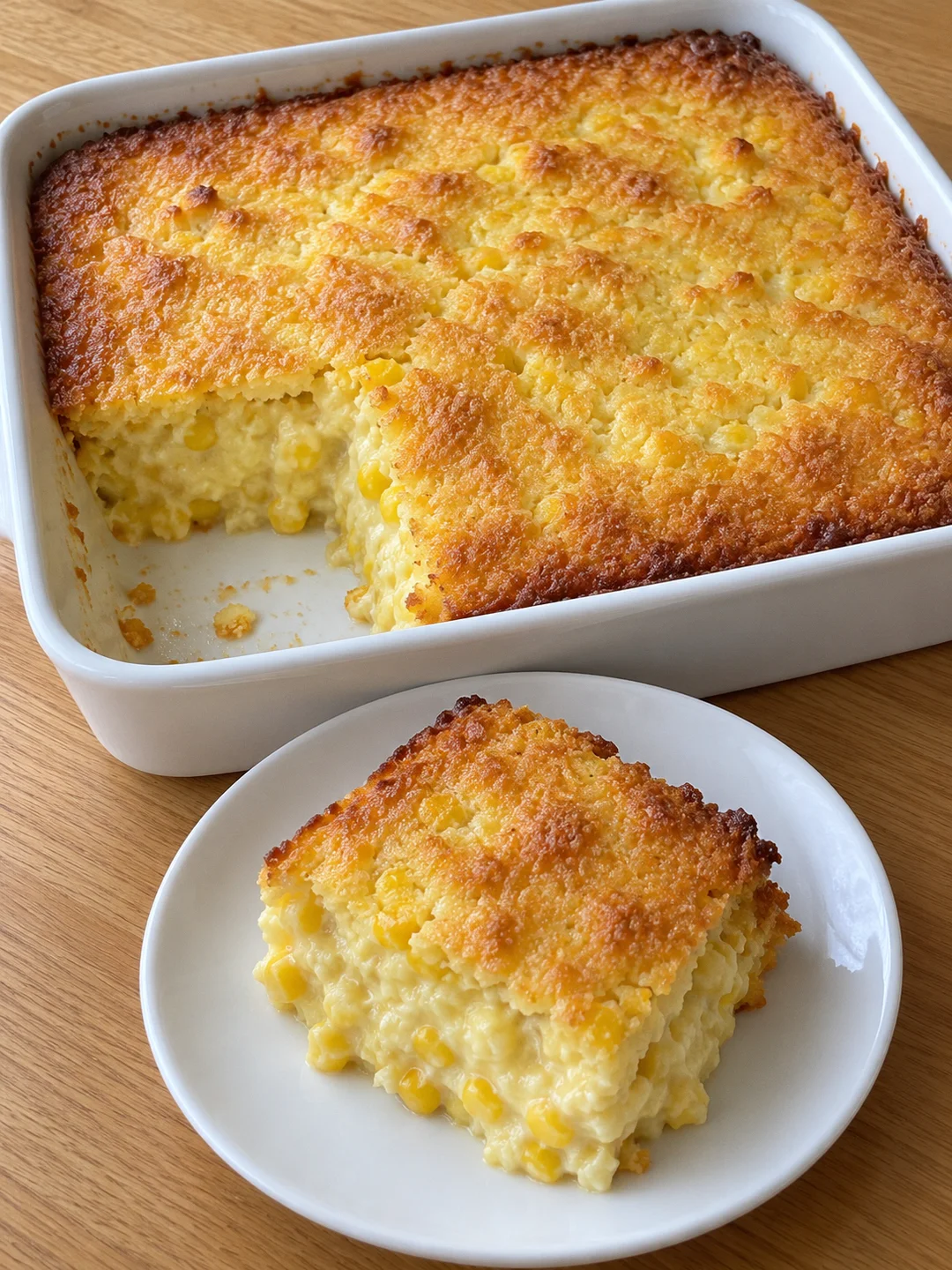
It was not what I expected. Soft and spoonable in the middle, almost custardy, with whole kernels giving way under the spoon and a golden lid on top that had gone slightly crisp at the edges of the pan.
I asked three questions about it before I finished eating. Marlene laughed and said it was the easiest thing on the table.
The next morning she wrote it out for me at her kitchen table on a paper napkin, in pen, pressing hard. Butter stain on one corner, a ring where her mug had sat. I still have it in the pocket of a notebook, and the ink has gone purple-brown where the grease soaked through.
What the Napkin Did Not Explain
Marlene’s note said nothing about where the dish came from, so I went looking later. The oldest ancestor of this bake belongs to Indigenous corn cookery, where fresh sweet corn was grated off the cob and simmered with its own starchy milk and a little water until it thickened on its own.
European settlers enriched that base with eggs, milk and butter, and what came out were the corn puddings and spoonbreads that fed rural households across the South and Appalachia through the 1800s and early 1900s. The Midwest ran a parallel version and called it scalloped corn.
The one most Americans picture now, with two kinds of canned corn and a box of corn muffin mix, is much younger. It circulated in the 1960s as a Corn Bowl recipe printed on tear-off sheets sitting beside the muffin mix in grocery stores, got renamed Spoonbread when the company published its first recipe book in 1976, and spread the rest of the way through church cookbooks, potlucks and handwritten cards exactly like Marlene’s.
Two things worth clearing up. A creamed corn casserole like this one is not corn pudding, which is looser, eggier and uses no muffin mix at all, and it is not cornbread baked in a bigger dish, because the volume of cream-style corn, sour cream and butter makes the batter far wetter than any cornbread batter has a right to be.
And despite tasting sweet, it goes next to the gravy. Never after it.
What I Used
- 8 tablespoons unsalted butter, melted and cooled a little, plus more for the dish
- 2 large eggs, lightly beaten
- 1 cup full fat sour cream, nothing lighter, it weeps
- 1 can cream-style corn, about 14.75 oz, undrained
- 1 can whole-kernel corn, about 15.25 oz, drained hard in a colander
- 1 box corn muffin mix, 8.5 oz, the Jiffy one if your market stocks it
- 2 tablespoons granulated sugar, optional, and I usually leave it out
- 3/4 teaspoon salt
- 1/4 teaspoon black pepper, ground fresh
Canned corn is not a shortcut here, by the way. Cream-style corn is structural. It carries both the sweetness and the loose, custardy body, and fresh kernels alone will give you something drier and less interesting.
What Happens Inside the Corn Casserole
I butter a glass 9×13 dish that has a small chip on one corner from a move years ago, and I get into the corners with my fingers because that is where it sticks. Then the drained kernels sit in the colander for five minutes while I whisk, dripping away water that would otherwise thin the custard.
Melted butter, eggs and sour cream whisked together go slack and pale, like loose pancake batter. Salt and pepper in. Then both cans of corn, folded, not stirred, so the kernels stay whole rather than bursting into starch.
The muffin mix goes over the top in a layer and gets folded in with twelve to fifteen strokes, no more. The batter will look lumpy and wet and vaguely wrong. That is correct. The first time I made this I whisked it smooth because my hands wanted to, and what came out of the oven was bready and dry, closer to a sad cake than to the thing I ate in that tent.
In the oven at 350 F the egg and dairy set slowly from the outside in while the cornmeal swells and drinks up the corn liquid. The edges firm first and pull a millimetre back from the glass. The top browns and tightens into that lid, and somewhere around forty-five minutes the middle stops wobbling when you nudge the dish.
Then it rests ten minutes on a rack and keeps thickening while it cools. Skip that and it slumps on the spoon.
Twists, and How It Travels
I always skip the sugar. Except at Thanksgiving, when I put in the full two tablespoons because the people at my table grew up with the sweeter Midwestern style and notice immediately when it is missing.
A cup of sharp cheddar and one seeded diced jalapeno turns it into something closer to street corn, which I have made twice and liked both times. You can also assemble the whole thing a day ahead, keep it unbaked in the fridge and add eight to ten minutes in the oven, which is the only reason I ever manage to cook anything else on a holiday.
If the top comes out pale, ninety seconds under the broiler fixes it. Watch it the whole time, it goes from gold to black fast.
Leftovers keep four days and reheat covered at 325 F for twenty minutes. Though mostly I eat them cold, standing at the counter, straight out of the dish with the serving spoon.
It does not taste exactly like the fair, and it never will. No generator noise, no barn smell, no stranger insisting I take the corner piece. But the napkin still works, and for ten minutes while it rests on the rack and the rain comes down, I am back in Simcoe.
Corn Casserole
Ingredients
Equipment
Method
- Preheat the oven to 350 F. Butter a 9x13 inch baking dish generously, including the corners.
- Drain the whole-kernel corn in a colander and shake it well. Let it sit while you mix the wet ingredients so excess liquid drips away, about 5 minutes.
- In a large bowl, whisk the melted butter, beaten eggs and sour cream until smooth and uniform, about 30 seconds. The mixture should look like loose pancake batter.
- Whisk in the salt, pepper and sugar if using.
- Add the cream-style corn and the drained whole-kernel corn. Fold with a rubber spatula just until the corn is evenly distributed.
- Sprinkle the corn muffin mix over the surface and fold it in with no more than 12 to 15 strokes, stopping the moment you no longer see dry mix. The batter will look lumpy and wet, and that is exactly right. Overmixing makes the finished casserole tough and bready.
- Scrape the batter into the prepared dish and smooth the top lightly. Do not pack it down.
- Bake uncovered on the center rack for 42 to 50 minutes, until the top is deep golden, the edges have pulled slightly from the sides, and the center no longer wobbles when you nudge the dish. A knife slipped into the middle should come out with moist crumbs, not wet batter.
- If the top is still pale at the 45 minute mark but the center is set, move the dish to the upper rack for 3 to 5 more minutes.
- Let the casserole rest on a rack for 10 minutes before serving. It firms up as it cools and scoops cleanly with a large spoon. Serve warm.