
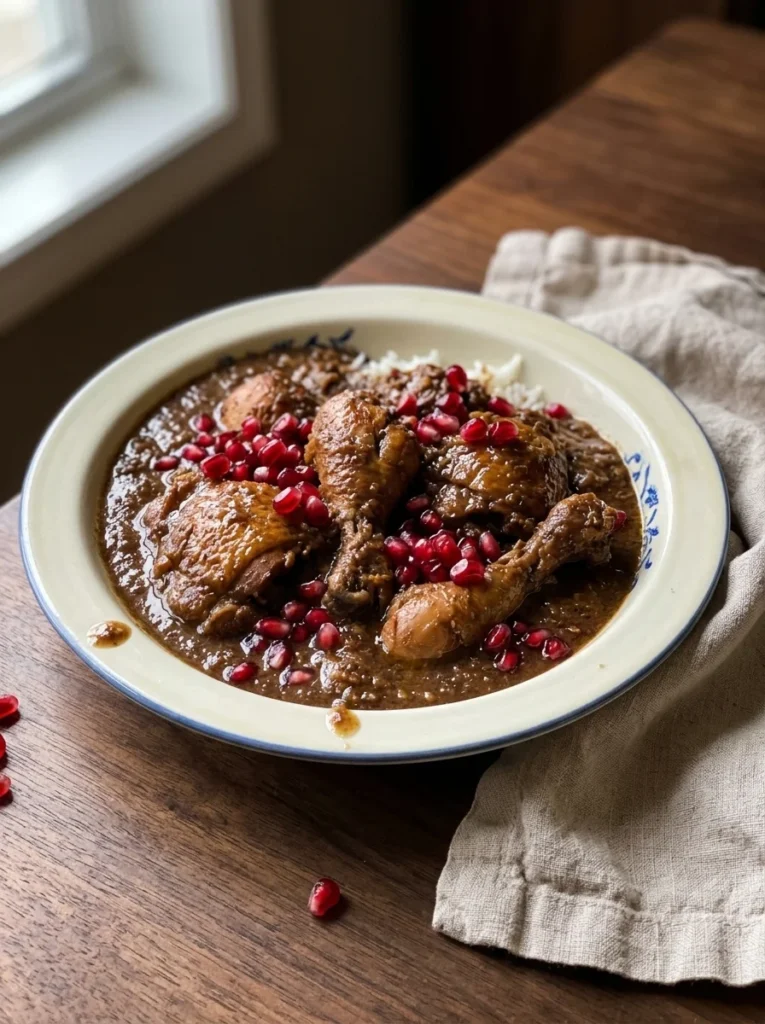
Persian Fesenjan found me on a wet October evening in Rasht, at a chalkboard stall tucked behind the covered bazaar where a man named Bahman ladled it out of a battered aluminum pot. The price was written in blue chalk. The queue was six people long and nobody spoke.
The Stall Behind Rasht Bazaar
I was in Gilan for the Rice Harvest week, dragged along by a friend-of-a-friend whose aunt was hosting a family dinner two nights later. Bahman worked from a folding table with one burner and a lidded pot the color of a dented moon. He served the stew over rice in a paper bowl, no garnish, no ceremony. Just a plastic spoon and a wedge of raw onion on the side.
I remember the smell before the taste. Toasted walnut oil, sour fruit, something almost smoky. I paid the equivalent of a dollar fifty. I stood under the awning while the rain came down harder.
The first spoonful was not what I expected. I had read somewhere in an in-flight magazine that fesenjan was sweet. It was not sweet. It was sour first, deep and puckering, and the sweetness only arrived at the back of the tongue as a correction. Bahman watched me eat, laughed, and said something I did not catch. His son translated. “He says the tourists always look surprised.”
What Bahman Told Me About Fesenjan
Between customers he told me, through his son, that the stew is Gilaki and old. Older than most things people eat. He mentioned Persepolis and stone tablets, waved his hand at the walnut trees you can see from the edge of town, and said his grandmother used wild duck from the Caspian marshes because that is what people had. Chicken is a modern shortcut, he said, not unkindly. Duck is the real bird.
He was right about the age. The dish traces back to the Sassanid era, and a 19th century Qajar cookbook called Sofra-ye At’ema records ten different varieties of it. In Gilan it is a celebration dish, made for weddings, for Nowruz, and above all for Shab-e Yalda, the winter solstice, when pomegranates carry their own quiet ritual weight.
The other thing Bahman insisted on, twice, was the pomegranate molasses. Thick, unsweetened rob-e anar. Not grenadine. Never grenadine. He mimed pouring something thin and shook his head like a man who has fought this battle before.
Bringing Persian Fesenjan Home to My Kitchen
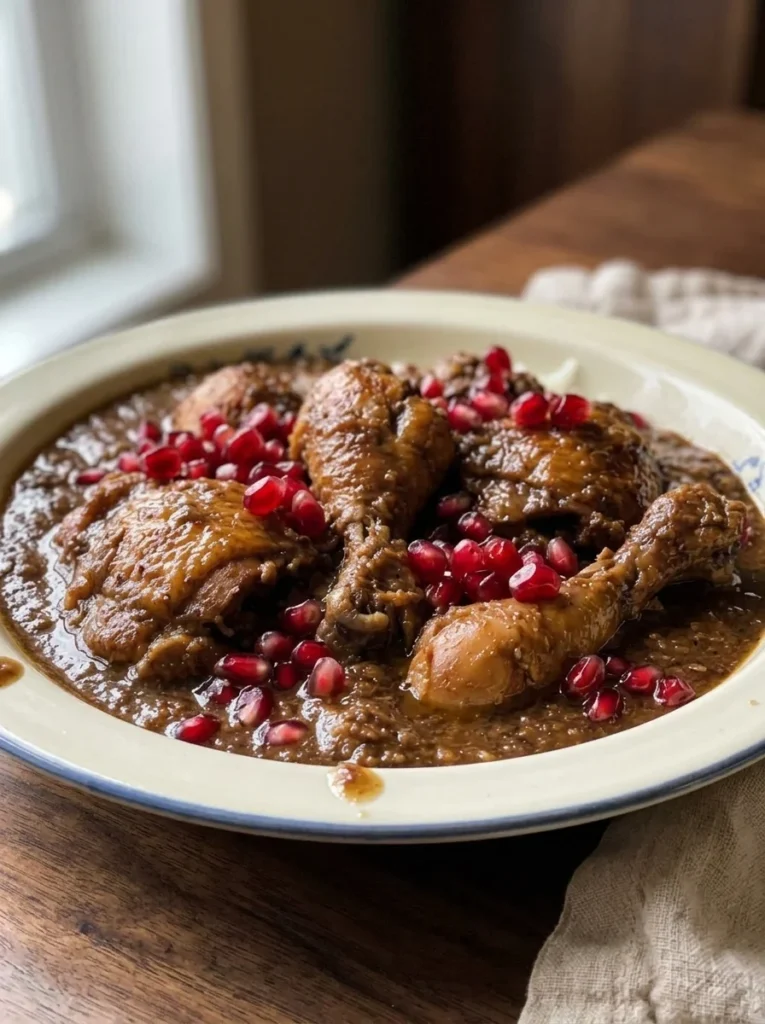
Two nights later I ate it again at the aunt’s dinner during a small neighborhood festival, from a proper serving dish this time, with saffron rice and a bowl of mast-o-khiar. That was the version I brought home in my head. Deeper, glossier, the walnut oil pooling on top like a slick of amber.
Back in my apartment kitchen I had to figure out the sourcing. Pomegranate molasses I get from the small Persian grocery in Westwood, the one where the owner writes the price on masking tape stuck to the shelf. Fresh walnuts I buy in November from a stand at the Sunday farmers’ market on 3rd Street. Rancid walnuts will ruin the whole pot. I learned that the hard way the first time I tried this, when I used a bag that had been in the pantry since spring and the sauce came out flat and slightly bitter. I threw the whole thing out and started over the next weekend.
I make it in the cast iron Dutch oven my mum gave me, lid slightly chipped on one side, the enamel gone a little dark at the base from years of tomato sauces. It is the only pot deep enough for the four cups of liquid the walnuts need to swell into.
What I Used
- 1 lb shelled raw walnut halves, fresh and never rancid
- 3.5 lb bone-in skin-on chicken thighs and drumsticks, or one 4 lb duck cut into 8 pieces for the traditional Gilani version
- 2 large yellow onions, thinly sliced
- 3 tbsp neutral cooking oil, divided
- 1 tsp ground turmeric
- 0.75 cup thick unsweetened pomegranate molasses, plus more to taste
- 4 cups water or low sodium chicken stock
- 1 tbsp granulated sugar, plus more to balance sourness
- 0.5 tsp saffron threads, ground and bloomed in 2 tbsp hot water
- 1.5 tsp fine sea salt
- 0.5 tsp freshly ground black pepper
- 0.5 cup fresh pomegranate arils for garnish
The Patience Part
This dish punishes impatience in three specific places, and I have failed at all three at least once.
First, toasting the ground walnuts dry in the pot. You want them to go from pale beige to a warm golden brown over 8 to 10 minutes, stirring almost the whole time. Turn your back and they scorch. Scorched walnuts taste like burnt coffee and there is no coming back from it.
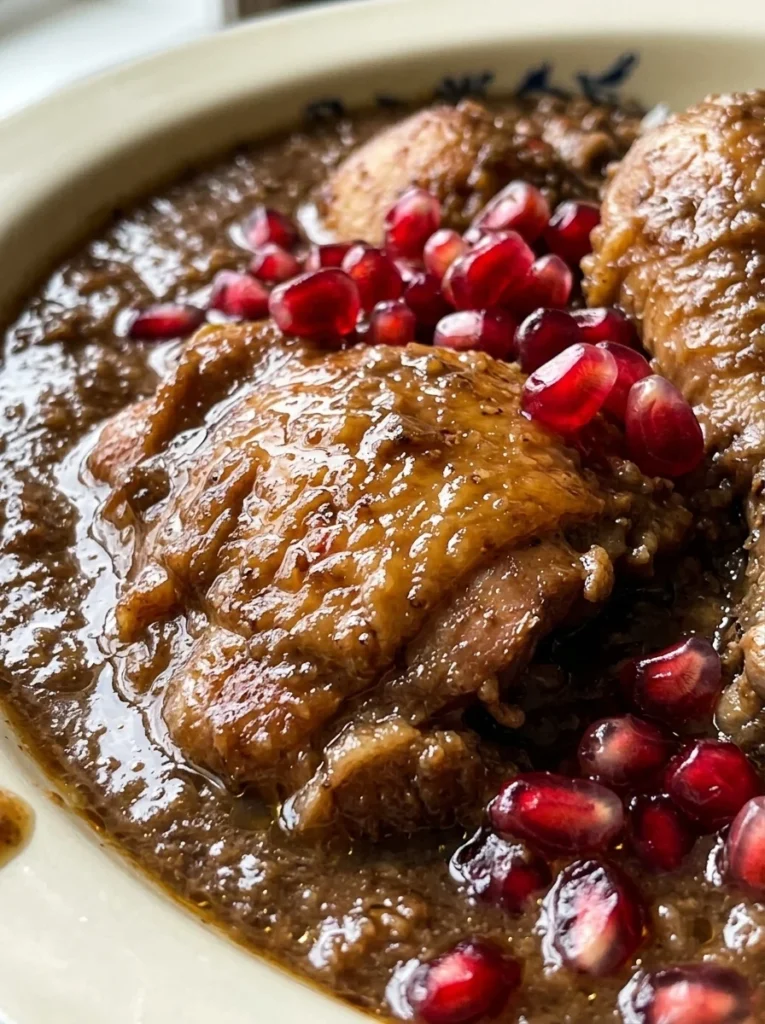
Second, the long simmer. Two to two and a half hours, on the lowest heat your stove will hold, stirring every 20 minutes so the walnuts do not stick. The sauce moves through ugly stages. Muddy tan, then greyish, then finally, around the ninety minute mark, it starts to turn the deep chocolate brown Bahman’s pot had. The color comes from long cooked walnut oil and reduced pomegranate molasses. Not chocolate. Not cocoa. Just time.
Third, the balancing. Taste after an hour. If it is sharply sour, add sugar a teaspoon at a time. If it feels flat or too sweet, another spoonful of pomegranate molasses. It should read sour first and then round out. Not the other way around.
Duck, Chicken, and the Day-After Rule
I use chicken thighs about eight times out of ten. When I have a proper reason to fuss, and once around Yalda when a Persian friend was coming over, I do the duck. The duck is better. It is also more work and more money and the skin renders extra fat that you have to skim, and on a rainy Tuesday I am not doing all that. Chicken with the skin on gets you most of the way there.
Cook it a day ahead if you can. The color deepens overnight in the fridge, the flavors settle, and when you reheat it gently the walnut oil rises again and you stir it back in. Cold leftovers, eaten standing up at the counter. Better than the first night, honestly.
Serve it over chelo with a piece of golden tahdig if you can manage one. I usually cannot. I try anyway.
I made this again last Sunday, rain on the skylight, Nick Drake on low, and I thought about Bahman’s chalkboard and the paper bowl and the wedge of onion. Six people in the queue and nobody spoke because the stew did the talking. That is the thing about cooking a dish you first ate somewhere else. You are always half back there.
Persian Fesenjan
Ingredients
Equipment
Method
- Grind the walnuts in a food processor in short pulses until they look like damp, fine sand. Stop before they turn into paste. You want an even, sandy texture with no big chunks.
- Set a heavy Dutch oven over medium-low heat, add the ground walnuts dry, and toast them slowly for 8 to 10 minutes, stirring almost constantly with a wooden spoon. They will deepen from pale beige to a warm golden brown and their oil will start to bead at the surface. Do not let them scorch.
- Pour 4 cups of water or stock into the walnuts, stir well to break up any clumps, bring to a gentle simmer, then lower the heat, cover, and let it cook quietly while you handle the rest.
- In a large skillet, warm 2 tbsp of oil over medium heat. Add the sliced onions with a pinch of salt and cook for 12 to 15 minutes, stirring often, until soft and lightly golden. Add the turmeric and stir for 30 seconds until fragrant.
- Push the onions to one side, add the remaining 1 tbsp oil, and lay the chicken pieces (or duck) skin side down in the skillet. Brown for 4 to 5 minutes per side until the skin is deep golden. Season with 1 tsp salt and the black pepper.
- Transfer the onions and browned poultry to the walnut pot. Add the pomegranate molasses and 1 tbsp sugar. Stir gently, making sure the poultry is mostly submerged. Return to a bare simmer.
- Partially cover the pot and cook over the lowest possible heat for 2 to 2.5 hours (up to 3 hours for duck), stirring every 20 to 30 minutes so the walnuts do not stick or scorch on the bottom. The sauce will slowly turn from muddy tan to a deep chocolate brown and a slick of walnut oil will rise to the surface.
- After the first hour, taste the sauce. If it is sharply sour, add sugar 1 tsp at a time. If it is flat or too sweet, add another spoonful of pomegranate molasses. The finished flavor should read sour first, then rounded by a whisper of sweetness.
- Stir in the bloomed saffron along with its yellow soaking liquid in the last 15 minutes of cooking. Adjust salt to taste.
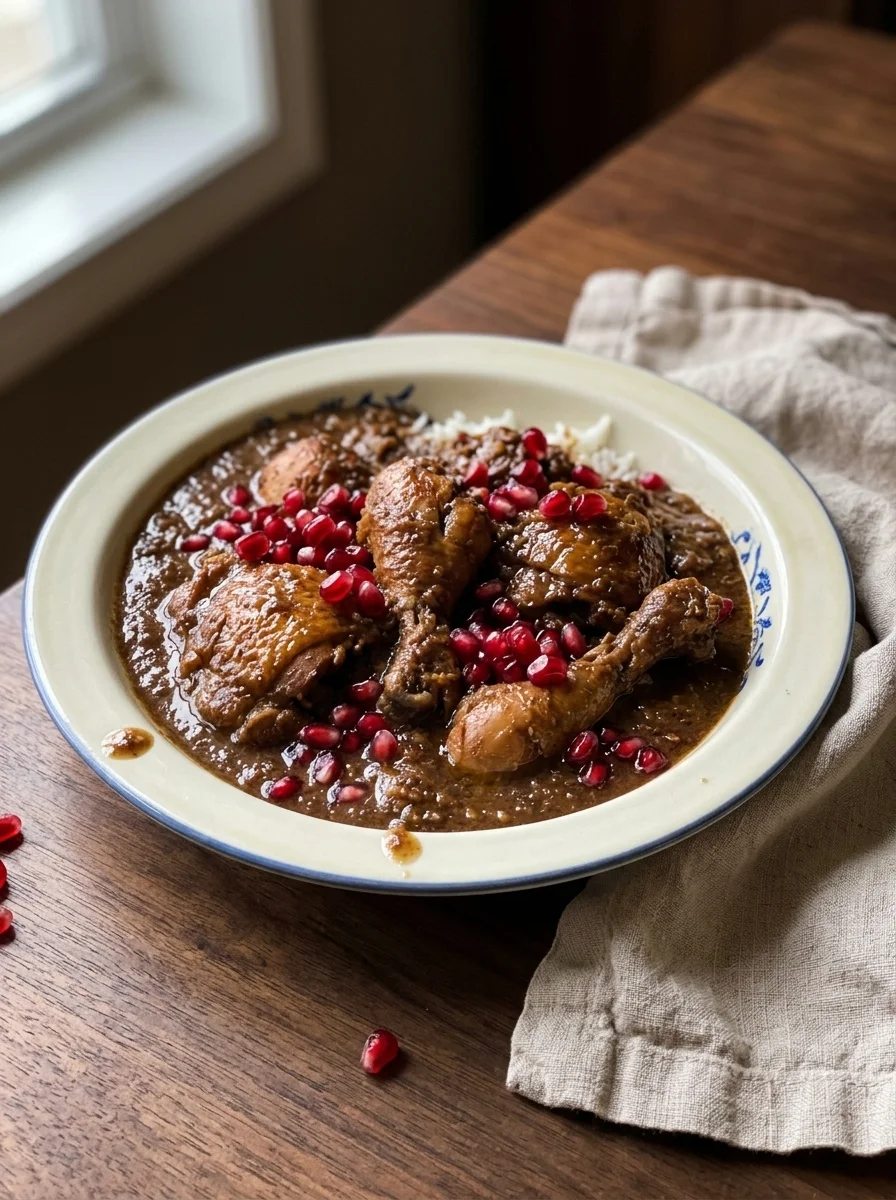
- The stew is ready when the sauce is thick enough to coat the back of a spoon, glossy with visible walnut oil, and the poultry is falling from the bone. Let it rest off the heat for 10 minutes, then scatter fresh pomegranate arils over the top just before serving.