
Membrillo, for me, arrived off a butcher’s block. Rafa was trimming a lomo for the woman ahead of me at a stall in the Mercado Victoria in Córdoba, explaining the cut to her slowly, where to salt it, how long to let it rest before she sliced it.
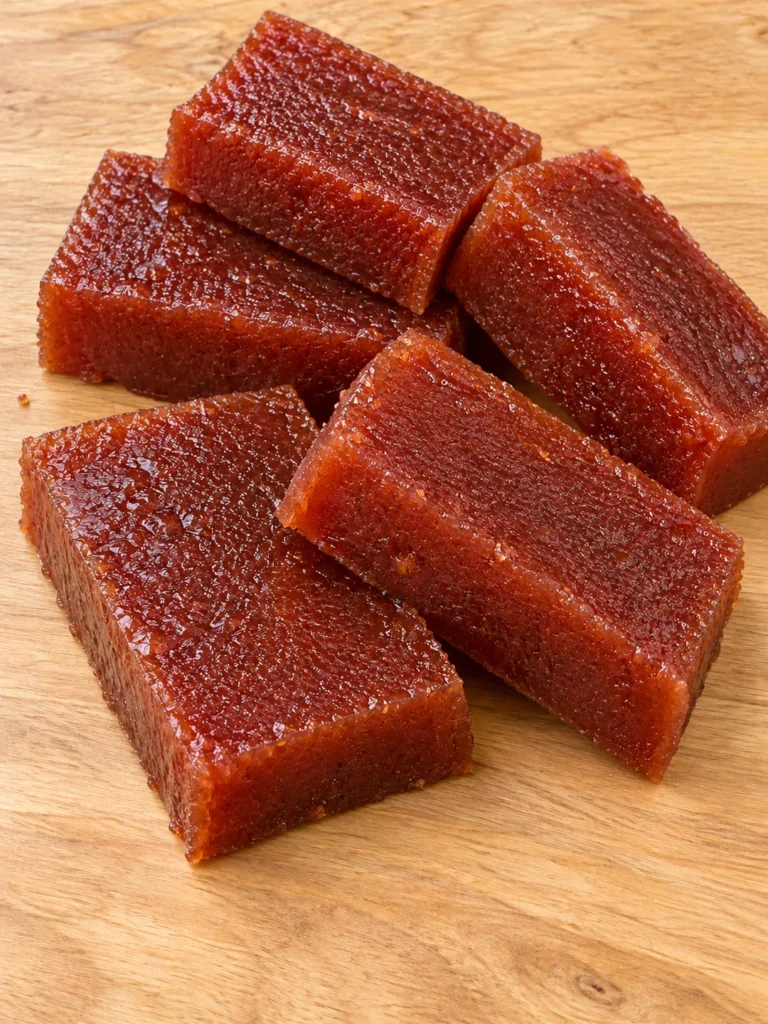
When she left he kept talking, this time at me, mostly with his hands. He pointed at a brick-red slab sitting under the glass beside the cheese, shaved off a sliver with the same knife he had just used on the pork, balanced it on a thin piece of Manchego and passed it over the counter.
Two euros something, chalked on a little board propped against the scale. I ate it standing in the aisle.
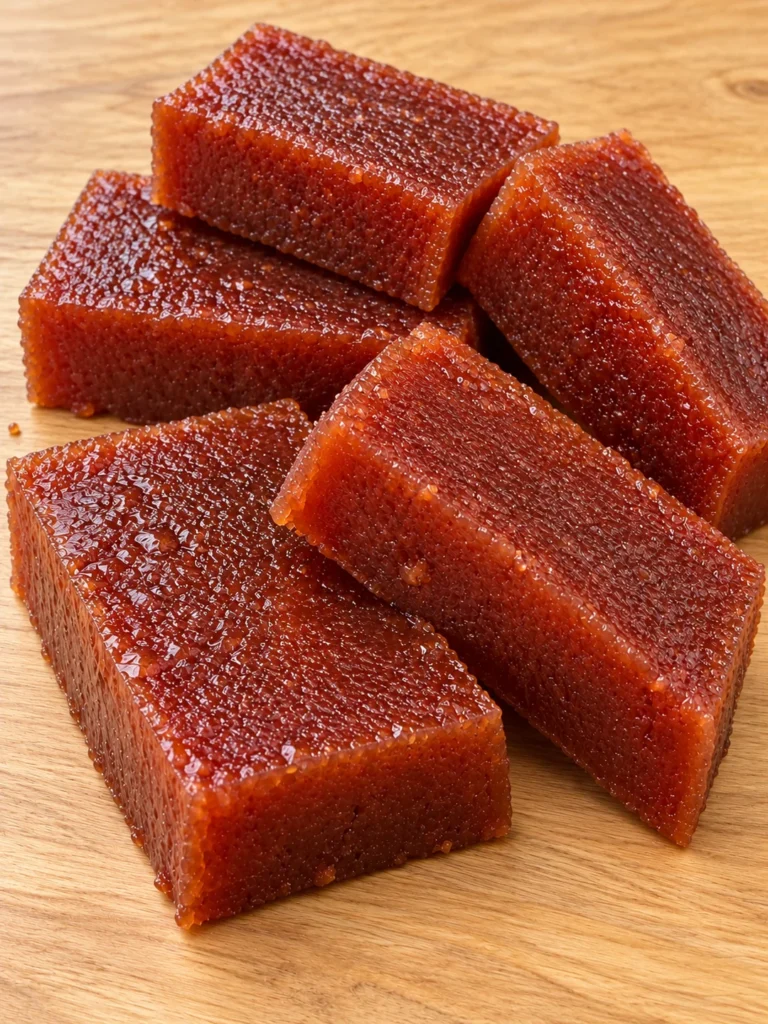
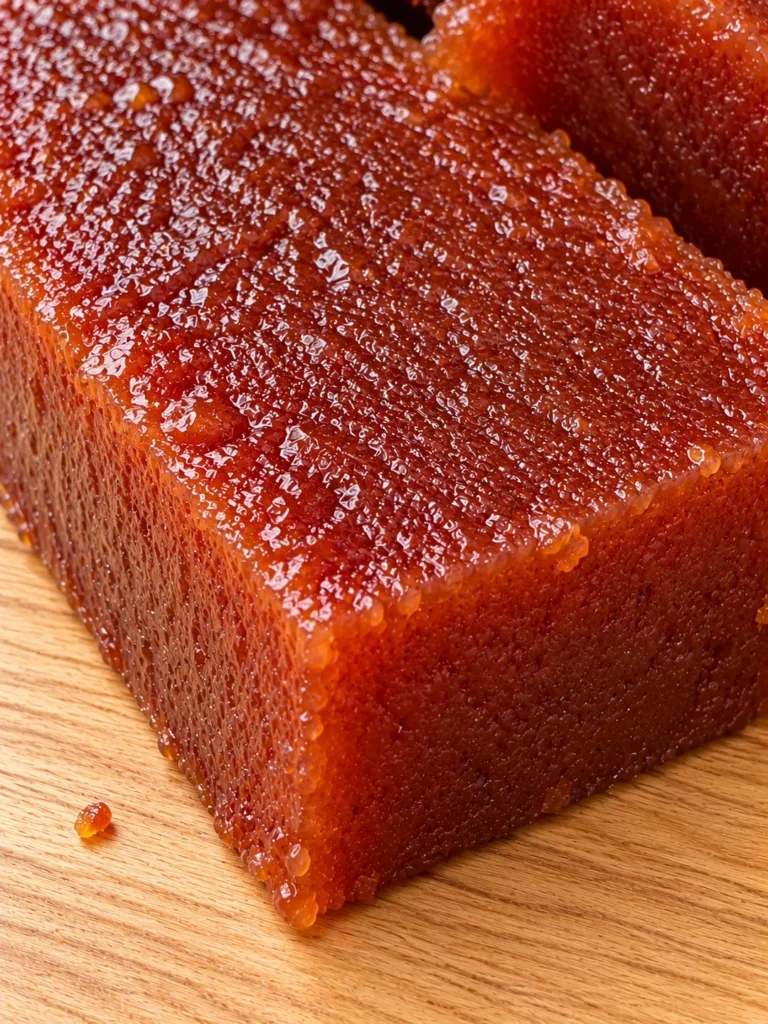
It was not jam. That was the first surprise. It held its shape between my fingers, firm as a caramel, and tasted like an apple that had been left out in the rain and then rescued by something floral. The salt of the sheep’s cheese went into it and came back out sweeter.
What Rafa Told Me While I Waited
He kept his own in a shallow earthenware dish behind the counter, covered with a square of paper, and he said the same thing three times in three ways so I would get it. Yellow fruit only. Never green.
His quinces came in during October and November and the whole lot got cooked at once, because quince is useless raw and rots fast. Whatever the family did not eat went out to neighbours in wrapped bricks, and the rest waited for Christmas, when it would come out next to the cheese again.
I asked him what he put in it. Quince, sugar, lemon. He looked almost offended that I had asked.
Membrillo Is Not a Cheese and Not a Jam
I went home and read about it for weeks, which is what I do when something gets under my skin. Quince is native to Asia Minor and the Caucasus and has been cultivated for roughly four thousand years, and the Greeks and Romans carried it into the Iberian Peninsula, cooking it down with honey because nobody could chew it otherwise. Apicius has quince preserves in it by the fourth or fifth century.
Sugar replaced the honey after cane arrived in al-Andalus, and the paste settled in as the standard way to get an autumn harvest through winter. Puente Genil, in Córdoba province, became the industrial capital of membrillo in the late 1800s and still leads the world in making it, which felt like a nice coincidence given where I first tasted it.
Two things worth clearing up. People call it quince cheese and the Spanish call it carne de membrillo, but there is no dairy and no meat anywhere near it, the names just describe the firm sliceable block. And it is not quince jelly with a different label, it is cooked far longer and far drier, until it stops being spreadable altogether.
The Portuguese version, marmelada, from marmelo, is where the English word marmalade comes from. I think about that every time I cut a slice.
What I Used
- Four pounds of ripe yellow quinces, deeply fragrant, no green on them anywhere
- Eight cups of water, enough to cover the whole fruit
- Four cups of white granulated sugar, which came out at 80 percent of my purée weight
- Three tablespoons of lemon juice, squeezed right then, not the bottled stuff
- A teaspoon of neutral oil for the dish
- Manchego for later, plus walnuts and a loaf for toasting
I find the quinces at the Wednesday farmers’ market, usually at the back of one stall in a crate nobody is looking in, hard and fuzzy and grey. The first year I got excited too early in the season and bought pale green ones. That batch never set. It sat on the counter for four days as a sad amber sludge and I threw it out, which is the single most common reason membrillo fails and I managed it on my first try.
Two and a Half Hours at the Stove
You poach them whole and unpeeled, cores and pips and all, and this is the part that matters most. The pectin lives in the cores and skins, so if you peel and core first you have thrown away the thing that makes it set. No commercial pectin. The lemon juice wakes up what is already there.
After they poach soft the skins come away under your thumb and the flesh goes through a food mill. I own a food processor and I have used it for this, but the mill gives a smoother pulp and I prefer it, so the mill wins even though it means washing a second thing.
Then it is just you and a pot. I use my Dutch oven, the one with the chipped lid I do not bother putting on, and a long wooden spoon that has gone permanently orange at the tip from exactly this job. Low heat, almost constant stirring, corners scraped.
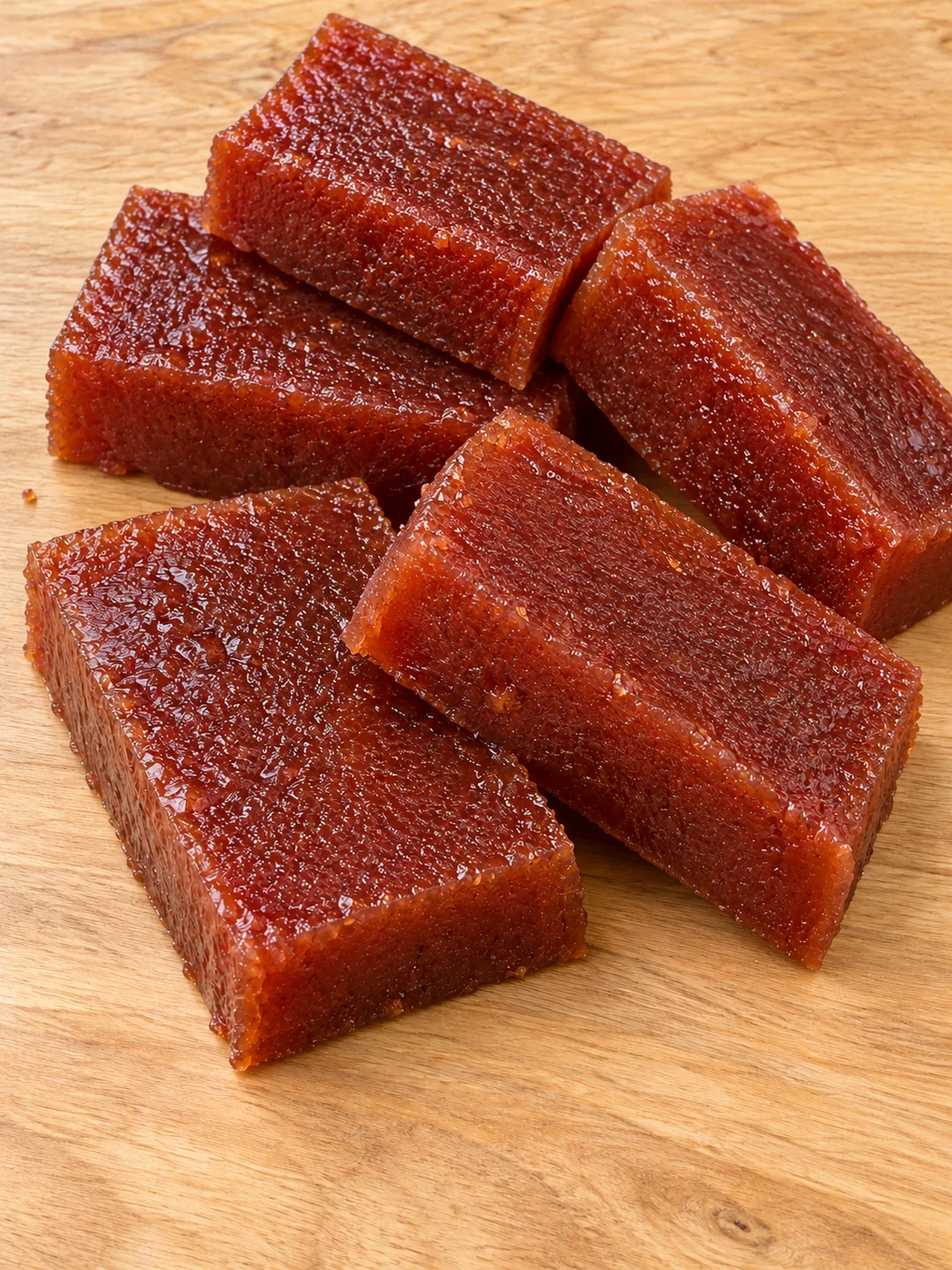
Sunday morning is when I make it, before anyone in the building is awake. The light comes across the wooden table around nine and the whole apartment smells like a cross between apple and roses, and somewhere in the second hour the paste stops being pale gold and goes amber and then that brick red Rafa had under his glass. No colouring. Just long slow cooking turning the fruit’s own tannins.
It spits near the end. Keep your hand back and use the long spoon, not the little one. I had Chet Baker on the first time it actually worked, and then nothing, because I forgot to restart the record and did not notice for forty minutes.
It is done when you drag the spoon along the bottom and the channel stays open for a few seconds instead of flooding back. Into an oiled eight inch dish, levelled with a wet spoon, parchment laid straight on the surface. Then you leave it on the counter for two or three days, uncovered by the fridge, which feels wrong and is correct.
How I Eat It in My Own Kitchen
I did not set out to make a homemade Spanish quince paste for a cheese board, but that is where most of it ends up anyway, in slices next to Manchego with walnuts and toast. Blue cheese works. Fresh goat’s cheese works better than I expected.
Diced into a green salad with something salty, it earns its place. In Spain it turns up at breakfast and as a tapa and alongside cured meats, so treating it only as dessert sells it short.
If you stop the cooking earlier you get a pale gold paste that is softer and more perfumed, less of the deep ruby brick. I like both, though the long version keeps better. Wrapped in parchment and then foil it holds three months in the fridge and a year in the freezer, only getting denser.
I miss that market, and cutting into a block I made myself is not the same as having Rafa hand me a sliver on the end of a knife. It is close enough to keep me making it every October. Mostly I eat it cold, standing up at the counter, which is how I ate the first piece anyway.
Membrillo
Ingredients
Equipment
Method
- Rub the grey fuzz off each quince with a rough cloth or paper towel, then wash the fruit well. Leave them whole and unpeeled with cores and seeds intact. That is your pectin supply.
- Put the whole quinces in a large deep pot, cover with about 8 cups water, and bring to a simmer. Cook uncovered at a low simmer for 40 to 50 minutes, turning the fruit occasionally, until a skewer slides into the thickest part with no resistance.
- Lift the quinces out and let them cool until you can handle them, about 20 minutes. Reserve 1/2 cup of the poaching liquid.
- Peel the quinces with your fingers or a small knife, then quarter them and cut out the cores and seeds. Work over a bowl to catch the juice.
- Pass the flesh through a food mill, or purée it in a food processor until completely smooth. Scrape it into a bowl and weigh it. For 4 lb of whole fruit you should have roughly 2 lb 3 oz of purée.
- Weigh out sugar equal to 80 percent of your purée weight, which is about 4 cups for the yield above. Combine the purée, sugar and lemon juice in a heavy-bottomed Dutch oven and stir until the sugar is wet throughout.
- Cook over low heat, stirring almost constantly with a long wooden spoon and scraping the corners of the pot. The mixture will loosen and go glossy for the first 15 minutes as the sugar dissolves. If it is very stiff at the start, stir in a splash of the reserved poaching liquid.
- Keep cooking and stirring for 60 to 90 minutes total. The paste will thicken, darken from pale gold to amber and finally to a deep brick red, and it will spit as it reduces, so use a long spoon and keep your hand away from the surface.
- Test for doneness: drag the spoon across the bottom of the pot. The channel should stay open for a few seconds without flooding back, and the mass should pull away from the sides in one piece. A spoonful dropped on a cold plate should hold its shape and not weep.
- Brush the 8x8 inch dish lightly with neutral oil. Scrape in the hot paste and level the top with a wet offset spatula or the back of a spoon, pressing out any air pockets. The layer should be about 1 inch deep.
- Cool at room temperature for 2 hours, then lay parchment directly on the surface and leave the dish on the counter for 2 to 3 days to firm up. Do not refrigerate it during this stage.
- Run a knife around the edge and turn the block out onto a board. It should release in one firm slab. Cut into slices or small squares with a dry knife and serve.