
Lebanese Muhammara is the reason I stopped pretending I could skip the mezze course. I met it properly in Mar Mikhael, in Beirut, in a fourth-floor kitchen that smelled like charred pepper skin and toasted walnut oil, and I have been chasing that exact smell in my own apartment ever since.

The Cooking Class in Mar Mikhael
The class was run out of a small apartment above a restaurant on Armenia Street. The instructor was a woman named Teta Mona, who told us on the first evening that the restaurant downstairs was her grandson’s and that he cooked the dinner service while she cooked the daytime lessons. She was in her seventies, wore a linen apron the color of dried apricot, and did not measure anything in cups.
She had four red peppers blistering directly on her gas burner when we walked in. No pan. No sheet tray. Just the peppers, blackening in the flame, filling the kitchen with something halfway between smoke and jam.
She said, and I remember this exactly, that muhammara is often called Lebanese but it was born in Aleppo. Her mother’s family had come down from Aleppo generations ago and brought the dish with them along the old trade road to Beirut. She was proud of the Lebanese mezze table it now belonged to. She was also honest about where it came from.
Reddened, and Named for It
Muhammara means reddened in Arabic. The name is literal. The color comes from the char on the peppers and the fruity heat of Aleppo pepper flakes, and the first written record of the dish shows up in Khayr al-Din al-Asadi’s 1981 Aleppo encyclopedia, where it appears as an appetizer of crumbled ka’ak, pomegranate molasses, walnuts, peppers, and oil.
Teta Mona made a point about the texture. It is not hummus. It should never be a smooth puree. You want to see the walnut. You want to see the pepper. She pounded ours in a heavy marble mortar the size of a soup pot, and when a woman in the class asked if a food processor would work, she shrugged and said yes but only in short bursts. Short bursts. She said it twice.
Bringing Lebanese Muhammara Home to My Kitchen
Back in my apartment, the first thing I had to solve was the pepper flakes. Aleppo pepper, or fulful halabi, is fruity and mild and tastes faintly of raisins. Generic crushed red pepper is not the same and will bulldoze the dish. I get mine from a small Armenian grocer in East Hollywood who scoops it out of a big tin into a paper bag, and I keep it in a jar next to my one good chef’s knife with the wonky handle.
The second thing was the pomegranate molasses. Non-negotiable. It needs to be thick, dark, and honestly tart, with pomegranate as the first ingredient on the label. Grenadine will not do it. Pomegranate juice will not do it. I found the right one at the same Armenian grocer, the bottle so sticky around the neck I have to wipe it every time.
The third thing was the peppers. Teta Mona’s Beirut market peppers were smaller and thinner-skinned than the giants I get at the Hollywood farmers’ market on a Sunday. I char mine directly on the gas burner anyway. The apartment smells like the class did for about an hour after, which is a small joy in itself.
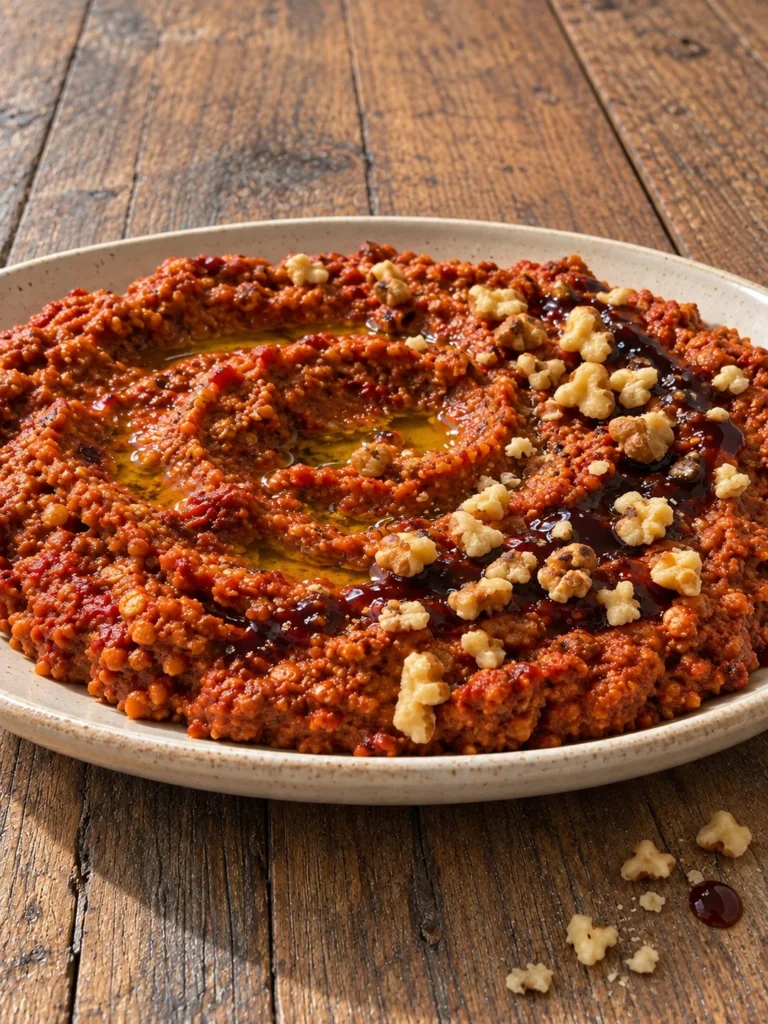
What I Used
- 4 large red bell peppers, charred until the skins go black
- 1 cup walnut halves, toasted in a dry skillet until fragrant
- Half a cup of coarse breadcrumbs from a stale country loaf
- 3 tablespoons real pomegranate molasses, the tart kind
- 2 tablespoons Aleppo pepper flakes, fulful halabi
- 2 cloves garlic, peeled
- A quarter cup of extra virgin olive oil, plus more for drizzling
- 1 teaspoon ground cumin, toasted for thirty seconds off the heat
- 2 teaspoons freshly squeezed lemon juice
- 1 teaspoon fine sea salt, then adjusted at the end
- 2 tablespoons roughly chopped walnuts to scatter on top
How I Make It in LA
I set all four peppers over a high flame and turn them with tongs every couple of minutes until the skins are fully collapsed and blackened. About twelve to fifteen minutes. Then straight into a big bowl, covered tight with a plate, to steam for a quarter of an hour. This is the step people rush. Do not rush it.
While the peppers steam, I toast the walnuts in a small dry skillet until they smell like they are about to turn. Then I tip them out onto a plate so they do not keep cooking in the pan. Same pan, off the heat, cumin in for thirty seconds. That is enough.
Here is where I diverge from Teta Mona. She used a mortar. I use a food processor, in short pulses, because I live in a one-bedroom and my mortar is the size of a teacup. The results are close. Not identical. Close.
I peel the peppers with my fingers, never under running water because you rinse away the smoke and the smoke is the whole point. Stems and seeds out, flesh torn into strips, then into the processor with the walnuts, breadcrumbs, garlic, pomegranate molasses, Aleppo flakes, cumin, lemon, and salt.
Pulse. Scrape. Pulse. Stop when you can still see flecks. Add the olive oil last, two or three pulses just to combine. Taste. It usually wants more salt and a little more pomegranate molasses. Sometimes more Aleppo. Trust your tongue over the measuring spoon.

The Overnight Rule
Muhammara is better the next day. I mean that. If I make it Friday night after work for a Saturday mezze spread, it tastes noticeably deeper by lunchtime the next day. The pepper mellows. The pomegranate settles in. The walnut oil pulls everything together. I almost skipped resting it the first time. I am glad I did not.
To serve, I scrape it onto a shallow plate, swirl a shallow well across the top with the back of a spoon, and drizzle it generously with olive oil, a thin ribbon of pomegranate molasses, and a scatter of chopped walnuts. Warm pita, cucumber batons, olives, a little labneh. That is the whole afternoon.
Small Twists I Sometimes Try
Some evenings I add a spoonful more breadcrumbs for a firmer, more spreadable roasted red pepper walnut dip that holds up on a cracker without weeping oil. Other times I go the opposite direction, lighter on the crumbs, and let it slump into a proper dip you scoop with torn bread. Both are correct. I go by the mood of whoever is coming over.
I once tried it with jarred roasted peppers on a lazy Tuesday. It was fine. It was not the same dish. The char is the whole thing.
The last note. Muhammara is a dip and a spread. Not a sauce. Do not cook it into anything. Let it sit on a plate at room temperature and be exactly what it is.
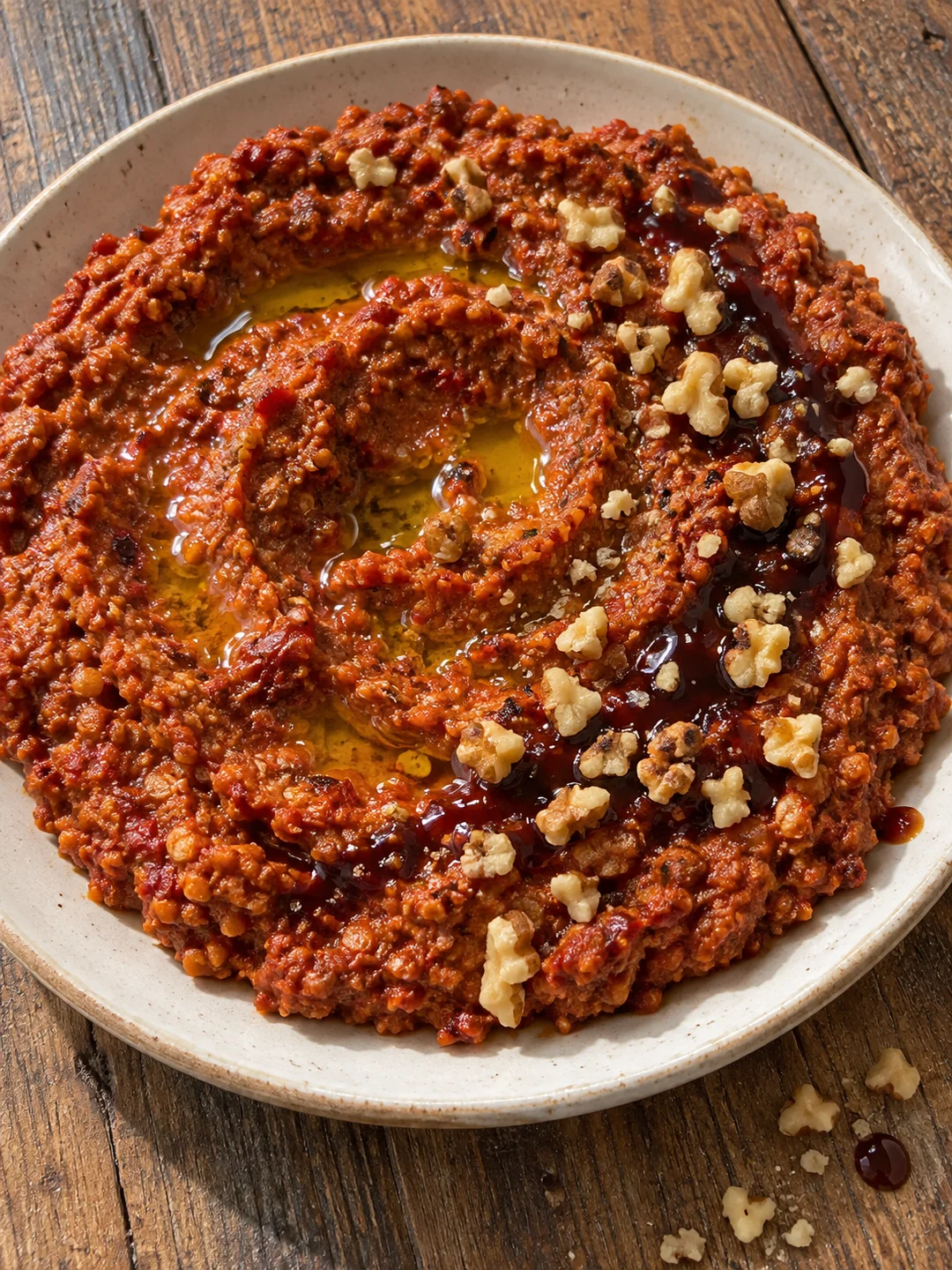
Lebanese Muhammara
Ingredients
Equipment
Method
- Set the bell peppers directly over a high gas flame, or on a sheet pan under a broiler set to high with the rack close to the element. Turn every few minutes with tongs until the skins are blackened and blistered all over and the flesh has collapsed slightly, about 12 to 15 minutes.
- Transfer the charred peppers to a large bowl, cover tightly with a plate or plastic wrap, and let them steam for 15 minutes.
- While the peppers steam, warm a small dry skillet over medium heat. Add the walnut halves and toast, tossing often, until fragrant and just a shade darker, 4 to 5 minutes. Tip onto a plate to cool.
- Add the cumin to the same warm skillet off the heat and toast for 20 to 30 seconds until fragrant, then set aside.
- Peel the blackened skins off the peppers with your fingers, pull out the stems and seeds, and give the flesh a quick tear into strips. Do not rinse them under water or you will wash away the smoke.
- Place the peeled peppers, toasted walnuts, breadcrumbs, garlic cloves, pomegranate molasses, Aleppo pepper flakes, toasted cumin, lemon juice, and salt in a food processor.
- Pulse in short bursts, scraping down the sides once or twice, until the mixture is a coarse, textured paste. You should still see small flecks of walnut and pepper — do not puree it smooth.
- With the motor off, add the olive oil and pulse two or three more times just to combine. Taste and adjust with more salt, pomegranate molasses, or Aleppo pepper as you like.
- Scrape the muhammara onto a shallow plate and use the back of a spoon to swirl a shallow well across the surface.
- Drizzle generously with extra virgin olive oil, add a thin ribbon of pomegranate molasses, and scatter the chopped walnuts on top. Serve at room temperature.