
The Beef Wellington that ruined me for all others came out of a kitchen in Ludlow, Shropshire, at nearly midnight, during the town’s food festival weekend in September. The restaurant had shut. The chef, a woman named Bridie who ran the place with her brother, was making one for staff because there was fillet left over and she did not want to waste it.
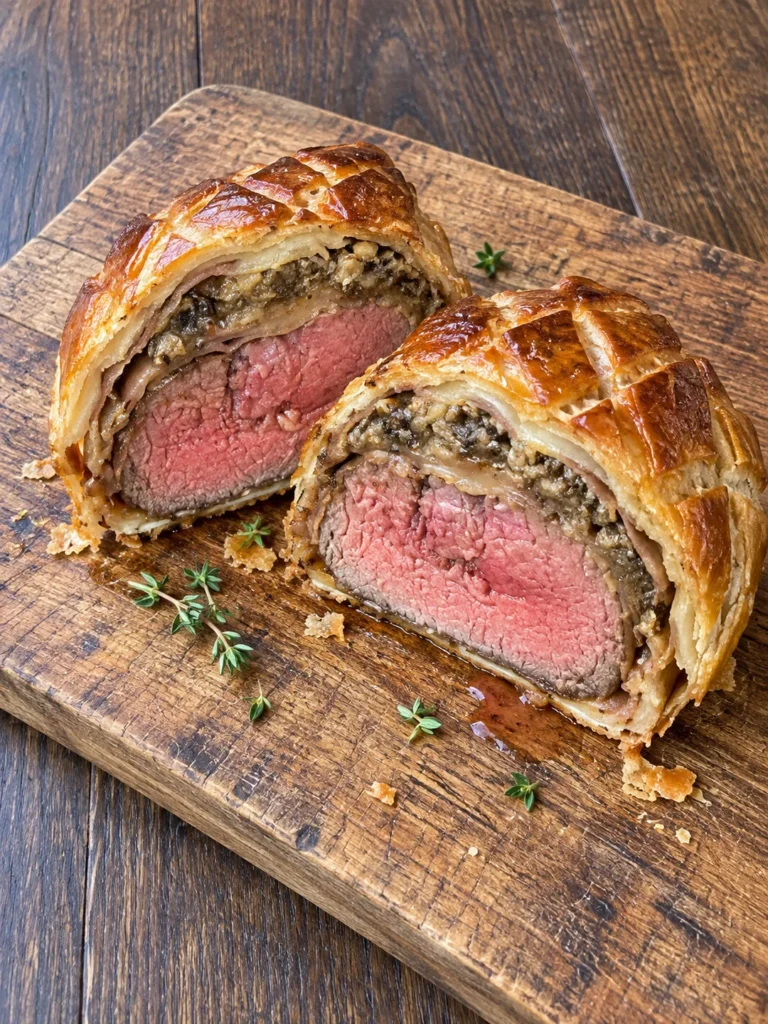
I had been standing in the market square all afternoon. Smoke from the hog roast, someone’s amplifier crackling out folk covers, a queue for cider that never got shorter. Bridie’s brother had served me a slice of Wellington at their stall around four, and I said something about the mushroom layer, and he told me to come back after service.
So I did. And that is how I ended up sitting on a prep counter at half past eleven, watching someone cook mushrooms for twenty-five minutes without hurrying once.
What Bridie Said About the Duxelles
She kept dragging the spoon through the pan and holding it up so I could see the trail it left. Wet trail, keep going. Dry trail, stop. That was the whole lesson and it took her about four seconds to teach it.
The soggy bottom people complain about is not the pastry’s fault. It is water leaving the mushrooms and the beef inside a sealed parcel with nowhere to go, so the base steams instead of baking. Cook the duxelles until it squeaks. Chill everything hard. That is the entire trick.
She also told me, flatly, that searing does not seal in juices. She said it like she had been waiting years for someone to argue with her about it. Nobody has ever proven that it does. You sear for browning and for the flavour that browning creates, full stop.
The Wellington Story Is Mostly Not True
I went looking afterwards, because I assumed the Duke of Wellington connection was solid history. It is not. There is no documented record tying the dish to Arthur Wellesley or to Waterloo in 1815, and the earliest references anyone has found turn up in the 1890s. An Austrian cookbook in 1891. A Hamburg-America line menu in 1899. Beef “à la Wellington” in print by 1903.
The technique is French. It is filet de bœuf en croûte with a patriotic British name stuck on top of it at some convenient moment. And the first published recipe actually calling it Wellington appeared in 1940, written by a chef at the Palmer House hotel in Chicago, which makes the oldest documented version American.
I like it more knowing that. A dish that is British by branding and French by method and American by paperwork.
Bringing It Back to My Kitchen
Ludlow smelled like woodsmoke and wet grass that weekend. My kitchen in September smells like nothing, because it is eighty-four degrees and the window is open onto a street.
A few things changed by necessity. Bridie used chestnut mushrooms, which are everywhere in Britain and annoying to find here, so I buy cremini at the farmers’ market on Wednesday and they behave nearly identically. Slightly less earthy. I compensate with more thyme than she used.
English mustard was the harder one. I tried Dijon the first time because it was what I had, and the Wellington was fine but flat, missing the sharp hit that cuts the richness. Now I keep a jar of Colman’s in the door of the fridge and I do not substitute. It is worth the extra errand.
Parma ham instead of whatever she had sliced that night. Prosciutto works the same way, which is to say it holds the duxelles against the beef and stops moisture reaching the pastry.
What I Used
- A two pound centre-cut beef fillet, trimmed and tied into an even log
- Vegetable oil for the sear, and plenty of salt and coarse black pepper
- English mustard, hot, not Dijon
- A pound and a half of cremini mushrooms, stems and all
- Two shallots and two garlic cloves
- Fresh thyme, picked off the stems
- Unsalted butter for the duxelles pan
- Ten slices of Parma ham
- Fourteen ounces of all-butter puff pastry
- Two egg yolks beaten with a splash of water
Cooking a Beef Wellington in a Hot LA Kitchen
The cast iron I use is the one my mother handed over when she downsized, still black and slick from decades of her cooking. It gets the fillet to a proper crust in about six minutes total, turning every ninety seconds, ends included.
Then the waiting. The beef cools, the mustard goes on while it is still warm, the duxelles cooks down forever. I put music on for that part. The first time I got this right I had Nick Drake playing and the whole thing felt slower than it needed to be, which was correct.
Chilling is where heat becomes a real problem here. Bridie’s kitchen was cold and stone-floored. Mine is not. I chill the ham-wrapped log longer than the recipe says and I chill the finished pastry parcel overnight, uncovered, so the surface dries out. Skip this and the layers slump.
One warning learned the hard way. I overloaded the food processor bowl the first time and got mushroom soup instead of mince, and no amount of cooking recovered it properly. Small batches. Pulse, do not blend.
Variations Worth Knowing
The older French style puts a layer of smooth pâté under the duxelles. Four ounces if you want it. I do not bother, and most modern versions leave it out without anyone noticing, foie gras being expensive and contentious and often just unavailable.
Do not swap the cut. I know fillet is the priciest thing in the case. But enclosed in pastry, fat cannot render out anywhere, so a marbled cut turns greasy rather than rich. And without the mushroom layer entirely, you have made beef en croûte, which is a perfectly good thing that is not this.
If you are cooking for two rather than six, an individual beef wellington recipe scaled down from these proportions works, though the timing tightens considerably and you will want the thermometer even more than usual.
What Does Not Travel
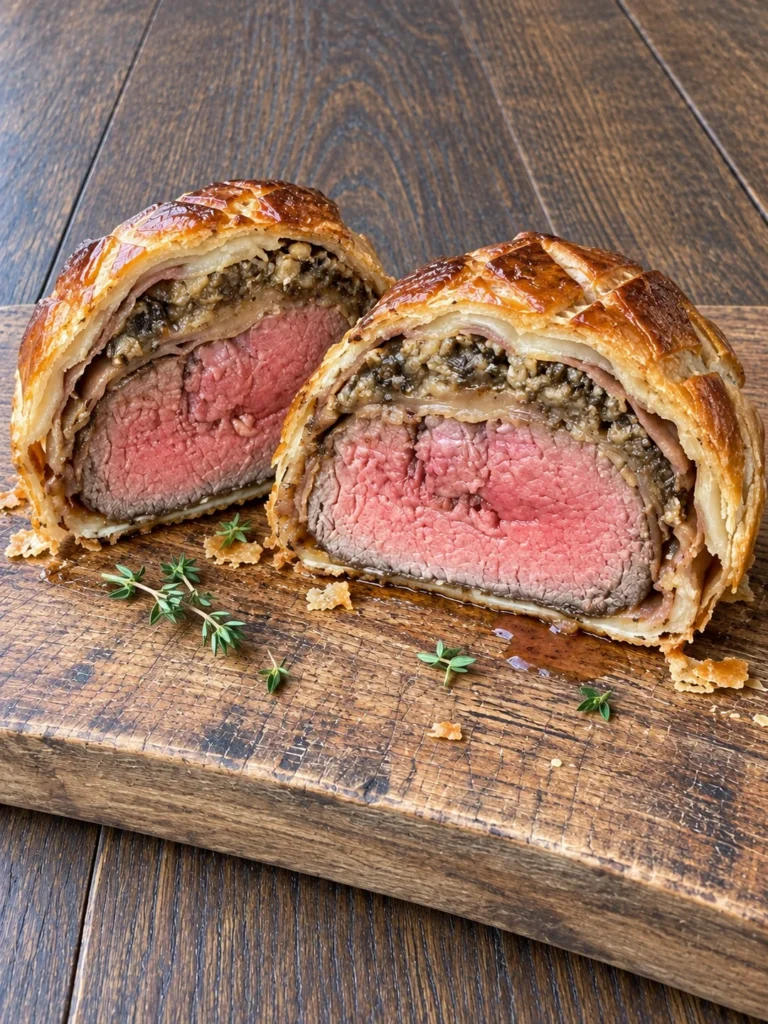
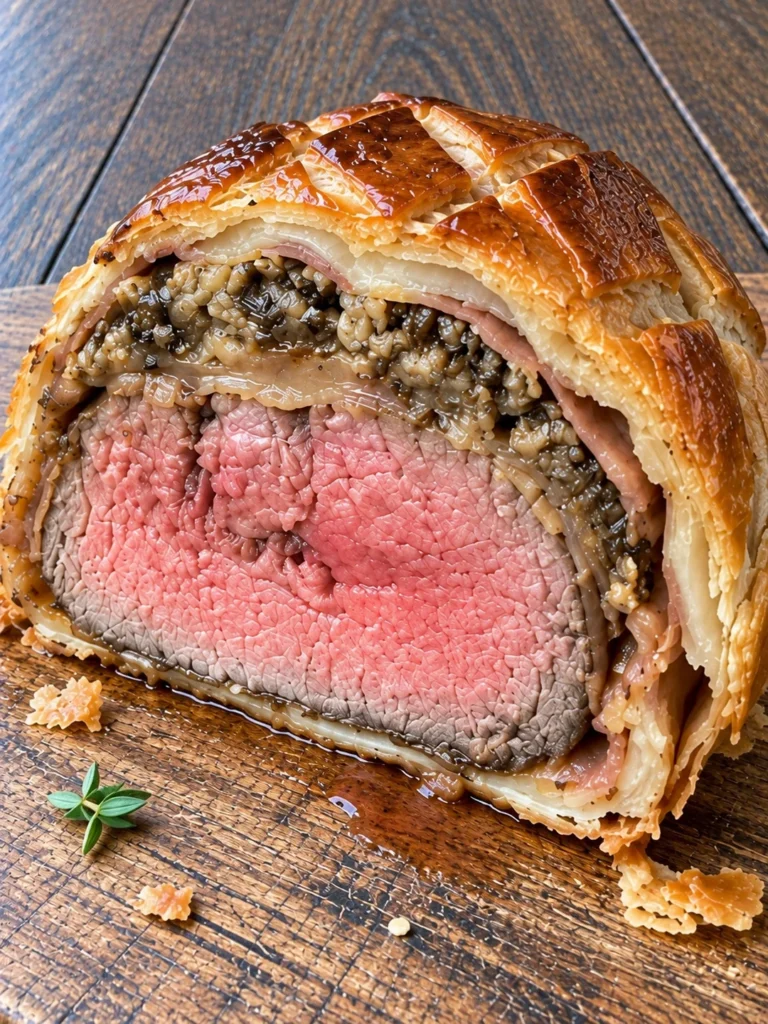
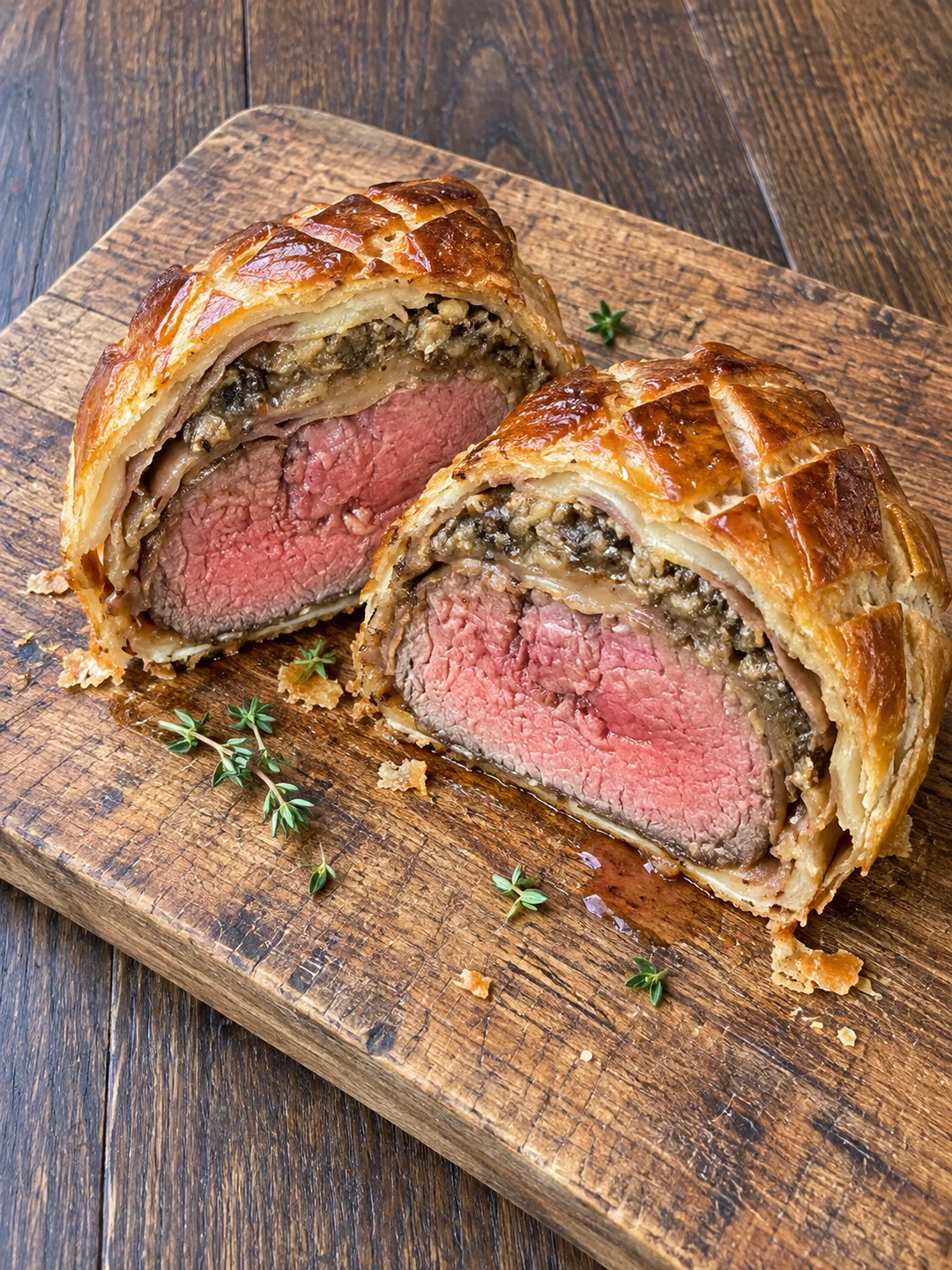
The pastry shatters when the serrated knife goes through it and the rounds come out rosy in the middle, which is the same as it was in Ludlow. The rest is not the same.
There is no folk music leaking in from a square. No cider queue. No Bridie leaning against the walk-in telling me her brother always cuts the slices too thin. I miss that room more than I expected to when I am standing in my own kitchen watching a thermometer climb to 125.
Still. Sunday evening, oven on, red wine sauce going from the drippings. It holds up. I make it maybe three times a year and I would happily make it more.
Beef Wellington
Ingredients
Equipment
Method
- Take the fillet out of the fridge 30 minutes ahead. Pat it completely dry with paper towels and season all over with the salt and pepper, pressing it into the surface.
- Heat the oil in a heavy skillet over high heat until it shimmers and just begins to smoke. Sear the fillet 1 to 2 minutes per side, turning with tongs, until every surface including the ends carries a deep brown crust. This is for flavour, not for sealing in juices.
- Transfer the fillet to a plate and let it cool for 10 minutes. Brush it all over with the English mustard while still warm. Set aside to cool completely.
- Pulse the mushrooms, shallots and garlic in a food processor in batches until finely minced, almost a paste but not wet puree. Do not overload the bowl or you will get liquid instead of mince.
- Melt the butter in the same skillet over medium heat. Add the mushroom mixture and thyme with a good pinch of salt. Cook, stirring often, for 20 to 25 minutes. The mixture will release a lot of liquid, then slowly tighten. Keep going until it is thick, dark and visibly dry, with no moisture pooling when you drag a spoon through. This step decides whether your pastry bakes or steams.
- Spread the duxelles on a plate and cool completely, about 20 minutes. Warm duxelles will melt the pastry later.
- Lay a large sheet of plastic wrap on the counter. Arrange the Parma ham in two overlapping rows to form a rectangle wide enough to wrap the fillet fully. Spread the cooled duxelles evenly over the ham in a thin layer, leaving a half inch border.
- Untie the fillet and lay it along the near edge of the ham. Using the plastic wrap, roll the ham and duxelles tightly around the beef, twisting both ends of the wrap like a candy wrapper to compact it into a firm even cylinder. Refrigerate 30 minutes.
- Roll the puff pastry on a lightly floured surface to a rectangle roughly 14 by 12 inches and about 1/8 inch thick. Unwrap the chilled beef log and set it along one long edge.
- Brush the exposed pastry with egg wash. Roll the pastry over the beef, pressing out air as you go, and trim away excess so the seam overlaps by about an inch. Press the seam and both ends firmly to seal, folding the ends under.
- Wrap the parcel in fresh plastic wrap, twisting the ends tight again, and chill at least 30 minutes and up to overnight. Meanwhile heat the oven to 400 F and set a rack in the middle.
- Unwrap the parcel onto a baking sheet, seam side down. Brush all over with egg wash. Score the top lightly with the back of a knife in a diagonal lattice, cutting only the surface. Sprinkle with a little salt.
- Bake 40 to 45 minutes, until the pastry is deep golden and an instant-read thermometer pushed into the centre reads 125 F for medium-rare. If the pastry browns too fast, tent loosely with foil.
- Rest the Wellington on a board for 10 to 15 minutes. The internal temperature will rise a further 5 degrees and the juices will settle.
- Slice into thick rounds about 1.5 inches wide using a sharp serrated knife, sawing gently so the pastry does not crush. Serve immediately.